

Your gut may shape immune signals that affect the brain - but in people, the proof is still limited. From what I see in this research summary, the clearest findings are these: animal studies show cleaner cause-and-effect links, human studies mostly show shifts in inflammation markers like CRP, TNF-α, and IL-6, and the best day-to-day steps are still simple ones like more fiber, fewer ultra-processed foods, and steady sleep.
Here’s the short version:
- The axis links gut microbes, the immune system, and brain function.
- Cytokines are one of the main messengers in that link.
- Dysbiosis may increase inflammatory signals and weaken the gut barrier.
- Animal studies show more direct mechanisms.
- Human studies are promising, but they mostly show association, not clear proof of brain effects.
- Probiotics and synbiotics may lower some inflammation markers, but results change by strain, dose, and condition.
- Fiber intake matters: U.S. adults average about 16.2 g/day, below the 21–38 g/day target.
What stands out most to me is simple: we can track changes in immune markers more easily than changes in mood, memory, or other brain outcomes. So the safest takeaway is not a fancy protocol. It’s consistent gut support through food and daily habits.
If I had to sum up the whole article in one line, it would be this: the gut-immune-brain link looks real, but daily health advice still comes back to the basics.
How can the gut microbiome modulate the peripheral and brain immune systems?
sbb-itb-1bbfe7f
The Gut Microbiota-Immune-Brain Axis: A Working Definition
Building on the cytokines described above, the gut microbiota-immune-brain axis explains how shifts in gut microbes can alter immune signaling, especially cytokine activity, and how those signals may influence the brain. The immune system sits right in the middle of this network.
Microbial molecules can switch on immune receptors and set off cytokine release. If intestinal permeability goes up, that response can get stronger. That point matters because this same pathway is not proven to the same degree in people.
From Gut Microbes to Immune Signals
When dysbiosis happens, pro-inflammatory cytokines such as TNF-α, IL-6, and IL-8 can rise, linking microbial changes to broader immune activity.
How Cytokines May Affect the Brain
Cytokines can carry gut-derived immune signals toward the brain, which helps explain why this axis goes both ways. The animal and human data below show where the evidence is strongest.
What Animal and Human Studies Show
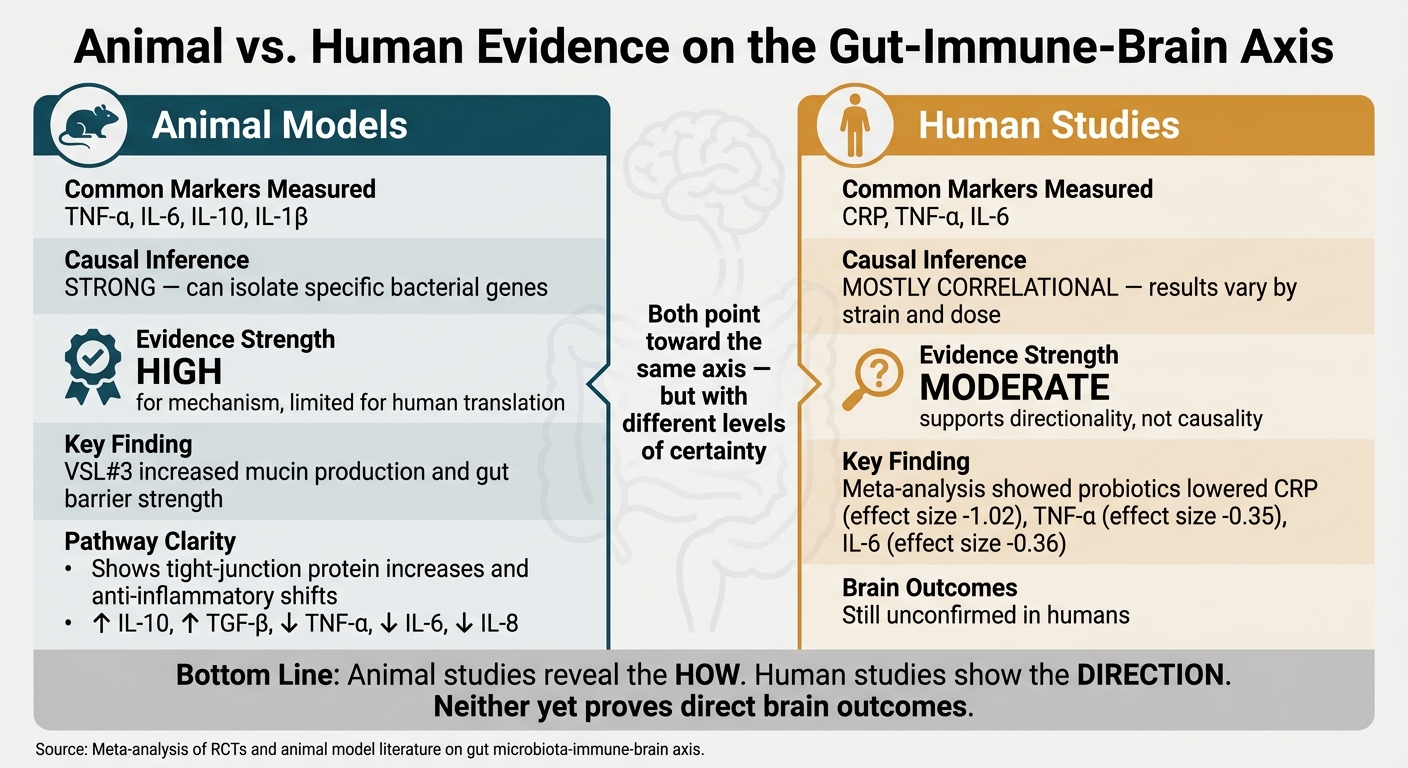
Animal vs. Human Evidence on the Gut-Immune-Brain Axis
Once the axis is mapped out, the next step is simple: do the studies back it up? So far, animal and human research point in the same general direction, but not with the same level of certainty. Animal studies tend to show cleaner mechanisms. Human studies usually show smaller and less steady effects.
Animal Models: Stronger Mechanistic Evidence
Animal research gives a clearer look at how probiotics may work. These studies show that probiotics can increase tight-junction proteins and reduce inflammatory cytokine signaling. Researchers have also seen shifts toward anti-inflammatory pathways, including higher IL-10 and TGF-β and lower TNF-α, IL-6, and IL-8.
In rat studies, VSL#3 increased mucin production, which helped strengthen the gut barrier.
Human Studies: Promising but Mostly Correlational
Human evidence looks promising, but it is less consistent. A meta-analysis found that probiotics lowered CRP, TNF-α, and IL-6. That sounds encouraging. The catch is that many human studies are observational or based on small clinical trials, so they are better at showing association than clear cause and effect.
The results also depend a lot on the condition being studied. Benefits appear more clearly in ulcerative colitis than in Crohn's disease. On top of that, outcomes shift by strain, dose, and condition.
That helps explain why microbiota-targeted therapies are studied next.
Animal vs. Human Evidence: A Side-by-Side Comparison
The table below shows the gap pretty clearly: animal findings are more mechanistic, while human findings are more practical.
| Feature | Animal Models | Human Studies |
|---|---|---|
| Common Markers Measured | TNF-α, IL-6, IL-10, IL-1β | CRP, TNF-α, IL-6 |
| Causal Inference | Stronger; can isolate specific bacterial genes | Mostly correlational; results vary by strain and dose |
| Overall Evidence Strength | High for mechanism, limited for human translation | Moderate; supports directionality, not causality |
These mixed findings shape how probiotics, synbiotics, and barrier-support strategies are evaluated.
How Microbiota-Targeted Interventions May Affect Cytokine Signaling
Animal and human studies don’t point in one clean direction, so the practical issue is pretty simple: can targeted gut interventions change cytokine signaling in a measurable way? And if they can, how dependable are those effects?
Probiotics, Synbiotics, and Gut Barrier Support
Human findings are mixed, so the main thing to look at is which interventions actually lower cytokine activity in measurable ways.
The proposed pathways are fairly well mapped out. Probiotics interact with Toll-like receptors such as TLR-2, TLR-6, and TLR-9, which can trigger anti-inflammatory signaling. That shift tends to favor Tregs over Th17 cells and is linked with higher IL-10 and lower TNF-α, IL-6, and IL-8. At the gut lining, probiotics may also strengthen tight-junction proteins like ZO-1 and occludin, which can help reduce LPS entry into the bloodstream. Less LPS crossing the gut barrier may mean less downstream immune activity throughout the body, including signaling that can reach the brain.
One umbrella meta-analysis of randomized controlled trials found that probiotics lowered CRP with an effect size of -1.02 and also reduced TNF-α (effect size -0.35) and IL-6 (effect size -0.36). Even so, brain-related outcomes are still unconfirmed.
Synbiotics combine prebiotics and probiotics, and they often show steadier effects than probiotics used on their own, especially in chronic inflammatory conditions. In ulcerative colitis, synbiotics seem more consistent than probiotic monotherapy. In Crohn’s disease, the picture is less settled.
There’s one catch that matters a lot: effects are strain-specific. One strain may do something another doesn’t. For instance, Lactobacillus reuteri ATCC PTA 6475 lowers TNF-α through histamine production.
Where Rebirth RE-1 Fits Mechanistically
Rebirth RE-1 is a 3-in-1 synbiotic that includes prebiotics, probiotics, and postbiotics. Its prebiotic fibers support beneficial bacteria and SCFA production, which is a key factor in short-chain fatty acids and brain health, which lines up with the synbiotic model described above. So it works here as an example of a synbiotic approach, not as proof of clinical benefit.
Intervention Types and Evidence Strength: A Comparison
The table below shows how these approaches differ in mechanism and level of human evidence.
| Intervention Type | Proposed Immune Mechanism | Cytokines Commonly Measured | Level of Human Evidence |
|---|---|---|---|
| Dietary Patterns | High fiber (21–38 g/day) supports microbiome diversity and host immune health | General inflammatory markers | Supports microbiome diversity and immune health |
| Probiotics | Compete with pathogens; stimulate mucus; reinforce tight-junction proteins | TNF-α, IL-6, IL-10, CRP | High for gut inflammation; emerging for brain outcomes |
| Synbiotics | Fiber + live bacteria work together; improves survival of beneficial strains | IL-10, TGF-β | Stronger and more consistent than probiotics alone for chronic conditions |
Evidence Gaps and Practical Takeaways
Why the Research Is Still Incomplete
The cytokine data is promising, but the human evidence still doesn't prove direct brain effects.
Most human studies look at markers like CRP, TNF-α, and IL-6. That's useful, but it's not the same as showing clear changes in mood, memory, or other cognitive outcomes. In plain English: we can see signs of inflammation shifting, yet we still can't say with confidence exactly how those shifts affect the brain in day-to-day life.
There's another problem too. The gut microbiome differs a lot from one person to the next. On top of that, chronic stress, poor sleep, and ultra-processed diets can all change it on their own. That makes research messy. If someone's microbiome improves or worsens, what caused it - diet, sleep, stress, or the intervention being tested? That's the hard part.
Daily Health Choices Supported by Current Evidence
For daily care, diet still stands out most clearly in the research.
Because cytokine effects are still hard to prove in humans, the safest takeaway is pretty simple: support the gut on a steady basis. U.S. adults average about 16.2 grams of fiber per day, which is below the 21–38 gram target.[1]
A few food habits line up best with the current evidence:
- Eat more prebiotic foods, such as onions, garlic, bananas, and chicory root. These feed gut bacteria that are linked with better gut balance.
- Cut back on ultra-processed foods, added sugars, and excess saturated fat. These are tied to the kind of dysbiosis that can push chronic low-grade inflammation.
- Add fermented foods like yogurt, kefir, sauerkraut, and kimchi. When shopping, look for labels that say "live and active cultures".
The big idea here isn't a short reset or a one-week health kick. Consistency matters more than short-term fixes.
Conclusion: Key Points to Remember
The gut microbiota-immune-brain axis has mechanistic support, and cytokines appear to be a key link. Animal studies show the clearest mechanisms. Human studies mostly show shifts in inflammatory markers rather than direct brain outcomes.
So if you're looking for the most evidence-aligned daily moves, stick with the basics: enough fiber, fewer ultra-processed foods, and consistent sleep.
FAQs
How strong is the human evidence?
Current human evidence is promising, but it’s still limited. A lot of the studies are small, and the way they differ in length makes it tough to judge long-term effects.
Research points to a gut-brain link and suggests that some strains may help with mood regulation and inflammation. That said, scientists still want larger, longer studies to confirm how consistent these effects are, fine-tune dosing, and see how different groups of patients respond.
Can gut changes really affect mood or memory?
Yes. Changes in your gut microbiota can affect mood and memory through the gut-brain axis.
Gut bacteria help shape neurotransmitters like serotonin, dopamine, and GABA. They also send signals through the vagus nerve and immune pathways. That means your gut isn’t just handling digestion. It’s also in constant contact with your brain.
Supporting microbiome balance with a synbiotic like Rebiirth RE-1 may help lower inflammation and support mood, cognition, and stress resilience.
What daily habits best support this axis?
Support the gut microbiota-immune-brain axis with steady daily habits that feed helpful bacteria and may help lower inflammation.
Start with a fiber-rich diet built around fruits, vegetables, legumes, nuts, seeds, and whole grains. Then add fermented foods like kimchi, kefir, sauerkraut, and yogurt.
Lifestyle matters too. Manage stress, get 30 minutes of moderate physical activity on most days, and stick to a regular sleep schedule. It also helps to limit light exposure before bed and cut back on processed foods, alcohol, and unnecessary antibiotics.