

My starting point for gut health on keto: check fiber intake and food variety before adding a supplement. Add low-carb fiber foods gradually, track symptoms, and seek medical advice if problems persist. A “reset” is a support plan - not proof that your gut microbes are restored.
Here’s my take on the seven questions:
- Gut microbes: Less fiber and fewer food choices can change which microbes thrive.
- Symptoms and nutrients: While signs your gut needs a reset like bloating, constipation, diarrhea, and nutrient gaps need attention, they don’t diagnose a microbiome problem.
- Who needs advice: Persistent symptoms, recent antibiotics, pregnancy, lactation, or complex gut conditions warrant a professional review.
- Ingredient roles: Prebiotics, probiotics, and postbiotics play different roles: prebiotics feed microbes, probiotics supply live microbes, and postbiotics contain inanimate microbes or their components. Results depend on the formula.
- RE-1™: The manufacturer lists 500 billion CFU and 4.5 grams of fiber per serving, with 7-day, 4-week, and 12-week plans. Its supplied evidence is a 35-person observational study - not proof that it works.
- Planning support: Review your diet, introduce fiber slowly, follow label directions, and reassess symptoms.
- When to seek care: Persistent or worsening bowel problems, fatigue, or unintentional weight loss call for medical review - not another reset.
<u>I’d judge a plan by nutrition, tolerance, and symptom changes - not its “reset” label.</u>
Keto’s Effects on Digestion and Nutrition
1. How Does Keto Affect Gut Microbes?
Low fiber intake and limited food variety can disrupt gut function and leave helpful microbes with less support. [1]
| Dietary factor | Possible effect | Why it matters |
|---|---|---|
| Low fiber intake | Can affect gut function | Leaves helpful microbes with less fuel [1] |
| Dietary monotony | Can contribute to nutrient deficiencies | Limits the range of foods in the diet [1] |
| Rapid dietary shifts | Can alter HOSt™ balance | May contribute to digestive symptoms [1] |
| Recent antibiotic use | Can reduce key gut microbes | May increase the need for support [1] |
If these changes persist, digestive symptoms and nutrient gaps can offer clues about what needs attention.
2. Which Digestive Symptoms and Nutrient Gaps Matter?
Digestive symptoms are clues, not a diagnosis. Bloating, abdominal pain, constipation, and irregular stools deserve attention, especially when they occur alongside low fiber intake or recent diet changes [1]. Track food changes, stool hydration, and when symptoms occur. These notes can help a clinician assess dietary transitions and fiber intake.
Keto can lead to nutrient shortfalls directly. A disrupted microbiome can also affect how some nutrients are produced or absorbed [1]. Intake and absorption aren't the same thing: some prebiotic fibers, such as inulin, can increase calcium absorption [1].
| Symptom or finding | Possible dietary contributor | Why it matters |
|---|---|---|
| Bloating or abdominal pain | Low fiber intake or dietary shifts | Common digestive problems worth monitoring [1] |
| Constipation or irregular stools | Changes in intestinal transit time or poor stool hydration | Track stool hydration and how easily you pass stools [1] |
| Nutrient shortfalls | Low intake or impaired microbial production | The microbiome helps produce key nutrients and metabolites [1] |
| Poor absorption | Lack of specific prebiotics, such as inulin | Some prebiotic fibers, including inulin, can increase calcium absorption [1] |
| Diarrhea | Rapid dietary shifts or recent antibiotics | May signal a need for review [1] |
3. Who May Need Gut Health Support?
Persistent symptoms or recent gut stress often call for a closer look. A professional review can help people with persistent bloating, abdominal pain, irregular stools, low fiber intake, limited food variety, recent antibiotic use, allergies, or frequent infections [1].
People who are pregnant or lactating, and those managing complex gut problems, should get professional advice before starting a gut microbiome reset [1].
sbb-itb-1bbfe7f
Fiber as part of a well-formulated ketogenic diet | Dominic D'Agostino
Microbiome Ingredients and Support Plans
Keto Gut Support: Review, Introduce, Maintain, Reassess
4. What Do Prebiotics, Probiotics, and Postbiotics Do?
Once you know who may need support, match the ingredients to their goals and keto tolerance. These ingredients do different jobs, and results depend on the product. Lower fiber intake on keto can make dose and tolerance more important. Increase prebiotics gradually and follow the label. [1]
| Ingredient | Definition | Role and cautions |
|---|---|---|
| Prebiotics | Substrates selectively used by host microorganisms that provide a health benefit. | Feed helpful microbes and support short-chain fatty acid production. Increasing intake too fast may cause gas or bloating. |
| Probiotics | Live microorganisms that provide health benefits when given in adequate amounts. | Add live strains, but higher CFU counts don't guarantee better results. People with serious illness or immunocompromise should seek medical guidance before use. |
| Postbiotics | Preparations of inanimate microorganisms or their components that provide a health benefit. | May support immune signaling and gut balance. Benefits depend on the preparation; metabolites alone aren't automatically postbiotics. |
5. What Does Rebirth RE-1™ Contain?
The manufacturer describes Rebirth RE-1™ as a 3-in-1 synbiotic containing prebiotics, probiotics, and postbiotics. It describes HOSt™ strains as live, human-origin microbes. It also says Lyosublime™ is a lipid-coated delivery system designed to protect strains from stomach acid and bile without refrigeration. Human origin, CFU count, and delivery technology alone don't prove that a product works better. [1]
| Plan | Length | Sachet schedule | CFU per serving | Fiber per serving | HOSt™ strains | One-time price |
|---|---|---|---|---|---|---|
| 7-Day Reset | 7 days | 1 sachet daily | 500 billion | 4.5 grams GOS and inulin | 7 probiotic strains + 1 postbiotic strain | $79 |
| 4-Week Reset | 4 weeks | 1 sachet daily | 500 billion | 4.5 grams GOS and inulin | 7 probiotic strains + 1 postbiotic strain | $279 |
| 12-Week Reset | 12 weeks | 1 sachet daily | 500 billion | 4.5 grams GOS and inulin | 7 probiotic strains + 1 postbiotic strain | $749 |
Specifications come from the manufacturer. Check current prices and label details before buying. The postbiotic is an inanimate component, not a live probiotic. The vegan, gluten-free, dairy-free, soy-free, nut-free, non-GMO, and no-refrigeration statements are manufacturer claims. [1]
The supplied product evidence is limited to a 35-person observational study. Self-reported improvements don't prove that the formula caused the results or that its marketing claims are established outcomes. [1]
Whether the product fits your needs depends on your symptoms, diet, and timeline.
6. How Can You Plan Gut Support on Keto?
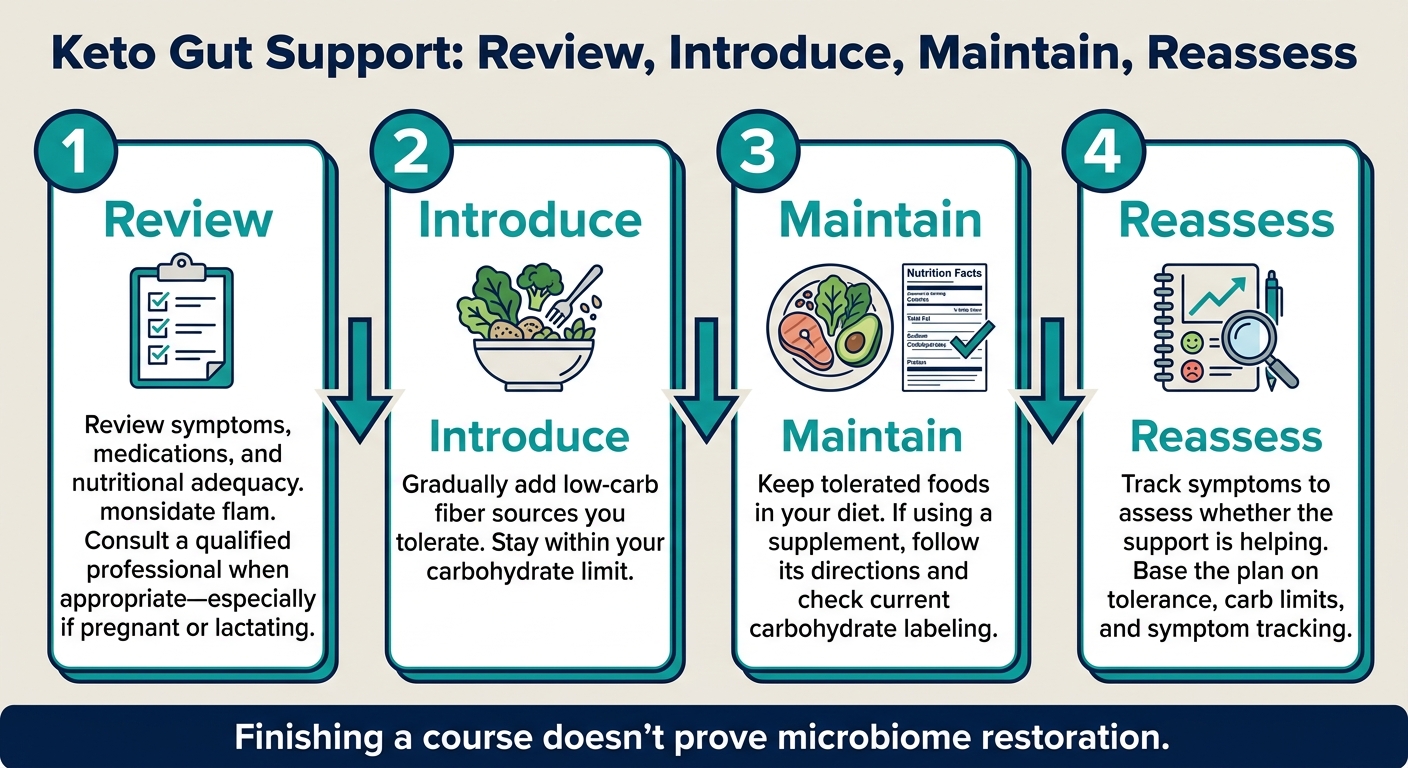
Build your plan around tolerance, carb limits, and symptom tracking. Use four steps: review, introduce, maintain, and reassess.
Before starting, review your symptoms, medications, and nutritional adequacy with a qualified professional when appropriate - especially if you're pregnant or lactating. Gradually add low-carb fiber sources you tolerate while staying within your carbohydrate limit.
Keep tolerated foods in your diet, follow supplement directions, and check current carbohydrate labeling. Track symptoms to assess whether the support is helping. Finishing a course doesn't prove microbiome restoration. [1]
Keto Safety and Medical Care
7. When Should You Reconsider Keto or Seek Care?
If constipation, diarrhea, fatigue, or unintentional weight loss persist or worsen - even after a short reset - get a medical review instead of continuing the plan.
Talk with a medical professional before starting a new health protocol or supplement. This is especially important if your symptoms aren’t improving or you have higher-risk needs, such as pregnancy or lactation [1].
Rebirth RE-1™ is a dietary supplement, not a treatment for disease [1].
Conclusion: Match Gut Support to Your Needs
Keto’s effects on gut microbes vary with diet quality, health status, and time. Getting enough fiber and nutrients plays a central role in microbiome health.[1]
Start with adequate nutrition and fiber you tolerate. If added support fits your needs, a 3-in-1 plan can combine prebiotics, probiotics, and postbiotics. Track digestive comfort and stool regularity over time.
One structured option, Rebirth RE-1™, combines 500 billion CFU and 4.5 grams of prebiotic fiber per serving, with 7-day, 4-week, and 12-week plans.[1] Use it alongside sound nutrition and medical guidance - not as a replacement for either.