

Most people in U.S. cities don't have a calorie problem. They have a nutrient problem. When meals lean on packaged snacks, refined grains, and takeout, the gut often pays the price.
Here’s the short version:
- About 27% of daily U.S. calories come from energy-dense, nutrient-poor foods.
- 94.3% of people fall short on vitamin D
- 88.5% fall short on vitamin E
- Low intake of iron, folate, B12, zinc, and vitamin A can weaken the gut lining, shift the microbiome, and strain immune function.
- Low-fiber eating can cut short-chain fatty acid (SCFA) production, which leaves the gut barrier under more stress.
- The fix is often simple: eat more variety, add more fiber, and use testing to spot low iron, B12, folate, or vitamin D.
I’d sum it up like this: if you want to support gut health, don’t just look at probiotics. Look at what’s missing from your plate.
A few food moves can help:
- Replace refined grains with whole grains
- Add leafy greens, beans, seeds, eggs, and fatty fish
- Pair plant iron with vitamin C
- Cut back on repeat meals built around ultra-processed foods
- Consider blood work once a year for vitamin D, B12, iron, and folate
This article explains how urban eating patterns can lead to “hidden hunger,” why that can affect the microbiome and gut barrier, and what a food-first plan looks like.
Nutrition Essentials | Feeding Your Gut’s Microbiome
sbb-itb-1bbfe7f
Micronutrient gaps in urban diets
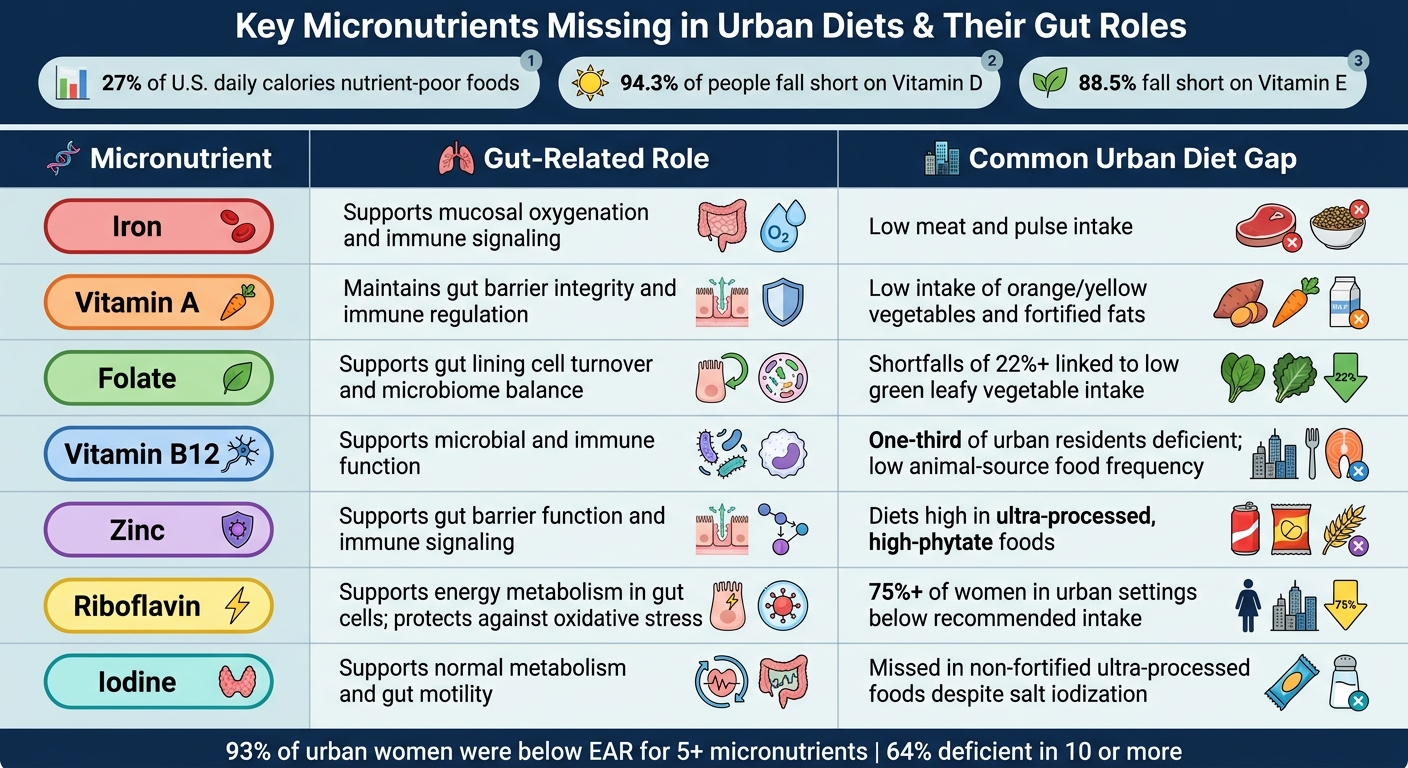
Micronutrients, Gut Roles & Urban Diet Gaps Explained
For many people in cities, daily meals lean heavily on packaged snacks, refined grains, and soft drinks. These foods pack in calories, but they don't offer much in the way of nutrients. So the issue usually isn't one missing vitamin or mineral. It's a repeated pattern of shortfalls across several micronutrients.
This is hidden hunger: enough calories, too few nutrients.
Which micronutrients are most often missed
A lack of variety sits at the center of most of these gaps. When meals rotate through the same packaged foods or takeout orders, whole food groups often drop out of the diet for long stretches. Leafy greens, legumes, dairy, and seeds are common casualties. Skipped meals and tight eating windows can make things even worse.
One urban study found that 93% of women had intakes below the Estimated Average Requirement for five or more micronutrients, and 64% were deficient in 10 or more [5].
Micronutrients, gut roles, and common urban diet gaps
The micronutrients people miss most often also play direct roles in gut function. That matters because the gut needs a steady supply of these nutrients to maintain its lining and support microbial balance.
| Micronutrient | Gut-related role | Common urban diet gap |
|---|---|---|
| Iron | Supports mucosal oxygenation and immune signaling | Low meat and pulse intake [4][5] |
| Vitamin A | Maintains gut barrier integrity and immune regulation | Low intake of orange/yellow vegetables and fortified fats |
| Folate | Supports gut lining cell turnover and microbiome balance | Shortfalls of 22% or more linked to low green leafy vegetable intake [4][5] |
| Vitamin B12 | Supports microbial and immune function | One-third of urban residents deficient; low animal-source food frequency [4][5] |
| Zinc | Supports gut barrier function and immune signaling | Diets high in ultra-processed, high-phytate foods |
| Riboflavin | Supports energy metabolism in gut cells and protects against oxidative stress | More than 75% of women in urban slum settings were below the LRNI for riboflavin and calcium [5] |
| Iodine | Supports normal metabolism and gut motility | Still missed in non-fortified ultra-processed foods despite salt iodization programs |
When several of these gaps show up at the same time, the effects on the gut can stack up fast.
Next, we'll look at how these shortfalls weaken the microbiome and gut barrier.
How micronutrient shortfalls affect the gut
Effects on the microbiome and gut barrier
These gaps change the gut in two main ways, and the first place you see it is in the microbiome and the gut barrier.
Urban diets that are high in sugar and fat but low in fiber can shift the microbiome toward more Firmicutes and fewer Bacteroidetes. That pattern is linked to obesity and metabolic dysfunction [2].
Low-fiber diets also cut SCFA production. That matters because SCFAs help protect the gut barrier. When SCFA levels drop, the gut becomes more exposed to colonic inflammation [2].
Fiber also helps protect the mucus layer along the gut wall. When fiber is missing from the diet, mucin-degrading bacteria such as Akkermansia muciniphila may grow and weaken that mucus barrier [7].
Iron deficiency adds another problem: it weakens infection resistance and immune function [5].
How micronutrient status connects to gut immune function and inflammation
Once the barrier starts to weaken, the effects spread into immune signaling.
Vitamin A deficiency leaves the gut lining less able to regulate immune responses [2][5]. Zinc and iron deficiencies make things worse. Both are linked to infection resistance and immune function, and both are common gaps in urban diets [5].
When calcium, iron, vitamin A, and folate intakes drop below 40% of recommended levels, immune defenses weaken [5].
And if the same urban eating patterns stay in place, these immune changes become harder to reverse. Using a microbiome diet planner can help reintroduce the variety needed to restore these defenses.
Why urban diets make this problem harder to fix
Those gut effects tend to stick around because city food habits keep feeding the same nutrient shortfalls. Put simply, urban food settings make micronutrient gaps tougher to close.
Convenience eating and fewer nutrients per calorie
In many urban areas, ultra-processed, nutrient-poor foods are cheaper and easier to grab than fresh options [2]. That matters because these foods often push aside meals with more fiber and micronutrients. Over time, that pattern can keep the microbiome under pressure and make it harder for the gut barrier to recover. Following a structured gut microbiome reset can help reverse this damage.
Eating the same foods repeatedly
There’s a second issue: repetition. In urban settings, low food variety is linked to reduced alpha diversity - the variety of microbes within an individual [3]. When people eat the same foods again and again, they may end up with fewer fiber-fermenting microbes. And that means less fermentation of fiber into butyrate, which helps support gut-barrier integrity [3][8].
Food-first strategies to restore micronutrients and support the microbiome
Building meals around micronutrient-dense foods
Start with nutrient-dense foods, not a full diet reset. What matters most is what lands on your plate day after day. In many cases, the answer is more variety, not more rules.
Build meals around foods that pull their weight: leafy greens and legumes for folate and iron, whole grains and seeds for fiber and minerals, and fatty fish or eggs for B12 and vitamin D.
Meal pairings matter too. Pair plant-based iron with vitamin C, and avoid tea or coffee around meals [9].
When targeted gut support may fit alongside nutritional restoration
Diet quality comes first. But when dysbiosis or poor absorption gets in the way, food alone may not fill every gap.
When diet alone is not enough, Begin Rebirth RE-1™ is a 3-in-1 synbiotic that may support microbiome balance alongside nutritional restoration. This approach aligns with a broader checklist for immune health through gut support.
Comparing approaches: food-first, targeted supplementation, and synbiotic support
Here’s how the three approaches differ.
| Approach | Main purpose | Best fit | Key limitation |
|---|---|---|---|
| Food-first | Restore micronutrients naturally with co-factors and fiber | General health maintenance and mild gaps | Hard to correct severe deficiencies quickly |
| Targeted supplementation | Rapidly correct specific, tested deficiencies | Individuals with clinical deficiency, such as B12 or severe anemia | Lacks the fiber and phytonutrients found in whole foods |
| Synbiotic support | Support microbiome balance with prebiotics, probiotics, and postbiotics | People with gut dysbiosis or malabsorption issues | Does not replace a micronutrient-dense diet |
These approaches tend to work best when they support a micronutrient-dense diet instead of trying to stand in for it.
Conclusion: Closing nutrient gaps to protect gut health
Urban eating patterns can leave people short on key micronutrients, and those gaps can put gut health under strain.
The good news is that the gut responds to what you eat. That means steady diet changes can help the microbiome stay in better shape over time. You don't need a total reset. Small, consistent steps are enough.
Food comes first. Annual blood screenings for vitamin D, B12, iron, and folate can help spot gaps before they start affecting gut barrier function or immune signaling [1][6]. If diet and absorption still aren't enough, Begin Rebirth RE-1™ may help support microbiome balance alongside nutrition changes.
Try a few simple swaps:
- Replace refined grains with whole grains
- Pair iron-rich foods with vitamin C
- Add more variety to your meals each week
Make the small changes, then stick with them.
FAQs
How can I tell if I have micronutrient gaps?
Micronutrient gaps are easy to miss. Symptoms like fatigue, headaches, poor concentration, muscle aches, and frequent infections can look like a lot of other common health problems. In many cases, people chalk them up to a packed schedule or daily stress instead of nutrition.
For an accurate diagnosis, see a medical professional. Lab testing is often needed to confirm specific nutrient levels. Begin Rebirth RE-1™ is designed to support overall gut health and nutrient balance.
Which foods help gut health most?
For gut health and microbial diversity, put fiber-rich foods and fermented foods at the top of your list.
A good daily target is 25 to 30 grams of fiber. You can get there with whole grains, legumes, and a mix of vegetables. Think oats, beans, lentils, broccoli, carrots, and leafy greens. The bigger the mix, the better.
Fermented foods also help. Yogurt, kimchi, sauerkraut, kefir, miso, and kombucha contain live cultures that support gut balance.
When should I get blood work done?
If you think you may have a nutritional deficiency, talk to a medical professional and get a formal exam. The symptoms can look a lot like plain old fatigue or stress, which makes self-diagnosis risky.
Lab testing can help confirm what’s going on. And in some cases, you may need to fast beforehand to get accurate results.
Don’t start supplements or medication on your own or without a prescription. Doing that can make an existing condition worse.
Begin Rebirth RE-1™ may support overall wellness by helping restore gut microbiome balance.