

Bottom line: probiotics are not a one-size-fits-all immune tool. From the studies I reviewed, some specific strains can lower markers like TNF-α and IL-6, improve gut barrier markers like zonulin and LPS, and in some groups reduce upper respiratory infections. But the effects are usually small, uneven, and tied to the exact strain, dose, and population.
If you want the short answer, here it is:
- Some strains lower inflammation markers, mostly TNF-α and IL-6
- IL-8, IFN-γ, and IL-1β often do not change much
- Gut barrier markers such as zonulin and LPS sometimes improve, mainly in people with gut or metabolic issues
- Healthy adults often see little or no change
- Fewer infections show up in some trials, especially for URTIs, but lab marker changes do not always match symptom changes
- Synbiotics may help barrier markers more than probiotics alone in some at-risk groups
- Postbiotics look promising in lab studies, but human data are still thin
A few numbers help put this in perspective:
- A meta-analysis found probiotics were linked to lower zonulin and LPS
- A Cochrane review found about a 43% lower odds of at least one URTI and about 1.89 fewer days per episode
- In healthy adults, pooled research found limited effects and a lot of variation across studies
What I’d pay attention to most: whether a product names the exact strain, whether it has a human RCT, and whether the study measured a clinical outcome like fewer infections instead of only blood or stool markers.
| What to look at | What the research tends to show |
|---|---|
| Inflammation markers | Small drops in TNF-α and IL-6 are the most common finding |
| Anti-inflammatory response | IL-10 may go up, but results vary |
| Gut barrier markers | Zonulin, endotoxin, and LPS sometimes go down, mostly in at-risk groups |
| Infection outcomes | Some strains lower URTI risk or shorten illness length |
| Healthy adults | Often little change |
| Best way to judge a claim | Check the strain, dose, population, and endpoint |
So if you’re reading probiotic claims, the simple rule is this: don’t trust the word “probiotic” by itself. I’d only take a claim seriously when it matches an exact strain and a human study with results people can actually feel.
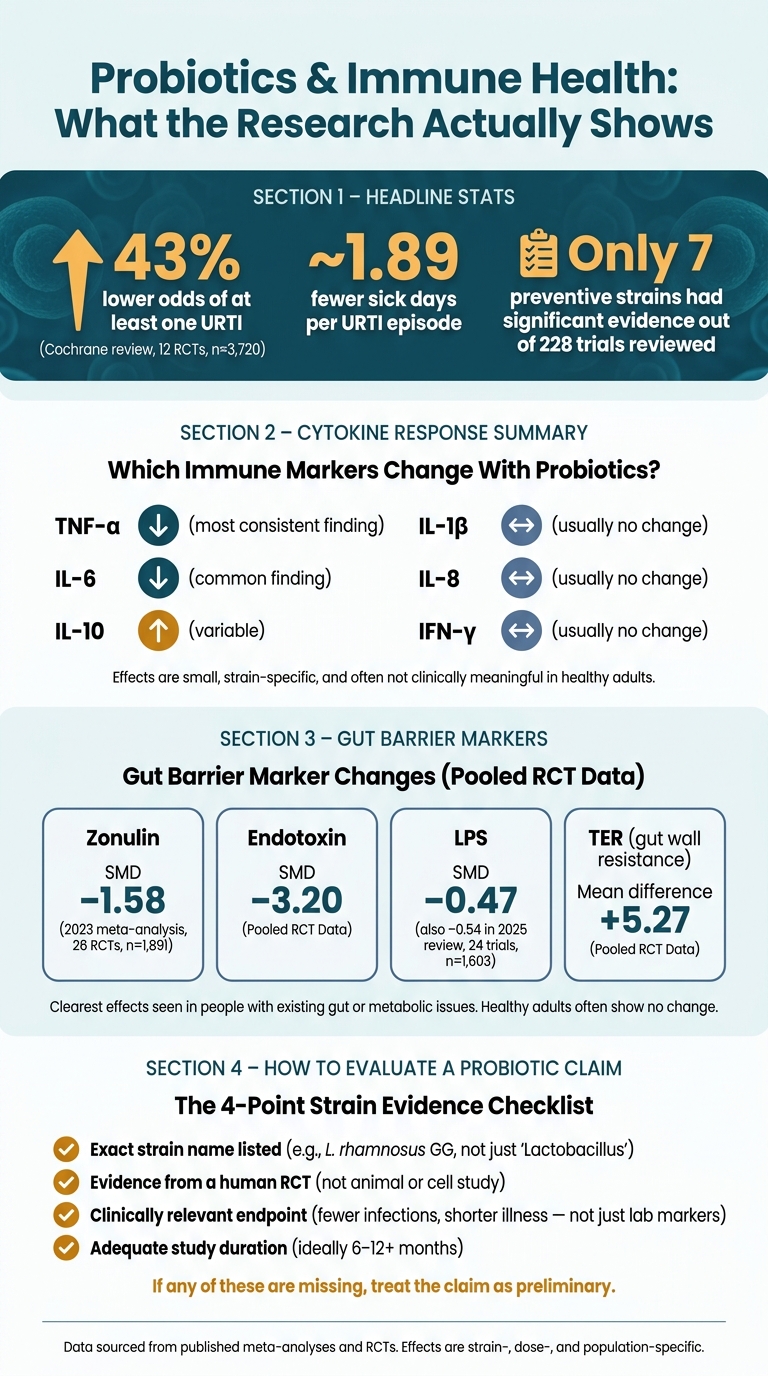
Probiotics & Immune Health: Key Stats & Strain-Specific Evidence
Episode 6: Mechanisms of action for probiotics
What Studies Show About Probiotic Strains and Cytokine Changes
Human trials and meta-analyses point to small and uneven effects. When results are pooled, probiotics appear to bring down TNF-α and IL-6 a bit, but IL-1β, IL-8, IFN-γ, and IL-17 usually stay about the same.[15][6] A 2021 meta-analysis in healthy adults found little change in blood immune markers, and the studies varied so much that firm takeaways were hard to make.[18] The same strain-by-strain pattern shows up in gut barrier markers too, but the data there are even more mixed.
Patterns Seen in Lactobacillus and Bifidobacterium Research
Research on Lactobacillus most often shows drops in TNF-α and IL-6, with small rises in IL-10. In critically ill or trauma patients, multi-strain formulations rich in Lactobacillus led to marked drops in TNF-α and IL-1β, along with higher IL-10 levels.[9] By contrast, IL-8 and IFN-γ tend to be the least responsive markers across Lactobacillus studies.[7][3]
Bifidobacterium longum shows a similar anti-inflammatory pattern, especially in gut-related settings. In IBS-D, 12 weeks of B. longum supplementation was linked to lower IL-6, IL-8, and TNF-α, along with better intestinal permeability and GI symptom scores.[13] A synbiotic that paired B. longum with the prebiotic Synergy 1 in ulcerative colitis led to statistically significant drops in mucosal TNF-α and IL-1α, plus histological improvement.[10][11]
That sounds promising on paper. But those cytokine shifts only matter if they line up with barrier repair or fewer infections, and that’s where the human data start to thin out.
Human Findings Versus Animal and In Vitro Results
Preclinical models tend to show bigger and steadier cytokine shifts than human trials. In IL-10 knockout mice, Bifidobacterium infantis 35624 lowered IFN-γ, TNF-α, and IL-12 and reduced colitis.[19] L. plantarum TN8 increased IL-10 while lowering IL-12, IFN-γ, and TNF-α in obese mice.[20]
Cell culture work often shows even larger effects. Probiotic strains or their metabolites can cut pro-inflammatory cytokines by more than 50–70% and sharply increase IL-10.[8][13][14] That gap isn’t surprising. Animal and lab models are tightly controlled, while human studies deal with messy things like diet, baseline health, medication use, and strain dosing. As a result, human trials rarely match the size of effect seen in preclinical work,[7][3][1] and many report changes that are too small to shift disease activity scores or quality-of-life measures.[7][12]
Strains and Cytokine Direction of Effect: Comparison Table
The table below separates strain-level findings from broad pooled results.
| Strain / Formulation | Study Type | Population | Cytokines Measured | Direction of Change | Strength of Evidence |
|---|---|---|---|---|---|
| Multi-strain Lactobacillus/Bifidobacterium | RCT | Critically ill / trauma | TNF-α, IL-1β, IL-10 | TNF-α ↓, IL-1β ↓, IL-10 ↑ | Moderate[9] |
| B. longum + Synergy 1 (synbiotic) | Pilot RCT | Ulcerative colitis | Mucosal TNF-α, IL-1α | TNF-α ↓, IL-1α ↓ | Moderate[10][11] |
| B. longum strains | Clinical trial | IBS-D | IL-6, IL-8, TNF-α | All ↓; permeability improved | Low–moderate[13] |
| Bifidobacterium infantis 35624 | Animal (IL-10 KO mice) | Colitis model | IFN-γ, TNF-α, IL-12 | All ↓ | Mechanistic only[19] |
| L. plantarum TN8 | Animal (obese mice) | Obesity model | IL-10, IL-12, IFN-γ, TNF-α | IL-10 ↑; IL-12, IFN-γ, TNF-α ↓ | Mechanistic only[20] |
| Mixed probiotics (pooled meta-analysis) | Meta-analysis | Multiple conditions | TNF-α, IL-6, IL-1β, IL-8, IFN-γ | TNF-α ↓, IL-6 ↓; IL-8, IFN-γ, IL-1β - | Moderate, heterogeneous[15] |
| Probiotics in athletes | Meta-analysis | Healthy athletes | TNF-α, IFN-γ, IL-6, IL-8, IL-10, sIgA | TNF-α ↓, IFN-γ ↑, sIgA ↑; IL-6, IL-8, IL-10 - | Moderate[16] |
| Probiotics in healthy adults | Meta-analysis | Healthy adults | Multiple cytokines | Limited effect; high heterogeneity | Low[17][18] |
Effects on Gut Barrier Markers and Immune Defense
Cytokines tend to get the spotlight in probiotic research. But there’s another part of the story: the gut barrier itself.
When the intestinal lining gets more permeable, bacterial fragments like lipopolysaccharide (LPS) can slip into the bloodstream and help fuel low-grade inflammation. That’s why researchers don’t just look at cytokines. They also track markers tied to barrier integrity.
Zonulin, Endotoxin, and Tight Junction Markers
The barrier markers most often measured in probiotic studies include zonulin, LPS/endotoxin, lipopolysaccharide-binding protein (LBP), and tight junction proteins such as occludin, claudins, and ZO-1. Related markers like mucins are also used. Zonulin is one of the main biomarkers for intestinal permeability, and higher levels usually point to a leakier gut barrier.[27][31]
A 2023 meta-analysis of 26 RCTs (n = 1,891) found that probiotics improved several barrier markers. Transepithelial resistance (TER) improved with a mean difference of 5.27 (95% CI: 3.82–6.72). Zonulin decreased (SMD −1.58; 95% CI: −2.49 to −0.66). Endotoxin also fell (SMD −3.20; 95% CI: −5.41 to −0.98), and LPS declined as well (SMD −0.47; 95% CI: −0.85 to −0.09).[4][32]
A 2025 review reached a similar result, though with more caution. Across 13 trials (n = 778), zonulin was lower with moderate certainty (SMD −0.49; I² = 74.9%). LPS also dropped across 24 trials (n = 1,603), but confidence in that result was lower because heterogeneity was very high (I² = 94.4%).[30][31]
The pattern is clearest in people who already have barrier problems. In adults with excess body weight, a diet-plus-synbiotic plan over 3 months lowered fecal zonulin and increased microbiota diversity.[29] In overweight kidney transplant recipients, synbiotic use reduced serum LBP along with hs-CRP, IL-6, and ICAM-1. That points to better barrier function along with lower systemic inflammation.[26]
Healthy adults look different. A randomized controlled trial of the synbiotic Ecologic® 825/FOS P6 found no significant changes in zonulin, cytokines, or intestinal permeability, even under indomethacin-induced stress.[22][25] In plain terms, when barrier function starts out normal, there may not be much room to move.
Where Synbiotics and Postbiotics Fit Into the Evidence
Synbiotics may help barrier function more than probiotics alone in at-risk groups. One reason is simple: prebiotic fermentation can increase short-chain fatty acids, which help support tight junctions and mucus.[24][29][23]
Postbiotics add another angle. They can affect epithelial signaling without needing live organisms to colonize the gut. Mechanistic studies show that postbiotic preparations can increase occludin, ZO-1, and MUC2, while also boosting human β-defensin 2 (HBD-2), an innate immunity peptide.[21][28]
One study looked at a postbiotic made through sequential fermentation of Lacticaseibacillus rhamnosus GG and L. paracasei NPB-01. In human Caco-2 enterocytes, it led to greater upregulation of occludin, ZO-1, and MUC2 than single-strain postbiotics.[28] Most of this work is still preclinical, but the mechanism makes sense: even without live strains, these compounds may help reinforce the barrier and support host defense.
The next step is practical. Do these marker changes line up with outcomes people can actually feel, like fewer infections?
Probiotic, Synbiotic, and Postbiotic Outcomes: Comparison Table
| Intervention Type | Marker(s) Measured | Population | Direction of Change | Evidence Type |
|---|---|---|---|---|
| Probiotics (pooled) | TER, zonulin, endotoxin, LPS | Mixed adult RCTs | Improved in pooled analyses | Human RCT / meta-analysis [4][32] |
| Pro- and synbiotics | Zonulin | 13 trials, n = 778 | Reduced (SMD −0.49; moderate certainty) | Human meta-analysis [30][31] |
| Pro- and synbiotics | LPS | 24 trials, n = 1,603 | Reduced (SMD −0.54; very low certainty, high heterogeneity) | Human meta-analysis [30][31] |
| Synbiotic (overweight/obese) | Fecal zonulin, microbiota diversity | Adults with excess body weight | Zonulin ↓; diversity ↑ | Human RCT [29] |
| Synbiotic (kidney transplant) | LBP, hs-CRP, IL-6, ICAM-1 | Overweight transplant recipients | All ↓ | Human RCT [26] |
| Synbiotic (healthy adults) | Zonulin, cytokines, permeability | Healthy adults | No significant change | Human RCT [22][25] |
| Postbiotics | Occludin, ZO-1, MUC2, HBD-2 | Caco-2 cells / preclinical | Upregulated | In vitro / mechanistic [21][28] |
If these marker shifts matter in practice, they should show up in day-to-day immune outcomes too, especially infection risk.
sbb-itb-1bbfe7f
Do Immune Marker Changes Lead to Fewer Infections?
Barrier and cytokine shifts matter only if they lead to a lower risk of getting sick. That’s the part most people care about.
Upper Respiratory Tract Infections and Influenza-Like Symptoms
Some probiotic strains appear to cut respiratory infections a bit, but the data are mixed.
A Cochrane review of 12 randomized controlled trials (n ≈ 3,720) found that probiotics reduced the odds of having at least one URTI by about 43% (OR 0.57; 95% CI: 0.37–0.76) and shortened each episode by about 1.89 days compared with placebo.[37][34][39] An adult meta-analysis also reported fewer URTI episodes overall, both for episode incidence (RR 0.77; 95% CI: 0.68–0.87) and episode rate (rate ratio 0.72; 95% CI: 0.60–0.86).[33][5]
A 2025 network meta-analysis gave a more specific picture. Bifidobacterium animalis lowered RTI risk by 20%. Multi-strain probiotics lowered RTI risk by 10% and cut RTI duration by about 0.97 days.[43]
The signal tends to be clearer in children, especially in daycare. Trials using Lactobacillus rhamnosus GG found lower URTI risk (RR 0.66; 95% CI: 0.52–0.84). The number needed to treat was about 5, meaning about five children would need the probiotic to prevent one infection. Those trials also found fewer episodes lasting more than 3 days.[44] In pediatric studies, antibiotic use fell too, with a pooled risk ratio of about 0.69.[35]
There are also a few eye-catching results in athletes. In distance runners given L. fermentum VRI-003, symptom days dropped from 72 days to 30 days in the probiotic group (p = 0.00006).[42][41]
How Secretory IgA and IFN-gamma Relate to Clinical Outcomes
This is where things get messy. sIgA and IFN-gamma may help support mucosal defense, but they don’t line up in a steady way with fewer infections across trials.
The L. fermentum VRI-003 runner studies show that gap pretty well. Respiratory symptom days fell in a big way, yet salivary IgA, IgA1, IL-4, and IL-12 did not change in a statistically meaningful way.[42][41] So while sIgA and IFN-gamma can be useful lab markers, they don’t reliably forecast who will get fewer infections.
Clinical Trials and Infection Outcomes: Comparison Table
The table below separates studies that measured infection outcomes from those that mainly tracked markers.
| Population | Strain / Formulation | Study Design | Intervention Length | Infection Endpoint | Immune Markers | Result |
|---|---|---|---|---|---|---|
| General adults & children | Mixed probiotic strains (pooled) | Cochrane review, 12 RCTs (n ≈ 3,720) | Varied | URTI incidence, episode duration | Not specified | URTI odds ↓ ~43%; duration ↓ ~1.89 days [37][34][39] |
| Adults | Mixed strains (pooled) | Meta-analysis of RCTs | Varied | Episode incidence, episode rate | Not specified | RR 0.77; rate ratio 0.72 [33][5] |
| Adults | B. animalis, multi-strain | Network meta-analysis (2025) | Varied | RTI risk, RTI duration | Not specified | RTI risk ↓ 20% (B. animalis); multi-strain RTI risk ↓ 10% and duration ↓ ~0.97 days [43] |
| Children (daycare) | L. rhamnosus GG | RCT | Not specified | URTI risk, episode length, antibiotic use | Not specified | RR 0.66; NNT ≈ 5; fewer long episodes [44] |
| Distance runners | L. fermentum VRI-003 | RCT | Not specified | Days with respiratory symptoms | Salivary IgA, IgA1, IL-4, IL-12 | Symptoms fell from 72 days to 30 days; no change in IgA or cytokines [42][41] |
| Elite athletes | L. casei Shirota | RCT | 16 weeks | URTI frequency | Salivary sIgA | sIgA maintained; URTI frequency reduced [38][40] |
What the Evidence Supports, Its Limits, and the Practical Takeaway
Across cytokines, barrier markers, and infection outcomes, one theme keeps showing up: the upsides are narrow and strain-specific.
Main Research Limitations to Keep in Mind
These studies are tough to compare side by side because the strain, dose, and study length often change from one trial to the next. One recent review found very high heterogeneity in pooled URTI incidence data (I² = 93.12%), which tells you the combined estimate doesn't say much on its own.[55]
Small sample sizes add another problem. So does uneven adverse-event reporting. Put those together, and it gets much harder to make firm calls. Most trials also stop too soon to show whether changes in immune markers stick around over time or fade once supplementation ends.[45][47][50]
That’s why product claims need strain-level evidence, not broad species-level wording.
How to Read Strain-Specific Claims More Carefully
A 2018 review of 228 trials found significant evidence for only 7 preventive strains and 11 treatment strains.[52] That’s a pretty small slice of all the strains reviewed.
So when you see a probiotic claim, use a simple screen:
If one of those parts is missing, treat the claim as preliminary. For example, a product that lists only a species name like Lactobacillus plantarum - without the strain tag, such as HEAL9 - doesn’t give you a way to tie it to a specific trial.[53]
It also helps to check what the study actually measured. Did it look at something that affects daily life, like fewer infections or shorter symptoms? Or did it only track a lab marker like IL-6 or zonulin?
That difference matters. Marker shifts do not always lead to clinical benefit.
Evidence Gaps and Why They Matter: Comparison Table
| Limitation | How It Affects Interpretation | What Future Research Needs |
|---|---|---|
| Short trial durations and no long-term safety data (weeks, not months; rare harms undetected) | Can't tell if immune benefits persist after stopping; waning effects or rare adverse events may go undetected[45][47][50] | RCTs lasting at least 6–12 months with standardized adverse-event reporting and follow-up periods |
| Strain and dose heterogeneity | Pooled results may not apply to any single product[45][48] | Head-to-head trials of specific strains at defined doses |
| Surrogate endpoints only (cytokines, zonulin) | Lab shifts don't always mean fewer infections or better health[2][55] | Trials measuring infection rates, antibiotic use, missed workdays |
| Narrow study populations | Results in athletes or children may not apply to general U.S. adults[36][49] | Diverse, real-world populations stratified by age and health status |
The practical takeaway is pretty simple: probiotic research shows promise, but it is not a class effect.[51][52][53] Some strains show real signals for lower URTI incidence and short-term immune changes in certain groups, but those results apply only to those exact strains, doses, and populations.[45][47][48] If you're sizing up a microbiome-support plan, look for clear strain-level evidence tied to human clinical outcomes, and view probiotics as an adjunct, not a standalone immune fix.[45][46][50]
FAQs
How do I know which probiotic strain is backed by research?
Look for products that list the exact strains studied for immune health, like Bifidobacterium lactis HN019 or Lactobacillus casei DN114001. That kind of detail matters. A label that only says “probiotics” doesn’t tell you much.
You’ll also want a dose that’s high enough to matter, usually at least 1 billion CFU per serving. And the product should be made to keep the probiotics potent and alive until you use them.
Because probiotic supplements aren’t regulated by the FDA, quality can vary from one product to the next. A healthcare provider can help you pick the right strains and dosages for your needs.
Why do probiotics seem to help some people but not healthy adults?
Probiotics often seem to work better in children or in people who already have some kind of imbalance. That makes sense: a child’s immune system and gut microbiome are still developing, and a disrupted system has more room to change.
In healthy adults, things are usually steadier. The gut microbiome and immune system tend to be more stable, so any effects may be more subtle.
That said, probiotics can still support immune health. They may help regulate anti-inflammatory responses and support gut barrier integrity.
Do lower cytokine or zonulin levels actually mean fewer infections?
Not necessarily. Lower cytokine and zonulin levels are tied to less inflammation and a stronger gut barrier, which can help support the body’s defense against pathogens.
But those markers alone don’t prove that infections happen less often. What they do suggest is better barrier function and steadier immune control, which may help reduce infection risk.