

If your SIBO is methane-positive, two antibiotics may work better than one - but they also bring more side effects, more cost, and more gut disruption.
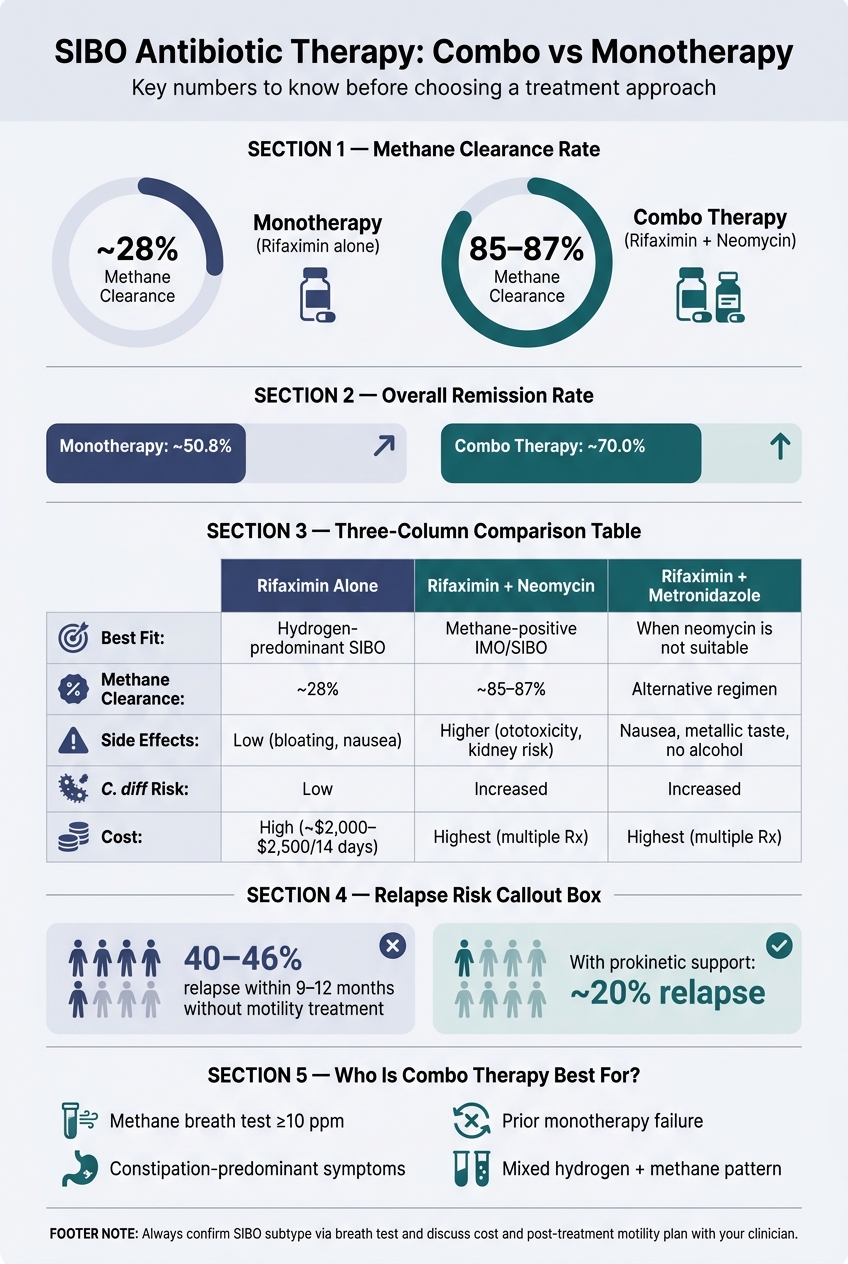
Here’s the short version: for methane-predominant SIBO/IMO, which may require a checklist for probiotic use alongside drugs, rifaximin + neomycin is often used because rifaximin alone clears methane in only about 28% of cases, while the combo clears it in about 85% to 87%. That can mean less bloating and constipation in the short term. But the tradeoff is plain: more safety concerns, more relapse planning, and a higher bill, with rifaximin alone often costing $2,000 to $2,500 for 14 days in the U.S.
If I were sizing this up, I’d focus on five things:
- Symptom relief: combo therapy may help more with methane-linked constipation and bloating
- Coverage: it targets both bacteria and methane-producing archaea
- Side effects: adding neomycin or metronidazole adds more risk
- Cost: two drugs cost more, and insurance approval can be a hassle
- Recovery: antibiotics may help now, but relapse is still common if long-term gut health and motility are not addressed
The big takeaway: combo therapy often makes the most sense for methane at 10 ppm or higher, constipation-predominant symptoms, or cases that did not improve with one drug. For hydrogen-predominant SIBO, one-drug treatment is often the first step.
SIBO Combo Therapy vs Monotherapy: Key Stats & Tradeoffs
Are Your Antibiotics for SIBO Right?
sbb-itb-1bbfe7f
Quick Comparison
| Option | Best fit | Short-term methane response | Main downside |
|---|---|---|---|
| Rifaximin alone | Hydrogen-predominant SIBO | ~28% methane clearance | Lower methane control |
| Rifaximin + Neomycin | Methane-positive IMO/SIBO | ~85%–87% methane clearance | More side effects; kidney/ear risk |
| Rifaximin + Metronidazole | When neomycin is not a fit | Used as another combo option | More nausea, metallic taste, no alcohol |
One more point matters: even after treatment works, about 40% to 46% of people may relapse within 9 to 12 months if the root problem - often slow gut motility - is still there. So when you look at combo therapy, it’s not just about killing overgrowth. It’s also about what happens after the antibiotics stop.
How Combo Antibiotics Work in SIBO
Intestinal methanogen overgrowth (IMO) is driven by Methanobrevibacter smithii, an archaeon. Rifaximin has weak activity against archaea, so clinicians sometimes pair it with a second antibiotic to cover what rifaximin may miss.
Common combinations used for methane-predominant SIBO or IMO
For methane-predominant SIBO, the most studied combo is Rifaximin 550 mg three times daily plus Neomycin 500 mg twice daily for 14 days [1]. Neomycin is added because it works against methanogens that rifaximin does not target well, though some probiotics reduce methane as well.
If neomycin isn't a good fit, metronidazole at 250 mg three times daily can be used instead. That option adds coverage for anaerobic organisms and methanogens [1].
This tends to matter most when a breath test shows both hydrogen and methane. In those mixed hydrogen-methane cases, combo therapy may make more sense because hydrogen-producing bacteria help keep methane production going [1].
Why broader coverage may improve short-term response
The short-term numbers lean toward combo therapy. Rifaximin alone clears methane in about 28% of IMO cases, while rifaximin plus neomycin clears methane in about 85% to 87% of cases [1][2]. Since less than 0.4% of a rifaximin dose is absorbed into the bloodstream [1][3], most of it stays in the small bowel, where it can act with fairly low systemic side effects. The second drug then adds coverage for targets rifaximin can't handle well on its own.
For methane-linked constipation and bloating, that two-part approach can make short-term symptom relief easier to reach. The tradeoff is pretty simple: more coverage may improve response, but it also adds to the treatment burden. This makes following a checklist for restoring gut health after antibiotics essential once the course is finished.
| Regimen | Primary Target | Methane Eradication Rate |
|---|---|---|
| Rifaximin alone | Hydrogen-producing bacteria | ~28% [1] |
| Rifaximin + Neomycin | Bacteria + Methanogens (Archaea) | ~85–87% [1][2] |
| Rifaximin + Metronidazole | Bacteria + Anaerobes/Methanogens | Alternative regimen when neomycin is not suitable [1] |
That broader coverage can improve short-term response, but it also raises the side effect and recovery tradeoffs covered next.
Benefits of SIBO Combo Therapy
Possible gains in bloating, constipation, and symptom relief
For people with methane-dominant SIBO, the day-to-day problem is often pretty clear: constipation, abdominal pressure, and bloating. In that group, combo therapy may lead to better short-term symptom control than rifaximin monotherapy.
Put simply, combo therapy can do more for short-term remission and bloating relief in methane-dominant SIBO.
Broader coverage of bacteria and methanogens
Combo therapy can help when rifaximin alone doesn't do enough for methanogens or mixed overgrowth. Neomycin stays mostly in the gut and adds methanogen coverage. Metronidazole is another option when neomycin isn't available, and it also adds coverage for anaerobic organisms.
That extra coverage may improve short-term response. The flip side is that it can also bring more side effects and make recovery a bit harder, which the next section covers.
Comparison table: Combo therapy vs monotherapy benefits
Here's the tradeoff in plain terms.
| Feature | Monotherapy | Combination Therapy |
|---|---|---|
| Methane clearance rate | ~28% [1] | ~85–87% with rifaximin + neomycin [1][2] |
| Overall remission rate | ~50.8% [4] | ~70.0% with combo protocols [4] |
| Best fit | Hydrogen-dominant SIBO | Methane-positive, constipation-predominant, or refractory SIBO |
| Coverage breadth | Narrower | Broader |
Risks and Tradeoffs of Using Two Antibiotics
Higher side effect burden and safety concerns
Using two antibiotics can improve coverage. But there's a catch: the second drug adds more side effects, more safety issues, and more recovery costs.
Common side effects include nausea, diarrhea, cramping, and bloating. Neomycin brings added risk of ototoxicity and kidney toxicity. Metronidazole can cause a metallic taste, nausea, vomiting, neuropathy risk, and it can't be mixed with alcohol during treatment [6].
Rifaximin works mostly inside the gut, so side effects outside the gut are usually limited [3][4]. When rifaximin is paired with neomycin, C. difficile risk may go up because the combo disrupts more of the gut.
This tradeoff matters most when the main goal is short-term symptom relief.
Microbiome disruption and recovery
The next issue shows up after treatment ends. Combo therapy does not fix the motility problems that drive recurrence.
So even if symptoms improve for a while, the root cause may still be there. That's why recovery planning after treatment matters. About 40% of patients have SIBO recurrence within nine months of successful antibiotic treatment [5].
A few practical points matter here:
- S. boulardii can be taken with antibiotics and may help reduce antibiotic-associated diarrhea [3].
- Bacterial probiotics should be taken at least 2 hours away from antibiotic doses [3].
- Clinicians recommend retesting with a breath test 2–4 weeks after treatment instead of relying on symptoms alone [5].
Comparison table: Risks, costs, and long-term tradeoffs
Here is the tradeoff in one view.
| Factor | Monotherapy (Rifaximin) | Combo Therapy (Rifaximin + Neomycin/Metronidazole) |
|---|---|---|
| Side effects | Lower; primarily bloating and nausea [5] | Higher; adds diarrhea, ototoxicity, and neuropathy risk [6] |
| C. difficile risk | Low [3] | Increased due to broader gut disruption [3] |
| Microbiome disruption | Selective; spares most normal flora [3] | Big disruption; higher dysbiosis risk [3] |
| Cost | High; single prescription, often requires prior authorization [6] | Highest; multiple prescriptions, prior auth likely [6] |
Rifaximin is already expensive and often needs prior authorization. Adding a second drug pushes up both out-of-pocket cost and admin hassle.
Those tradeoffs help decide who should use combo therapy.
Bottom Line: When Combo Therapy May Be Worth It
Who may be a better fit for combo therapy
Combo therapy tends to make the most sense when the upside is more likely to beat the drawbacks. The clearest best fit is a methane-positive breath test with methane at or above 10 ppm. That result points to IMO, which is where combo therapy has the strongest support for probiotics vs. synbiotics for methane control. In plain terms, patient selection is what makes or breaks this choice.
People with chronic constipation, stubborn symptoms, or a past monotherapy failure may be a better match for this approach. For hydrogen-predominant SIBO, monotherapy is usually the first step.
Key points to bring to a clinician discussion
If combo therapy is being considered, the next visit should clear up three things.
- Confirm the subtype. Breath test results should line up with the gas pattern being treated. This helps match the drug plan to what is actually going on.
- Review cost before starting. A 14-day course of rifaximin (Xifaxan) costs about $2,000–$2,500 in the U.S. without insurance coverage [1]. Add a second antibiotic, and that cost goes up. It also makes sense to ask whether your insurance will cover the prescription under an IBS-D diagnosis, since that can sometimes get better approval odds than a SIBO label.
- Clarify the post-treatment plan. If gut motility is not addressed, relapse rates are about 44%–46% within 9–12 months [1]. A nightly prokinetic after antibiotics can bring that down to about 20% [1]. That is a big gap. Ask what the recovery plan looks like and how it will support motility and lower the chance of symptoms coming back. This is especially important if you notice signs your gut microbiome needs a reset following intensive treatment.
Combo therapy works best when the breath test pattern, symptoms, and follow-up plan all line up.
FAQs
How do I know if I have methane-positive SIBO or IMO?
The main noninvasive way to check for methane-positive SIBO or IMO is a hydrogen and methane breath test. After you consume a specific substrate, the test measures gases made by microorganisms in your digestive tract.
Because the symptoms can overlap with other gastrointestinal conditions, a healthcare provider also looks at your clinical history to confirm the subtype and help shape treatment.
Who should avoid neomycin or metronidazole?
Patients with kidney issues should use neomycin with care because it can increase the risk of ototoxicity, which means damage to the ears or hearing.
If you're taking metronidazole, avoid alcohol completely during treatment.
These antibiotics can also disrupt the gut microbiome and may increase the risk of C. difficile infection. Because of that, it’s smart to talk with your healthcare provider about a personal recovery plan, including whether Rebiirth RE-1™ may help restore gut balance after treatment.
What should I do after antibiotics to lower relapse risk?
After antibiotics, the next step is helping your gut get back on track. That matters because a better-balanced gut microbiome may help lower the risk of SIBO coming back. Synbiotics - which pair probiotics with prebiotics - have clinical support for post-antibiotic recovery. They can help support gut repair, back the gut lining, and calm inflammation.
One example is Rebiirth RE-1™, a 3-in-1 eubiotic synbiotic made to help restore intestinal health and support a more resilient gut environment.