

If you have SIBO, the strain is only part of the story. The formula and timing often matter more. In this article, I’d boil it down like this: plain spore-based products usually make more sense after the strict phase, while products with inulin, GOS, or fiber blends can be rough during stricter diet phases.
Here’s the short version:
- I’m looking at 7 soil-based, spore-forming strains often used in SIBO diet plans
- The list includes:
- These strains are often used with:
- low-FODMAP
- Specific Carbohydrate Diet (SCD)
- elemental diet
- Hydrogen-dominant SIBO more often lines up with diarrhea
- Methane-dominant SIBO/IMO more often lines up with constipation and slow motility
- One small study cited for B. coagulans found 94% of 35 adults reported less bloating and abdominal pain after 7 days
What I’d want you to know first is simple:
- During strict phases, keep the product plain
- After antimicrobials or during reintroduction, these strains may fit better
- Start low and track symptoms for 7 days
- Watch for bloating, gas, constipation, diarrhea, or brain fog
- Underlined point: <u>always read the full label, not just the strain name</u>
Top 3 Types of Probiotics That Heal SIBO, Candida & IBS
sbb-itb-1bbfe7f
Quick Comparison
| Strain | What stands out | Best fit in the article | Main caution |
|---|---|---|---|
| Bacillus coagulans | Spore-forming, acid-stable | After strict low-FODMAP phase | Watch for GOS/inulin |
| Bacillus clausii | Often well tolerated | Plain formula after treatment | Avoid fermentable fillers |
| Bacillus subtilis | Stable, often shelf-stable | Later recovery or reintroduction | Formula matters more than name |
| Bacillus indicus HU36 | Endospore helps survival | After strict phase | Check full formula |
| Bacillus licheniformis | Spore-forming | Later-phase use | Start slow if bloating is active |
| Bacillus mesentericus | Simpler products fit better | After strict phase | Skip added prebiotic fiber |
| Bacillus laterosporus | Tolerance varies | Short trial after treatment | Start with a low dose |
So if I had to sum up the whole piece in one line, it would be this: for SIBO, a plain spore-based probiotic used at the right phase often makes more sense than a synbiotic formula used too early.
How Soil-Based Probiotics Differ From Traditional Probiotics in SIBO
Bacillus strains form spores, and that changes the game in SIBO. Those spores can make it through stomach acid, bile, and digestive enzymes, which is why they sometimes show up in SIBO protocols.
In practice, some clinicians trial spore-forming strains during active symptoms or after an antimicrobial protocol. The logic is pretty simple: they're stable, easy to dose, and less likely to get thrown off before they reach the gut. That can matter even more during restrictive eating phases like low-FODMAP or elemental diets.
That said, they aren't a free pass. Some people still deal with bloating, constipation, diarrhea, or brain fog in the first few days. So dose and timing matter.
Labels matter too. During low-FODMAP, SCD, or elemental phases, check for added fibers like inulin or GOS, or consider the trade-offs of probiotics vs. synbiotics for SIBO. Those extras can trip people up, even when the probiotic strain itself seems like a good fit.
With that context, the next strains show where these traits matter most in SIBO diet protocols.
How These Strains Fit Into SIBO Diet Protocols
SIBO diets vary based on how much fermentation they allow. That matters because each phase changes how much fermentable fuel is left in the gut. And that can change whether a probiotic makes sense right now or should wait until later.
Put simply: the stricter the diet, the less room there is for products that may add fermentable material.
Spore-forming Bacillus strains may make more sense after antimicrobials or during reintroduction, not during the strictest phase.
It also helps to read supplement labels closely. Some products add GOS or inulin, which can be a problem early on. Rebirth RE-1 includes 4.5 g of prebiotic fiber per serving, so it usually fits better after the strict phase. Diet phase is only part of the picture, though. SIBO subtype can change tolerance too, so phase alone doesn't decide what fits. This is especially true when considering how probiotics and motility interact.
| Diet Phase | Restriction Level | Spore Probiotic Timing | Prebiotic Fiber Caution |
|---|---|---|---|
| Elemental | Highest | After the initial treatment phase | Avoid high-fiber synbiotics |
| Low-FODMAP (strict) | High | After antimicrobial treatment | Delay GOS/inulin products |
| SCD | Moderate | Later in recovery | Introduce gradually |
| Low-FODMAP (reintroduction) | Lower | After the strict phase | Reassess fiber tolerance carefully |
Hydrogen-dominant SIBO more often causes diarrhea; methane-dominant SIBO, or IMO, more often causes constipation and slow motility [1].
1. Bacillus coagulans
Bacillus coagulans is a hardy spore-former, so it tends to make it through stomach acid well.
In one small 7-day study of 35 adults, 94% reported less bloating and abdominal pain [2]. That sounds promising. But its value still comes down to the formula itself and whether it stays clean enough for the diet phase you're in.
During strict low-FODMAP or Phase 1, check labels for GOS or inulin. Those add-ins can be a problem, which is why this strain often fits better after the strict phase. Powder sachets are easier to dose, and freeze-dried forms store well at room temperature [2].
That same label check matters for the next Bacillus strains.
2. Bacillus clausii
With Bacillus clausii, the big issue is simple: is the formula plain enough for your current SIBO diet phase?
B. clausii is stable and many people tolerate it well. But during strict low-FODMAP or elemental phases, the fit depends almost entirely on what else is in the product. That’s the make-or-break point.
Go with a plain formula and skip products packed with fermentable fillers. During SIBO support, B. clausii tends to fit best when the formula has very few add-ins. In strict diet phases, avoid:
- inulin
- GOS
- fiber blends
During reintroduction, you have more room to work with. Still, the label check matters.
The same label screen matters for Bacillus subtilis.
3. Bacillus subtilis
Like the strains above, B. subtilis is mostly a label-check item during strict SIBO phases.
With Bacillus subtilis, the formula matters more than the strain name. That’s the part to pay attention to. Some products use lipid microencapsulation, and freeze-dried formulas can stay stable at room temperature.
During strict low-FODMAP, SCD, or elemental phases, stick with plain products. Skip anything that includes:
- inulin
- GOS
- fiber blends
The same label-first approach applies to the next strain.
4. Bacillus indicus HU36
B. indicus HU36 forms a protective endospore. That outer layer helps it make it through stomach acid and bile salts.
That staying power is one reason it shows up in SIBO protocols. In practice, though, the big issue is often formula purity and tolerance. So HU36 is usually judged less by the strain name alone and more by the full product formula.
The same idea applies to other spore-forming probiotics. Added prebiotics can matter more than the strain itself. HU36 may be easier to pair with restrictive diet phases because of its stability, but the full formula still decides whether a product fits.
Check the label for added fibers like inulin or GOS. Those can clash with strict SIBO phases.
5. Bacillus licheniformis
For SIBO, the label often matters more than the strain name. B. licheniformis is a spore-forming Bacillus, which means the main thing to watch during SIBO diets is formula purity.
Plain products usually fit best during strict low-FODMAP, SCD, or elemental phases. Products with added inulin, GOS, or fiber blends are more likely to be a poor fit, so it makes sense to skip those.
If bloating is active, start slowly. In practice, that often makes B. licheniformis a better later-phase option than something to use during the strict phase.
6. Bacillus mesentericus
B. mesentericus is a spore-forming Bacillus. During stricter SIBO diet phases, that usually makes the formula itself more important than the strain name.
In plain English: simpler products tend to make more sense here.
Products without added prebiotic fibers are often a better fit for later phases than formulas packed with extra ingredients. So when you check a label, don’t stop at the front of the bottle. Flip it over and look at the add-ons too.
The same label check applies to the next Bacillus strain.
7. Bacillus laterosporus
Like the other spore-forming strains, the formula matters just as much as the strain name. Bacillus laterosporus is a spore-forming bacterium, which means its spores help it survive stomach acid and bile.
That said, tolerance can vary from person to person. Start with a low dose and watch for bloating, gas, or changes in bowel habits. It tends to fit best in plain formulas without added inulin, GOS, or fiber blends. During restrictive phases, simpler products usually go down better.
Quick Reference: When Each Strain May Make the Most Sense
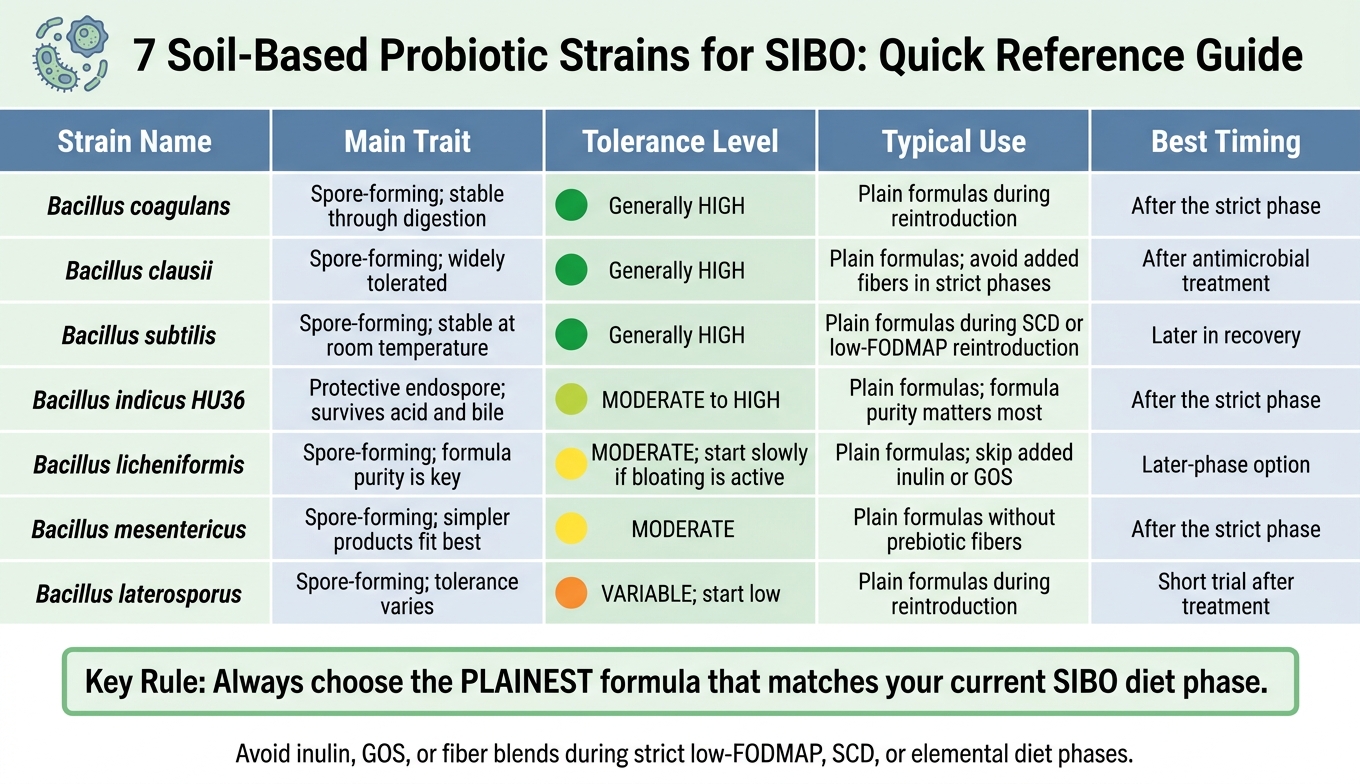
7 Soil-Based Probiotic Strains for SIBO: Quick Comparison Guide
Use this as a fast scan. First, look for a simple formula. Then line up the timing with your current diet phase.
| Strain | Main Trait | Tolerance | Typical Use | Best Timing |
|---|---|---|---|---|
| Bacillus coagulans | Spore-forming; stable through digestion | Generally high | Plain formulas during reintroduction | After the strict phase |
| Bacillus clausii | Spore-forming; widely tolerated | Generally high | Plain formulas; avoid added fibers in strict phases | After antimicrobial treatment |
| Bacillus subtilis | Spore-forming; stable at room temperature | Generally high | Plain formulas during SCD or low-FODMAP reintroduction | Later in recovery |
| Bacillus indicus HU36 | Protective endospore; survives acid and bile | Moderate to high | Plain formulas; formula purity matters most | After the strict phase |
| Bacillus licheniformis | Spore-forming; formula purity is key | Moderate; start slowly if bloating is active | Plain formulas; skip added inulin or GOS | Later-phase option |
| Bacillus mesentericus | Spore-forming; simpler products fit best | Moderate | Plain formulas without prebiotic fibers | After the strict phase |
| Bacillus laterosporus | Spore-forming; tolerance varies | Variable; start low | Plain formulas during reintroduction | Short trial after treatment |
The safest pick is usually probiotics vs. synbiotics in the plainest formula that fits where you are in the diet process.
Conclusion
When you step back and look at the pattern, one thing stands out: simpler formulas tend to make the most sense early on. Spore-forming probiotics often show up in SIBO protocols because they’re stable and usually easier to use alongside restrictive diets when the formula stays plain.
The main job is to match the strain to the diet phase, symptom pattern, and stage of treatment. Since relapse is common after treatment [1], post-treatment timing matters just as much as strain choice. A probiotic that works well during recovery may not work the same way during an active flare.
Start with a low dose, track symptoms for 7 days, and adjust based on bloating, stool changes, and overall tolerance. Motility and stomach acid can shape both tolerance and response, so dosing and timing matter just as much as the strain itself. In SIBO, the best probiotic is the one that fits your diet phase, the formula, and your current symptoms.
FAQs
When should I start a spore-based probiotic for SIBO?
Start only after you’ve checked with your healthcare provider to make sure this lines up with your specific SIBO diagnosis. People can respond differently, so it’s smart to get the green light first.
Once you’re cleared, start slow with a low dose, like one-quarter to one-half of the recommended serving. Stay there for a few days, watch your symptoms closely, and then increase little by little if your body handles it well.
How do I know if a probiotic formula is too harsh during strict SIBO phases?
Watch for bloating, gas, abdominal pain, or major bowel changes that stick around or get worse after a few weeks of steady use. That can be a sign the formula isn’t a good match for your gut right now.
A simple symptom journal can help. Track:
- what you took
- your symptoms
- meals
- sleep
If you think you’re reacting to it, cut the dose to 1/4 or 1/2. If the symptoms are still severe or haven’t improved after 30 days, talk with your healthcare provider.
Does my SIBO type affect which soil-based probiotic I may tolerate?
Yes. Your SIBO type can affect which probiotic strains you may tolerate. And the wrong strain may make symptoms worse or increase methane production in methane-dominant SIBO, also called Intestinal Methanogen Overgrowth.
Because the gut microbiome is different from person to person, and SIBO can make the intestines more sensitive, it helps to stick with strains backed by clinical trials. Start low and go slow. A small dose can give you a clearer sense of how your body reacts.
It’s also smart to talk with a healthcare professional before adding a probiotic, especially if your symptoms flare easily.