

Here’s the short answer: psychobiotics may help sleep, but the effect is usually small, strain-specific, and more clear on self-reported sleep scores than on device-based sleep data.
When I look across the studies, the pattern is pretty simple:
- Best-studied strains: B. longum 1714 and L. gasseri CP2305
- Promising early strains: B. breve CCFM1025, L. plantarum Lp815, L. paracasei PS23
- Main outcome: sleep quality scores like PSQI tend to improve more often than actigraphy or polysomnography
- Typical timeline: 4 to 12 weeks, not overnight
- Average pooled effect: about 0.7 points lower on PSQI
- Bigger changes: usually show up in adults who already have poor sleep, stress, or low mood
In other words: if you want a fast sleep aid, this research doesn’t point there. If you want a gut-brain approach that may help stress, mood, and sleep together over several weeks, some strains look useful.
A few numbers stand out. Meta-analyses report PSQI improvements around −0.71 to −0.78 points. One B. breve CCFM1025 trial went from 11.60 to 7.75, while placebo went from 10.10 to 8.65. And in one Lp815 trial, the responder rate for a ≥4-point ISI drop was 77.3% vs. 57.8% on placebo.
Clinical innovations in sleep, stress, and the gut-brain axis with Microbiome Labs & Fullscript
sbb-itb-1bbfe7f
Quick comparison
| Strain | Main sleep signal | Time frame | What to keep in mind |
|---|---|---|---|
| B. longum 1714 | Better subjective sleep quality, daytime function | 4–8 weeks | Global PSQI not always different from placebo |
| L. gasseri CP2305 | Lower PSQI, less sleep latency, less wake after sleep onset | 4–24 weeks | Best repeated sleep-and-stress data |
| B. breve CCFM1025 | Clear PSQI drop in poor sleepers | ~8 weeks | Fewer trials so far |
| L. plantarum Lp815 | Lower ISI, higher response rate | 6 weeks | Smaller study base |
| L. paracasei PS23 | Better insomnia scores and less anxiety | 6 weeks | Early but encouraging data |
My takeaway: psychobiotics are not a stand-alone fix for insomnia, and one probiotic product should not be treated like another. The strain, the person taking it, and the sleep measure used all change the result.
That’s the lens I’d use for the rest of the article.
Study Map: Clinical Trials, Reviews, and How Outcomes Were Measured
The evidence fits into three main buckets: RCTs, reviews/meta-analyses, and mechanistic studies. Mechanistic studies are usually smaller. They look at how a given strain might affect sleep through cortisol, microbiome changes, or inflammation.
That split matters because strain-level results can change a lot based on the sleep measure used. A strain might look helpful on a questionnaire but show little movement on actigraphy or PSG. The table below shows how different study types measured sleep.
Human Studies at a Glance
| Study / Population | Strain or Intervention | Duration | Sleep Measure | Main Finding |
|---|---|---|---|---|
| Meta-analysis of mixed adults | Probiotics / paraprobiotics | Varied | PSQI, actigraphy/PSG | PSQI improved by −0.78 points; no significant change in objective sleep measures.[5] |
| Pooled reviews (including systematic review of 15 RCTs and review of mixed adult studies) | Probiotics | 4–16 weeks | PSQI, ISI, sleep questionnaire | PSQI improved by MD −0.71; significant decreases seen at 4–6 and 8–16 weeks; insomnia severity not clearly improved overall.[10][20] |
| L. gasseri CP2305 meta-analysis | Lactobacillus gasseri CP2305 | Varied | PSQI | PSQI global score improved by −0.77 vs. control in stressed adults.[9] |
| B. longum 1714 RCT, 89 adults ages 18–45 | Bifidobacterium longum 1714 | 8 weeks | PSQI, sleep diary | PSQI subscales improved by week 4 and stayed better at week 8; the global score did not differ significantly from placebo.[17][18] |
| B. breve CCFM1025 trial | Bifidobacterium breve CCFM1025 | ~8 weeks | PSQI | Treatment-group PSQI fell from 11.60 to 7.75; placebo dropped from 10.10 to 8.65.[19][21] |
These measures are not interchangeable, and that’s where people can get tripped up. They do not measure the same thing. Across studies, subjective sleep scores tend to improve more often than actigraphy or PSG.[5][8][10][14]
What the Main Sleep Scores Mean
PSQI measures sleep quality over the past month. Lower scores are better. A score of 5 or higher usually points to poor sleep.[12][14]
ISI measures insomnia severity. Lower scores are better here too, and a 5- to 7-point drop is often seen as meaningful.[14][16]
Sleep diaries track bedtime, wake time, awakenings, and perceived sleep quality day by day.[12][13]
Actigraphy estimates sleep based on movement, while polysomnography records sleep physiology directly.[7][8][14]
Keep that subjective-vs.-objective split in mind when looking at the strain-by-strain results below.
Strain-by-Strain Roundup of the Clearest Sleep Findings
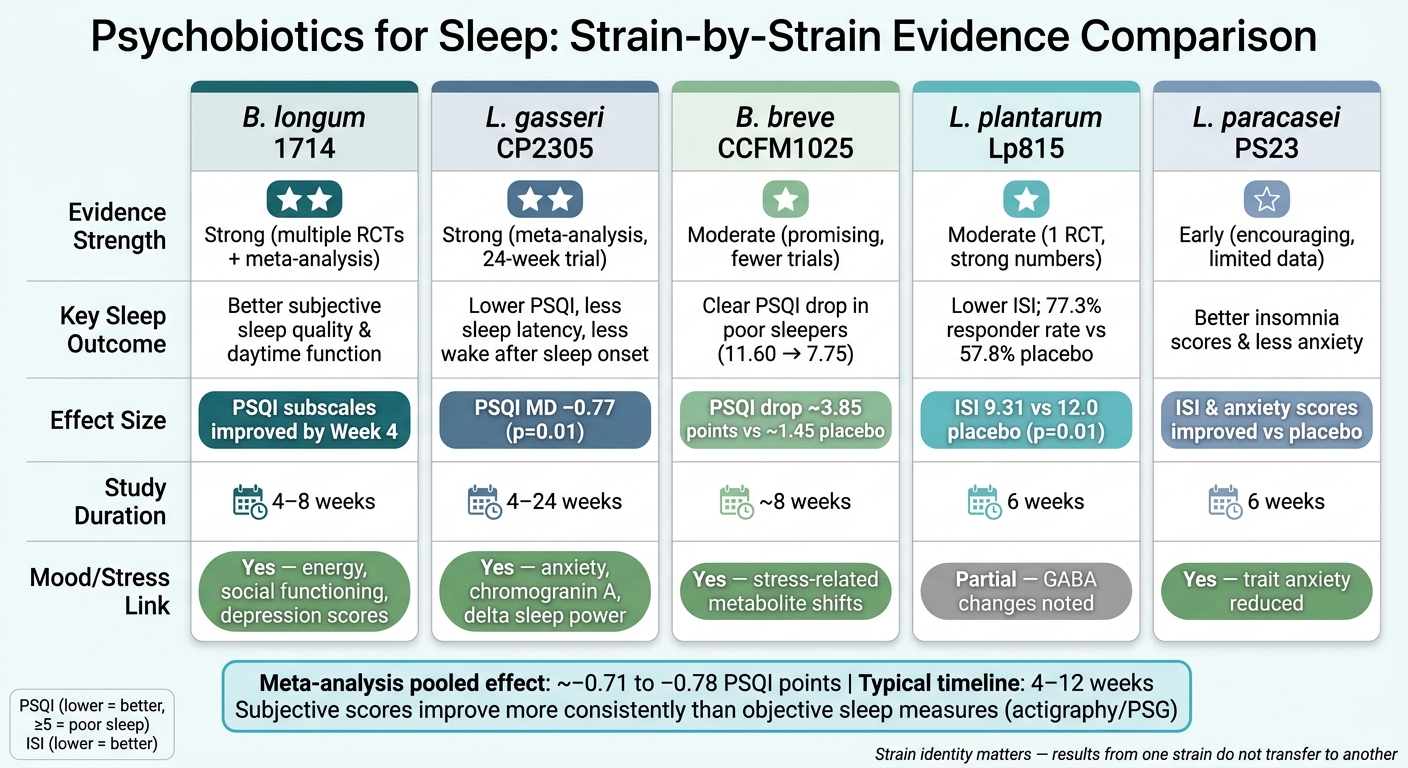
Psychobiotics for Sleep: Strain-by-Strain Evidence Comparison
Strain matters. The clearest sleep effects show up in a small group of well-studied psychobiotics, and most of those effects appear first in subjective sleep scores. When you line strains up side by side, a pattern starts to show: some mainly shift sleep questionnaires, while others also change objective sleep markers.
Bifidobacterium longum 1714 and Bifidobacterium breve CCFM1025
B. longum 1714 has more adult sleep data than most strains in this group. In one study, it improved subjective sleep quality and daytime dysfunction by week 4, with added gains in energy/vitality and social functioning by week 8, even though the total PSQI global score improved in both groups.[12] An earlier 8-week exam-stress study in 20 healthy male students using 1×10^9 CFU/day also found better overall sleep quality and sleep duration during chronic stress.[23][22]
Then there’s B. breve CCFM1025, which shows a similar sleep signal but with a clearer tie to stress biology.
In adults with poor sleep quality, PSQI scores dropped from 11.60 to 7.75 in the CCFM1025 group over about 8 weeks, compared with a smaller drop from 10.10 to 8.65 in the placebo group.[15] The trial also linked metabolite shifts with stress-related markers, which points to a gut-brain route for the effect.[15][30]
Lactobacillus gasseri CP2305 and Lactiplantibacillus plantarum Lp815
This is the most repeated strain in the group, and it has the strongest combined sleep-and-stress data.
L. gasseri CP2305 showed a mean PSQI improvement of −0.77 points versus control (95% CI −1.37 to −0.16; p=0.01) in adults with mild-to-moderate stress.[8][29] In a 24-week trial of Japanese medical students under chronic exam stress, heat-inactivated CP2305 tablets lowered STAI anxiety scores, improved global PSQI, shortened sleep latency, reduced wake after sleep onset, increased delta power in the first sleep cycle, and lowered salivary chromogranin A.[24][26][25][27]
Lactiplantibacillus plantarum Lp815 has fewer trials behind it, but the numbers stand out. In a 6-week, double-blind, placebo-controlled trial of 139 adults with poor sleep, people taking 5 billion CFU/day had ISI scores of 9.31 ± 4.58 at week 6 versus 12.0 ± 5.78 on placebo (p=0.01). The responder rate, defined as a ≥4-point ISI reduction, was 77.3% in the Lp815 group versus 57.8% on placebo (p=0.02).[31][32] Wearable data and GABA changes moved in the same direction.[31][32]
What Strain Differences Mean for Interpreting Results
Strain identity matters more than the species name on the label. CP2305 and B. longum 1714 have the deepest human trial record here, with support from meta-analyses and more than one study, so their sleep signals carry more weight overall. CCFM1025 and Lp815 also look promising, but they rest on a smaller base of trials, which means their effect sizes could change as more studies come out.
That’s an important line to keep in mind: results backed by repeated human trials belong in a different bucket than early signals that still need to be repeated. When you read any one study, that difference should shape how much confidence you put in the result.
How Sleep Changes Connect to Stress, Mood, and Microbiome Reset Goals
Sleep Score Changes Alongside Mood and Stress Outcomes
Across trials, sleep often gets better alongside stress, anxiety, and mood over 4 to 8 weeks of daily use.[12][3][33][8][27] One pattern shows up again and again: mood and stress tend to shift first, and sleep quality follows after that.
| Strain | Population | Duration | Sleep Outcome | Mood/Stress Outcome |
|---|---|---|---|---|
| B. longum 1714 | Adults with impaired sleep | 8 weeks | PSQI components improved by Week 4, especially subjective sleep quality and daytime dysfunction.[12] | Better social functioning and energy/vitality on SF-36 by Week 8.[12] |
| B. longum 1714 | Adults with mild to moderate depression | 8 weeks | PSQI total score dropped more than placebo at Week 4 (difference −0.923; 95% CI −1.62 to −0.23; p = 0.009).[3] | PHQ-9 depressive scores improved more at Week 4 (difference −1.013; p = 0.045), with differences no longer clear by Week 8.[3] |
| L. gasseri CP2305 | Stressed adults | 4 to 24 weeks across studies | Global PSQI improved vs. control (MD −0.77; 95% CI −1.37 to −0.16; p = 0.01).[8] | Anxiety and depressive mood improved.[27][24] |
| L. paracasei PS23 | Adults with insomnia/anxiety | 6 weeks | ISI scores improved, including sleep latency and sleep maintenance.[33] | Trait anxiety was reduced vs. placebo.[33] |
| Cerebiome® (B. longum R0175 + L. helveticus R0052) | Adults with major depression | 12 weeks | PSQI improved significantly by Week 8 (p = 0.005).[34][35] | GAD-7 and STAI improved by Week 4 (p = 0.031; p = 0.008), so mood and anxiety shifted before sleep did.[34][35] |
This matters because the clearest sleep gains tend to show up with strains that also shift anxiety or depression scores, not just sleep scores alone.
A meta-analysis of probiotic interventions in adults found a mean PSQI reduction of −2.10 points (95% CI −3.86 to −0.34; p = 0.02) and a HAMD reduction of −7.72 points (95% CI −14.55 to −0.89; p = 0.03).[21][10] Put simply, a 2-point PSQI drop is usually meaningful.
Where a Microbiome Reset Fits Into the Discussion
Because these effects usually build over weeks, they line up better with a reset model than with a fast sleep aid. Stress, low mood, and poor sleep can also disturb the microbiome, which helps explain why psychobiotic trials are often framed this way.[10][4][8][21][24]
Strains like B. longum 1714 and L. gasseri CP2305 have been linked with changes in gut microbial composition alongside sleep and mood effects.[8][2][27][24] That makes these studies a good fit for a microbiome-reset approach, with the clearest sleep and mood signals showing up over 4 to 12 weeks of steady use.
If you're looking at a structured microbiome reset, Rebirth RE-1 is a 3-in-1 synbiotics and eubiotics with prebiotics, probiotics, and postbiotics in sachet form, built for 7-day, 4-week, and 12-week microbiome reset protocols. Based on the timing in these studies, a multi-week reset fits this evidence better than a short, one-off intervention.
Conclusion: What the Current Evidence Supports
Across the studies above, one thing is clear: the evidence is real, but it has limits. The clearest pattern shows up in subjective sleep quality - how people say they slept. By contrast, objective measures like actigraphy and polysomnography are weaker and less consistent.[7][11][36][37][28]
The effects also look modest and strain-specific. One meta-analysis found an average improvement of about 0.7 PSQI points. That change was statistically significant, but for many adults, it may not feel dramatic.[7][11][36][37][6] Bigger shifts, such as B. breve CCFM1025 lowering PSQI scores from 11.60 to 7.75, appear most clearly in people who already have sleep complaints.[15]
The strains with the strongest repeat signals are B. longum 1714 and L. gasseri CP2305. Both have been studied across more than one trial, in specific groups, over periods ranging from 4 to 12 weeks.[17][1][15][8] And that point matters: results from one strain do not carry over to another.
Sleep changes also tend to track with shifts in stress and mood. That lines up with the idea that psychobiotics may act through a broader gut-brain pathway, instead of working like a direct sleep drug.[13][3][4][15]
Since most of the reported gains show up over weeks, not days, the 4- to 12-week timeline fits a reset-style approach more than a fast sleep-aid model. A multi-week microbiome reset lines up with that window, including Rebirth RE-1's 7-day, 4-week, and 12-week formats. It makes the most sense as an adjunct to steady sleep habits, stress management, and medical help when insomnia is clinically serious, not as a substitute for any of them. In plain English: psychobiotics may support sleep, but they are not a stand-alone fix.
FAQs
How long do psychobiotics take to help sleep?
Some people notice sleep benefits in about 1 week. But the bigger changes in sleep quality and daytime functioning usually stand out more after about 4 weeks.
With steady use, the strongest effects are often seen after 8 to 12 weeks.
One randomized trial of a GABA-producing strain found meaningful improvements by 6 weeks.
Which psychobiotic strains have the best sleep evidence?
Several strains stand out for sleep support.
Lactiplantibacillus plantarum Lp815 has some of the strongest evidence. A 2025 study found lower insomnia scores, longer sleep duration, and better deep sleep.
Other strains have shown promise too. Lactobacillus plantarum PS128, Bifidobacterium longum 1714, and Lactobacillus gasseri BR-LAC-343 were linked to better sleep quality, lower insomnia severity, lower cortisol, or less daytime dysfunction.
Can psychobiotics replace insomnia treatment?
No. Psychobiotics can’t replace insomnia treatment.
Research suggests that some probiotic strains, including Lactobacillus gasseri and GABA-producing Lactiplantibacillus plantarum Lp815, may help improve sleep quality and lower insomnia severity.
That said, they make more sense as one part of a broader sleep plan, not as a stand-in for medical treatment or professional care. That matters even more for severe sleep disorders, major psychiatric conditions, or people taking multiple medications.