

If you want steadier training energy, prebiotics can help - but only with daily use, not as a last-minute fix.
I’d sum it up like this: prebiotic fibers such as inulin and GOS feed gut microbes, and those microbes make short-chain fatty acids (SCFAs) like acetate, propionate, and butyrate. Those compounds are linked to fuel use, gut lining support, glucose control, glycogen refill, and recovery. The article’s main point is simple: prebiotics are a support tool, not a swap for carbs, fluids, or sleep.
Here’s the short version:
- What prebiotics are: fermentable fibers that feed gut microbes
- What they do: help microbes make SCFAs
- Why athletes care: SCFAs are linked to energy metabolism, gut support, and lower training stress
- What matters most: consistent daily intake
- Best food sources: oats, bananas, beans, lentils, onions, garlic, asparagus, and cooled potatoes
- When to use them: at a time your gut handles well, often away from hard sessions
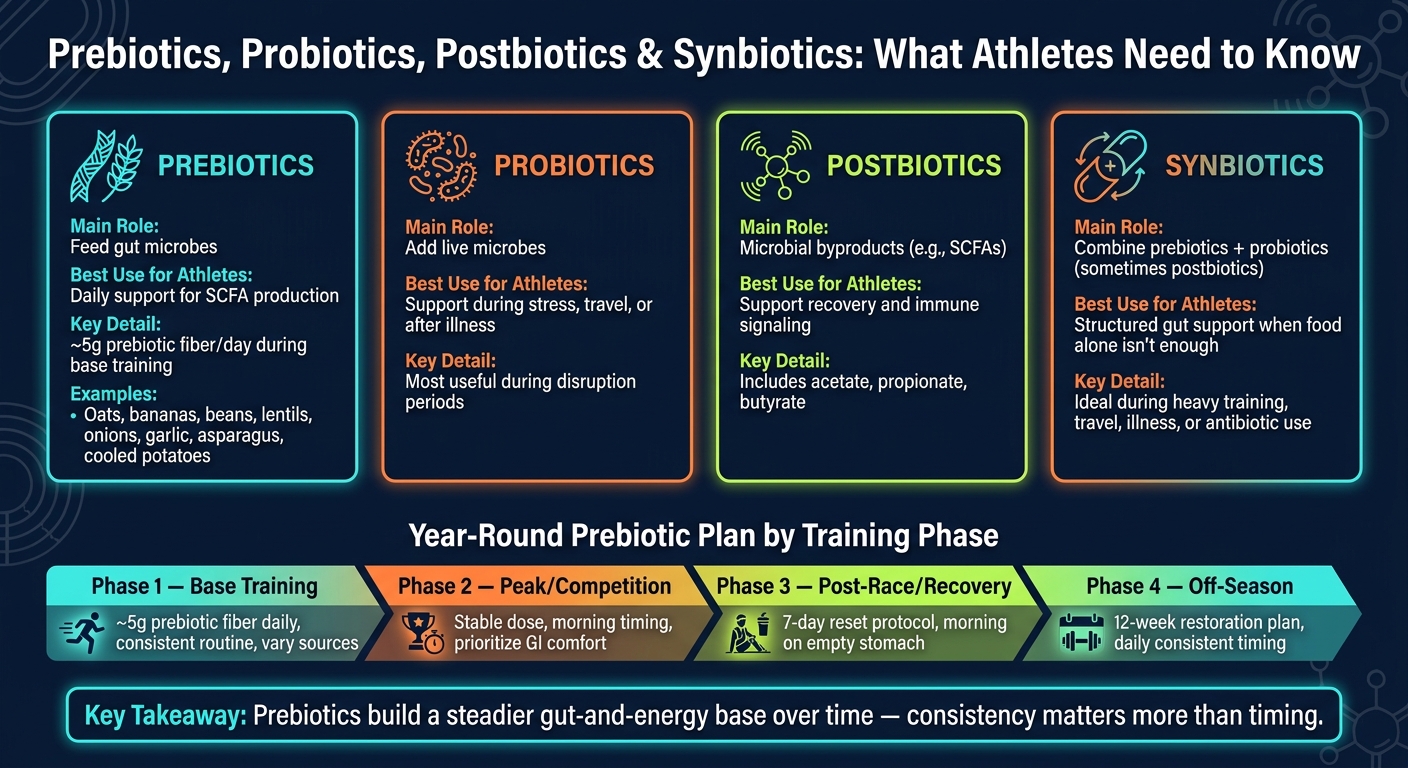
- Where synbiotics fit: they combine prebiotics, probiotics, and sometimes postbiotics for times like travel, illness, antibiotics, or heavy training
- How the plan changes by season: steady daily use in base training, stable intake near competition, short reset after stress, and longer gut support in the off-season
A few points stand out from the article:
- Butyrate helps feed colon cells and supports the gut lining
- Acetate and propionate can enter circulation and are linked to fuel use in the liver and muscle
- Some research points to a lactate-to-propionate pathway involving Veillonella, which may connect hard training and microbial fuel handling
- The article suggests about 5 g of prebiotic fiber per day during base training
- For structured plans, it lists 7-day, 4-week, and 12-week reset formats, with prices of $79, $279, and $749
The Gut Microbiome in Athletic Performance | Prof. Stavros P. Derdas | HEYDAY Unity Symposium 2026
Quick Comparison
| Item | Main Role | Best Use for Athletes |
|---|---|---|
| Prebiotics | Feed gut microbes | Daily support for SCFA production |
| Probiotics | Add live microbes | Support during stress, travel, or after illness |
| Postbiotics | Microbial byproducts | Support recovery and immune signaling |
| Synbiotics | Combine prebiotics + probiotics, sometimes postbiotics | More structured gut support when food alone may not be enough |
If I were boiling the whole article down to one line, it would be this: prebiotics help build a steadier gut-and-energy base over time, especially when training load, travel, or recovery make digestion harder to keep on track.
How Gut Microbes and Short-Chain Fatty Acids Affect Athletic Energy
In the colon, gut microbes ferment prebiotic fiber into short-chain fatty acids (SCFAs): acetate, propionate, and butyrate.[4] These compounds help shape how your body uses fuel, how much inflammation builds up, and how well the gut holds up under training stress.
How Prebiotic Fiber Becomes SCFAs: Acetate, Propionate, and Butyrate
SCFAs are the main byproducts of prebiotic fiber fermentation. And they do more than just sit in the gut.
Butyrate is the main fuel source for colon cells. That helps support the gut barrier and can lower local inflammation.[4][7] Acetate and propionate move into the bloodstream, where they help support fuel use in the liver and muscles during longer sessions.[4][7]
SCFAs also work like signaling molecules. They help regulate fuel use and insulin sensitivity, which affects how the body handles glucose and other energy sources.[7] So this isn’t just about calories. It’s about how the body manages fuel. And that effect shows up most when prebiotics are used on a regular basis, not as a one-off add-on.
Energy Use, Glycogen Support, and Lactate Recycling
SCFAs may help with glycogen handling in skeletal muscle by upregulating GLUT4, which supports glucose uptake and glycogen repletion after exercise.[3][9] Propionate also plays a part here. It feeds into liver gluconeogenesis and may help maintain blood glucose during long sessions or repeated efforts.[4][3]
There’s also an emerging pathway that’s getting a lot of attention: lactate-to-propionate conversion. Certain gut microbes, especially Veillonella, can convert exercise-derived lactate into propionate,[5][8] creating a microbial loop where lactate gets recycled into a fuel-linked metabolite.
That idea is interesting because it connects hard training, gut activity, and fuel handling in a direct way. But it’s not magic. These pathways may help, yet they don’t replace carbs, sleep, or hydration.
Why Microbiome Balance Matters for Recovery and Training Capacity
A stable microbiome can help limit gut stress and training-related inflammation, which may support recovery between sessions.[2][6][7] Put simply: when the gut is in better shape, the body often handles training load better too.
The research is more consistent on recovery and resilience than on direct performance gains. So SCFAs make more sense as a support system, not a solo performance tool.
With the mechanism clear, the next step is how to use prebiotics without upsetting digestion.
sbb-itb-1bbfe7f
How to Add Prebiotics to a Sports Nutrition Plan
Prebiotics vs Probiotics vs Postbiotics vs Synbiotics for Athletes
Understanding the science is one thing. Using it day to day is where it starts to matter. The goal with prebiotics is pretty simple: make them part of your routine in a way that helps training without upsetting your stomach.
Daily Intake, Dose Changes, and GI Tolerance
Because SCFA effects build over time, the practical goal is a repeatable daily intake. Prebiotics support energy best when taken daily, because they work by steady use over time.[1] In plain English, this isn't the kind of thing you take once and expect to feel right away.
A simple daily serving usually works better than trying to fine-tune the dose every few days. For most athletes, consistency matters more than complexity.
Since prebiotic effects come from regular fermentation, the main job is making intake easy to stick with. If added fiber tends to bother your gut, start with a measured serving and see how you feel. A small, steady start is often easier on digestion than jumping in with a big amount.
Best Prebiotic Food Sources for Common U.S. Meals
When your schedule gets messy or your meals change from one day to the next, a measured serving can make it easier to keep intake steady. Food can do the job too. Good sources include:
- oats
- bananas
- beans
- lentils
- onions
- garlic
- asparagus
- cooled potatoes
These foods fit into normal U.S. meals without much effort. Oats and bananas work well at breakfast. Beans and lentils can go into lunch bowls, soups, or burritos. Onions and garlic slide into dinner almost without thinking about it. Cooled potatoes are an easy add-on for meal prep or post-workout meals.
A repeatable serving fits especially well into a morning meal or a recovery routine, when habits tend to be easier to keep.
When to Eat Prebiotics Around Training
Prebiotics are most useful when taken consistently, not as a last-minute pre-workout boost.[1] That point matters. This is more like laying bricks than flipping a switch.
Take them at a consistent time each day that your gut handles well. For some people, that may be breakfast. For others, it may be later in the day, away from training. The best timing is the one you can repeat and that doesn't leave you dealing with GI issues before a session.
That steady approach makes prebiotics more of a base layer than a one-off performance tool. For athletes who want a broader gut-support plan, prebiotics can also fit into a synbiotic approach.
Synbiotics and Personalized Sports Nutrition
When food-based prebiotics aren’t enough, synbiotics can add another layer of gut support.
When a Synbiotic Approach May Help
A synbiotic combines probiotics and prebiotics in one formula. In some cases, it also includes postbiotics to help support microbial balance. For athletes, that can matter during periods of high strain, when the gut often takes a hit before the rest of the body makes it obvious.
Heavy training, frequent travel, illness recovery, antibiotic use, and inconsistent eating can all disrupt gut balance. In those stretches, a structured synbiotic plan may offer more support than food alone. The right fit depends on a few key factors:
- Training load
- Travel frequency
- Diet quality and consistency
- Gut history
How Rebirth RE-1 Fits a Microbiome Reset Plan
Rebiirth RE-1 is a 3-in-1 synbiotic that includes prebiotics, probiotics, and postbiotics in sachet form. It comes in 7-day, 4-week, and 12-week plans, depending on how much support is needed.
Personalizing by Sport, Season, and Gut Baseline
Athletes dealing with frequent bloating, travel stress, or slow recovery may need a more structured plan. The best approach is to match the plan to training load, travel, diet, and GI history. That starting point can shift across training cycles, so what fits in the offseason may not be the same setup that makes sense during a heavy block or competition season.
Building a Year-Round Prebiotic Plan
Training load changes what your gut has to deal with. So your prebiotic plan should shift with the season too.
How to Change Prebiotics Across Training Cycles
Prebiotic needs move with training demands. In base-building phases, the goal is simple: stay consistent. A daily routine built around fiber-rich foods, plus about 5 g of prebiotic fiber per day, can support microbial diversity and SCFA production [1].
As competition gets closer, the focus changes. At that point, GI comfort matters more than trying to squeeze out some last-minute boost. After a race, a hard block, illness, or travel, a 7-day reset can help you get back into rhythm fast [1]. If you're in a longer rebuild, a 12-week plan fits the off-season better [1].
Use the table below to match intake to your training phase, not to chase a pre-workout effect.
| Training Phase | Fiber Pattern | Timing Focus | GI Consideration |
|---|---|---|---|
| Base Training | Around 5 g prebiotic fiber daily, plus fiber-rich foods | Consistent daily routine | Good time to vary sources |
| Peak/Competition | Keep the dose stable | Morning, on an empty stomach | Helps support comfort around race days |
| Post-Race/Recovery | 7-day reset protocol | Morning, on an empty stomach | Useful after travel, illness, or a hard training block |
| Off-Season | 12-week restoration plan | Daily, consistent timing | Better time for deeper microbiome restoration |
Rebirth RE-1 Reset Formats
If you want a more set plan, Rebirth RE-1 offers a few reset formats depending on what you're dealing with.
| Plan | Duration | Price | Best Use |
|---|---|---|---|
| 7-Day Reset | 7 days | $79 one-time | Fast microbiome reset after travel, illness, or hard training |
| 4-Week Reset | 4 weeks | $279 one-time | Gut and immune support over a longer stretch |
| 12-Week Reset | 12 weeks | $749 one-time | Extended microbiome restoration |
Conclusion: Main Points for Athletes to Remember
Consistent prebiotic intake supports energy management over time. Structured resets make more sense when travel, illness, or hard training blocks throw gut balance off.
FAQs
How long do prebiotics take to work?
It depends on your goals and how your body reacts. Some people notice early changes - like less bloating or more regular digestion - within 24 to 48 hours.
The bigger shifts usually take more time. Things like gut barrier support or immune support often show up after 4 to 16 weeks of steady daily use, based on research. And if you stop taking it, those effects can start to fade within seven days.
Can prebiotics help with stomach issues during training?
Yes. Prebiotics help feed the good bacteria in your gut. As those bacteria grow, they produce short-chain fatty acids that support the gut lining and help calm inflammation.
One catch: adding more fiber too fast can lead to temporary bloating or gas. So it’s smart to start small and increase the amount little by little as your body adjusts.
Rebiirth RE-1 brings together prebiotics, probiotics, and postbiotics to support gut balance and recovery.
Should I get prebiotics from food or a synbiotic?
It comes down to your goals and how your gut responds.
Prebiotic-rich foods like garlic, onions, bananas, asparagus, and whole grains give you a solid starting point. They help feed your existing microbiome and support short-chain fatty acid production.
If you want more targeted support - or want help sooner - a synbiotic like Rebiirth RE-1™ can be a good add-on. It combines prebiotics, probiotics, and postbiotics in one product.
A lot of people use both:
- Whole foods for day-to-day support
- A synbiotic for a steady extra push