

Antibiotics can help clear an infection, but they can also upset the gut-brain link. When gut bacteria drop, the gut lining can get stressed, immune signals can shift, and that can affect mood, focus, and energy.
Here’s the short version:
- Step 1: Antibiotics lower gut bacteria, especially after broad-spectrum or repeat use.
- Step 2: That change can strain the gut lining.
- Step 3: Immune activity may shift.
- Step 4: Brain-related inflammation may go up.
- Step 5: You may notice changes in stress, mood, energy, or clear thinking.
The article also points to a simple recovery plan:
- Prebiotics feed gut bacteria during recovery
- Probiotics help add bacteria back
- Postbiotics help support the gut lining and immune function
- A fiber-rich diet helps the gut rebuild over time
One useful point: recovery may take 7 days, 4 weeks, or even 12 weeks, depending on how much support your gut needs after antibiotics.
If I were putting this in plain English, I’d say this article is about one main idea: antibiotics don’t just affect germs causing illness - they can also change the gut in ways that may reach the brain.
How antibiotics disrupt the gut ecosystem
Microbial loss after broad-spectrum or repeated antibiotic use
Broad-spectrum or repeated antibiotics can shrink microbial diversity and throw off the gut’s normal bacterial balance [1]. When helpful bacteria drop, the whole system gets less stable. That shift starts the problem early, even before the gut barrier is under strain.
What dysbiosis changes inside the gut
As protective microbes decline, the gut has a harder time bouncing back. It also produces fewer of the things that help support digestion and immune function [1].
Early evidence linking gut disruption to behavior and cognition
This kind of disruption doesn’t stay in the gut. Early evidence links it to changes in stress, mood, and cognition [1]. In plain terms, the chain reaction can start with microbial loss, then move toward gut barrier strain and changes in immune signaling.
Antibiotics, Anxiety and Your Gut
The step-by-step chain from antibiotics to brain effects
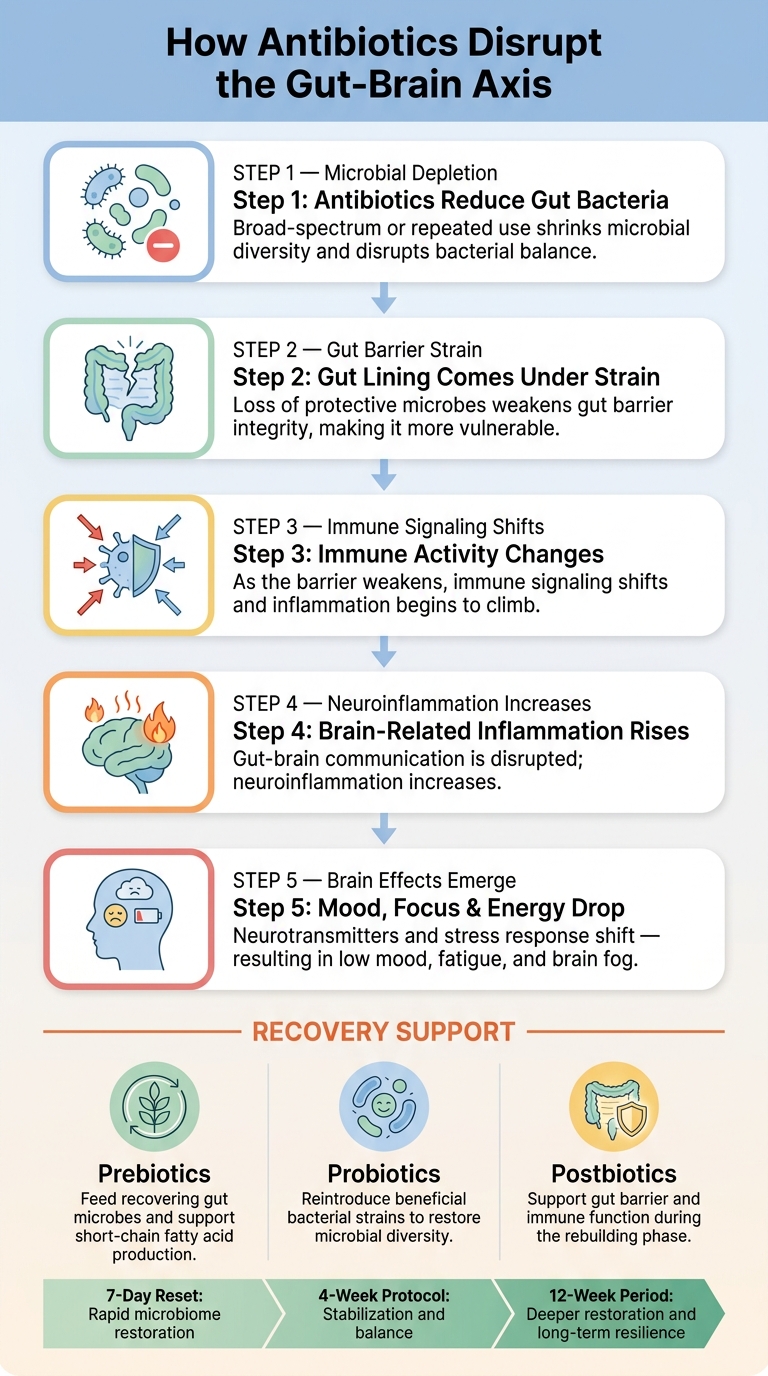
How Antibiotics Disrupt the Gut-Brain Axis (5-Step Chain)
The path from antibiotics to brain-related effects tends to follow five connected steps. It often starts with microbial loss in the gut, then moves outward - affecting mood, energy, and focus[1].
Steps 1–2: microbial depletion leads to gut barrier strain
When antibiotics reduce gut microbes, the gut barrier can come under strain. In some cases, that loss weakens barrier integrity and makes the gut more vulnerable[1].
Steps 3–4: immune signaling shifts and neuroinflammation increase
As the barrier weakens, immune signaling can change and inflammation can climb. That may increase neuroinflammation and disrupt gut-brain communication[1].
Step 5: mood, focus, and energy can drop
Once those changes ripple through the system, neurotransmitters and the stress response can shift too. The result can be lower mood, fatigue, and foggy thinking[1]. That is where prebiotics, probiotics, and postbiotics come in.
Prebiotics feed microbes as they recover. Probiotics help add back helpful strains. Postbiotics support recovery while the microbiome rebuilds. Rebiirth RE-1 brings all three together in a 3-in-1 microbiome reset.
sbb-itb-1bbfe7f
How to support a microbiome reset after antibiotics
After antibiotics cut down microbes and put stress on the gut barrier, recovery has to work in the other direction. The job is to rebuild microbial diversity, support gut barrier integrity, and help bring the immune system back into balance. Each part plays a different role in that reset.
Where prebiotics fit: feeding beneficial microbes and short-chain fatty acid production
Prebiotics are non-digestible fibers that feed the helpful bacteria already living in your gut. GOS and inulin help nourish those microbes and support short-chain fatty acid production, which helps with microbiome recovery.
Where probiotics and Human Origin Strains fit: reintroducing beneficial organisms
After antibiotic-related dysbiosis, the goal is to add back strains that work well in the human gut. Human Origin Strains (HOSt™) mirror bacteria naturally found in the human gut, which supports effective restoration of microbial diversity[1].
As those microbes begin to return, postbiotics can help support the setting they’re rebuilding.
Where postbiotics fit: direct support while the microbiome rebuilds
Postbiotics can give direct support to the gut barrier and immune function during this rebuilding phase. That makes them especially helpful in the early recovery window, when live bacteria are still getting re-established.
Put simply, these three layers handle different parts of recovery:
- Prebiotics feed recovering microbes
- Probiotics, including HOSt™ strains, help restore helpful bacteria
- Postbiotics support barrier and immune function during rebuilding
Rebiirth RE-1 brings these together in a 3-in-1 microbiome reset with prebiotics, HOSt™ probiotics, and postbiotics.
Putting recovery into practice: key takeaways
Start gut support soon after antibiotics. That helps limit microbial loss and eases stress on the gut barrier. A fiber-rich diet can also help the microbiome rebuild.
Recovery doesn’t happen all at once. It tends to move in phases, so the reset should match the stage of repair.
| Reset Timeframe | Primary Recovery Goal | Key Mechanisms |
|---|---|---|
| 7-Day Reset | Rapid microbiome restoration | Reintroduce beneficial strains and fiber quickly. [1] |
| 4-Week Protocol | Stabilization and stable balance | Use prebiotics, probiotics, and postbiotics to stabilize balance and support the gut barrier. [1] |
| 12-Week Period | Deeper restoration and long-term resilience | Support long-term gut-brain, mood, and immune recovery. [1] |
The best reset plan brings those three layers together instead of treating them as separate steps.
Rebiirth RE-1 combines prebiotics, probiotics, and postbiotics in a 7-day, 4-week, or 12-week microbiome reset.
Key points to leave the reader with
Antibiotics remove harmful bacteria, but they also wipe out helpful microbes. That’s why recovery needs to support both the microbiome and the gut environment.
Prebiotics, probiotics, postbiotics, and a fiber-rich diet can help the gut rebuild.
FAQs
Can antibiotics affect mood and focus?
Yes. Antibiotics can affect mood and focus because the gut and brain are in constant contact through the gut-brain axis.
When antibiotics reduce helpful microbes, they can throw off signaling tied to serotonin, dopamine, and GABA. That shift doesn’t just stay in the gut. It can ripple outward and affect how you feel and think.
The problem can also build from there. Changes in the gut may increase inflammation and put stress on the gut barrier. If bacterial toxins pass into the bloodstream and reach the brain, they may play a part in neuroinflammation, brain fog, trouble concentrating, anxiety, and depression.
How long does the gut take to recover after antibiotics?
Full gut microbiome recovery after antibiotics may take up to three months of steady support. Some people notice early changes, like less bloating, within the first week. But longer-term balance usually takes patience and consistency.
A 3-in-1 synbiotic like Rebiirth RE-1 may help support that process. It combines prebiotics, probiotics, and postbiotics to help replenish native colonies and support the gut barrier.
When should I start prebiotics, probiotics, and postbiotics?
Start them right after you finish antibiotics. Timing matters because antibiotics can wipe out helpful bacteria along with harmful ones, which can increase the risk of dysbiosis.
A 3-in-1 synbiotic like Rebirth RE-1 can help by giving you prebiotics, probiotics, and postbiotics in one formula. Some people notice early relief within 1 week, but full microbiome recovery can take up to 3 months.