

Antibiotics can help treat infections, but they can also disrupt the gut in ways that matter for IBD. In the research covered here, antibiotic exposure is linked with about 52% to 66% higher odds of IBD, flare risk is highest during treatment and in the first 1 to 14 days after, and microbiome recovery can take weeks to months, often requiring a checklist for restoring gut health.
If I were to boil the article down, I’d say this:
- Antibiotics can lower gut diversity and reduce short-chain fatty acids, which may weaken the gut lining.
- Broad-spectrum drugs and repeat courses seem to cause more disruption.
- People with IBD may have a harder time bouncing back because baseline diversity is often lower.
- Probiotics, prebiotics, synbiotics, postbiotics, and FMT are all being studied after antibiotics.
- The clearest human data are in ulcerative colitis, especially for synbiotics.
- These approaches are add-ons, not replacements for standard IBD care.
Here’s the short version of what the evidence points to:
| Topic | What I’d take from the research |
|---|---|
| IBD risk | Antibiotic exposure is linked with higher IBD odds, often around OR 1.66 in pooled data |
| Flare timing | Risk looks highest during antibiotics and shortly after the course ends |
| Gut effects | Lower SCFAs, lower diversity, and more room for bacteria tied to inflammation |
| Recovery | Not everyone returns to baseline, and recovery may be slow or partial |
| Best-studied reset option | Synbiotics in UC have the most steady clinical signal |
| Limits | Many trials are small, short, and use different products and outcome measures |
I read this article as a practical evidence review: antibiotics may push the gut toward dysbiosis, and post-antibiotic microbiome support may help some patients, but the data are still uneven across IBD types and products.
How Antibiotics Affect IBD Risk, Flares, and Gut Ecology
What Studies Report About IBD Risk and Flare Timing
Research points in the same direction: antibiotic exposure is linked with a higher chance of IBD. A meta-analysis of 23 studies found a pooled odds ratio of 1.66 for IBD in people exposed to antibiotics compared with those who were not.[5][6][7] In children, the signal can be even stronger. A Finnish study found that 7 to 10 antibiotic purchases in childhood were tied to an odds ratio of 3.48 for pediatric Crohn's disease compared with no antibiotic use.[16]
For people who already have IBD, timing matters a lot. Flare risk is highest during antibiotic treatment and in the 1 to 14 days after a course ends, then moves back toward baseline by about 6 weeks.[1] Broad-spectrum antibiotics show the highest flare risk, with an adjusted OR of about 3.10.[2] Recent antibiotic exposure also appears more strongly linked with Crohn's disease (OR about 2.75) than with ulcerative colitis (OR about 2.00).[3]
That changes the conversation a bit. It’s not just about whether antibiotics add risk. It’s also about what happens after the course is over, and whether the gut microbiome can recover.
What Antibiotic-Induced Dysbiosis Looks Like
Antibiotics don’t just hit the target bug. They can shake up the gut microbiome in a big way. Broad antibiotic classes can deplete Bifidobacterium and Lactobacillus and lower production of short-chain fatty acids, or SCFAs.[10][12]
SCFAs do a lot of heavy lifting in the colon. They fuel colonocytes, help regulate immune responses, and support tight-junction proteins that help seal the gut lining.[20][21][22] When SCFA levels drop, the gut barrier gets weaker. That opens the door for opportunistic bacteria such as Escherichia coli to expand after antibiotics.[12][14]
Put those shifts together, and the result is a gut that’s more inflamed and easier to tip into a flare. In people with IBD, that threshold is already lower, so the effect can hit harder.[10][11][12] This is why people are paying close attention to microbiome reset methods in IBD.
Why Microbiome Recovery Varies by Person
Recovery after antibiotics is not the same for everyone, and it’s often incomplete. In one study of 66 healthy adults, the fecal microbiome showed lasting shifts for months after treatment, including depletion of butyrate-producing species and enrichment of antibiotic resistance genes.[18]
A few factors seem to shape recovery:
- Broad-spectrum antibiotics tend to disrupt the microbiome more deeply than narrow-spectrum drugs.[4][9][10][13][14][17][19]
- Repeated courses can compound the damage.[4][9][10][13][14][17][19]
- Adults age 40 and older show less resilience after treatment.[4][9][10][13][14][17][19]
- Low-fiber diets make microbiota collapse worse, while fiber-rich diets are linked with faster recovery.[4][9][10][13][14][17][19]
For people with IBD, the starting point is often tougher. Active inflammation, prior surgeries, and immunosuppressive therapies can reduce baseline microbial diversity, which leaves the microbiome more exposed to antibiotic disruption and slower to settle afterward.[11][15] Some microbiomes do not fully rebound after antibiotics, especially in IBD. That gap is exactly why post-antibiotic microbiome restoration methods are now under study, with a close eye on whether they can speed recovery or lower flare risk.
sbb-itb-1bbfe7f
How Long Does the Microbiome Recover After Antibiotics? | Dr. Will Bulsiewicz | The Proof Clips #271
What Microbiome Restoration Studies Show After Antibiotics
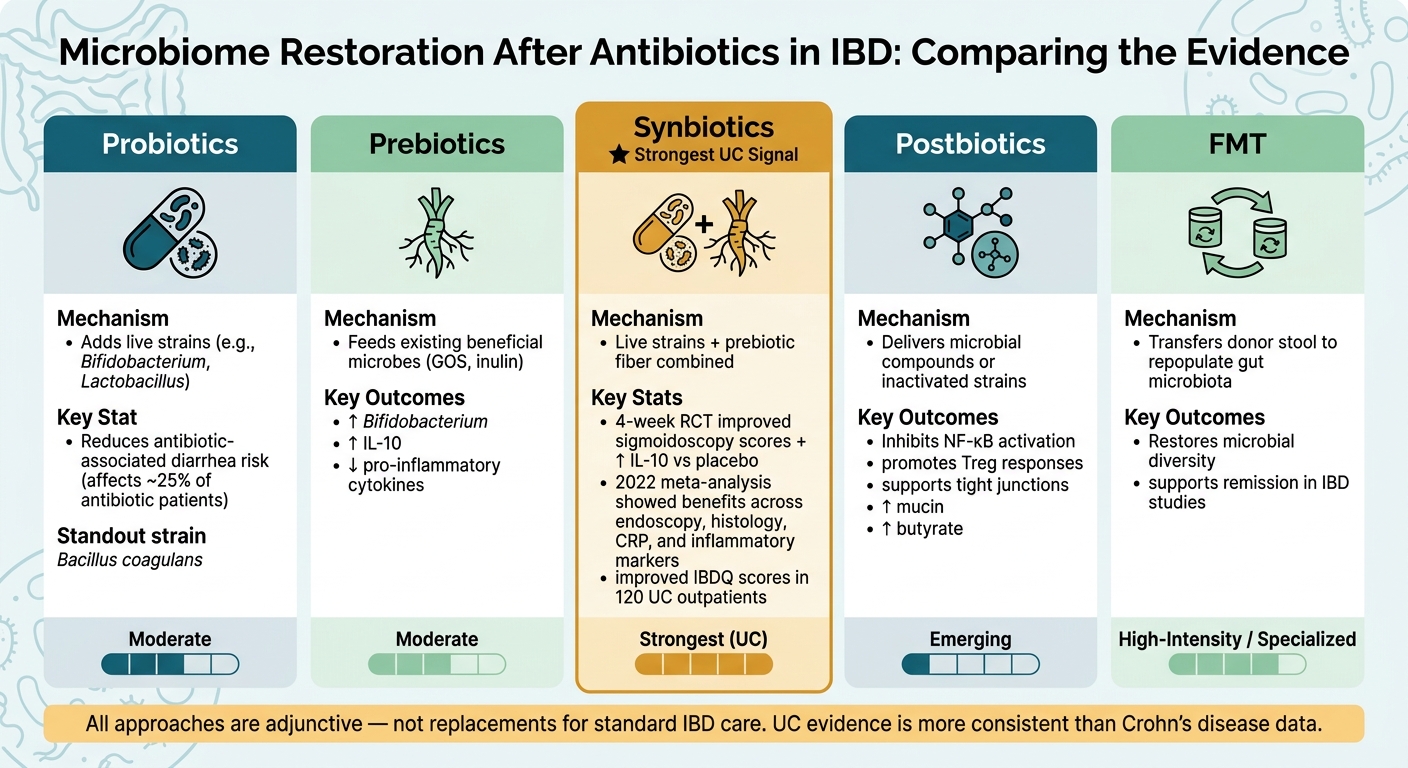
Microbiome Restoration Options After Antibiotics in IBD: Evidence Comparison
After antibiotics, researchers look at whether probiotics, prebiotics, synbiotics, postbiotics, and FMT can help the gut recover sooner and lower flare risk. The main issue is simple: which options help the microbiome bounce back fastest after antibiotic exposure?
Probiotics, Prebiotics, Synbiotics, and Postbiotics
Probiotics can cut the risk of antibiotic-associated diarrhea (AAD), which affects about 25% of patients who receive antibiotics. Among the strains studied, Bacillus coagulans has been singled out as especially effective for lowering AAD incidence.[23]
Prebiotics such as GOS and inulin feed the helpful microbes already in the gut. GOS has been linked with more Bifidobacterium, higher IL-10, and lower inflammatory cytokines.
Synbiotics pair live strains with prebiotic fiber. The idea is to help good bacteria not just arrive, but also stick around and grow. Postbiotics, by contrast, deliver microbial compounds or inactivated strains. These can affect cytokines and inflammation more directly, with the immune effects tied to barrier support and inflammation control.
When basic supplement options fall short, studies shift to stronger reset methods.
FMT and Other Higher-Intensity Reset Methods
FMT is a higher-intensity reset method used to restore microbial diversity after major disruption. It works by transferring donor stool to repopulate the gut microbiota.
Restoration Methods Compared: Outcomes at a Glance
| Intervention | Mechanism | Primary Outcomes in IBD Research |
|---|---|---|
| Probiotics | Adds live strains (e.g., Bifidobacterium, Lactobacillus) | Reduces AAD; may lower inflammation |
| Prebiotics | Feeds existing beneficial microbes (GOS, inulin) | Increases bifidobacteria; raises IL-10; reduces pro-inflammatory cytokines |
| Synbiotics | Combines live strains + prebiotic fiber | Supports eubiosis; may improve post-antibiotic recovery |
| Postbiotics | Provides microbial compounds or inactivated strains | Modulates immune signaling; regulates inflammation |
| FMT | Transfers donor stool to repopulate gut microbiota | Restores diversity; supports remission in IBD studies |
Taken together, these results lean toward combined approaches, especially synbiotics and 3-in-1 eubiotic setups designed to support eubiosis and barrier integrity.
Synbiotics and Eubiotic Reset Approaches in IBD Research
Where Synbiotic Evidence Looks Most Promising
Among post-antibiotic reset options, synbiotics have the clearest human data in UC. The strongest findings in IBD are in ulcerative colitis, especially mild-to-moderate disease. That matters after antibiotic disruption, when the microbiome may need more guided support as it rebuilds, especially if dysbiosis from processed foods is also a factor.
A 4-week pilot RCT of B. longum plus inulin–oligofructose improved sigmoidoscopy scores, lowered mucosal pro-inflammatory cytokines, and increased IL-10 versus placebo.[24][26]
In 120 UC outpatients, synbiotic therapy was the only arm to improve IBDQ scores and lower CRP over 4 weeks.[27][30]
A 2022 meta-analysis found synbiotic benefits across endoscopy, histology, CRP, and inflammatory markers.[25] In Crohn's disease, the picture is much less clear. Results have been less consistent, in part because anatomy and disease behavior can vary so much from one patient to another.[28][29]
Immune Support and Barrier Repair Mechanisms
These clinical gains line up with immune and barrier effects seen in mucosal studies. In active UC, synbiotics have been linked to lower mucosal TNF-α and IL-1β and higher IL-10.[24][26][31] Postbiotics add another layer by inhibiting NF-κB activation and promoting regulatory T-cell (Treg) responses.[31]
They may also help support tight junctions, increase mucin, and promote SCFA-driven epithelial repair, especially butyrate.[24][25][31][32] Put simply, the goal isn't just to change which microbes are present. It's also to help the gut lining recover and calm the inflammatory loop.
Rebiirth RE-1™ as a 3-in-1 Eubiotic Synbiotic Example
Taken together, the data lean toward multi-component formulas rather than single-ingredient options in UC. Across studies, the steadiest signal comes from formulas that pair live strains with fermentable fiber and give the microbiome enough time to shift. Three features show up again and again in UC research:
- Multi-component formulas
- Fermentable prebiotic fibers
- Multi-week protocols
Rebiirth RE-1™ is a 3-in-1 eubiotic synbiotic with prebiotics, probiotics, and postbiotics. It comes in sachets with 500 billion CFU per serving and uses a Lyosublime™ delivery system. It's offered in 7-day, 4-week, and 12-week reset formats.
Patient Context, Research Limits, and Key Takeaways
Early-Life and Lifestyle Factors That May Shape Resilience
How someone responds after antibiotics depends on host context, not just on the product they take.
Early-life exposures may shape how well the microbiome bounces back after antibiotic use. For example, C-section birth may change early microbiome development. But large studies have not shown a steady independent link with IBD risk.[33][35][36][40][42] Antibiotic exposure around birth and during infancy, on the other hand, has been linked with higher later IBD risk, especially Crohn's disease.[34][37][38][39][41]
Some of the numbers are hard to ignore. In a Swedish cohort, antibiotic therapy during the third trimester was linked with higher infantile Crohn's risk, with an OR of 2.48.[37] In another study, four or more antibiotic prescriptions in the first 6 months of life were linked with childhood-onset IBD, with an OR of 6.34 (95% CI 1.68–24.02).[43][8]
That said, these are associations, not proof of direct cause. Recovery after antibiotics also varies a lot from person to person. Baseline microbial diversity, prior antibiotic history, diet, age, immune status, comorbidities, and medication use can all shape resilience. Put simply, two people can take the same drug and end up with very different outcomes. That's why study design and patient context matter so much when reading these results.
Why Study Design Limits Matter
The research comes with some plain limits. Most trials are small, last only a few weeks, and use different strains, doses, and outcome measures. That makes head-to-head comparison tough. Many studies also have a hard time controlling for diet, medications, and disease severity. And stool findings do not always match what's happening at the mucosal level.
UC data are more consistent than Crohn's disease data, partly because UC is easier to standardize in trials. That doesn't mean microbiome-based therapies fail in Crohn's disease. It means the evidence is still too patchy to support firm claims.
What Readers Should Take From the Evidence
Taken together, the evidence points to a cautious, practical read.
- Antibiotics can promote dysbiosis linked to IBD risk and flares.
- Probiotics, prebiotics, synbiotics, postbiotics, and FMT show the clearest signals in ulcerative colitis.
- The evidence is uneven across IBD subtypes, products, and trial designs.
These approaches are adjunctive, not standalone treatments. The next step is likely better patient stratification, standardized protocols, and trials that track direct clinical outcomes instead of leaning too heavily on surrogate markers alone.
FAQs
Should I avoid antibiotics if I have IBD?
That’s a medical call to make with your healthcare provider. Antibiotics are often needed for infections, but they can throw off the gut microbiome and may lead to dysbiosis, bloating, and diarrhea.
If you have IBD, a gentler approach may help lower the chance of a flare-up. If your provider prescribes antibiotics, a synbiotic supplement after the course may help bring the gut back into balance and support the gut barrier.
How long can the gut microbiome take to recover after antibiotics?
Some people may notice gut health changes within the first week of starting a synbiotic regimen after antibiotics. But full microbiome recovery can take up to three months with steady use.
That time frame reflects what the gut is trying to do: rebuild native bacterial colonies and help restore the gut barrier. Rebiirth RE-1™ is designed to support that process with prebiotics, probiotics, and postbiotics.
Which microbiome reset option has the strongest evidence in ulcerative colitis?
Clinical evidence points to synbiotics as the option with the steadiest support for managing ulcerative colitis. They pair prebiotics with probiotics, and studies suggest this combo works better than either one on its own. Part of the reason is simple: synbiotics may help strengthen the gut barrier while also shaping immune responses.
Research has also linked synbiotic therapy with lower inflammatory markers, better endoscopic scores, and gains in disease activity and quality of life.