

If you’re recovering from SIBO, the best exercise plan is usually simple: start with gentle mind-body movement, move into moderate aerobic exercise, and add submaximal strength training later. The big goal is to help your gut lining, lower inflammation, and support microbiome recovery without pushing so hard that symptoms flare.
Here’s the short version:
- Early recovery: gentle walking, yoga, tai chi, and slow breathing
- Mid recovery: 30–60 minutes of moderate aerobic work at about 50–70% VO₂ max
- Late recovery: resistance training with controlled breathing and no max-effort lifts
- Main risk: hard sessions above about 70% VO₂ max or workouts longer than 90 minutes can stress the gut
- Simple check: if a workout leaves you tired for hours or brings back bloating, pain, or bowel changes, it’s too much
The article compares aerobic exercise, resistance training, and mind-body movement across three main recovery needs:
- Microbiome balance
- Gut barrier repair
- Inflammation control
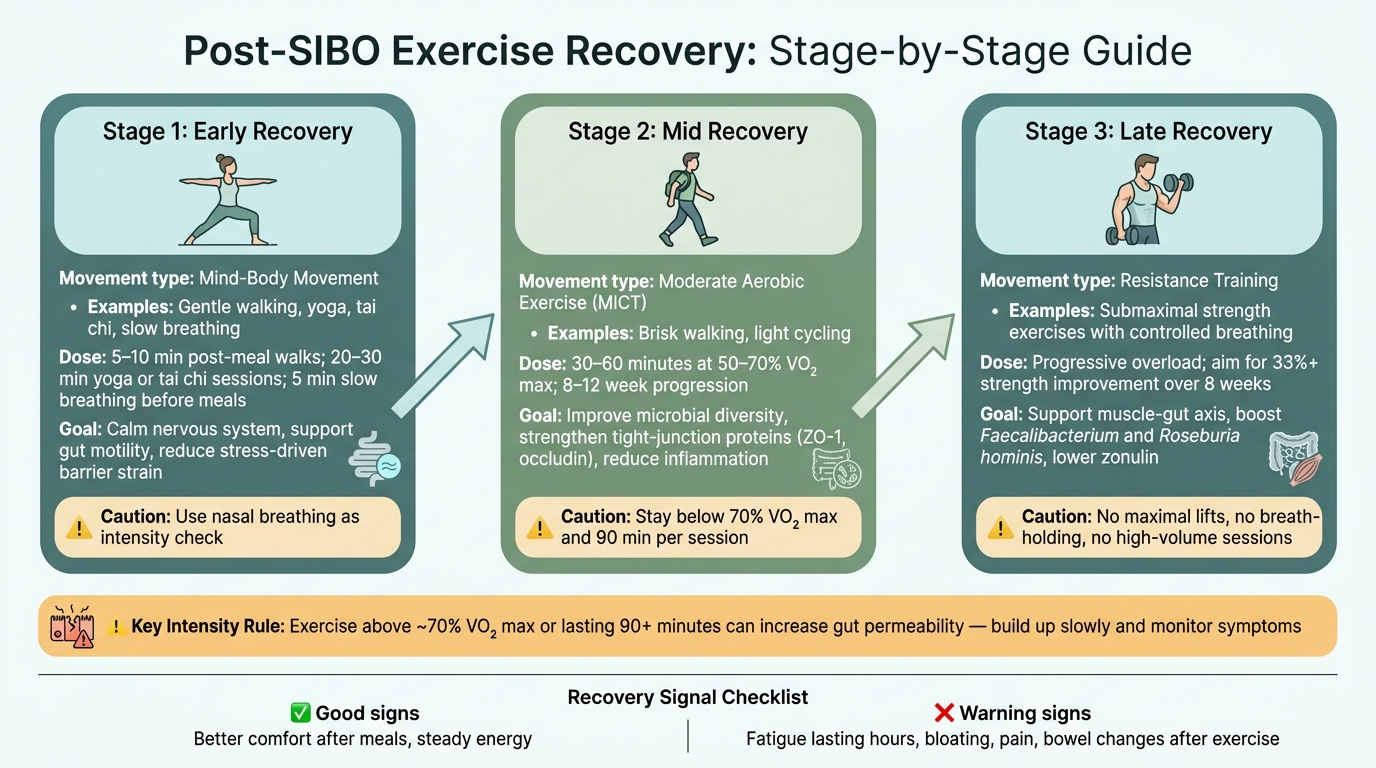
Post-SIBO Exercise Recovery: Stage-by-Stage Guide
How Does Exercise Impact Your Gut Health?
Quick Comparison
| Movement type | Best use | Main upside | Main caution |
|---|---|---|---|
| Mind-body movement | Early recovery | Supports relaxation, motility, and an easier return to activity | Less direct effect on microbiome diversity |
| Moderate aerobic exercise | Mid recovery | Helps gut barrier proteins, microbiome diversity, and inflammation control | Too much intensity can irritate the gut |
| Resistance training | Late recovery | Supports the muscle-gut link and may help butyrate-linked microbes over time | Heavy lifting and breath-holding can strain the gut |
In other words: the right exercise can help after SIBO, but the wrong dose can slow you down. I’d treat intensity as the main thing to watch and build up in stages.
1. Aerobic Exercise
Aerobic exercise is the clearest match for post-SIBO recovery because moderate effort can help repair the gut barrier and calm inflammation. But the big thing here is intensity. A moderate dose tends to help. Push too hard, and you can wipe out that upside.
In plain terms, moderate-intensity continuous training (MICT) is your best bet. Think brisk walking or light cycling for 30–60 minutes at 50–70% VO₂ max. Over 8–12 weeks, this type of exercise can improve microbial diversity and support tight-junction proteins like ZO-1 and occludin [2]. It also helps bring down inflammatory load, which gives barrier healing and microbial recovery more room to happen.
There’s another reason this matters. Just 30 minutes of activity can increase bile acid output into the small intestine by up to 10 times compared with being sedentary [3]. Since bile has antimicrobial effects, that can be useful during SIBO recovery.
The catch? More is not always better. HIIT or long, hard aerobic sessions can turn into a problem once you get above roughly 70% VO₂ max or go past 90 minutes [2][3]. At that point, blood flow gets pulled away from the gastrointestinal tract, and the mucosal lining can thin [3]. That’s the opposite of what you want when your gut is still trying to settle down.
| Exercise Type | Intensity | Gut Barrier Effect | Best Recovery Stage |
|---|---|---|---|
| Walking / light cycling | Low | Supports motility and bile flow [3] | Early recovery |
| MICT (brisk walking / cycling) | 50–70% VO₂ max | Strengthens tight junctions; increases diversity [2] | Mid recovery |
| HIIT / endurance running | >70–80% VO₂ max | Risks leaky gut and dysbiosis [2] | Late recovery, only if fully healed |
A simple rule of thumb: if exercise leaves you wiped out for hours, or sets off bloating, pain, or bowel changes, it’s too intense for where you are right now [2][3].
Resistance training plays a different role in recovery. It works more through muscle signaling and metabolic support than direct aerobic stress.
2. Resistance Training
Aerobic exercise helps the gut mostly through blood flow. Resistance training works a bit differently. It leans more on muscle signaling.
This is often called the muscle-gut axis - a two-way link where muscle health and microbiome health support each other. More lean mass and better glucose control may help support microbial diversity [4].
One study looked at 150 sedentary adults in an 8-week supervised program. The result was pretty clear: only the people who improved strength by at least 33% had higher levels of Faecalibacterium and Roseburia hominis by week 8. People with small strength gains saw little microbiome change [4]. Put simply, progressive overload matters.
Resistance training may also help with barrier repair. It may lower zonulin, support mucin, and reduce pro-inflammatory signaling [1][5].
There is one big watchout: abdominal pressure. Higher-intensity lifting can put mechanical stress on the gut lining. So if you're still dealing with GI sensitivity after SIBO, keep the work submaximal [2].
A safer approach usually looks like this:
- Skip maximal lifts
- Avoid breath-holding
- Pass on high-volume sessions
- Use submaximal loads with controlled breathing
This tends to fit best in mid-to-late recovery, once bloating and pain are stable.
sbb-itb-1bbfe7f
3. Mind-Body Movement
When exercise needs to stay gentle, mind-body movement helps recovery keep going without adding more physical strain. If aerobic work is more about blood flow, and resistance training leans on muscle-related signals, mind-body movement works through the nervous system and the gut-brain axis [2].
After SIBO, that gut-brain link can still be off. So, calming the nervous system may help support motility and digestion.
Yoga, tai chi, and slow, breath-led walking can shift the body toward a parasympathetic, rest-and-digest state. That shift supports motility and may lower stress-driven barrier strain [7]. As stress signals come down, mind-body movement may also help with barrier repair and lower inflammatory load.
The dose here is pretty simple:
- A 5–10 minute walk after meals can support motility
- A 20–30 minute gentle yoga or tai chi session fits well when you have more time
- Nasal breathing works as an easy intensity check. If you need to switch to mouth breathing, you're probably pushing too hard for early recovery [7]
- 5 minutes of slow breathing before meals may help prepare digestion [7]
There’s also some support for this idea from a 2024 randomized IBS study. It found that yoga plus probiotics reduced Klebsiella and improved quality of life [6]. It wasn’t SIBO-specific, but it does point to something useful: gentle movement and microbiome support may work well together.
Use recovery as your guide. Better comfort after meals and steadier energy usually mean the dose is about right. Prolonged fatigue is a sign to pull back.
Tradeoffs, Cautions, and Use Cases by Recovery Stage
No single type of exercise does it all after SIBO recovery. The easiest way to think about it is simple: match the type of movement to the stage of recovery.
| Exercise Type | Stage Summary |
|---|---|
| Mind-Body (Yoga, Tai Chi, Walking) | Best for early recovery; lowers stress and supports motility; less direct impact on microbiome diversity. |
| Moderate Aerobic (MICT, 30–60 min at 50–70% of VO2 max) | Best for mid recovery rebuilding; supports diversity, barrier repair, and lower inflammation; keep sessions moderate. |
| Resistance Training | Best for late recovery and maintenance; supports the muscle-gut axis and beneficial microbes; keep loads submaximal. |
The main caution at every stage is intensity. Hard sessions can temporarily increase gut permeability when the gut barrier is still fragile. That’s why more isn’t always better here.
A good gut check is your energy after the workout. If you feel wiped out for hours, the session was too much. Dial it back. Hydration matters too, since dehydration can make permeability worse.
As movement starts to feel easier and symptoms calm down, microbiome support can be added to the mix. When energy and tolerance improve, Rebirth RE-1 can fit alongside exercise to support microbiome balance.
Conclusion
Getting over SIBO doesn’t happen in one gear. Different kinds of exercise help in different ways, and timing matters.
The simplest way to think about it is by recovery stage. In early recovery, mind-body movement tends to fit best. In the middle phase, moderate aerobic work usually makes more sense. Later on, resistance training can have a place.
The main thing to watch is intensity. High-intensity exercise can temporarily increase permeability, so it’s smart to build up slowly and pay attention to how you feel afterward. Exercise should help you feel better, not wiped out.
As recovery starts to steady, gut support can be added. When symptoms settle, Rebirth RE-1 can be layered in to support microbiome balance.
FAQs
How do I know which recovery stage I’m in?
Your recovery stage comes down to one thing: how steady your symptoms and bowel habits are after treatment.
If you felt 70% to 90% better during treatment and that progress sticks, with normal bowel habits, you're probably in maintenance.
If the change was only partial or didn't last, you may need a stricter relapse-prevention phase.
It also helps to keep a simple log of:
- what you ate
- portion size
- timing
- symptoms like bloating
- energy
That kind of notes-and-patterns approach can make things much clearer over time.
Can exercise make my SIBO symptoms come back?
Yes. Excessive or high-intensity exercise may play a part in SIBO symptoms coming back, even though moderate activity usually supports gut health and microbial balance.
Strenuous or long-duration exercise can increase gut dysbiosis, intestinal permeability, and inflammation. If you're already dealing with gut issues, moderate movement is often a better fit until gut health is restored. Rebiirth RE-1 can support this process through a rapid microbiome reset.
When should I add strength training after SIBO?
Add strength training slowly during SIBO recovery. Put the focus on movement, not intensity. Start at a low-to-moderate level, and aim to finish feeling energized rather than drained.
Skip HIIT and hard endurance workouts that last more than 10 minutes, since they can add more stress to the gut. A simple rule of thumb: let how you feel after exercise set the pace.