

If I have IBD, the short answer is this: these products do different jobs, and the best fit depends on UC vs. Crohn’s vs. pouchitis, flare vs. remission, and how well I tolerate fiber or live microbes.
Here’s the plain-English version:
- Prebiotics feed gut bacteria already there.
- Probiotics add live microbes.
- Postbiotics use nonliving microbial parts or byproducts, such as butyrate.
- Synbiotics combine prebiotics + probiotics.
- 3-in-1 synbiotics combine all three in one formula.
The article’s main point is simple: there is no one best option for every person with IBD. In ulcerative colitis, probiotics and synbiotics have the most direct data. In Crohn’s disease, results are less clear. In distal UC, postbiotics like butyrate may make more sense when delivery reaches the colon, such as by enema or microencapsulated oral forms. And with prebiotics, fiber tolerance matters because some people get bloating, gas, or loose stools.
A few numbers stand out:
- In one distal UC trial, 14 of 20 people improved with SCFA enemas vs. 5 of 20 on placebo.
- In another butyrate enema trial, results were less clear: 37% improved on butyrate vs. 47% on placebo.
- Oral microencapsulated sodium butyrate showed 51% clinical improvement and 31% remission in mild-to-moderate UC as add-on use.
- A 2025 umbrella review reported a 0.55 risk ratio for UC relapse with probiotics vs. placebo.
- A 2021 review of 21 trials found synbiotics outperformed single components in UC.
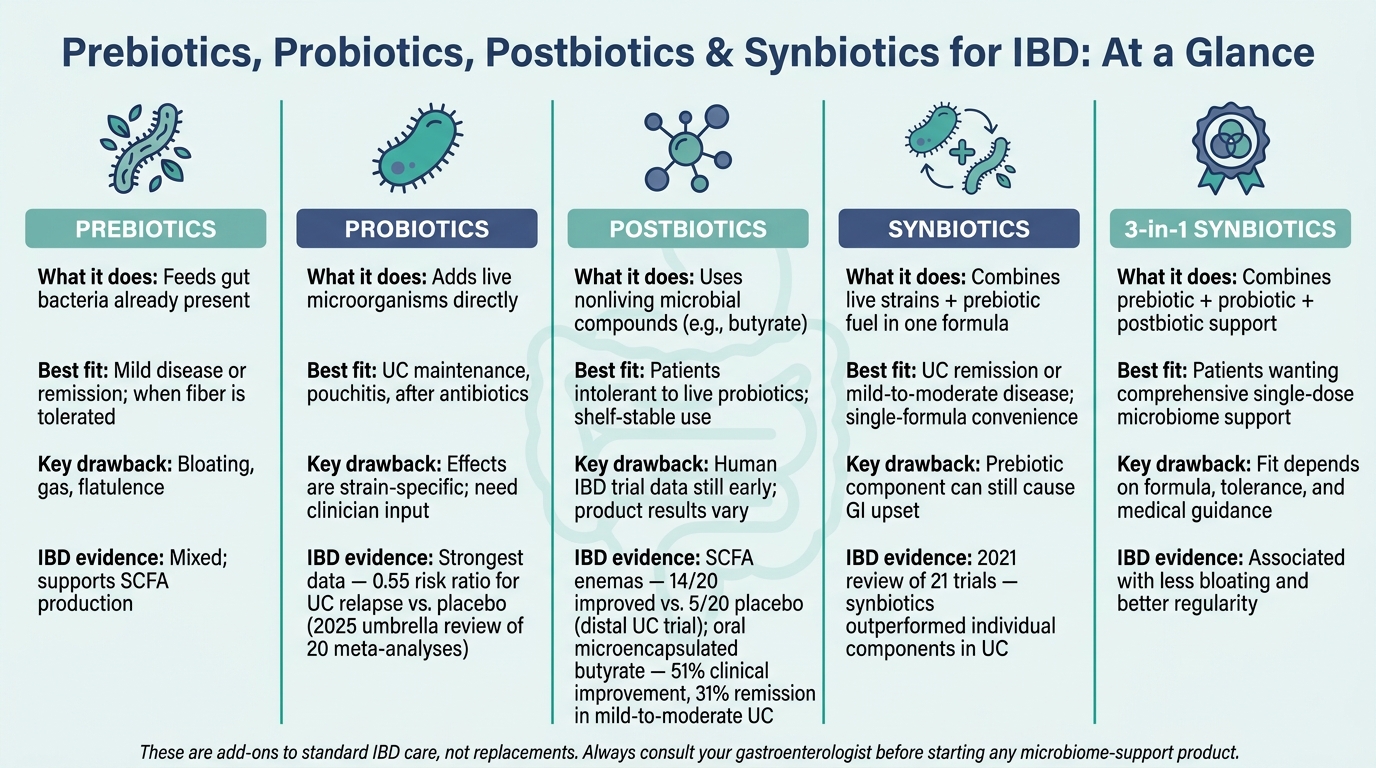
Prebiotics vs Probiotics vs Postbiotics vs Synbiotics for IBD: Side-by-Side Comparison
Prebiotics, Probiotics, and Postbiotics Explained | Dr. Will Bulsiewicz
sbb-itb-1bbfe7f
Quick Comparison
| Option | What it does | Where it may fit best | Main drawback |
|---|---|---|---|
| Prebiotics | Feed gut microbes | Mild disease or remission when fiber is tolerated | Can cause bloating, gas, flatulence |
| Probiotics | Add live strains | UC maintenance, some pouchitis settings, after antibiotics | Effects are strain-specific; live microbes need clinician input |
| Postbiotics | Use nonliving microbial compounds | People who don’t do well with live probiotics; shelf-stable use | Human IBD data are still limited and product results vary |
| Synbiotics | Combine live strains + their fuel | UC, mild-to-moderate disease, single-formula use | The prebiotic part can still upset the gut |
| 3-in-1 synbiotics | Combine prebiotic + probiotic + postbiotic support | People who want all-in-one microbiome support | Fit still depends on formula, tolerance, and medical guidance |
My takeaway: I’d treat these as add-ons to standard IBD care, not replacements. The label alone doesn’t tell me much. I’d look at the strain, formula, dose, delivery method, and my own tolerance before using any of them.
1. Prebiotics
Prebiotics are special fibers that feed the good bacteria already living in your gut. That matters in IBD care because the goal isn’t to add live bacteria here. It’s to help shape the microbiome and support the gut barrier.
So, think of prebiotics as a microbiome-support tool, not a source of live microbes.
Clinical formulas often use galactooligosaccharides (GOS) and inulin, and some protocols use 4.5 g per serving [1].
Since prebiotics work by feeding microbes that are already there, they’re often used as one part of a broader microbiome-support plan. You can use a microbiome diet planner to help organize these choices. Next, probiotics add live microbes directly.
2. Probiotics
Prebiotics feed the microbes already living in the gut. Probiotics do something different: they add live microorganisms directly.
In IBD, probiotics are often used to help support microbiome balance and the gut barrier. But the main issue isn’t whether probiotics help in some broad sense. It’s which strain and which format make sense for IBD support.
That matters because probiotic effects are strain-specific. In plain English, one strain can act very differently from another. Some may help support the gut barrier. Some may affect immune signaling in ways that matter in IBD care. But those effects don’t automatically apply to every probiotic on the shelf.
Strain choice can also shape day-to-day fit. Some strains are native to the human gut, which may make them a better match for the gut environment and easier to use over time for people dealing with chronic digestive issues.
If you have IBD, probiotics should be used with clinician guidance, especially during active symptoms or while taking IBD medications.
Postbiotics take this idea one step further by using microbial byproducts instead of live bacteria.
3. Postbiotics
Postbiotics are made from inactivated microbes or parts of them - nonliving cells, cell fragments, and related metabolites. The International Scientific Association of Probiotics and Prebiotics (ISAPP) defines postbiotics as:
"a preparation of inanimate microorganisms and/or their components that confers a health benefit on the host." [4]
In IBD, the postbiotics studied most often are short-chain fatty acids (SCFAs), especially butyrate. Butyrate is the main fuel source for colon cells, and low butyrate levels in the gut have been linked with distal ulcerative colitis. It may help support the gut barrier and calm inflammatory signaling. That’s why how it’s delivered - and where the disease is located - matters so much in IBD use.
The clinical picture is mixed, and the results change based on IBD type and delivery method. In mild-to-moderate distal ulcerative colitis, a randomized, double-blind trial of SCFA enemas found improvement in 14 of 20 treated patients, compared with 5 of 20 on placebo, along with greater symptom improvement [2]. But another randomized trial of butyrate enemas alone did not show a clear edge over placebo: 37% of the butyrate group improved versus 47% of the placebo group [3]. Oral microencapsulated sodium butyrate has shown add-on results in mild-to-moderate UC, with 51% of patients reaching clinical improvement and 31% reaching clinical remission [7]. In Crohn's disease, the evidence is still early and mostly focused on microbiota modulation rather than clear clinical endpoints [5][8][9].
One practical upside is tolerability. Since postbiotics do not contain live microbes, they come with a lower infection risk. That can matter for people using IBD immunosuppressive therapy [6][8]. The format also shapes where they work best. Rectal enemas send postbiotics straight to the distal colon, which makes them more relevant for proctitis or left-sided UC. Oral microencapsulated forms help limit breakdown in the upper digestive tract and may fit better into day-to-day use. The tradeoff? Enemas can cause local discomfort or urgency, and plenty of people find them hard to stick with because they’re inconvenient [2][3].
That same idea leads into synbiotics, which combine microbial support with the substrate that helps keep it going.
4. Synbiotics and 3-in-1 Eubiotic Synbiotics
Synbiotics bring prebiotics and probiotics together in one formula. Put simply, they roll two gut-support tools into a single approach.
3-in-1 synbiotics go a step further by combining all three tools in one formula to help support microbiome balance. This is particularly important when addressing gut dysbiosis caused by modern diets. That gives you single-dose microbiome support. Some evidence connects these formulas with less bloating and better regularity [1].
A 3-in-1 formula shows what this combined approach looks like in practice. Rebiirth RE-1™ is a 3-in-1 eubiotic synbiotic that uses Human Origin Strains (HOSt™) modeled on bacteria found in the human gut, along with prebiotics such as GOS and inulin. It comes in sachets, provides 500 billion CFU per serving, does not need refrigeration, and is sold in 7-day, 4-week, and 12-week protocols [1].
That setup can make day-to-day use easier. Sachets are simple to carry, and shelf-stable storage means there’s no need to keep the product cold.
People with IBD should talk with their gastroenterologist before starting a synbiotic or 3-in-1 protocol.
Pros and Cons of Each Category for IBD Support
No single category does everything well. That’s the big picture. Each one has clear upsides, but each also comes with trade-offs that can matter a lot in IBD.
The table below turns those mechanisms into practical pros, cons, and best-use cases.
| Category | Main Benefits | Limitations | Best-Fit Scenarios | Caution Points |
|---|---|---|---|---|
| Prebiotics | Feed helpful gut bacteria; may support SCFA production [12][13][14] | Evidence in IBD is mixed; higher doses can lead to bloating, gas, and flatulence, and some studies report more withdrawals [28][29][31] | Mild disease or remission; best when fiber is tolerated [29] | Use with care during active flares, in patients with strictures, or when fiber intolerance is already known [27][28][30] |
| Probiotics | Best-studied category; may help induce or maintain UC remission; a 2025 umbrella review of 20 meta-analyses found a 0.55 risk ratio for relapse vs. placebo [19] | Effects depend on the strain; live-cell viability and dose differ by product; results are less convincing in Crohn's disease [21][22][24] | UC maintenance; after antibiotics or for dysbiosis support; selected pouchitis cases; best when live-count stability matters [21][22][25] | Live organisms need clinician oversight in immunocompromised patients [11][12][16] |
| Postbiotics | Stable, nonliving support; may reduce inflammation and support the gut barrier without requiring live colonization [10][8][26] | IBD-specific human trial data are still early; effects seen with one product may not carry over to another [10][8][26] | Patients who can't tolerate live probiotics; best for shelf-stable use [10][8] | Benefits from one preparation may not apply to another because product differences are high [8][26] |
| Synbiotics | Live strains plus their fuel; a 2021 review of 21 trials found synbiotics outperformed individual components in UC [15][17] | GI side effects from the prebiotic part can still happen; results depend on the formula [23][15][18] | UC patients in remission or with mild-to-moderate disease; best for single-formula convenience; situations where strain survival is the goal [20][23][15] | Benefits depend on the formulation; fiber tolerance should be checked before starting [28][29] |
In practice, these differences matter most in UC, where the evidence is strongest. Probiotics and synbiotics have the most direct IBD outcome data, while prebiotics and postbiotics tend to work better as add-ons. And as with many gut-health products, the fine print matters: the exact strain, formula, dose, and tolerance profile can make all the difference.
Conclusion
Prebiotics feed gut microbes. Probiotics add live strains. Postbiotics provide nonliving microbial compounds.
That sounds simple on paper, but the practical difference goes further than labels. What matters is how each option fits the patient’s IBD type, tolerance, and treatment plan. Synbiotics bring those functions together to support microbiome balance and address dysbiosis and gut barrier function.
One product shows what that looks like in practice. Rebiirth RE-1™ is a 3-in-1 eubiotic synbiotic delivered in sachets and offered in 7-day, 4-week, and 12-week protocols [1].
People with IBD should use any microbiome-support product only under gastroenterologist guidance.
FAQs
Which option fits UC vs. Crohn’s best?
Research suggests probiotics may work better for ulcerative colitis (UC), including helping induce remission and keep it going. For Crohn’s disease, the evidence for probiotics on their own is less consistent.
For Crohn’s, synbiotics - which combine prebiotics and probiotics - have shown steadier results by helping support immune balance and gut barrier function. Rebiirth RE-1 offers a 3-in-1 eubiotic synbiotic with prebiotics, probiotics, and postbiotics.
Can I use these during an IBD flare?
If you have IBD, talk with your healthcare provider before starting any new supplement, especially during a flare.
If you decide to use a synbiotic like Rebirth RE-1, start with a small dose and increase it slowly while you watch how your body responds. If you notice gas, bloating, or worse symptoms, cut back and get medical advice.
How do I choose between live and nonliving options?
Start with the risk-benefit tradeoff. Probiotics are live microorganisms that may help by competing with harmful microbes and supporting gut motility and immune signaling. But they don't work the same way for everyone. Some people tolerate them poorly, and because they contain live organisms, they also come with theoretical concerns in certain conditions.
Postbiotics are nonliving microbial components. They’re usually more stable and may feel like a safer option because there’s no infection risk. A synbiotic sits in the middle by pairing prebiotic “food” with probiotics and, in some cases, postbiotics.