

Here’s the short answer: psychobiotics may help with stress, sleep, and mood in some cases, but the evidence is still narrow, strain-specific, and often indirect. A microbe that makes GABA in a lab does not automatically change GABA in people. And most human trials measure symptoms like stress, insomnia, or depression, not brain GABA itself.
If I boil this article down, these are the main points:
- Strain matters most. One Lactobacillus or Bifidobacterium strain does not stand in for the whole group.
- Human proof is limited. Many claims come from lab work, animal studies, or small trials.
- Mood data looks stronger than anxiety data. One meta-analysis found lower depression scores, but not clear anxiety relief.
- Some human trials showed changes in cortisol, ACTH, norepinephrine, stress, and insomnia over 8 weeks.
- Human-origin strains are not a shortcut. Origin may help gut fit, but it does not prove a clinical effect.
- Products that mix prebiotics, probiotics, and postbiotics should still be judged by strain-level human data.
Put simply: psychobiotics are worth watching, but broad brain-health claims go too far. I’d read the topic with one question in mind: what happened in humans, with which strain, and for which outcome?
What Psychobiotics Are and How They Affect the Gut-Brain Axis
What Counts as a Psychobiotic
These days, psychobiotic usually means a probiotic, prebiotic, or postbiotic that has evidence of affecting gut-brain signaling.
Each group matters in clinical settings for a different reason:
- Probiotics are live microorganisms. Some strains have been studied for stress, sleep, and GABA-related effects.
- Prebiotics are selectively used fibers, such as GOS and FOS. They can support SCFA-producing microbes that may affect inflammation and gut-brain signaling.
- Postbiotics are nonliving microbes or microbial parts, including metabolites such as SCFAs and cell-wall fragments. They may affect barrier integrity, immune signaling, and neuroactive metabolite pathways without needing live bacteria.
That said, the term should be used with some care. It makes the most sense for interventions backed by human or preclinical evidence tied to stress, sleep, anxiety, or other neuroendocrine outcomes. Of these three groups, probiotics come up most often in discussions of GABA-related signaling.
The Main Pathways Linking the Gut to the Brain
Psychobiotics may work through several pathways at the same time. It’s less like flipping one switch and more like nudging a whole control panel.
| Pathway | How It Works |
|---|---|
| Vagal signaling | Microbial metabolites activate vagal afferents. |
| Immune/cytokine patterns | Psychobiotics can shift cytokine balance, including IL-6, TNF-α, and IL-10. |
| Intestinal barrier integrity | Tight-junction support can limit LPS translocation. |
| HPA-axis activity | Some interventions may influence cortisol. |
| Microbial metabolites | Gut microbes produce or transform GABA, SCFAs, and tryptophan-related compounds. |
These pathways overlap quite a bit. Still, GABA signaling gets a lot of attention because it sits near the center of stress regulation and inhibitory signaling.
Why Psychobiotic Research Goes Beyond Digestion
Clinical interest in psychobiotics goes well past digestion. Trials often track stress, sleep, mood, and inflammatory markers, not just bowel symptoms. That broader set of endpoints reflects the gut-brain link in practice.
sbb-itb-1bbfe7f
Psychobiotics: Therapeutic Potential for Modulating the Gut-Brain Axis
How Gut Microbes Modulate GABA and Which Strains Are Most Studied
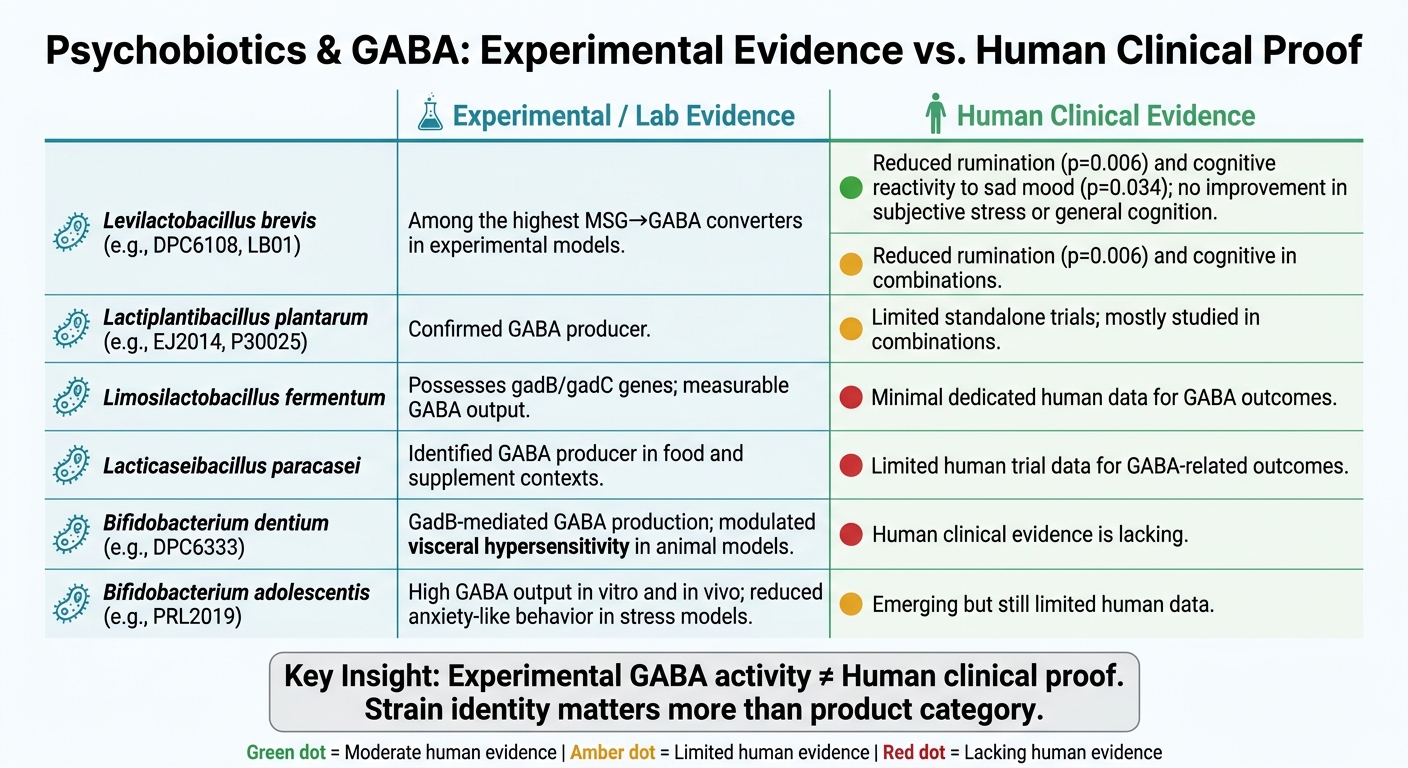
Psychobiotics & GABA: Lab Evidence vs. Human Clinical Proof by Strain
What GABA Does and Why It Matters
Among gut-brain signals, GABA is the most discussed inhibitory pathway. It’s the brain’s main inhibitory neurotransmitter, which means it helps slow neuronal firing. That matters for stress regulation and sleep.
Gut microbes may affect GABA signaling indirectly through peripheral GABA pools, receptor activity, and inflammation.
Because GABA effects are strain-specific, the next step is figuring out which strains show up again and again in the research.
Strains That Appear Most Often in GABA-Related Research
GABA production among gut microbes is strain-specific, not a genus-wide trait.[3] In plain English: you can’t assume a whole bacterial group produces GABA just because one strain does.
Screening studies make that pretty clear. One found only a few GABA-producing isolates among 91 human intestinal strains, while another found 58 producers among 135 strains tested.[1][3]
Species that appear often in this area include Levilactobacillus brevis, Lactiplantibacillus plantarum, Limosilactobacillus fermentum, Lacticaseibacillus paracasei, and select Bifidobacterium species, especially B. dentium, B. adolescentis, and B. infantis (B. longum subsp. infantis).
Table: Reported GABA-Related Mechanisms vs. Human Clinical Evidence
The big dividing line here is simple: experimental activity is not the same thing as human proof.
| Strain / Group | Reported GABA-Related Role (Experimental) | Human Clinical Evidence (Strength / Limits) |
|---|---|---|
| Levilactobacillus brevis (e.g., DPC6108, LB01) | Among the highest MSG→GABA converters in experimental models.[13][14] | A 2024 human study using a formulation containing L. brevis and L. plantarum reported reduced rumination (p = 0.006) and cognitive reactivity to sad mood (p = 0.034), but no improvement in subjective stress measures or general cognitive performance.[8][15] |
| Lactiplantibacillus plantarum (e.g., EJ2014, P30025) | Confirmed GABA producer.[9] | Limited standalone human trials; mostly studied in combination formulations. |
| Limosilactobacillus fermentum | Certain strains possess gadB/gadC genes and show measurable GABA output.[6][2] | Minimal dedicated human clinical data specific to GABA outcomes. |
| Lacticaseibacillus paracasei | Identified as a potential GABA producer in food and supplement contexts.[4][2] | Limited human trial data specific to GABA-related outcomes. |
| Bifidobacterium dentium (e.g., DPC6333) | GadB-mediated GABA production; modulated visceral hypersensitivity and sensory neuron activity in animal models.[10][11][12] | Human clinical evidence is lacking. |
| B. adolescentis (e.g., PRL2019) | High GABA output in vitro and in vivo; linked to reduced anxiety-like behavior in stress models.[7][5] | Human data are emerging but remain limited. |
That gap between lab findings and human confirmation is exactly why human-origin strains get so much attention.
What Human-Origin Strains Add and Who May Consider Gut Support
What Human-Origin Strains Mean Clinically
Human origin and GABA production are not the same thing. A strain can produce GABA in vitro and still not be well suited to life in the human gut.
When people say "human-origin strains," they usually mean microbial strains first isolated from the gut microbiota of healthy humans. The idea is simple: strains that come from the human gut may be better suited to the gut environment. They may handle stomach acid and bile well. But origin by itself doesn't tell you whether a strain will help people in a clinical setting.
What counts most is strain-level human evidence. Not just where the strain came from.
That difference matters. Clinical use depends on how a strain behaves in humans, not on whether the label says it is human-origin.
Who Commonly Looks Into This Kind of Gut Support
Adults dealing with stress or sleep disruption often look into gut support along with sleep habits and nutrition. It's usually part of a bigger picture, not a stand-alone fix.
People also turn to gut support after antibiotics. That's not surprising, since microbiota recovery can stay incomplete for months, often requiring synbiotics and probiotics for gut recovery.
A Practical Example of a Combined Gut-Support Formulation
One product example in this space is Rebirth RE-1™. Rebirth RE-1™ (rebiirth.com) is a 3-in-1 synbiotic that combines prebiotics, probiotics, and postbiotics, including Human Origin Strains (HOSt™).
It is a dietary supplement, not a drug.
Like any gut-support approach, it makes the most sense as part of a broader plan that includes:
- nutrition
- sleep
- movement
- medical oversight when needed
The main issue is whether those formulation details lead to human outcomes.
What Current Studies Show, What They Do Not Show, and Key Takeaways
What Human Studies Suggest So Far
Current human research points most often to depressive symptoms, not anxiety. One meta-analysis found lower depression scores, but no meaningful benefit for anxiety.[24] That same pattern shows up again and again across reviews.
A few trials also report changes in stress markers. In an 8-week RCT of highly stressed nurses, heat-killed Lactobacillus paracasei PS23 lowered cortisol and perceived stress.[27][28] In another 8-week trial, Lactiplantibacillus plantarum PS128 plus heat-treated PS23 lowered ACTH, norepinephrine, job stress, and insomnia severity.[29]
Evidence in humans for gut barrier and inflammation effects is still early.[18][22]
Even with those symptom shifts, the how is still hard to pin down.
What Remains Unclear
The biggest issue in the current human evidence is the mechanism gap.
A systematic review of 45 studies described the field as promising but still early. Small sample sizes and mixed methods make firm conclusions hard to draw.[19][23][25][26]
Direct human evidence on GABA is still thin. Most trials look at symptoms, but do not test systemic or brain GABA. One RCT shows why that matters: Lacticaseibacillus rhamnosus HN001 changed visual cortex connectivity and processing speed and affected peripheral serotonin, without changes in GABA, glutamate, or BDNF.[16] So yes, clinical effects can show up without measurable GABA changes. That makes mechanism claims much harder to sort out.
Conclusion: Key Clinical Points To Remember
The practical takeaway is pretty simple: psychobiotics may help with some outcomes, but the evidence is still strain-specific and incomplete.
The main clinical points are these:
- Strain identity matters more than product category. Evidence for one strain does not transfer to another, even if both are sold as probiotics.[19][21]
- Human GABA proof is still limited and mostly indirect. Preclinical work gives a plausible case, but direct clinical proof is still missing.[17][20]
- Human-origin status is not enough on its own. It does not promise better results without strain-specific human data.[16][19]
Modest, strain-specific benefits look plausible. Broad claims do not.
FAQs
Can psychobiotics really change brain GABA?
Yes. Research suggests psychobiotics may affect GABA signaling.
Some Lactobacillus and Bifidobacterium strains naturally make GABA in the gut. That matters because signals from the gut can travel to the brain through the vagus nerve and the gut-brain axis.
Some psychobiotics have also been shown to change GABA receptor expression in the brain. In plain English, they may influence how the brain responds to this key neurotransmitter. That shift may help reduce anxiety-like behaviors and support emotional balance.
Which probiotic strains have human evidence?
Several probiotic strains have human evidence behind them, especially for GABA modulation, stress, sleep, and mood. The ones that come up most often are Lactiplantibacillus plantarum Lp815, Lactobacillus plantarum PS128, Bifidobacterium longum 1714, and Lactobacillus gasseri BR-LAC-343.
Other studied strains include Bifidobacterium infantis BR-M63, Lactobacillus helveticus BR-MCC1848, and Lactobacillus paracasei BR-MCC1849. These are linked to mood, serotonin synthesis, and gut-brain axis function.
Are human-origin strains automatically better?
Human-origin strains (HOSt) aren't automatically better. But they may be a better fit for the human gut than strains taken from other sources.
Because these strains closely match microbes already found in the human microbiome, they may help steady the gut and support a healthier balance. That said, results still come down to the exact strain and the person’s gut health.