

Yes - fermented foods can increase gut microbiome diversity, but the effect is uneven and usually takes time. The clearest human trial found that people who ate about 6 servings a day for 10 weeks had higher alpha diversity and lower levels of 19 inflammatory markers. This reduction in inflammation is a key part of restoring gut balance after periods of high stress. But many single-food studies showed small shifts in gut bacteria without a clear change in overall diversity.
If you want the short answer, here it is:
- Mixed fermented foods work better than one food alone in the best human trial.
- Yogurt and kefir have the strongest human data.
- Kimchi and sauerkraut may help, but results are less steady.
- Kombucha does not have human microbiome trial data yet.
- Changes can start in 24–48 hours, but steadier results tend to show up over 4–12 weeks.
- Your starting gut makeup, diet, health, and medications can change the result.
What this means for you: if you want to test fermented foods for gut health, think in weeks, not days, and use them often, not once in a while.
| Food type | What studies most often show | Best read on diversity |
|---|---|---|
| Yogurt, kefir | Changes in gut bacteria; some trials show higher diversity | Best support |
| Kimchi, sauerkraut | More often shifts in composition than full diversity change | Mixed |
| Kombucha | Human microbiome data not there yet | Unknown |
| Mixed fermented foods | Best trial showed higher alpha diversity after 10 weeks | Strongest signal |
I’d sum it up like this: fermented foods may help your microbiome, but they are not a guaranteed fix, and more is not always better for every person.
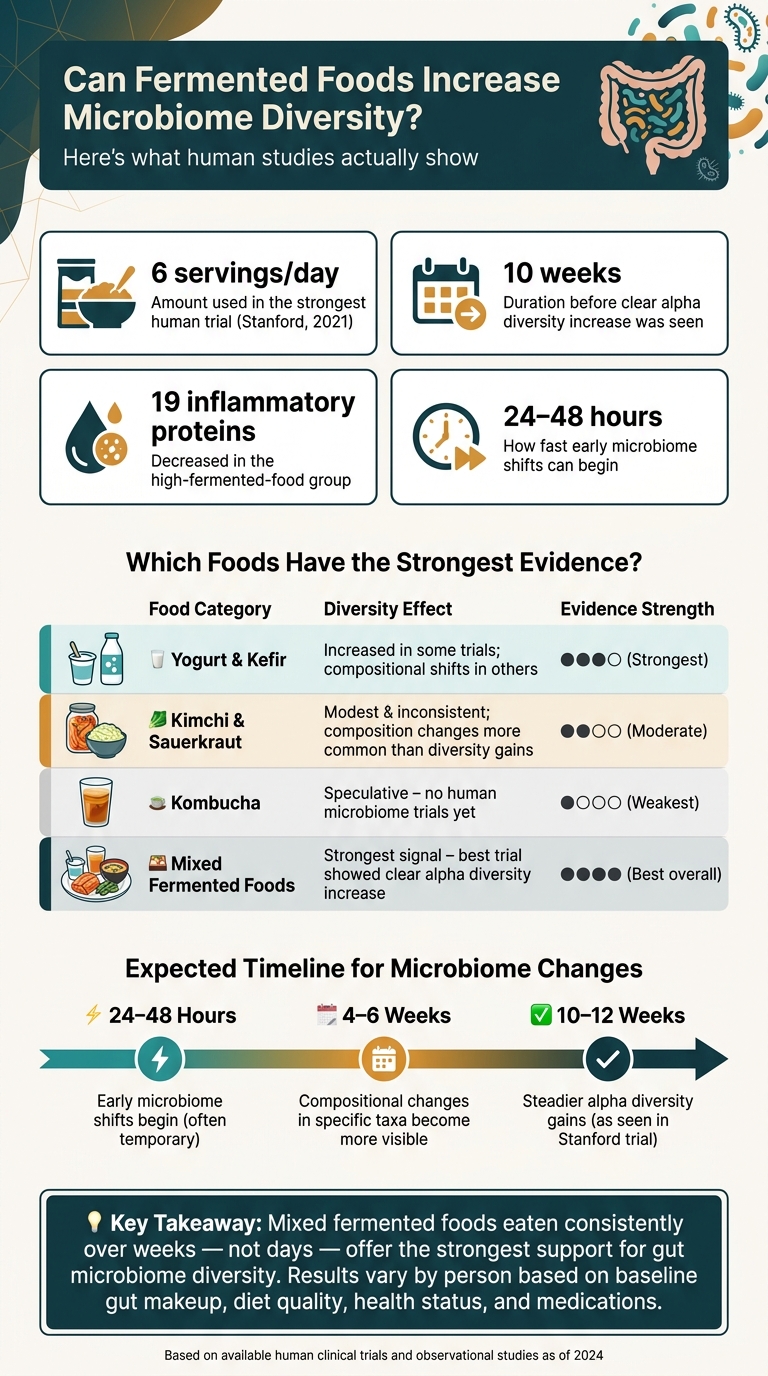
Fermented Foods & Gut Microbiome Diversity: What the Evidence Shows
The Gut Microbiome Showdown: Fermented Foods Win by a Landslide
sbb-itb-1bbfe7f
What Microbiome Diversity Means and Why It Matters
To see why fermented foods matter, it helps to get clear on what diversity means in the gut.
Your gut holds trillions of microbes, with most of them living in the large intestine.[10] These microbes help break down food, support immune function, and help protect the gut lining.[10][12]
Richness, evenness, and alpha diversity explained simply
When researchers talk about microbiome diversity, they’re usually looking at two basic things: how many different microbes are there, and how balanced are they?[9][10][18]
- Richness means the number of different microbes present.[9][13][17]
- Evenness means how evenly those microbes are spread out in the gut.[9][13][17]
- Alpha diversity rolls richness and evenness into one within-person measure.[9][10][18]
These are the same metrics used in the trials and reviews covered later in this article.
Why does that mix matter? Because a more diverse gut is often more stable and better able to keep doing its job.
Why more diversity often helps, but is not the whole picture
Higher alpha diversity is often linked with more resilience when the gut faces antibiotics, infections, or changes in diet.[12][15][18][19] But diversity alone doesn’t tell the whole story. Microbial function matters just as much.[12][18][20]
For example, many gut bacteria make short-chain fatty acids. These compounds help feed colon cells and support the gut barrier and immune balance.[11][14][16][18][20] So even if diversity shifts only a little, those functions can still matter a lot.
That’s the lens researchers use when they test whether fermented foods change the microbiome.
What Studies Show About Fermented Foods and Microbiome Diversity
Not all studies carry the same weight. Randomized trials give the strongest evidence, because they test what happens when people change their diet under controlled conditions. Observational studies can still help, but they mainly show links, not proof of cause and effect.
Randomized trials: the strongest evidence
The clearest signal comes from a 2021 Stanford randomized controlled trial, often called the Wastyk et al. trial, published in Cell. About 36 healthy U.S. adults were randomly assigned to either a high-fermented-food diet or a high-fiber diet for 10 weeks. People in the fermented-food group worked up to about 6 servings per day, using foods like yogurt, kefir, kimchi, sauerkraut, and kombucha.[2]
That group showed a rise in alpha diversity across multiple measures. At the same time, 19 inflammatory proteins fell, including IL-6, IL-10, and IL-12b. The high-fiber group did not show the same overall gain in diversity or a similar drop in inflammatory markers.[2][21][22][23] One detail stands out here: the strongest effect showed up when people ate several fermented foods together over a period of weeks, not when they added one item here and there.
Smaller trials that test just one fermented food paint a more mixed picture. In a 6-week sauerkraut study of 34 adults with IBS, researchers found clear shifts in microbiome composition, but changes in diversity were less marked.[7] Kefir studies often land in the same zone. They tend to show changes in specific taxa and functional pathways, including higher Bifidobacterium species and short-chain-fatty-acid-related modules, while overall alpha diversity often stays about the same.[26][27][29] Put simply, single-food trials more often change who is there than how diverse the whole community is.
Observational studies and reviews: supportive but mixed
Cohort studies usually show modest links between fermented-food intake and gut microbiota patterns. One cohort of regular fermented-food consumers had distinct gut and metabolite profiles, including more CLA.[5][8] In large cohorts, yogurt consumers often have higher alpha diversity and greater abundance of taxa such as Streptococcus, Lachnospiraceae, and Christensenellaceae than non-consumers.[30][4]
Systematic reviews show much the same pattern. Genus-level shifts show up often, but alpha diversity changes are inconsistent. Across many interventions, Lactobacillus and Bifidobacterium tend to shift in a fairly steady way, while broader diversity changes appear only in some subgroups.[24][25][8] So the review-level evidence lines up with the trial data, but it still stops short of proving cause and effect.
Study comparison table: fermented foods and diversity outcomes
| Study Type | Population | Fermented Food Category | Duration | Primary Microbiome Outcome | Inflammatory/Clinical Markers |
|---|---|---|---|---|---|
| Randomized controlled trial (Stanford/Wastyk et al.) | ~36 healthy U.S. adults | Mixed: yogurt, kefir, kimchi, sauerkraut, kombucha | 10 weeks | Clear alpha diversity increase | 19 proteins decreased, including IL-6, IL-10, IL-12b [2][21][22][23] |
| Parallel-group trial (IBS sauerkraut study) | 34 adults with IBS | Fermented vegetables (sauerkraut, 75 g/day) | 6 weeks + 2-week follow-up | Composition changed more than diversity | Significant reduction in IBS severity scores [7] |
| Kefir studies | Healthy adults | Fermented dairy (kefir) | Varied | Little measurable alpha diversity change | Increased Bifidobacterium species and SCFA-related functional modules [26][27][29] |
| Observational cohort | General population | Mixed fermented foods (yogurt, kimchi, kombucha, pickled vegetables, sauerkraut) | Long-term habitual intake | Modest compositional differences | CLA enrichment; metabolome shifts [5][8] |
| Systematic review | Varied populations | Mixed categories | Varied | Composition changed more than diversity | Genus-level shifts in Lactobacillus and Bifidobacterium [24][25][8] |
Food type matters next: dairy, vegetables, and beverages do not appear to affect the microbiome in the same way.
Which Fermented Foods Are Most Often Linked With Better Microbiome Outcomes
Among fermented foods, dairy stands out most clearly in human studies when the focus is microbiome changes.
Fermented dairy: yogurt and kefir
Fermented dairy has the strongest human trial data, especially yogurt and kefir. That said, diversity gains don't show up in every study.
In one randomized trial, adults who ate yogurt daily for 6 weeks had a measurable increase in gut microbial diversity, based on the Shannon index, along with higher Lactobacillus abundance.[31] A separate 4-week trial in female soccer players found that kefir increased Shannon and Chao1 diversity and enriched Akkermansia muciniphila and Faecalibacterium prausnitzii.[31][35] But the picture isn't identical across all groups. In a 12-week trial in people with metabolic syndrome, researchers found no change in alpha diversity.[33]
So the signal is there, but it isn't universal.
Vegetable ferments show a similar pattern, though the data is less steady from study to study.
Fermented vegetables and beverages: kimchi, sauerkraut, and kombucha
In obese women, kimchi increased Bifidobacterium and improved clinical markers.[37][38] In one intervention study, sauerkraut was tied to a small increase in the Shannon index.[39] But a larger 4-week crossover trial found no overall microbiota shift, even though some individual species changed.[36][28]
Kombucha is where the hype runs ahead of the data. There are no published human microbiome trials on kombucha, so any claims about diversity are still speculative.[32][34]
Which fermented foods have the clearest evidence?
| Category | Common U.S. Foods | Consistency of Evidence | Diversity Effects | Key Taxa Enriched | Quality Considerations |
|---|---|---|---|---|---|
| Fermented dairy | Yogurt, kefir | Strongest human trial evidence | Increased in some trials; compositional shifts in others | Lactobacillus, Akkermansia muciniphila, F. prausnitzii | Refrigerated products are more likely to retain live cultures |
| Fermented vegetables | Kimchi, sauerkraut | Moderate; smaller and more variable studies | Modest and inconsistent; composition changes are more common than diversity gains | Lactobacillus, Leuconostoc, Bifidobacterium | Refrigerated live-culture products are more likely to retain active microbes |
| Fermented beverages | Kombucha | Weakest; no human microbiome trials | Speculative; not yet clinically established | Acetic acid bacteria, lactic acid bacteria, yeasts | Live culture content varies; pasteurized products may lack viable cultures |
| Fermented soy | Miso, natto | Emerging; observational and short intervention data | Higher diversity in observational data; beneficial compositional shifts in short trials | Lactobacillus, Bifidobacterium, Bacillus | Traditional preparations vary in microbial composition |
No single category works best for everyone. A more practical approach is to rotate across different fermented foods instead of leaning on just one. And, like a lot of gut-related changes, results tend to vary from person to person and may take time to show up.
How Long Changes Take, Why Results Differ, and Where Rebirth RE-1 Fits
Timeline: early shifts in days, steadier changes in weeks
Gut microbes can change fast. In some studies, shifts show up within 24–48 hours after a diet change. But there’s a catch: those early changes often fade once the diet ends.[6][43] They can affect diversity in the short run, though not always in a way that lasts.
That’s why it helps to look at a longer window, not just the first few days.
More lasting diversity gains tend to take more time. In the Stanford trial, alpha diversity increased after 10 weeks of a high fermented-food diet.[3][1][2] For most people, 4–12 weeks of daily intake is a better time frame for judging whether anything is changing.[40][6] Even then, timing is only one part of the picture. Response size can differ a lot from person to person.
Why some people respond more than others
People don’t start from the same place. Response can vary based on baseline microbiome makeup, overall diet quality, health status, and certain medications.[41][44][6]
Diet matters a lot here. If someone eats a low-fiber, ultra-processed diet, gut microbes may not get enough fuel to do well. That can weaken the effect of adding fermented foods.[40][41][43]
It’s also worth noting that small changes in diversity don’t mean “nothing happened.” Some trials found shifts in specific taxa and drops in inflammatory markers even when alpha diversity barely changed.[40][2][42]
Conclusion: The most accurate takeaway
The clearest takeaway is this: fermented foods can help support microbiome diversity, but the change usually takes weeks, not days, and results can vary a lot by person.
If you want a more structured reset plan, one option is Rebirth RE-1, a 3-in-1 synbiotic sachet with prebiotics, probiotics, postbiotics, Human Origin Strains, 500 billion CFU per serving, and 7-day, 4-week, and 12-week protocols.
FAQs
How many servings of fermented foods a day are needed to make a difference?
Research suggests that 2 to 3 servings a day can make a meaningful difference in your microbiome.
Because fermented foods don’t all contain the same bacteria, it helps to mix things up. Eating a range of fermented foods over the course of the day may give you a broader mix of strains.
A serving can look like this:
- 1 cup of yogurt or kefir
- 1/4 to 1/2 cup of sauerkraut
- 2 to 3 tablespoons of kimchi
- 1 to 2 tablespoons of miso
Start small, then increase little by little.
Do I need live-culture fermented foods for microbiome benefits?
No. Fermented foods can help the microbiome by adding bacteria, plus vitamins and fiber, but they aren’t the only choice.
Foods like yogurt, kefir, sauerkraut, and kimchi can differ a lot in the strains and amounts of bacteria they contain. That can change based on how they’re made and how they’re stored.
By contrast, Rebiirth RE-1™ offers a more consistent, clinically backed way to support gut health with targeted Human Origin Strains.
Why might fermented foods help one person more than another?
Fermented foods can affect people in different ways because the amount and survival of live bacteria can vary a lot. In foods like yogurt, kimchi, and sauerkraut, probiotic content can change based on how the food is made, how it's stored, and how fresh it is.
On top of that, each person’s gut microbiome is different, so people may react differently to those shifting doses. Some strains also don’t make it through stomach acid, which can make the effects less consistent.