

Your gut can shape GABA signaling, but it’s not just about one neurotransmitter. What matters most is the network: GABA, serotonin, dopamine, glutamate, gut bacteria, the gut lining, the immune system, and stress all affect each other.
Here’s the short version:
- GABA is the main calming neurotransmitter
- Some gut microbes, mainly Lactobacillus and Bifidobacterium, can make GABA from glutamate
- Gut signals often travel through the vagus nerve
- 90% to 95% of the body’s serotonin is made in the gut
- Stress, inflammation, and a weak gut barrier can throw this system off
- Support usually works best when I look at strains, fiber/prebiotics, microbial byproducts, sleep, and stress load together
If I strip the article down to its core, the message is simple: GABA balance depends on the state of the whole gut-brain system, not one supplement or one strain. Some microbes may support GABA more directly, some work through SCFAs, and some shift immune tone or gut barrier function. At the same time, serotonin depends on tryptophan, dopamine tends to change more indirectly, and glutamate is the closest chemical partner to GABA.
A quick way to think about it:
| Part of the system | What it does |
|---|---|
| GABA | Helps quiet nerve activity and may affect stress and gut sensitivity |
| Serotonin | Helps control gut motility, secretion, and sensory signaling |
| Dopamine | Links to motivation, food response, and gut motility |
| Glutamate | Drives excitatory signaling and feeds into GABA production |
| Microbes | Can make GABA, shift precursors, and change immune signaling |
| Gut barrier | Helps control how much inflammation and microbial debris crosses into tissue |
| Stress/vagus nerve | Changes gut signaling, microbial balance, and brain-gut communication |
The practical takeaway is plain: if you want to support this system, I’d focus on strain-specific probiotics, prebiotic fibers, postbiotic compounds, barrier support, sleep, exercise, and steady stress control - not just “more GABA.”
Below, the article breaks down how that cross-talk works and where a microbiome reset may fit.
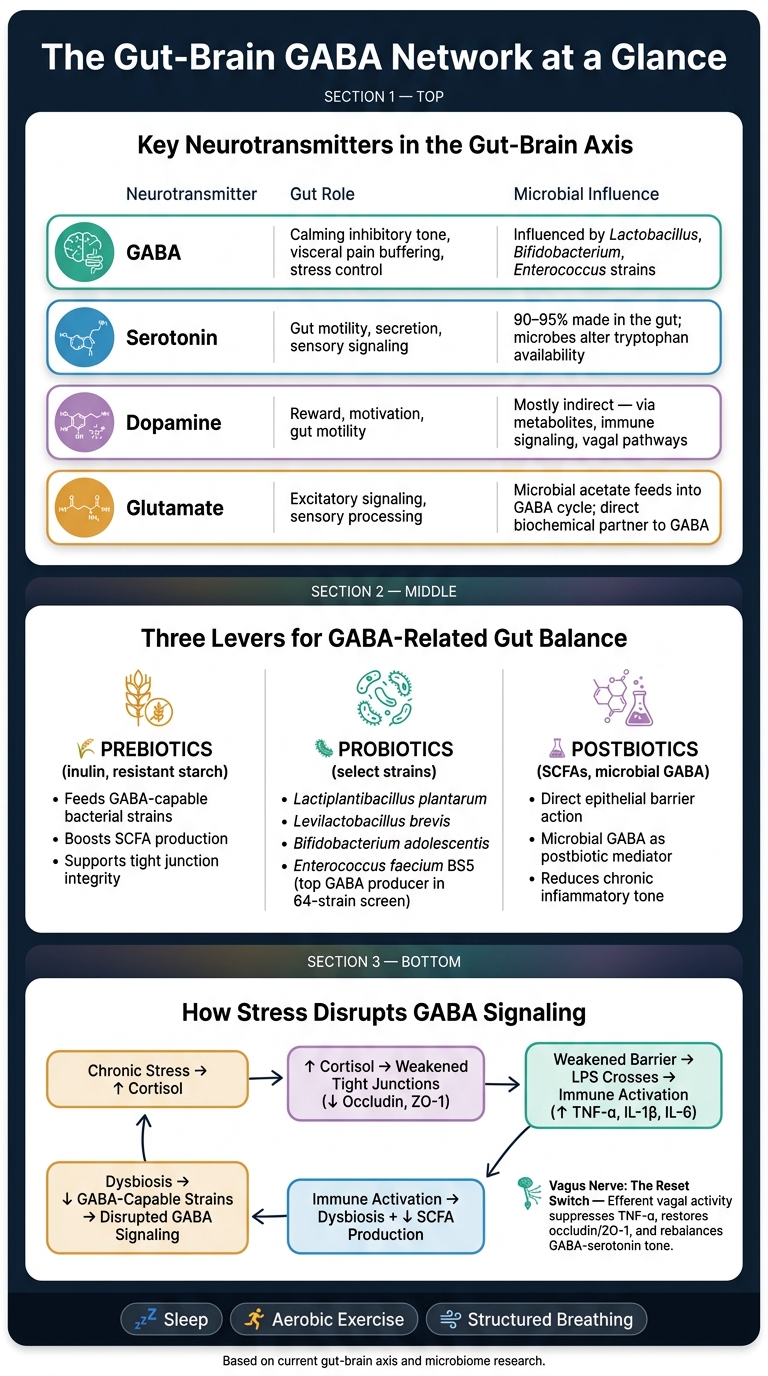
Gut-Brain GABA Network: Neurotransmitters, Microbes & Pathways Explained
The Brain-Gut Connection: Anxiety & Stress Coming from Missing Gut Bacteria – Dr.Berg
sbb-itb-1bbfe7f
How GABA Interacts with Other Gut Neurotransmitters
GABA, serotonin, dopamine, and glutamate don't work in isolation. They move together, and the microbiome can nudge that balance in one direction or the other.[7][2] Once you zoom in on the microbes involved - and the substrates they act on - that shift becomes a lot easier to see.
| Neurotransmitter | Main Gut Relevance | Microbial Influence |
|---|---|---|
| GABA | Inhibitory tone, visceral pain, stress buffering | Strain-specific GABA-related effects in Lactobacillus, Bifidobacterium, and specific Enterococcus strains; indirect modulation through metabolites |
| Serotonin | Gut motility, secretion, sensory signaling | Microbes can alter tryptophan availability and serotonin synthesis; about 90% to 95% of the body's serotonin is produced in the gut.[12][13] |
| Dopamine | Reward, motivation, gut motility, autonomic signaling | Mostly indirect, through metabolites, immune signaling, and vagal/enteric pathways |
| Glutamate | Sensory processing, pain signaling, enteric excitability | Microbial metabolism can influence glutamate availability; acetate from fermentation can feed into the GABA cycle.[5] |
GABA and Serotonin: Calming Signals, Tryptophan Metabolism, and Mood
Serotonin and GABA both shape the gut–brain axis, but they do it through different lanes.
Serotonin is tied closely to tryptophan metabolism. Gut microbes can push tryptophan toward serotonin production, or send it down the kynurenine pathway, which has links to pro-inflammatory states and mood disorders.[9][11] GABA works differently. It comes from glutamate conversion and acts more like a direct brake on neuronal activity.
This matters because microbial imbalance can throw off both systems at once. If tryptophan gets pulled away from serotonin, changes in motility and stress sensitivity can show up side by side. Serotonin helps govern gut motility, while GABA helps quiet overactivity in the enteric nervous system. Focus on one and ignore the other, and you're only seeing half of what's going on.[6][5]
GABA with Dopamine and Glutamate: Reward, Motivation, and Excitation-Inhibition Balance
Dopamine's gut role is less direct than GABA's or serotonin's. Microbes don't often produce dopamine themselves. Instead, they influence dopamine signaling through metabolites, immune mediators, and vagal pathways.[7][2] When gut dysbiosis sets in, dopamine-linked circuits tied to food response and motility can shift too. That's one reason digestive patterns can change when the microbiome is off.
The glutamate-to-GABA relationship is the most direct biochemical link in this group. Glutamate pushes excitation. GABA puts a limit on it. Microbially derived acetate from colonic fermentation can cross the blood–brain barrier and feed into the central GABA cycle, especially in the hypothalamus.[5] In plain English: what happens in the colon after a meal doesn't just stay in the colon. It can shape inhibitory tone in the brain. If excitation climbs too high - or inhibition drops too low - gut and brain regulation can both get thrown off.[6] That balance comes back to the strains, substrates, and metabolites covered next.
Microbes and Microbiome Tools That May Support GABA Balance
Once GABA’s role in gut-brain cross-talk is clear, the next step is practical: which strains and substrates may help move it? The catch is that GABA balance is strain-specific. It’s not enough to say “Lactobacillus helps” or “Bifidobacterium helps.” The strain matters.
GABA-Related Microbial Strains: Lactobacillus, Bifidobacterium, and Enterococcus
GABA production is not a genus-wide trait. Screening work found it in only a small group of named strains, including Lactiplantibacillus plantarum, Levilactobacillus brevis, Bifidobacterium adolescentis, B. dentium, and B. angulatum.[3]
Among these, Bifidobacterium adolescentis stands out. Many tested strains converted MSG to GABA, and strains PRL2019 and HD17T2H increased in vivo GABA levels in animals.[16] Enterococcus faecium BS5 has also been flagged as the most efficient GABA producer among nine positive strains in a screen of 64 isolates. It also met several probiotic safety and survival criteria.[14]
That said, strain effects are only part of the story. The way those microbes are supported and delivered matters too.
Prebiotics, Probiotics, and Postbiotics in the Same Framework
Prebiotics feed GABA-capable microbes. Probiotics supply select GABA-producing strains. Postbiotics deliver GABA and SCFAs that act on the gut lining and immune tone.
| Tool | GABA Support | Barrier Integrity | Immune Modulation |
|---|---|---|---|
| Prebiotics (inulin, resistant starch) | Indirect - feeds GABA-capable taxa; boosts SCFA production and reduces inflammation | SCFA-mediated tight junction and mucus support | Shifts microbiota toward anti-inflammatory SCFA profiles |
| Probiotics (select Lactobacillus, Bifidobacterium, Enterococcus strains) | Direct GABA production by specific strains; indirect via pH and competition | Upregulates tight junction proteins; enhances mucin; excludes pathogens | Strain-specific cytokine and regulatory T-cell effects |
| Postbiotics (SCFAs, microbial GABA, metabolites) | Microbial GABA as a direct postbiotic mediator; SCFAs support signaling environment | Direct epithelial action; tightens junctions; improves resilience | Reduces chronic inflammatory tone |
Newer research places GABA itself in the postbiotic bucket. In plain English, that means a molecule made by live microbes may act locally in the gut and affect neural circuits through enteric and vagal pathways.[4]
Where a Microbiome Reset Fits: A 3-in-1 Synbiotic Approach
Supporting GABA-related gut-brain balance tends to work best as a combined setup: prebiotics, probiotics, and postbiotics each act on a different part of the same system. That’s the logic behind a 3-in-1 synbiotic approach.
If you want one simple way to pull those three levers together, a microbiome reset can package them into a single protocol. Rebirth RE-1 uses this 3-in-1 synbiotic approach in a 7-day, 4-week, or 12-week microbiome reset.
Immune, Barrier, and Stress Pathways That Shape GABA Signaling
GABA signaling doesn't happen in isolation. It depends on the state of the gut barrier, the level of immune activity, and the strain that chronic stress puts on the microbiome. When the barrier is damaged or stress sticks around for too long, GABA-related signaling gets distorted because microbes, immune messengers, and the vagus nerve stop communicating cleanly. In plain English: barrier health and stress load matter just as much as neurotransmitter chemistry.
Gut Barrier Integrity: Tight Junctions, Mucins, and Inflammatory Tone
Tight junction proteins - claudins, occludin, and ZO-1 - along with mucins, help keep microbes at a safe distance from the epithelium. When that barrier stays intact, it supports a gut setting that leans toward GABA and SCFA production.
Once the barrier starts to fail, things can shift fast. Pro-inflammatory cytokines such as TNF-α, IL-1β, and IL-6 can lower occludin and ZO-1 levels, which increases permeability.[18][22] That gives bacterial products like lipopolysaccharide (LPS) an easier path across the barrier, where they can trigger immune responses that change GABA receptor expression on enteric neurons and immune cells.[19] Chronic barrier damage is also tied to mood disorders and neuroinflammation through shifts in gut-derived neurotransmitter signaling, including GABA and serotonin.[22]
Immune Modulation and the Vagus Nerve Under Chronic Stress
Stress reshapes the same signaling web that GABA relies on. Higher cortisol levels can weaken tight junction proteins, thin the mucus layer, and push the microbiome toward less diverse, more inflammatory patterns. That drop in SCFA production can also crowd out GABA-capable strains.[21][22] The loop can get ugly fast: stress drives gut dysbiosis, dysbiosis pushes up inflammatory tone, and inflammation further harms the barrier and neurotransmitter output.
The vagus nerve is a central link in that loop. Its afferent fibers send gut-derived signals - including neurotransmitters such as GABA and serotonin - to the brain. Its efferent fibers release acetylcholine, which binds to α7 nicotinic receptors on macrophages, suppresses TNF-α, and cools local inflammation.[20][18] Efferent vagal activity has also been shown to improve intestinal barrier integrity and normalize occludin and ZO-1 expression.[18][20] So vagal tone doesn't just shape inflammation. It also affects the GABA-serotonin-dopamine balance described above.
Animal work backs this up. Stress-driven gut microbiota changes need an intact vagus nerve to produce central serotonin and dopamine shifts, which shows that the vagus acts as a required relay between dysbiosis and neurotransmitter change.[10]
A few habits can help steady this system:
- Sleep
- Structured breathing
- Regular aerobic exercise
These support vagal tone and can help calm the loop before it spirals.
Putting It Into Practice: A Microbiome Reset for GABA-Related Balance
GABA balance depends on the full gut picture: microbes, barrier health, immune tone, and stress load. So the next step isn't about chasing one pill. It's about using a reset that gives your system some room to steady itself.
Short, Medium, and Extended Reset Windows
Use three reset windows, each with a different job. Here's how that reset can play out over time.
| Phase | Timeframe | Primary Goal | Key Focus |
|---|---|---|---|
| Short Reset | 7 days | Reduce gut disruption | Reduce major dietary and circadian stressors; introduce high-CFU synbiotic support |
| Medium Reset | 4 weeks | Stabilize microbial communities | Consistent daily synbiotic intake; build sleep and stress routines |
| Extended Reset | 12 weeks | Support long-term resilience | Diversify diet; reinforce barrier integrity; cement lifestyle habits |
A 3-in-1 synbiotic fits this setup because it works across all three layers at the same time.
The 7-day window is about cutting down disruption and starting support for helpful strains, including Lactobacillus and Bifidobacterium species tied to GABA production.[7][5][8] Rebirth RE-1™ fits the 7-day reset as a 3-in-1 eubiotic synbiotic with prebiotics, probiotics, postbiotics, HOSt™ strains, 500 billion CFU per serving, and Lyosublime™ delivery.[15][17]
The 4-week window shifts toward stabilization. This is the phase for steady daily habits and continued microbial support.[19][7][5]
The 12-week window is where repair and resilience can start to take hold. Use this phase to support resilience and hold onto the progress you've made.[23][7][5]
Rebirth RE-1 is available in three formats: 7-Day Reset ($79), 4-Week Reset ($279), and 12-Week Reset ($749).[15]
Key Takeaways for Restoring Gut Neurotransmitter Balance
Those reset windows only help if the main systems stay in sync. GABA doesn't work alone. It stays in constant cross-talk with serotonin, dopamine, and glutamate, and the gut microbiome helps shape that signaling network. Some microbial strains act directly by producing GABA from glutamate through gadB/gadC genes. Others help in indirect ways by generating SCFAs, modulating immune tone, and influencing vagal signaling.[1][20]
That same three-part synbiotic setup applies here. But microbes aren't the whole story. Barrier health and stress management are the base layer that decides whether a microbial or dietary plan has a fair shot at working. Cut disruption, rebuild microbial support, and manage stress over weeks, not days.
FAQs
Can gut bacteria really affect GABA?
Yes. Some gut bacteria, especially Bacteroides, Lactobacillus, and Bifidobacterium, can make GABA from amino acids like glutamate and glutamine.
A diverse, balanced microbiome helps support gut-brain signaling tied to mood, sleep, and stress. When dysbiosis happens, GABA production may drop, which can affect mental well-being.
Which probiotic strains may support GABA balance?
Several gut bacteria can make GABA. The main groups include:
- Bacteroides such as B. faecis, B. fragilis, B. ovatus, and B. xylanisolvens
- Lactobacillus including L. plantarum L5 and L. brevis
- Bifidobacterium such as B. adolescentis, B. dentium, B. infantis UCC35624, B. longum, and B. bifidum TMC3115
These strains are known for helping support GABA production and gut-brain balance. Rebiirth RE-1™ supports this balance with Human Origin Strains.
How do stress and gut health affect GABA signaling?
Chronic stress can throw the gut off balance. And when that happens, GABA signaling can take a hit too.
Here’s why. Stress hormones like norepinephrine and epinephrine can help harmful bacteria grow and push the gut toward dysbiosis. At the same time, they can reduce helpful bacteria such as Lactobacillus and Bifidobacterium, which play a role in GABA production.
Stress can also make the intestinal lining more permeable and drive inflammation. That can disrupt the gut-brain axis and interfere with vagus nerve signaling.
A microbiome reset with Rebiirth RE-1 may help bring the gut back into balance, reduce inflammation, and support the body’s natural GABA production.