

If I want to judge a GABA-microbiome trial fast, I look at six endpoint groups: mood, stress, sleep, gut symptoms, immune markers, and neurotransmitter proxies. That’s the short answer.
Here’s why: a single score can miss the full picture. In these trials, mood may shift by weeks 2–4, sleep scores may drop by about 0.71 points on PSQI pooled data, gut symptoms can improve by 50+ points on IBS-SSS, and cortisol may show little change even when people say they feel less stressed. So if I only track one outcome, I can miss what the intervention is doing.
At a glance, these are the six domains the article focuses on:
- Mood scores: tools like HAM-D, BDI, PHQ-9, and GAD-7
- Stress response: self-report plus cortisol, HRV, and heart rate
- Sleep quality: PSQI, ISI, actigraphy, and sometimes PSG
- Gut symptoms: IBS-SSS, GSRS, stool form, bloating, and pain
- Immune markers: CRP, IL-6, TNF-α, IL-10, sIgA, and calprotectin
- Neurotransmitter proxies: urinary, plasma, or fecal GABA/glutamate
A few numbers stand out:
- Mood effects in multi-strain probiotic trials often fall around 0.3 to 0.5 SMD
- A 50% drop in HAM-D is often used as a clinical response
- PSQI scores above 5–7 often point to poor sleep
- Placebo-controlled data showed cortisol pooled effects near SMD = -0.02, which is close to flat
- In one 6-week Lp815 trial, 77.3% of the probiotic group had meaningful insomnia improvement vs. 57.8% with placebo
What I take from this is simple: the cleanest trial signal shows up when several domains move together. If mood gets better, sleep improves on a wearable, gut symptoms ease, and a proxy like urinary GABA shifts early, the result is much harder to dismiss as noise.
Here’s a quick comparison of what each endpoint is there to show:
| Endpoint | What it tells me | Common tools |
|---|---|---|
| Mood | Whether anxiety or depression symptoms changed | HAM-D, BDI, PHQ-9, GAD-7 |
| Stress | Whether felt stress matches body-level stress signals | PSS, STAI, cortisol, HRV |
| Sleep | Whether sleep got better on paper and in device data | PSQI, ISI, actigraphy, PSG |
| Gut symptoms | Whether digestion and bowel symptoms improved | IBS-SSS, GSRS, stool diaries |
| Immune markers | Whether inflammation or mucosal immune activity shifted | CRP, IL-6, TNF-α, IL-10, sIgA |
| Neurotransmitter proxies | Whether GABA-linked biology may be moving | Urinary/plasma/fecal GABA, glutamate |
Bottom line: I’d summarize the article this way: don’t judge GABA trials by one score alone. The best read comes from lining up symptom scales, lab work, and device data over 4, 8, and 12 weeks.
Why Trial Endpoints Matter in GABA–Microbiome Research
An endpoint is a pre-specified, measurable trial outcome. Put simply, it answers one question: did the intervention produce a measurable effect? Pre-specified endpoints help separate a true signal from placebo response and normal day-to-day swings.
That matters even more in GABA–microbiome research because this is multi-system biology. What happens in the gut can show up in sleep, mood, stress, or digestion. So endpoint selection isn't just a study design detail. It's a big part of whether the trial can give a clear answer.
Trials usually sort endpoints into three groups:
- Primary endpoints test the main study question
- Secondary endpoints track other clinical effects
- Exploratory endpoints look for mechanistic signals
That setup works best when it's tied to more than one kind of evidence. In practice, endpoint definitions mean the most when researchers match them with the right tools. Since no single measure can show the full picture, GABA-focused microbiome trials often combine three types of measurement: patient-reported outcomes, biological markers, and digital measures. When self-reported sleep gets better and wearable data shows the same pattern, confidence in the signal goes up.[10][12][13]
Timing also shapes what a trial can pick up. Baseline shows the starting point. Week 4 often catches early changes, especially in gut comfort and sleep onset. Week 8 can show mid-course effects. Week 12 helps show whether gains hold up.[2][11][14] Those checkpoints make it easier to tell apart early symptom shifts from slower microbiome-linked changes.
With that framework in place, the next section breaks down the first endpoint: mood scores.
1. Mood Scores
Mood scores are often the first clinical sign researchers watch. In GABA-focused microbiome trials, they measure depression, anxiety, and emotional well-being with validated scales, mainly HAM-D, BDI, PHQ-9, and GAD-7.
The main issue isn’t just if mood shifts happen. It’s when they show up. In many studies, mood changes start to appear around weeks 2–4 and then level off by weeks 8–12. In a 31-day randomized trial in major depressive disorder, a high-dose multi-strain probiotic lowered HAM-D more than placebo, and the gains lasted 4 weeks after supplementation stopped.[3][15] In that same trial, higher Lactobacillus abundance tracked with lower HAM-D and BDI scores.[3]
For context, a 50% or greater reduction in HAM-D from baseline counts as a clinical response, and a score of 7 or lower means remission.[16] Multi-strain probiotic trials often show standardized mean differences of about 0.3 to 0.5 for mood outcomes, which falls in the small-to-moderate range.[20] In a study of the GABA-producing Lactiplantibacillus plantarum Lp815, a 5 billion CFU dose led to larger GAD-7 reductions at weeks 2, 4, and 6 than placebo. Urinary GABA also increased and showed an inverse correlation with insomnia and anxiety scores.[18][19]
On their own, mood scores tell you how people feel. They get more useful when they shift at the same time as biomarkers. If mood improves alongside changes in microbial composition and inflammatory markers, that points more strongly to a GABA-linked or anti-inflammatory effect.
Mood scores show the subjective signal. Stress response shows whether that shift also reaches the body.
2. Stress Response
Stress response is one of the most useful endpoints in GABA–microbiome research. It helps show whether feeling less stressed lines up with a change in the body.
Common tools include PSS, STAI, DASS-21, cortisol, HRV, and heart rate. Some trials also use an acute stress challenge, such as the Trier Social Stress Test (TSST), to test whether an intervention blunts the stress spike instead of only lowering baseline levels.[22][24] The main issue is simple: do these measures change together?
The pattern is pretty clear. Self-reported stress tends to shift more often than cortisol. A meta-analysis of 7 studies involving 1,146 participants found that probiotics could reduce subjective stress, but the pooled effect on cortisol was basically flat, with SMD = -0.02 (95% CI, -0.34 to 0.30; p = .89).[25][26]
That said, cortisol doesn’t always stay still. Under tighter study conditions, it can move. In a 14-day randomized, placebo-controlled study of 41 students under exam stress, Lactobacillus plantarum 299v was linked to a significant between-group difference in salivary cortisol at day 10, along with higher lactobacilli counts in the treatment arm.[21] In a 2014 prebiotic trial in 45 healthy volunteers, 3 weeks of B-GOS reduced waking salivary cortisol reactivity, but did not change self-reported stress or anxiety on questionnaires.[23]
These split results matter. A person can feel calmer before cortisol changes. Or cortisol can shift before questionnaire scores do. The two don’t always run on the same clock, which is why repeated measures are so useful.
When stress scores and biomarkers move in the same direction, the case for a gut-brain effect gets stronger. The clearest signal shows up when both change together over 4–12 weeks.
Stress and sleep often change side by side, which makes sleep quality the next key endpoint.
3. Sleep Quality
Stress and sleep tend to move together, so sleep quality deserves its own endpoint. In GABA–gut-brain trials, researchers track it because poor sleep often lines up with mood issues and immune trouble, and shifts in the microbiome may shape both relaxation and how fast someone falls asleep.[29][32][33]
The Pittsburgh Sleep Quality Index (PSQI) is the sleep questionnaire used most often. Higher scores mean worse sleep, and scores above 5–7 usually point to a clinically meaningful problem.[27][30] The Insomnia Severity Index (ISI) is often used with it to show how sleep issues spill into daily life.[27][33] A 2024 systematic review of 15 randomized controlled trials found that probiotic supplementation significantly lowered PSQI scores compared with placebo at both 4–6 weeks and 8–16 weeks.[35] Another meta-analysis found a pooled change in PSQI global score of −0.71 (95% CI −1.23 to −0.20).[36]
Questionnaires tell part of the story. Objective sleep measures help show whether those score changes match actual sleep improvement. Trials often pair PSQI with wearable metrics such as:
- total sleep time
- sleep latency
- sleep efficiency
- deep sleep duration
Some studies also use polysomnography for a closer look at sleep architecture.[27][12][13][29] Cortisol and melatonin can show whether microbiome interventions are affecting stress and circadian rhythms. Fecal microbiome profiles and GABA-related metabolic pathways add a mechanistic layer.[28][31][33] A 2024 Frontiers in Microbiology study linked specific gut microbiota patterns, including GABA degradation pathways and species like Faecalibacterium prausnitzii, to sleep quality.[37]
One trial makes this easier to picture. In a double-blind, randomized, placebo-controlled trial with 138 participants, a GABA-producing Lactiplantibacillus plantarum Lp815 strain at 5 billion CFU/day improved subjective insomnia and wearable sleep metrics after 6 weeks. That included gains in total sleep time, deep sleep duration, and sleep latency.[18][12]
When PSQI scores improve at the same time as wearable data and microbial shifts, the case for a microbiome-linked sleep effect gets much stronger.[29][33]
When sleep shifts first, gut symptoms are often the next signal to track.
4. Gut Symptoms
Gut symptoms are a main endpoint in GABA–gut-brain trials. Abdominal pain, bloating or distension, stool form, bowel habit changes, and urgency can reflect motility, barrier function, and immune signaling. Those same systems are also tied to GABA activity, mood, and stress.[3][38][41] In many studies, these symptom shifts show up before deeper biologic changes, which makes them a helpful early readout.
Two common tools here are the GSRS and IBS-SSS. The IBS-SSS runs from 0 to 500. Scores below 175 point to mild symptoms, 175–300 to moderate symptoms, and above 300 to severe IBS.[46] A drop of 50 points or more is widely used as a clinically meaningful improvement.[46][45] The GSRS looks at abdominal pain, reflux, indigestion, diarrhea, and constipation. The IBS-focused version, GSRS-IBS, adds items such as bloating and satiety.[47]
Early changes in bloating and stool consistency often appear within 2–4 weeks. Pain and total symptom burden tend to move more slowly.[20][39][42] That timing matters. If stool form improves first but pain lags behind, the gut may be settling down before the full symptom picture catches up.
When GABA-modulating strains, including some Lactobacillus and Bifidobacterium species, reduce abdominal pain and bloating, it points to less gut irritation.[3][40][41] In IBS models, GABA-producing Lactococcus lactis has been linked to reduced IL-6 gene expression and iNOS activity, along with increased claudin-2, and several parameters showed dose-dependent improvement.[43][44]
When these gut-level changes happen alongside lower anxiety, stress, or sleep scores, the pattern becomes harder to ignore. It suggests a microbiota–GABA–brain link rather than a simple symptom blip. And if symptom relief tracks with changes in inflammation, immune markers are the next place to look.
5. Immune Markers
Immune markers can show whether a microbiome intervention is changing biology, not just symptoms. That matters because cytokines and inflammatory proteins may reflect host-microbe effects before changes show up in mood, sleep, or stress.
The main markers worth tracking are CRP/hs-CRP, IL-6, TNF-α, IL-1β, IL-10, and secretory IgA (sIgA). Which ones you choose depends on the goal of the trial. If the focus is systemic inflammation, use blood. If the focus is mucosal immunity in the gut, use stool. If you want both, measure both. In an 8-week synbiotic trial, plasma CRP and IFN-γ fell, IL-10 and stool sIgA rose, and fecal sIgA increased 24%.[49]
In practice, anti-inflammatory shifts like higher IL-10 or sIgA tend to show up more clearly than big changes in CRP or IL-6, especially in healthy participants who start with low baseline inflammation.[49][52][53]
Timing matters too. A 4-week window can pick up early directional movement, but 8–12 weeks gives you a better shot at seeing stable immune change instead of short-term noise from diet, sleep, or a minor illness. Fecal calprotectin is also worth adding when the trial is meant to measure gut immune activation. It reflects neutrophil migration into the gut lining and can point to intestinal inflammation or barrier disruption.[48][50][51]
When these markers shift alongside mood, sleep, or gut scores, the case for a microbiome-driven effect gets stronger.
Immune markers, by themselves, do not prove efficacy. Taken together, they can show that symptom change has a biological basis. Neurotransmitter-related proxies then help show whether that biology reaches GABA-linked signaling.
sbb-itb-1bbfe7f
6. Neurotransmitter-Related Proxies
Peripheral markers don't measure brain GABA directly. So in trials, researchers use neurotransmitter proxies to estimate GABA-linked activity. That matters because these markers can shed light on gut–brain signaling and help tie shifts in mood, stress, and sleep to a plausible biological pathway. Put simply, they help link symptoms to what's happening under the hood.[1][58]
Common proxies include urinary, plasma, and fecal GABA and glutamate, along with GAD-pathway signatures. To keep the data cleaner, collection timing should be standardized so circadian patterns and diet don't muddy the picture.[54][55][56][57][59]
One short trial shows how fast these markers can move. In a 6-week study of a GABA-producing Lactiplantibacillus plantarum strain, urinary GABA increased within 1 week and remained elevated through week 6.[18] That kind of early biochemical change can show up before clearer movement in mood or sleep scores.
There are a few practical caveats. Urinary and plasma neurotransmitters can shift based on diet, medications, circadian rhythms, and acute stress. That's why standardizing collection time and fasting status is so important.[55][57][4][59][18]
In U.S. trials, these proxies are usually treated as secondary or exploratory endpoints. Even so, they still matter. They help support mechanism-of-action claims and make the gut–brain case stronger when paired with mood, stress, and sleep outcomes.[55][58][4][59] The next section shows how trials track these signals with questionnaires, biosamples, and wearables.
How These Endpoints Are Measured
These six endpoints are measured with questionnaires, biosamples, and digital tools. The strongest trial setups don't lean on just one type of data. They pair symptom scales with biomarkers and wearable data. A good rule of thumb is simple: start with self-report, then check whether the same signal shows up in biosamples and devices.
Questionnaires and Rating Scales
Validated questionnaires are the main way researchers measure symptoms. For mood scores, common tools include the Beck Depression Inventory (BDI), Hamilton Depression Rating Scale (HAM-D), Patient Health Questionnaire-9 (PHQ-9), Hospital Anxiety and Depression Scale (HADS), and DASS-21. For anxiety and perceived stress, researchers often use the Hamilton Anxiety Rating Scale (HAM-A), State-Trait Anxiety Inventory (STAI), and Perceived Stress Scale (PSS).[3][17]
For sleep quality, two of the most common tools are the Pittsburgh Sleep Quality Index (PSQI) and the Insomnia Severity Index (ISI).[67][68] For gut symptoms, trials often use the IBS Symptom Severity Score (IBS-SSS), Gastrointestinal Symptom Rating Scale (GSRS), and daily symptom diaries to track bloating, pain, stool form, and stool frequency over time.[17]
These tools are standard for a reason: they come with established cutoffs and change thresholds, which makes it easier to judge whether a shift is small, meaningful, or hard to trust.
Lab Markers and Biosamples
Self-report tells you how a person feels. Biosamples show whether biology moved in the same direction.
Salivary cortisol is commonly used to track HPA-axis stress response. Researchers usually collect it at several points across the day, often at waking, 30 minutes after waking, afternoon, and evening, to map the cortisol awakening response and the diurnal slope.[69][70] Alongside cortisol, salivary alpha-amylase (sAA) reflects autonomic stress activity. Salivary cytokines such as IL-1β, IL-6, and TNF-α, and sometimes secretory IgA (sIgA), help show stress-linked immune activity.[69][34] Put together, these markers link cortisol reactivity, cytokine shifts, and GABA-linked gut-brain signaling within the same biological window.
Blood draws add systemic immune markers such as high-sensitivity CRP and circulating cytokines. Stool samples support microbiome sequencing and fecal calprotectin measurement for gut inflammation.[17][34] For neurotransmitter-related proxies, plasma or serum GABA is usually analyzed by HPLC, LC-MS, or ELISA. Some protocols also measure salivary GABA.[9][1][71]
Wearables and Digital Measures
Objective data is most useful when it follows the same baseline and follow-up schedule as the trial's main endpoints. That's where wearables help. They fill the gap between clinic visits and show whether reported changes hold up overnight instead of living only on a survey form.
Actigraphy, which uses wrist-worn devices to record movement, can estimate sleep onset latency, total sleep time, sleep efficiency, and nighttime awakenings.[61][64][65] When more detail is needed, polysomnography (PSG) or EEG can map sleep architecture at a deeper level.[6][66] Heart rate variability (HRV), measured with chest straps or wearables that use photoplethysmography (PPG), gives another view into autonomic balance. Lower HRV is linked with higher stress and poorer sleep.[61][62][63] In plain terms, wearables help confirm whether symptom change in sleep and stress lines up with objective change.
Electronic patient-reported outcome (ePRO) platforms let participants complete validated scales on phones or tablets, with automatic time-stamping and adherence monitoring. Some trials also use ecological momentary assessment (EMA), where participants rate mood or gut discomfort several times a day. That added detail can catch shifts that weekly questionnaires miss.[3][17]
When these digital streams are synchronized with lab results and microbiome data, the combined picture is far more informative than any single measure alone.[61][62][63][64][65]
Endpoint Summary Table: Domain, Measures, and What a Signal Looks Like
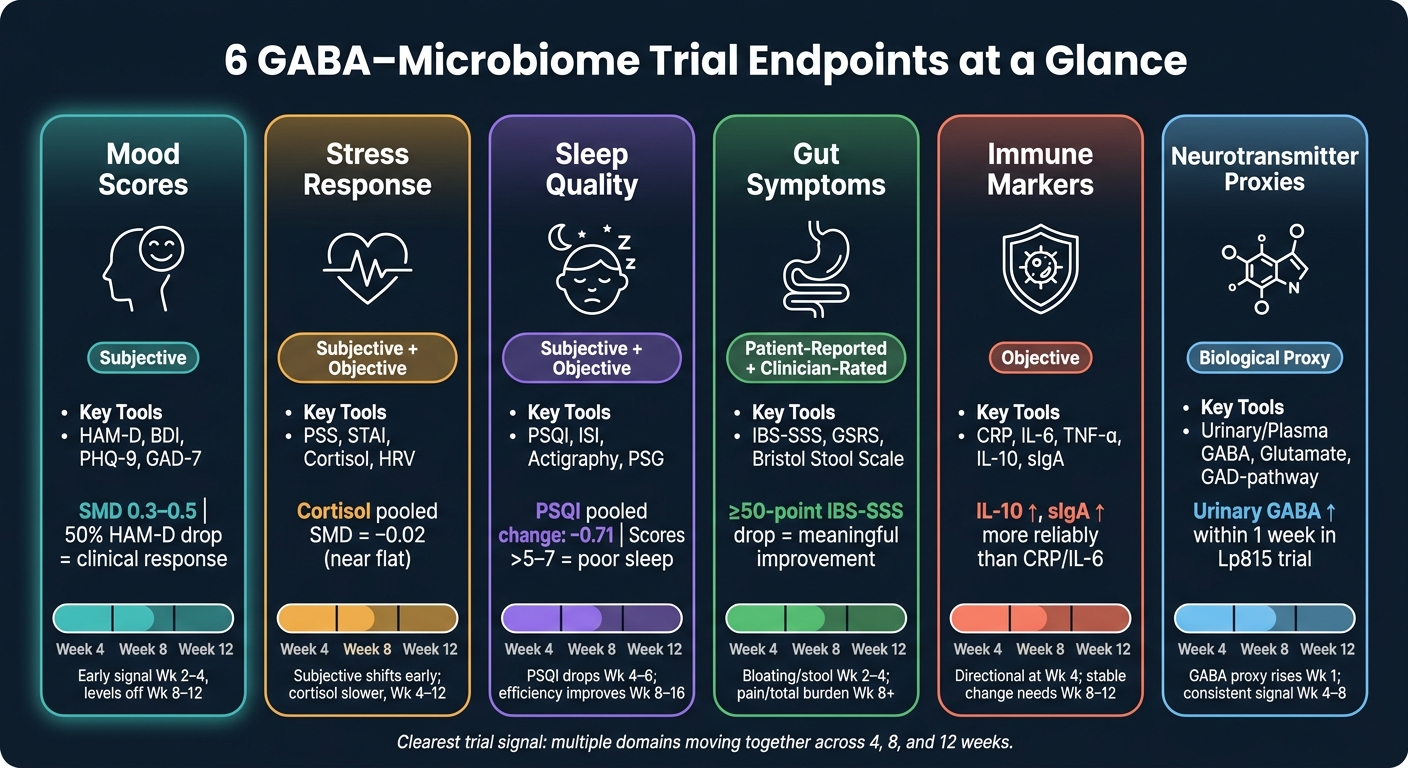
6 GABA Trial Endpoints: Measures, Tools & Signal Timelines
Here’s the quick view of the six endpoint domains used in GABA-focused microbiome trials. The table below boils them down into a trial-design snapshot.
| Domain | Example Measures | Type | 4 Weeks | 8 Weeks | 12 Weeks |
|---|---|---|---|---|---|
| Mood Scores | BDI-II, HADS, POMS, PANAS | Subjective | ~20–30% drop in scale scores; early signal | ≥35–40% drop; clearer signal | Relief that holds up; some reach remission thresholds |
| Stress Response | PSS, STAI; salivary cortisol, HRV | Subjective + Objective | ~15–25% drop in PSS; modest cortisol blunting | ≥30% drop in perceived stress; diurnal cortisol normalizing | Lower cortisol, better HRV, low stress scores that persist |
| Sleep Quality | PSQI, ISI; actigraphy, PSG | Subjective + Objective | 2–3 point PSQI drop; +3–5% sleep efficiency on actigraphy | +5–10% sleep efficiency; fewer nighttime awakenings | Low PSQI scores that stay steady; more normal sleep architecture on PSG |
| Gut Symptoms | IBS-SSS, GSRS, symptom diaries, Bristol Stool Form Scale | Patient-reported + clinician-rated | ≥50-point IBS-SSS drop; less bloating and irregularity | ≥75–100 point IBS-SSS drop; more regular stool form | Low symptom scores maintained; near-normal bowel habits |
| Immune Markers | hs-CRP, IL-6, TNF-α, IL-10, secretory IgA | Objective | Small but significant decreases in hs-CRP and IL-6 | Clearer cytokine shifts; possible rise in anti-inflammatory IL-10 | Low inflammatory profile maintained; stable mucosal IgA |
| Neurotransmitter-Related Proxies | Urinary/plasma GABA, glutamate, GAD-pathway signatures | Biological proxy | Early trends in peripheral GABA; data often noisy | More consistent shifts in peripheral GABA and glutamate; GAD-pathway signatures emerging | Brain-imaging GABA signals; symptom relief moving in parallel |
The next section shows why combining these endpoints gives a clearer trial signal than any single measure.
How Multi-Domain Endpoints Strengthen Trial Design
Once proxy markers start to shift, the next step is simple: do mood, sleep, and stress move too? Multi-domain endpoints help answer that by lining up symptom scores, biomarkers, and wearable data around the same effect. You’re looking at the result from a few angles at once - mechanism, symptom, and digital signal - which makes this a direct extension of the six endpoints above.
Why Combined Endpoints Matter
Trials are easier to trust when biologic change and patient-reported change move together. Pair subjective symptom scores with objective biological markers and wearable data, and you get more than a single reading. You get a built-in cross-check.
A biomarker on its own can’t tell you if people actually feel better. A symptom score on its own can’t show when the underlying biologic shift started. Put them together, and the picture gets much clearer.
How Study Windows Affect What You See
Timing plays a big role in multi-domain trial design because different endpoints change on different schedules. In a 6-week double-blind, placebo-controlled trial of the GABA-producing probiotic Lactiplantibacillus plantarum Lp815 involving 138 adults with sleep disturbances, urinary GABA increased in week 1, wearables showed longer sleep that same week, anxiety dropped by week 2, and insomnia showed its biggest improvement by week 6. At that point, 77.3% of participants in the probiotic group showed clinically meaningful improvement, compared with 57.8% in the placebo group. [72]
That pattern - biomarker first, then wearable signal, then symptom score - is exactly what multi-domain trials are built to pick up. Baseline severity can also change the timeline, since participants with more severe symptoms often improve earlier. If the follow-up window is too short, later symptom changes may never show up.
Conclusion
Taken together, these six endpoints give a broader view of GABA–microbiome effects. If you look at just one mood score, you can miss shifts in stress, sleep, gut function, inflammation, and GABA-related biology. This framework matters because it follows all six domains at once: mood, stress response, sleep quality, gut symptoms, immune markers, and neurotransmitter-related proxies.
That’s also why strain-specific findings can matter even when the headline scores don’t move. For example, Bifidobacterium longum 1714 improved sleep quality at week 4 without changing depression or stress scores, which is exactly why domain-specific endpoints matter.[8]
The clearest signal comes when multiple domains move in the same direction, not when only one measure shifts.[60][5][7][73] For clinicians and researchers, the main question is whether change shows up across domains and holds over time.
FAQs
Why do GABA trials need multiple endpoints?
GABA trials need more than one endpoint because the gut-brain axis works like a two-way street. What happens in the gut can affect the brain, and what happens in the brain can affect the gut. Neurotransmitter activity, stress hormones, and gut health are tightly connected.
That’s why researchers look at several signals at once. Measuring mood, stress response, sleep quality, gut symptoms, immune markers, and neurotransmitter proxies gives a broader view of whether microbial interventions lead to meaningful mental and physical changes.
Which endpoints change first?
In gut-brain axis trials, functional gut symptoms often improve first as the microbiome starts to settle. Bloating and digestive discomfort may ease before other body-level changes show up.
After that, shifts in immune markers and stress hormones like cortisol often begin to appear. Improvements in mood scores and sleep quality usually take longer, since they depend on a steadier return of neurotransmitter production and circadian signaling.
How long should a GABA trial last?
GABA-linked clinical trials usually run for 4 to 12 weeks. That gives researchers enough time to track meaningful shifts in mood, stress, and sleep.
Some changes can show up sooner. For example, less gut discomfort may appear within 7 days.
That said, steadier drops in anxiety and stress-related symptoms are more often seen after 8 weeks of regular use. Study length can vary, but one thing stays the same: consistency matters when you're trying to support the gut-brain axis.