

Your gut can affect your mood, and your mood can affect your gut. This guide makes one point clear: anxiety and depression often line up with lower short-chain fatty acid output, more inflammation-related gut changes, and stress-driven shifts in the gut-brain link.
Here’s the short version:
- Stress can change the gut. Long-term stress can alter cortisol, vagus nerve signaling, gut movement, and the gut lining.
- The microbiome can shape mood. Gut microbes affect serotonin, GABA, dopamine, SCFAs, and the kynurenine pathway.
- Anxiety and depression share gut patterns. Studies often find fewer butyrate-producing bacteria and more inflammation-linked microbes.
- There is no single “anxiety microbe” or “depression microbe.” These are group patterns, not a diagnosis.
- Daily habits matter most. Fiber, fermented foods if tolerated, regular meals, sleep, movement, and lower alcohol intake can help over 4 to 12 weeks.
- Supplements are not all the same. Prebiotics feed gut bacteria, probiotics are live microbes, postbiotics are non-living microbial parts or compounds, and synbiotics combine them.
- Mental health care still matters. Gut support can help, but it should not replace care from a doctor or therapist.
A few details stand out. A meta-analysis covering 59 case-control studies found a shared gut pattern across depression, anxiety, bipolar disorder, and schizophrenia: fewer butyrate producers and more pro-inflammatory taxa. That helps explain why gut symptoms, stress, and low mood often show up together.
Gut Health & Anxiety: How the Gut-Brain Connection Affects Your Mental Health
Quick comparison
| Area | What the guide says |
|---|---|
| Main gut change | Lower SCFA-producing bacteria, mainly butyrate producers |
| Main inflammation pattern | More pro-inflammatory and opportunistic taxa |
| Anxiety lean | More stress-related gut changes, often more Proteobacteria |
| Depression lean | More altered tryptophan metabolism, with more kynurenine pathway activity |
| Best starting steps | More fiber, steady meal timing, blood sugar balance, sleep, movement |
| Time frame | Most people should think in weeks, not days |
| When to get help | If mood or gut symptoms continue despite steady habits |
If you want the plain-English takeaway, it’s this: food, stress, sleep, and routine can shift gut-brain signaling, and small daily actions often matter more than chasing fast fixes.
How Gut-Brain Signaling Works
The gut and brain are in constant contact. They send signals back and forth through nerves, hormones, and the immune system. The main routes are stress signaling, immune signaling, and microbial metabolites.
Stress Biology: The HPA Axis, Cortisol, and the Vagus Nerve
When stress sticks around, it activates the HPA axis, increases cortisol, and changes vagus nerve signaling. Over time, that can affect how the gut moves, weaken the gut barrier, and shift the makeup of the microbiome.
Immune Crosstalk, Gut Permeability, and Inflammation
The gut microbiome plays a big part in regulating immune signaling. When the microbiome is disrupted, the gut barrier can weaken, inflammatory signaling can increase, and stress-linked signals can travel to the brain.
Neurotransmitters and Metabolites: Serotonin, GABA, Dopamine, and Kynurenine
Gut microbes affect the production and breakdown of key metabolites and neurotransmitter pathways. Serotonin, GABA, dopamine, SCFAs, and kynurenine sit at the center of gut-brain signaling and can shape mood, stress reactivity, and inflammation.
These pathways help explain the microbiome patterns linked to anxiety and depression.
sbb-itb-1bbfe7f
Microbiome Changes Linked to Anxiety and Depression
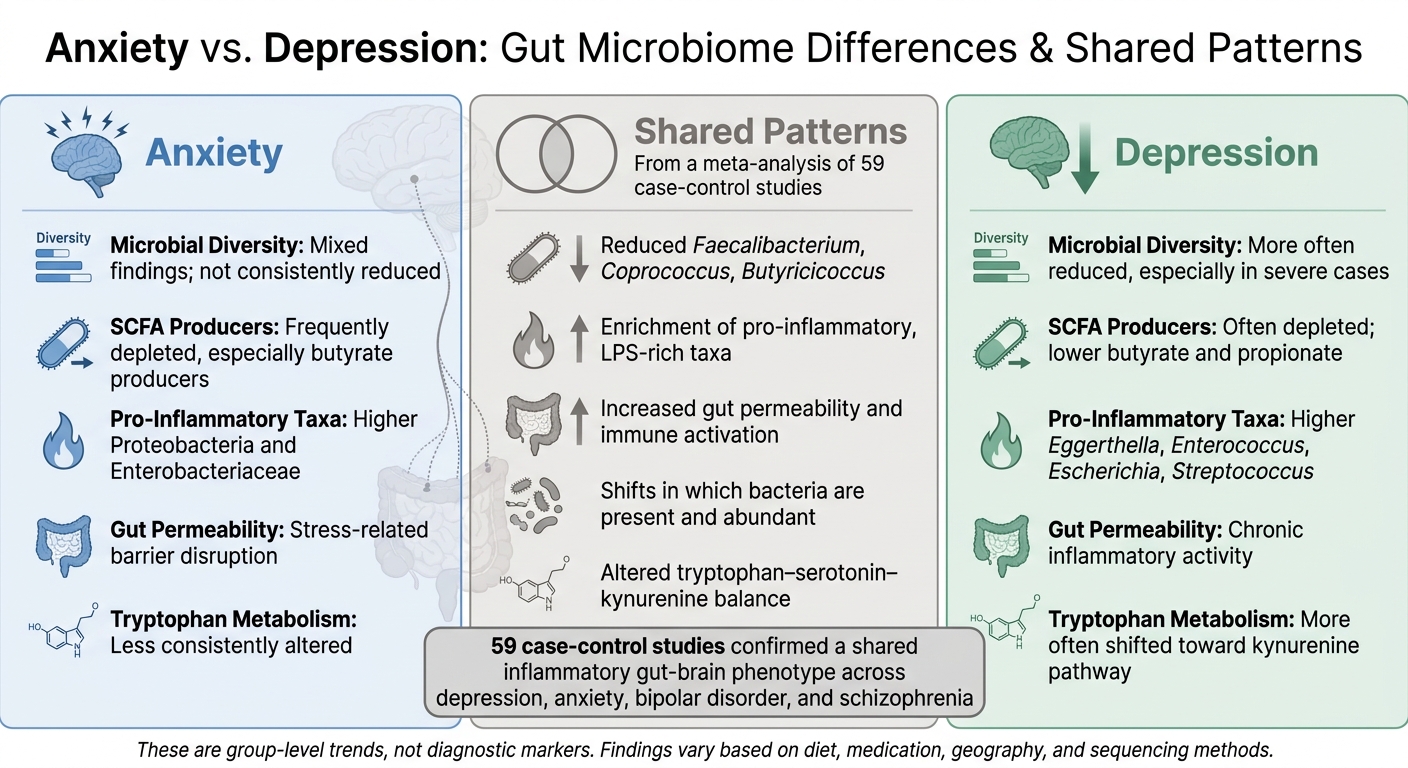
Anxiety vs. Depression: Gut Microbiome Differences & Shared Patterns
Research points to a shared pattern in anxiety and depression: fewer SCFA-producing bacteria, more pro-inflammatory and opportunistic taxa, and a shift in the gut ecosystem. In plain English, stress and immune activity seem to show up in the microbiome as lower SCFA output, weaker gut barrier support, and more inflammation-linked microbes.
Common Patterns: Lower Diversity, Fewer SCFA Producers, More Inflammatory Signaling
The clearest finding isn’t one “bad” microbe. It’s a broader shift in the gut ecosystem. People with anxiety and depression often have lower levels of bacteria that make short-chain fatty acids, especially butyrate, along with higher levels of pro-inflammatory and opportunistic taxa.[4][5][9][13]
Bacteria such as Faecalibacterium, Coprococcus, Butyricicoccus, and some Ruminococcus species show up at lower levels across many anxiety and depression cohorts.[2][4][8][10][13] On the other side, taxa tied to inflammatory signaling - including members of Proteobacteria, Enterobacteriaceae, Desulfovibrio, Streptococcus, and Veillonella - appear more often in these groups.[3][4][7][8][10][11][13]
That matters because butyrate helps maintain the gut barrier and keeps inflammation in check. Both of those jobs connect directly to anxiety and depression.[7][10][12]
Findings on overall microbial diversity are less clear-cut. Some studies find lower diversity, some don’t. What shows up more often is a change in which bacteria are present and how abundant they are.[14][15][16]
Anxiety-Specific and Depression-Specific Microbiome Patterns
There’s a shared pattern, but anxiety and depression don’t look exactly the same.
Anxiety tends to show more Proteobacteria and fewer SCFA producers, which fits with stronger stress reactivity.[3][10][13]
Depression more often shows altered tryptophan metabolism, with tryptophan pushed toward the kynurenine pathway and lower SCFA levels. Those changes are linked to persistent low mood and poorer remission rates.[4][5][6][7][9][10][12]
Comparison Table: Anxiety vs. Depression vs. Shared Gut Findings
The table below separates shared findings from patterns that lean more toward anxiety or depression. These are group-level trends, not diagnostic markers, because findings can shift based on diet, medication use, geography, and sequencing methods.[4][6][7][9][10]
| Feature | Anxiety-Related Patterns | Depression-Related Patterns | Shared Gut-Brain Findings |
|---|---|---|---|
| Microbial diversity | Mixed findings; not consistently reduced | More often reduced, especially in more severe cases | Shifts in which bacteria are present and abundant are more reliable than overall diversity changes |
| SCFA-producing bacteria | Frequently depleted, especially butyrate producers | Often depleted, with lower butyrate and propionate in several studies | Reduced Faecalibacterium, Coprococcus, Butyricicoccus, and related SCFA producers |
| Pro-inflammatory taxa | Higher Proteobacteria and Enterobacteriaceae in several cohorts | Higher Eggerthella, Enterococcus, Escherichia, and Streptococcus in multiple studies | Enrichment of pro-inflammatory, often LPS-rich taxa |
| Gut permeability | Associated with stress-related barrier disruption | Associated with chronic inflammatory activity | Increased permeability and immune activation are seen in both |
| Tryptophan metabolism | Less consistently altered | More often shifted toward the kynurenine pathway | Altered tryptophan–serotonin–kynurenine balance can appear in both |
A transdiagnostic meta-analysis of 59 case-control studies found a shared gut pattern across depression, anxiety, bipolar disorder, and schizophrenia - marked by reduced butyrate-producing bacteria and increased pro-inflammatory taxa.[17][18] That doesn’t point to one diagnostic microbiome signature. It does, however, support the idea of a shared inflammatory gut-brain phenotype that may help explain why these conditions so often overlap.
How to Restore Gut-Brain Balance
The microbiome reacts to what you eat, when you eat, how stressed you are, and whether you use targeted supplements. But this usually doesn’t shift overnight. In most cases, meaningful change takes weeks.
So start with the things you can control most: food, meal timing, and daily rhythm.
Food First: Fiber, Fermented Foods, Meal Timing, and Blood Sugar Stability
Start with dietary fiber, especially prebiotic fibers like galactooligosaccharides (GOS) and inulin. These help feed beneficial bacteria and support metabolite production.[1]
If you tolerate them well, add fermented foods. It also helps to eat at regular times and pair carbs with protein and fat. That simple move can smooth out blood sugar swings, which matters more than many people think.
Rebirth RE-1™ is a 3-in-1 eubiotic synbiotic with prebiotics, probiotics, and postbiotics in sachets, designed as a short-term microbiome reset.
If food alone isn’t enough, the next step is usually more targeted support: prebiotics, probiotics, synbiotics, and postbiotics.
Prebiotics, Probiotics, Synbiotics, and Postbiotics Explained
These four terms show up all the time in gut health discussions. And to be honest, they often get lumped together when they mean very different things.
Prebiotics are non-digestible fibers that feed beneficial bacteria already living in your gut.
Probiotics are live beneficial microbes that help repopulate the microbiome and defend against pathogens.
Postbiotics are inanimate microbial components or metabolites that help regulate immune signaling and inflammation.
Synbiotics combine prebiotics and probiotics, and sometimes postbiotics, in one formulation designed to work together to restore microbial balance.
One important catch: the evidence is strain-specific. And most gut-brain findings are still in the early stage.
Comparison Table: Prebiotics vs. Probiotics vs. Synbiotics vs. Postbiotics
| Category | What It Is | How It Works | Example |
|---|---|---|---|
| Prebiotics | Non-digestible fibers | Feed beneficial bacteria already in the gut | GOS, inulin |
| Probiotics | Live beneficial microbes | Repopulate the microbiome and help defend against pathogens | L. helveticus |
| Postbiotics | Inanimate microbial components or metabolites | Help regulate immune signaling and inflammation | L. paracasei BR-MCC1849 |
| Synbiotics | A combination of prebiotics, probiotics, and sometimes postbiotics | Designed to work together to restore microbial balance | Rebirth RE-1™ |
Beyond these categories, a few experimental options are still under study.
Newer Approaches and Realistic Expectations
FMT is FDA-approved for recurrent Clostridioides difficile infection, but its role in anxiety and depression is still investigational.[1] Early human trials show some signal, but the evidence isn’t strong enough yet to support clinical conclusions.
That’s why daily habits matter so much. Small, repeatable actions - and simple tracking - can help turn these shifts into steady support.
Daily Support for Adults and Families, and When to Get Help
Daily Habits That Support Gut and Mental Health
Food and supplements matter. But daily routine is what helps changes stick.
A few habits tend to throw the microbiome off balance: low fiber intake, ultra-processed foods, chronic stress, poor sleep, low physical activity, and not spending much time outdoors. The day-to-day fix is pretty simple, even if it’s not always easy.
Focus on:
- regular sleep
- daily movement
- daylight exposure
- less alcohol
- fewer ultra-processed foods and artificial sweeteners
For families, regular meal times can make a big difference. They give the day some structure, and that makes healthy habits easier to repeat.
How to Track Progress Without Chasing Day-to-Day Changes
This kind of change usually happens slowly. So instead of judging progress every day, check in once a week.
A few useful signs to watch:
- bowel regularity
- bloating frequency
- sleep quality
- stress tolerance
- general focus
These markers are practical because you can notice them in everyday life without overthinking it. And when it comes to broader shifts in the microbiome and mood, 4 to 12 weeks is a more realistic time frame.[1]
Conclusion: Key Takeaways and When to See a Clinician
Daily habits around sleep, stress, movement, food quality, and meal timing shape gut-brain balance over time.
If anxiety, low mood, or gut symptoms keep going even after you’ve been consistent with these habits, get clinical support. If you're pregnant or breastfeeding, consult a healthcare professional before starting any new protocol. Depending on your needs, that may mean a primary care clinician, gastroenterologist, or mental health professional.
FAQs
Can improving gut health ease anxiety or depression symptoms?
Yes. Better gut health may help ease symptoms of anxiety and depression. The gut-brain axis connects gut bacteria and mood through signals that involve neurotransmitters like serotonin, dopamine, and GABA.
When the microbiome gets out of balance, those signals can be thrown off. That may lead to more inflammation and stress. Rebiirth RE-1 is a 3-in-1 eubiotic synbiotic made to help bring that balance back.
How long does it take for gut-brain changes to show up?
Gut-brain changes don't always happen at the same pace. For some people, digestive relief, such as less bloating or abdominal discomfort, can show up within 7 days.
Changes tied to mood and stress often take longer, usually 2 weeks or more. A 4-week protocol may help steady gut flora and lower perceived stress. Fuller gut-brain support tends to peak around 8 to 12 weeks with steady use.
Should I start with food changes or supplements first?
A balanced approach works best because diet and supplements can support the gut-brain connection together.
Start with diet. Fiber-rich whole foods, fermented foods, and a Mediterranean-style eating pattern help build the base for a healthy microbiome.
Then supplements such as Rebiirth RE-1™ can build on that support and may help restore balance faster than diet alone, especially in cases of stress-related dysbiosis.