

More gut microbes don’t automatically mean better immunity. My starting advice: eat a range of fiber-rich foods, increase fiber slowly, and don’t treat a stool microbiome score as a diagnosis.
Here’s how I look at the main points:
- Function matters, not just species count. Microbes help maintain the gut barrier, regulate immune responses, and limit pathogen growth.
- Low diversity isn’t the same as disease. Diet, antibiotics, infection, and inflammation can change the microbiome - and illness can cause those changes, too.
- Daily habits come first. I’d focus on foods such as beans, oats, fruits, and vegetables, plus regular sleep and activity. These steps don’t replace medical care.
- Biotics need product-specific evidence. Prebiotics, probiotics, and synbiotics (plus postbiotics) work differently. Strains, doses, and human trial results matter more than labels.
- A “reset” isn’t a proven outcome. Rebirth RE-1’s advertised 500 billion CFU per serving and 7-day, 4-week, and 12-week plans don’t establish lasting results.
My takeaway: aim for <u>gut function and symptom relief</u>, not the highest diversity score. If symptoms persist - or you have blood in your stool or unexplained weight loss - seek medical care rather than relying on supplements.
The Emerging Role of the Gut Microbiome in Immune Health: Nutrition Nexus Live
sbb-itb-1bbfe7f
How Gut Microbes Shape Immune Responses
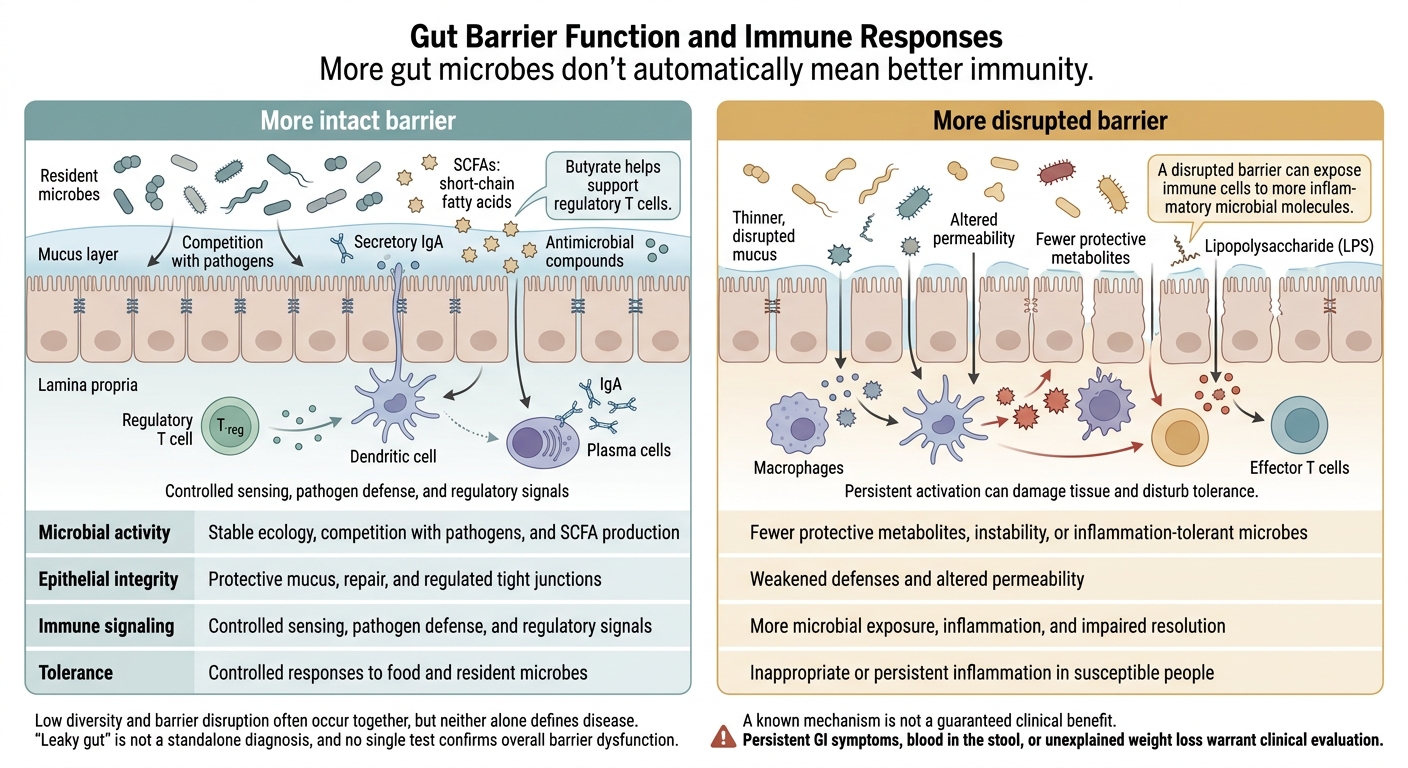
Gut Barrier Function and Immune Responses
A more diverse gut community exposes the immune system to a broader range of microbial signals - and gives it more signals to learn to regulate.
Microbial Signals and Immune Cells
Microbial cell-wall components and metabolites activate innate immune sensors on epithelial and immune cells. Macrophages eliminate invaders, while dendritic cells sample material and guide targeted T- and B-cell responses.
Cytokines coordinate this work. Interleukin-10 limits inflammation, while other signals support pathogen defense. Butyrate also helps support regulatory T cells.[4][8][11]
More diverse communities usually supply more varied signals. This can support immune balance and keep inflammation-tolerant microbes from dominating. These signals can strengthen barrier defenses and train immune tolerance. When poorly regulated, though, they can drive inflammation.
A known mechanism is not a guaranteed clinical benefit. The same microbial signal can promote protection, tolerance, or inflammation depending on where it acts, how much is present, and the host’s condition. Cell and animal studies support many short-chain fatty acid (SCFA) mechanisms, but human outcomes still depend on context.[6][11]
These signals don’t just trigger defenses. They also help establish tolerance at the gut surface.
Immune Tolerance and Gut Defenses
Gut-associated lymphoid tissue coordinates responses to food and microbes.[7] Regulatory T cells, secretory IgA, mucus, tight junctions, and antimicrobial compounds help contain threats. Meanwhile, resident microbes compete for space and nutrients.
When these defenses hold, immune signaling stays local and controlled.
Intact vs. Disrupted Gut Barriers
Protective immune activation is targeted and temporary. A loss of microbial diversity can reduce protective metabolite production and weaken resistance to invasion.
A disrupted barrier can expose immune cells to more inflammatory microbial molecules, including lipopolysaccharide. If activation persists, it can damage tissue and disturb tolerance.[9][10]
| Feature | More intact barrier | More disrupted barrier |
|---|---|---|
| Microbial activity | Stable ecology, competition with pathogens, and SCFA production | Fewer protective metabolites, instability, or inflammation-tolerant microbes |
| Epithelial integrity | Protective mucus, repair, and regulated tight junctions | Weakened defenses and altered permeability |
| Immune signaling | Controlled sensing, pathogen defense, and regulatory signals | More microbial exposure, inflammation, and impaired resolution |
| Tolerance | Controlled responses to food and resident microbes | Inappropriate or persistent inflammation in susceptible people |
Low diversity and barrier disruption often occur together, but neither alone defines disease.
“Leaky gut” is not a standalone diagnosis, and no single test confirms overall barrier dysfunction. Persistent GI symptoms, blood in the stool, or unexplained weight loss warrant clinical evaluation - not treating “leaky gut” as a diagnosis.
Low Microbial Diversity and Dysbiosis
When these shifts persist, the microbiome can become less resilient and move toward dysbiosis.
Dysbiosis is a change in microbial composition, location, or function. Low diversity means fewer types of microbes or a less even distribution among them. The two can overlap, but neither proves the other.[13][17][19][21][15][23]
Causes of Microbiome Changes
Diets low in fiber and high in saturated fat, added sugar, and ultraprocessed foods are linked to less favorable microbial patterns. Vegetables, fruits, legumes, whole grains, nuts, and seeds provide more fermentable fiber. Increase fiber gradually, especially if you have gastrointestinal symptoms. Active intestinal disease may call for dietary advice tailored to your needs.[13][18][20]
Antibiotics, gastrointestinal (GI) infections, illness, hospitalization, and some medications can also change the microbiome. Changes linked to aging aren't always harmful: diet, frailty, activity, and living conditions help explain the differences. Sleep, activity, stress, and surroundings may also play a role, though the evidence is mostly observational. Aim for regular sleep and activity, but don't expect one habit to restore the microbiome by itself. Don't stop prescribed medication to protect your microbiome.[13][14][15][20][26]
These shifts can change the signals your immune system receives.
Links to Inflammation and Reduced Tolerance
Dysbiosis can weaken colonization resistance and change mucus, intestinal permeability, and immune tolerance. These changes may promote inflammation, but a low-diversity result doesn't automatically mean disease.[16][12][3][22]
Laboratory findings point to possible mechanisms, while observational studies link dysbiosis with inflammatory bowel disease (IBD), obesity, and type 2 diabetes. Those links don't establish that changing the microbiome will improve health. Controlled human studies are needed to show benefits, such as fewer symptoms or relapses.[17][18][19][24][25]
In IBD, inflammation, diarrhea, dietary changes, and treatment can themselves reshape the microbiome. Findings also vary by disease, diet, medication, population, and testing method. Treat stool microbiome reports as context - not as a stand-alone basis for treatment.[17][18][19][24][25]
Microbiome Support: Daily Habits, Biotics, and Rebirth RE-1
Microbiome support aims to help your microbiome function well and withstand disruption - not promise a reset. Build meals around a range of fiber sources: beans, lentils, oats, whole grains, vegetables, fruits, nuts, and seeds, as tolerated. Add fiber gradually and drink enough fluids to reduce gas, bloating, or stool changes.
Physical activity, sleep, stress control, and avoiding unnecessary antibiotics also help. These habits do not replace treatment for diagnosed disease.[30] When microbial diversity drops, support starts with diet and may include targeted biotics.
Prebiotics, Probiotics, Postbiotics, and Synbiotics
These terms have specific definitions. A complementary synbiotic combines components that independently meet probiotic and prebiotic criteria. A synergistic synbiotic uses a substrate chosen to support the microorganism given alongside it. Results depend on the strain, dose, formulation, duration, and person.[1][2][27][28][29]
Each tool works differently: feeding resident microbes, adding live strains, or supplying microbial components.
| Category | Definition | Key requirement or limitation |
|---|---|---|
| Prebiotic | A substrate selectively used by gut microbes that provides a health benefit | Not every fiber qualifies; effects vary with dose, diet, and microbiome |
| Probiotic | Live microorganisms that provide a health benefit in adequate amounts | Benefits require defined strains and adequate viable doses; findings are strain-specific |
| Postbiotic | Inanimate microorganisms and/or their components that provide a health benefit | Isolated metabolites or sterile filtrates alone do not qualify |
| Synbiotic | Live microorganisms plus selectively used substrates that together provide a health benefit | Added fiber or a high CFU count alone does not prove efficacy |
Human Origin Strains and Rebirth RE-1 Ingredients
Rebirth RE-1 is a branded synbiotic. Its label and evidence for the finished formula matter more than its marketing summary.
Human Origin Strains (HOSt™) refers to strains selected from human-associated sources. That origin alone does not establish efficacy.
The manufacturer describes Rebirth RE-1 as a 3-in-1 eubiotic synbiotic with prebiotics, probiotics, and postbiotics, supplied in sachets containing 500 billion CFU per serving. It also claims Lyosublime™ delivery technology and says refrigeration is not required.
Check the exact strains, postbiotic components, allergens, storage instructions, and whether the CFU count holds through expiration. The label and website list different amounts of GOS and inulin fiber, so confirm the current figures before publication. Claims about absorption or clinical benefits need human evidence for the finished product.[32]
Rebirth RE-1 Plans, Evidence, and Safety
Consider price and duration alongside human data that match the finished formula. The manufacturer lists a 7-Day Reset at $79, a 4-Week Reset at $279, and a 12-Week Reset at $749. Before publication or purchase, verify current prices, serving counts, shipping charges, and daily instructions.[31]
These plans are marketing programs, not established clinical protocols. Neither a longer duration nor a higher CFU count guarantees better outcomes. Review randomized human trials of the finished formulation for matching strains, doses, and durations; comparable participants; predefined immune or barrier outcomes; and adverse events. Current evidence does not establish a lasting microbiome reset for Rebirth RE-1.[29][32]
Safety: GOS and inulin can cause gas, bloating, discomfort, or stool changes. Follow the verified label, and do not double doses. Consult a clinician before use if you are immunocompromised, pregnant, breastfeeding, hospitalized, managing complex GI disease, have severe allergies, or are considering use in a child. Seek medical care for persistent GI symptoms, blood in stool, unexplained weight loss, or severe symptoms such as abdominal pain, vomiting, fever, or dehydration.[30]
Conclusion: Diversity Is One Part of Immune Health
A higher diversity score doesn’t automatically mean better immunity. Microbial metabolites, including short-chain fatty acids, help regulate immune tolerance and support the integrity of the gut barrier.
Read test results with care. Stool microbiome tests offer limited context, and no validated healthy species profile or restoration target exists. They show part of the picture of low diversity and dysbiosis - not the full picture of immune health.[5][35]
The practical goal is support, not a reset. Start with diet and daily habits, and seek care tailored to your needs if symptoms persist. Track progress through symptoms and function, not microbe count.
If you use a product, assess the evidence for its finished formula. For Rebirth RE-1, look for human trials of the finished formulation that report the desired benefit, how long it lasts, and any safety issues. Its 7-day, 4-week, and 12-week programs are marketing timelines, not biological deadlines. Let evidence - not reset terminology - guide product use.[33][34][36]
FAQs
How can I tell if my gut health is improving?
Signs your gut health may be improving include less bloating and abdominal discomfort, more regular digestion, and fewer allergy-like symptoms or recurring infections. Lower inflammation markers and better gut barrier function may also point to progress.
Keep a symptom log and consider at-home testing to track changes. Improvements typically build over 4–12 weeks of consistent use, but they can fade if you stop. [1][2]
How long does microbiome recovery take after antibiotics?
Gut recovery after antibiotics often takes months or even years, and some helpful bacterial populations may never return to their previous levels [1]. Antibiotics can also sharply reduce the variety of gut microbes within a single week [1].
Consistent support with synbiotic interventions, such as Rebiirth RE-1, can help replenish helpful bacteria and restore balance in the gut during recovery [1].
What evidence should I look for before trying Rebirth RE-1?
Look for clinical evidence supporting high-potency synbiotics that combine prebiotics, probiotics, and postbiotics to work together [1][2]. Focus on clinically researched strains, such as Human Origin Strains (HOSt), selected to colonize the gut and support immune health [1][2].
Check for evidence that delivery systems like Lyosublime protect these ingredients from stomach acid, helping them reach the lower intestine for optimal absorption [1][2].