

Antibiotics can change gut-brain signaling fast. After treatment, research often finds lower SCFAs and GABA, shifts in serotonin-related pathways, and slower recovery of some gut microbes for weeks, months, or even longer.
If I had to sum it up in plain English, it’s this:
- Antibiotics can reduce gut microbial diversity
- Some bacteria linked to GABA, serotonin, and butyrate often drop
- That may affect digestion, mood, sleep, stress signaling, and immune activity
- Recovery is often partial, not instant
- Food choices like fiber-rich foods and fermented foods are being studied to support recovery
A few facts stand out:
- 90% to 95% of the body’s serotonin is made in the gut
- In one study, the microbiota moved close to baseline at about 1.5 months, but nine common species were still missing in most people at 180 days
- In some children, lower microbiome richness after 12 to 14 days of antibiotics lasted up to 2 years
Put another way: when antibiotics disrupt key microbes like Lactobacillus, Bifidobacterium, Faecalibacterium prausnitzii, and some Clostridia, the gut may make less of the compounds that help regulate motility, stress response, inflammation, and sleep-related signaling.
Here’s the short version of what the article shows:
- Serotonin: mostly made by gut cells, but microbes help control the process
- GABA: linked to microbes such as Lactobacillus and Bifidobacterium
- SCFAs: support the gut barrier and help keep inflammation lower
- After antibiotics: these systems can shift together, not one at a time
So if you’ve ever felt “off” after antibiotics, the article’s main point is simple: the gut may recover before its chemical output fully does.
Antibiotics, Anxiety and Your Gut
sbb-itb-1bbfe7f
Gut Bacteria Linked to Neurotransmitter Production
Some gut bacteria make signaling compounds on their own. Others change how many raw materials are available, or nudge gut cells to do the work instead. In practice, two groups stand out most: microbes tied to serotonin and microbes that make GABA. These are also the groups that often change or drop after antibiotic use.
Serotonin-Related Microbes and Tryptophan Pathways
Spore-forming Clostridia are closely tied to gut serotonin signaling because they stimulate enterochromaffin (EC) cells. Those cells produce most of the serotonin found in the intestine.
Genera such as Lactobacillus, Streptococcus, Klebsiella, and Escherichia coli affect tryptophan metabolism indirectly. That matters because tryptophan is a key starting material for serotonin. After antibiotics, more tryptophan may get diverted away from serotonin synthesis and into the kynurenine pathway. That shift has been linked to inflammation and depressive symptoms.
GABA-Producing Microbes and Key Synthesis Genes
Lactobacillus and Bifidobacterium are major GABA producers. They turn glutamate into GABA through the glutamate decarboxylase, or GAD, system. This pathway is tied to the genes gadA, gadB, and gadC.
Bacteroides xylanisolvens and Blautia use that same glutamate decarboxylation route. So when these microbes change, GABA signaling can change with them.
Table: Microbial Taxa, Signaling Compounds, and Physiological Roles
| Bacterial Group or Genus | Primary Signaling Compound | Main Pathway or Gene | Physiological Roles |
|---|---|---|---|
| Spore-forming Clostridia | Serotonin (5-HT) | EC cell signaling | Gut motility |
| Lactobacillus | GABA, Serotonin | GAD pathway; tryptophan metabolism | Mood, sleep, stress response |
| Bifidobacterium | GABA | GAD pathway | Stress response, immune balance |
| Bacteroides xylanisolvens | GABA | gadA, gadB, gadC | Inhibitory signaling |
| Streptococcus | Serotonin | Tryptophan metabolism | Serotonin-linked signaling |
| Escherichia coli | Serotonin | Tryptophan metabolism | Mood signaling |
| Faecalibacterium prausnitzii | SCFAs (Butyrate) | Carbohydrate fermentation | Anti-inflammatory signaling |
| Blautia | GABA | Glutamate decarboxylation | Mood and metabolic regulation |
After antibiotics, these taxa are often among the first to shift. When that happens, signaling tied to serotonin, GABA, glutamate, and SCFAs can shift too.
What Studies Show After Antibiotic Exposure
After antibiotics, studies tend to show the same pattern: the gut makes less of several neuroactive compounds. And those changes can appear fast in metabolite data.
Changes in Serotonin, GABA, and SCFAs After Antibiotics
After antibiotic treatment, drops in SCFAs and GABA are some of the most consistent findings in the research. In plain English, that points to a microbiome that’s no longer doing its usual job in making compounds tied to gut-brain signaling.
Serotonin works a bit differently. Most serotonin is made by enterochromaffin cells in the gut, not by microbes themselves. But gut microbes help control that process, so when the microbiome shifts, serotonin-related signaling can shift too.
Antibiotic-Treated vs. Germ-Free Models: What Each Reveals
These two research models show slightly different sides of the same story.
Germ-free models show what happens when microbes are missing from the start: lower serotonin levels, altered sleep-wake patterns, and stronger HPA-axis responses. Antibiotic-treated models show what happens when an established microbiota gets disrupted: lower SCFA and GABA output, along with mood- and anxiety-like changes.
Put together, they help separate two effects:
- what happens when microbes are absent
- what happens when microbes are suddenly lost after being there before
Timeline: Baseline, Treatment, and Recovery Phases
The table below shows the broad pattern seen across studies, from a stable microbiome to disruption and then partial recovery.
| Phase | Microbial Changes | Neuroactive Metabolite Changes |
|---|---|---|
| Baseline | Stable, diverse microbiome | Typical SCFAs, GABA, and serotonin-related signaling |
| During Antibiotic Exposure | Microbial diversity drops | Decreased SCFA and GABA production |
| Recovery | Microbial balance begins to recover | Neuroactive metabolite levels recover toward baseline |
These metabolite shifts help explain why later effects often show up in digestion, mood, sleep, and immune balance.
How Dysbiosis May Affect Digestion, Mood, Sleep, and Immune Function
Low levels of SCFAs and GABA can throw off digestion, sleep, mood, and immune signaling.
Digestion and Gut Motility
When antibiotics disrupt serotonin-linked microbes, gut transit can speed up or slow down. The result can be diarrhea or constipation.
If GABA-producing microbes drop, visceral sensitivity may go up. That can mean more pain, bloating, and a gut that feels harder to settle.
Lower butyrate from depleted Faecalibacterium prausnitzii can weaken the gut barrier and worsen local inflammation.
Those same changes don't stay in the gut. They can spill over into sleep and stress patterns too.
Mood, Stress Response, and Sleep
Low-grade inflammation can break up sleep and disrupt circadian rhythm [1].
And that doesn't happen in isolation. Immune signaling helps keep that cycle going.
Immune Balance and Inflammatory Signaling
When butyrate-producing bacteria decline, the gut barrier gets weaker. That can let lipopolysaccharides (LPS) and other endotoxins pass into the bloodstream through increased gut permeability. Once LPS is in circulation, it can trigger the release of pro-inflammatory cytokines like IL-6 and TNF-α, pushing the immune system into a more inflammatory state.
That inflammation can feed back into the gut-brain axis in a few ways:
- It can activate the HPA axis and increase cortisol.
- It can divert tryptophan away from serotonin production and toward the kynurenine pathway, which makes metabolites tied to mood disturbances.
- The vagus nerve can carry these inflammatory signals to the brain, contributing to sickness behavior - fatigue, low mood, anxiety, and poor concentration.
Mood and sleep symptoms can last longer than digestive symptoms because inflammation may continue even after the microbiome starts to recover [1].
Microbiome Recovery, Research Gaps, and Key Takeaways
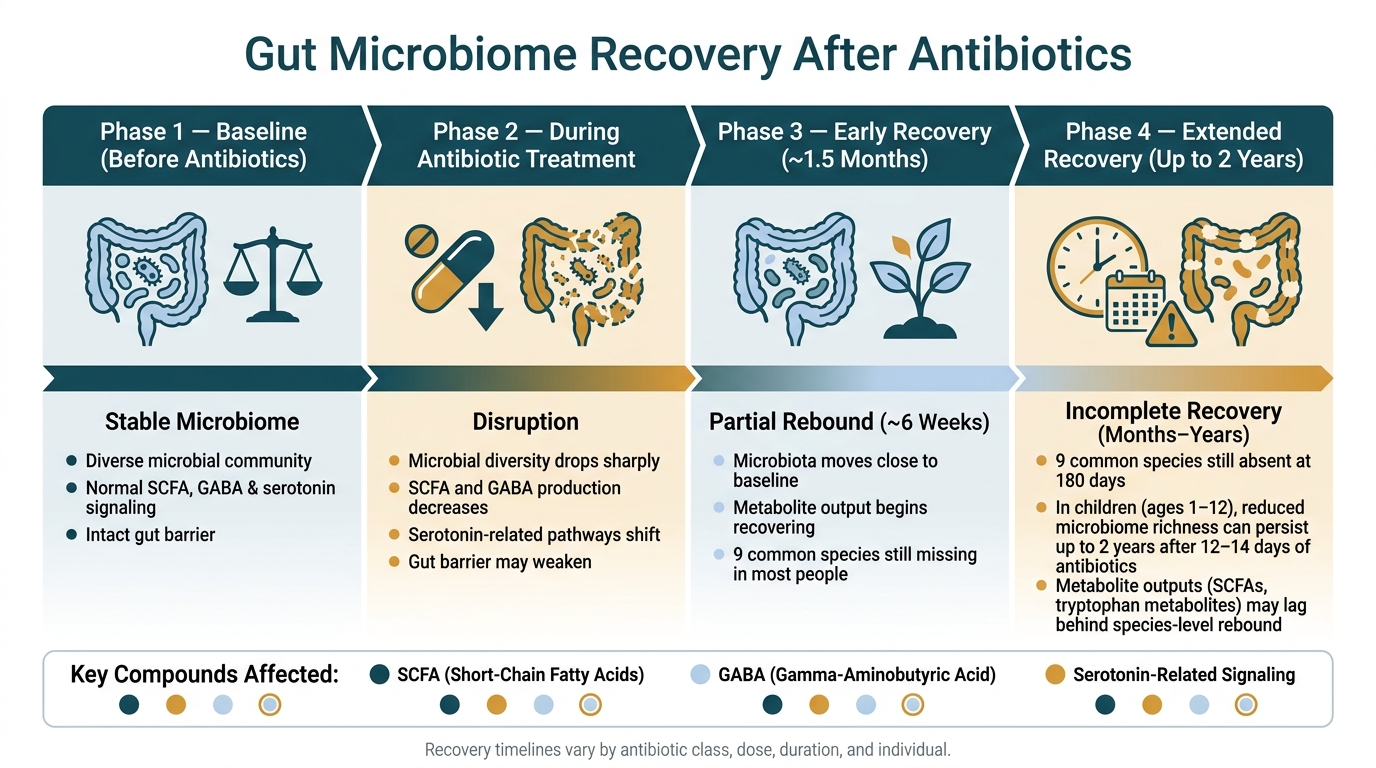
Gut Microbiome Recovery Timeline After Antibiotics
Recovery Strategies Currently Being Studied
Some metabolite shifts stick around longer than the first hit to the microbiome. That’s why current research looks at two things at once: getting microbial diversity back and getting microbial activity back. After antibiotics, recovery can take weeks to months, and a full return to baseline doesn’t always happen. In one study, the microbiota moved close to baseline at about 1.5 months, but nine common species were still missing in most participants at 180 days.[5]
On the diet side, high-fiber eating patterns are among the most studied options after disruption.[6][11] That usually means foods like legumes, whole grains, oats, and a mix of fruits and vegetables. These patterns are linked to support for SCFA-producing bacteria such as Faecalibacterium and Roseburia, which matters for butyrate output and tryptophan availability.[6][11]
Fermented foods like yogurt and kefir are also getting attention. They can introduce live microbes and bioactive metabolites tied to GABA and serotonin signaling during recovery.[6]
Outside of food, researchers are also looking at synbiotic and eubiotic formulations as tools to help rebuild microbial diversity and restore metabolite output, including SCFAs, GABA, and tryptophan metabolites tied to the gut–brain axis.[6][8] Rebirth RE-1™ is one example of a clinically backed eubiotic synbiotic being studied for microbiome recovery. These approaches may help support recovery from dysbiosis, but effects are strain-specific, and results can differ from person to person.[2][6][8][10]
Even so, recovery doesn’t follow the same path for everyone, and the data still has gaps.
Limits of the Current Evidence
The research is encouraging, but it’s still patchy. One big issue is that studies are hard to line up side by side. Antibiotic class, dose, duration, and patient group all differ, which makes clean comparisons tough.[2][7][10] In children ages 1–12 years, studies found that 12–14 days of antibiotics reduced microbiome richness, and in some cases that loss did not recover for up to 2 years.[8]
There’s also an important split between taxonomic recovery and functional recovery. In plain English, one asks which species came back, while the other asks what those species are actually making. Those aren’t always the same thing. Metabolite outputs such as SCFAs and tryptophan metabolites may recover more slowly than species-level rebound.[3][9][14]
Animal models do a good job of mapping mechanisms, but human research still leans mostly on indirect markers instead of direct CNS neurotransmitter measures.[11][12]
Conclusion: What Current Research Suggests
Taken together, the studies suggest partial recovery, not a fast reset.
- Antibiotics can quickly reduce gut microbial diversity and disrupt taxa involved in producing SCFAs, tryptophan metabolites, serotonin, GABA, and glutamate-related signaling molecules. Some species and functions may stay altered for months to years.[2][3][4][8][9][13]
- Dysbiosis after antibiotics may affect digestion, mood, stress response, sleep, and immune balance, though responses differ by person, and cause-and-effect links are still being sorted out.[2][6][8][9][11][12]
- Dietary strategies and targeted synbiotic or eubiotic formulations are being studied as practical ways to support microbial diversity and metabolite production during recovery.[2][6][8][10][11]
- The evidence still has limits because study designs vary, animal and human findings don’t always match neatly, and researchers have not fully mapped specific microbes to neurotransmitter outcomes.[2][3][6][9]
FAQs
How long can gut changes last after antibiotics?
Antibiotics can hit the gut microbiome hard. They don’t just target the bacteria causing an infection. They can also reduce helpful gut bacteria, which may leave the microbiome out of balance for a while.
Some people notice digestive symptoms start to improve within the first week of using a restorative synbiotic. But gut recovery usually takes longer than that. In many cases, full microbiome recovery can take up to 3 months with steady care.
Rebiirth RE-1 is built to support that timeline with a 7-day reset, a 4-week stability phase, and a 12-week program for longer-term recovery.
Can antibiotics affect mood or sleep through the gut?
Yes. Antibiotics can affect mood and sleep through the gut-brain axis. They can cut down microbial diversity and lower helpful bacteria such as Lactobacillus and Bifidobacterium.
These microbes help support the production of serotonin, GABA, and dopamine. So when antibiotics disrupt the gut microbiome, that imbalance may play a part in mood changes, sleep problems, anxiety, and gut-driven inflammation that can also affect the brain.
What foods may support microbiome recovery?
Foods that can help the microbiome recover include prebiotic foods, which feed helpful bacteria. Good picks include garlic, onions, bananas, oats, and legumes.
Fermented foods can help too. Yogurt, kimchi, and sauerkraut supply natural probiotics.
Foods high in glutamate and glutamine, such as tomatoes, spinach, aged cheese, and bone broth, may also help support signaling compounds like GABA.
Rebiirth RE-1™ may help as a rapid microbiome reset.