

Home microbiome tests are shifting from simple gut reports to action-focused wellness tools. From strain-level tracking and 7-day lab turnaround to better sample handling, AI-based report reading, family testing, infant screening, and reset programs, the big theme is simple: people want results they can use.
If I had to sum it up fast, here’s what matters most:
- Tests are getting more precise by looking past genus-level labels
- Labs are moving toward about 7-day results
- Sample stability matters because shipping can change what shows up
- AI helps sort patterns and make reports easier to use
- Family and infant testing are gaining attention
- More kits now connect results to follow-up reset programs, not just a report
A few numbers stand out:
- 80% of urban dwellers reported daily gut issues in the last 30 days before seeking support
- C-section rates are up 400% since 1985
- Urban infants may lose about 50% of gut microbiota compared with infants in less developed settings
- In one 7-day program, 94% of adults reported less bloating and abdominal pain
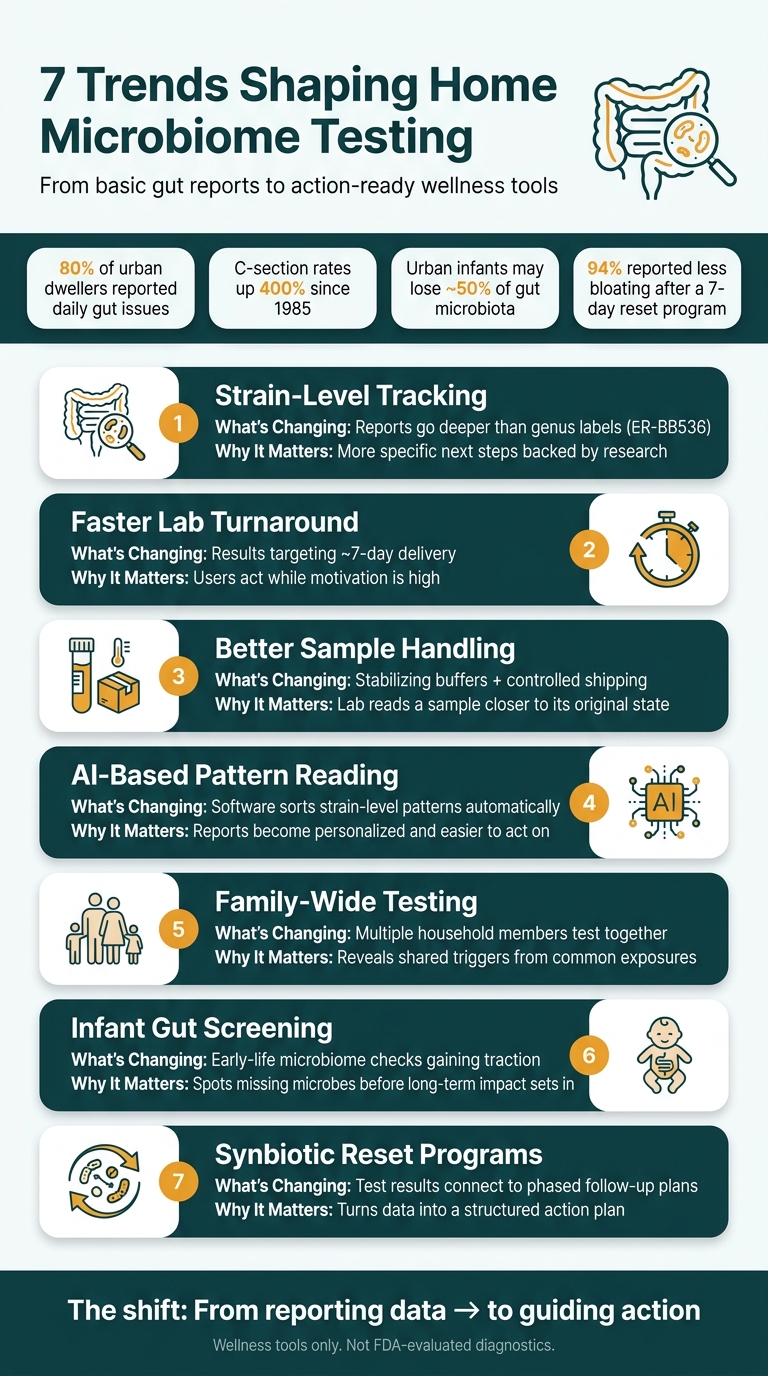
7 Home Microbiome Testing Trends: What's Changing & Why It Matters
At-home gut microbiome tests grow in popularity, but experts say they’re limited
sbb-itb-1bbfe7f
Quick Comparison
| Trend | What’s changing | Why it matters |
|---|---|---|
| Strain-level tracking | Reports go deeper than genus labels | Gives a more specific next step |
| Faster turnaround | Results often aim for about 7 days | Lets people act while interest is still high |
| Better sample handling | Buffers and shipping controls protect the sample | Helps the lab read a sample closer to the original state |
| AI-based reading | Software sorts strain patterns and report findings | Makes results easier to understand |
| Family-wide testing | Multiple people in one home test together | Can show shared triggers in the household |
| Infant screening | Early-life gut checks get more attention | May help spot missing microbes early |
| Synbiotic reset programs | Testing links to follow-up routines | Turns results into a plan |
The short version: I see this market entering a new stage where the report itself matters less than the next step it supports. That’s the shift behind all seven trends below.
Why Home Microbiome Testing Is Entering a New Phase
Home microbiome testing is moving in a more useful direction. The focus now is on testing that leads to a clear next step, built to support microbial balance through human-derived strains. Those changes are showing up in seven clear trends.
As gut disruption becomes easier to see, testing is shifting from simple reporting to action. Urbanization, antibiotics, and ultra-processed foods have reshaped the gut microbiome in ways that are hard to ignore. And people don’t just want data anymore. They want testing that tells them what to do next.
Better stabilization is also changing the picture. It helps samples arrive intact and improves the reliability of results. That’s a big deal for at-home testing, where handling and shipping can affect what shows up in the final report. This makes proper sample storage essential for maintaining data integrity.
Consumer expectations are changing too. Buyers want more than a static report sitting in their inbox. They want a clear next-step program they can actually use.
1. Strain-Level Tracking Replaces Basic Genus Reports
Most early at-home microbiome tests reported only a genus, like Lactobacillus or Bifidobacterium. That’s a useful starting point, but it’s still too broad to guide a clear next move.
Strain-level tracking goes one step deeper. Instead of stopping at a genus like Bifidobacterium, it identifies the exact strain - for example, Bifidobacterium longum BR-BB536 - and ties it to specific outcomes backed by research. A 2024 study linked that strain to lower visceral fat and total fat after 16 weeks.[1]
That extra detail matters. The strain listed in a report should match what’s actually established in the gut. And not every detected strain meets that bar. Some signals may be temporary. By contrast, Human Origin Strains (HOSt®) are designed to support lasting colonization.[1]
So the value here is pretty simple: strain-level reporting makes it easier to move from a vague label to a more targeted next step. Then comes the next hurdle - speed. Even deeper reports need to show up fast enough to stay useful.
2. Faster Lab Turnaround Becomes a Competitive Standard
Seven days is starting to look like the mark consumers expect for rapid microbiome results. That puts labs under more pressure to move fast. And when results arrive sooner, users can act on them within days instead of waiting around. [1]
To keep pace, labs are leaning on faster DNA sequencing pipelines, automated report generation, and tighter sample logistics as part of the standard workflow. But speed alone isn't enough. If accuracy slips, fast results don't help much. That's why many labs are adding more checkpoints, including 50-plus quality checks and batch-to-batch testing, alongside GMP standards. [1]
The demand makes sense. 80% of urban dwellers reported daily gut disturbances in the 30 days before they looked for microbiome support. [1] For people dealing with symptoms day after day, speed is what makes testing feel usable, not just informative.
Fast reporting matters only if the sample stays usable in transit. This requires following specific steps to store microbiome samples correctly before they reach the lab.
3. Better Sample Handling Improves At-Home Accuracy
Speed matters, but only if the sample arrives at the lab in good shape.
A home microbiome test is only as useful as the sample that gets there. That means collection and shipping need to protect the original profile, not change it along the way.
One clear step forward is the use of stabilizing buffers. These help maintain the sample's microbiome composition after collection. And when shipping time, temperature, and packaging are controlled, the lab can read a sample that's closer to its original microbiome profile.
That cleaner input also makes AI-based analysis more reliable.
4. AI-Based Pattern Reading Makes Reports More Personalized
With cleaner samples and stronger data, AI can spot strain-level patterns that a basic genus summary can miss. And that matters. Strains that sit under the same genus don’t always affect health in the same way.
AI also helps on the interpretation side. It can sort through results faster, surface what matters first, and make reports feel more tailored to the person reading them. In plain English: it helps turn raw microbiome data into a more usable next step. [1]
That makes reports feel more personal and easier to read. It also opens the door to broader family testing.
5. Family-Wide Testing Expands Beyond Individual Users
Family-wide testing can show patterns that a single test may miss. When several people in the same home test together, the results give a household-level view of the microbiome, not just one person’s snapshot.
Shared exposures at home - like air pollution, chlorinated water, BPA, and PFOAs - can lower microbiome diversity across a household.[1] So instead of reading each report in isolation, families can look for overlap and spot trends that affect everyone under the same roof.
This kind of testing can also show whether core microbes appear across parents and children. That shared data may help connect common symptoms to the same microbial imbalances.[1] In plain English: if more than one family member is dealing with similar issues, the microbiome data may point to a shared trigger rather than a string of separate problems.
For households with infants, that often points to early-life gut screening as the next step.
6. Infant Gut Screening Gains Traction in Early-Life Health
The gut microbiome takes shape fast during the first year of life. And those early patterns can affect immune function and allergy risk later on.
Two shifts are pushing more attention toward infant gut screening. First, C-section delivery rates have risen by 400% since 1985, which can disrupt the natural transfer of early microbes from mother to child[1]. Second, infants raised in urban settings may lose about 50% of their gut microbiota compared with infants in less developed settings[1].
That matters because screening can show what’s missing. Instead of guessing, parents and clinicians can look for low or absent strains and respond based on actual data. If strains like Bifidobacterium infantis or Bifidobacterium breve are low, there’s a clearer path forward. One example: supplementing C-section infants with Bifidobacterium breve M-16V increased bifidobacteria and lowered fecal pH by week 8[1].
| Factor | Impact on Infant Microbiome |
|---|---|
| C-Section Birth | Reduces early microbial transfer |
| Antibiotics | Disrupts early microbial balance |
| Urbanization | Reduces microbiota diversity |
| HOSt® Strains | Support early colonization |
From there, the focus shifts to targeted follow-up.
This trend leans toward Human Origin Strains (HOSt®), which are human-origin strains tied to early colonization, instead of probiotics that pass through without sticking around for long. Any infant supplementation should be guided by a pediatric clinician. Early screening data can also point to the next move: synbiotic reset studies.
7. Home Testing Connects More Directly to Synbiotic Reset Programs
Getting a test result used to be the end of the process. Now, for many people, it’s the starting point. The bigger shift is what happens after the report.
At-home microbiome testing is moving from simple reporting to action. Guided reset programs are built to help restore gut balance, and test data can point to depleted Bifidobacterium or Lactobacillus species that may need support. That makes the next step more specific: matching results to a reset plan.
Home testing can show which core microbes may need support, while a structured reset program focuses on restoring balance over time. Results can help shape short-, medium-, and long-term phases of a reset. Then follow-up testing can track progress through markers such as Bifidobacteria proportion, fecal pH, acetate levels, and pathogen reduction.
The value of testing is no longer just the report. It’s the action the report helps guide. Rebirth RE-1™ is one example of this test-to-protocol model in practice. That’s why testing is becoming part of the intervention, not just the intake.
These before-and-after markers are easiest to track in a simple table.
| Marker | Before Reset | After Reset |
|---|---|---|
| Bifidobacteria proportion | Lower than target range | Moving toward target range |
| Fecal pH | Out of balance | Closer to desired range |
| Acetate levels | Lower or uneven | More stable |
| Pathogen reduction | Higher unwanted load | Lower unwanted load |
Visuals and Tables to Support the Article
Four simple visuals can make these trends much easier to scan. They also help readers compare options without digging through long paragraphs.
Testing method comparison. Readers need a fast side-by-side view of the main testing methods:
| Feature | 16S Sequencing | Shotgun Metagenomics | Strain-Level Testing (HOSt® Focus) |
|---|---|---|---|
| Resolution | Genus/Species level | Species/Some strain level | Specific alphanumeric strain level |
| Functional data | Limited/Inferred | High (gene pathways) | High (Clinical strain matching) |
| Best use | General wellness | Research/Diagnostic | Targeted follow-up |
| Key Benefit | Low cost, broad overview | Comprehensive genetic map | Matches strains already associated with the gut |
Once readers see which method fits their needs, the next thing they usually want to know is simple: How should the sample be handled?
Sample stability at a glance. A comparison of common sample-handling workflows helps answer that right away:
| Workflow Feature | Standard Collection | Buffered Stabilization | Temperature-Controlled Shipping |
|---|---|---|---|
| Stability Window | Short; degrades quickly | Extended; preserves microbial profile | Maintained through transit |
| Shipping Requirements | Cold chain often needed | Room temperature compatible | Controlled packaging required |
| Accuracy Tradeoff | Higher variability | Lower variability | Most consistent results |
After that, timing matters. Test data is one thing. Knowing what happens next is what makes it useful.
Reset timeline. The phases break down like this:
| Intervention Phase | Duration | Primary Goal |
|---|---|---|
| Rapid Reset | 7 days | Reduce bloating and support microbial balance |
| Stability Phase | 4 weeks | Maintain stability and protect against daily disruptions |
| Restoration Phase | 12 weeks | Establish eubiosis and address the root cause of imbalance |
Regulatory note. Add a brief U.S. disclaimer stating that wellness microbiome tests are not FDA-evaluated and are not intended to diagnose disease. Also add a short quality note that reputable programs use GMP/HACCP controls.
These visuals also set up the next section nicely by showing how test results connect to synbiotic reset programs. From there, it becomes much easier to explain where synbiotic reset programs fit in the testing workflow.
Where Synbiotic Reset Programs Fit Into the Trend
Building on the phased model above, synbiotic reset programs turn test results into a clear next step. As home tests get more specific, results are starting to feed into phased follow-up. The idea is simple: a test points to what may be missing or out of balance, and users then move into set protocols - a 7-day reset, a 4-week stabilization phase, and a 12-week restoration phase - to give the gut a set window to respond.
Rebirth RE-1™ is one example of this test-to-reset model. It’s a clinically backed synbiotic blend that combines prebiotics, probiotics, and postbiotics, using Human Origin Strains (HOSt™) and a Lyosublime™ delivery system to support different stages of the test-treat-retest cycle [1].
Short programs can also lead to measurable changes that follow-up testing can track. In one 7-day study of 35 adults, 94% reported less bloating and abdominal pain, and 87% noticed fewer allergies and infections [1].
Conclusion
Home microbiome testing is moving toward faster, more precise, action-ready results.
The big change is action. Data by itself doesn’t fix anything. Structured microbiome reset programs, such as Rebirth RE-1™, turn data into a clear next step [1].
Microbiome tests and related products are wellness tools, not FDA-evaluated medical diagnostics.
For U.S. consumers, the real value isn’t just measuring the gut microbiome. Knowing the signs of a healthy gut provides a baseline for these tests. It’s doing something with that information.
FAQs
How accurate are home microbiome tests?
Home microbiome tests are usually sold as wellness products, not medical devices. That means they aren't reviewed under the same rules used for clinical tests, and they don't have to meet the same bar for medical accuracy or proven use in patient care.
The results can also differ from one company to another. Labs may use different methods, rely on proprietary algorithms, and handle samples in their own way. On top of that, there still isn't a standard testing method across the industry.
So it's not unusual for reports to feel inconsistent - or just plain hard to make sense of. A healthcare provider can help you look at the results in context and avoid reading too much into a single report.
What does strain-level tracking actually change?
Strain-level tracking gives you a much sharper view of gut health because it looks at specific microbes, not just broad categories. That matters. Two microbes in the same group can behave very differently, so this kind of detail can lead to more useful next steps for personalized nutrition and targeted supplement plans.
It also makes it easier to measure change over time. For example, if you're doing a microbiome reset program, strain-level tracking can show how your gut composition shifts before and after the plan, including one that uses Rebirth RE-1.
Who should consider family or infant testing?
Family or infant testing can help parents keep an eye on gut health during the first 1,000 days, from pregnancy through a child’s third birthday. That window matters because it’s a key time for early gut development and may help flag risks like eczema.
Since infant and adult microbiomes aren’t the same, age-specific testing can give families more tailored nutrition and lifestyle guidance. Depending on the results, some families may also look into targeted support, such as Rebirth RE-1™.