

Synbiotics don’t “reset” your gut overnight. They tend to shift it little by little by feeding helpful microbes, adding live strains, and supporting the gut lining. In the article, the pattern is simple: days often bring more fermentation and gas, weeks can bring changes in certain gut bacteria, and a month or more may bring steadier bowel habits and gut comfort.
Here’s the short version:
- Dysbiosis means your gut ecosystem is out of balance, often with less diversity and less stability.
- Synbiotics combine prebiotics + probiotics + postbiotics.
- Prebiotics feed helpful bacteria.
- Probiotics add live microbes, even if many only stay for a short time.
- Postbiotics help support the gut barrier and immune response.
- Early on, you may notice more gas or bloating from fiber fermentation.
- Over time, the goal is a shift toward better balance, not a total microbiome overhaul.
- In one 28-day study, some helpful groups went up: Ruminococcus +86.31%, Faecalibacterium +34.42%, and Blautia +16.04%.
- What I’d track day to day is simple: stool form, bloating, gas, energy, mood, and sleep.
What stands out most is this: the article argues that gut progress is often better judged by patterns in symptoms than by chasing bacterial counts. That makes the idea of a microbiome reset less about a dramatic change and more about watching for small, steady shifts in how you feel.
If I had to sum it up in one line: synbiotics may help move the gut from imbalance toward a more steady state, but the change usually happens in phases, not all at once.
What Are Synbiotics? | GutDr Mini-Explainer
sbb-itb-1bbfe7f
How Synbiotics Change the Gut Ecosystem
Synbiotics combine prebiotics, probiotics, and postbiotics to shift the gut environment in ways that work together. Each one does a different job, but the effect builds over time.
How Prebiotics, Probiotics, and Postbiotics Work Together
Prebiotics are fibers your body can’t digest. Instead, they feed helpful bacteria more than harmful ones. That gives strains like Bifidobacterium and Lactobacillus a better shot at outcompeting opportunistic pathogens for food and space.
Probiotics are live microorganisms that can provide a health benefit when taken in adequate amounts. Many strains don’t stay in the gut for long. But while they’re there, they can produce organic acids, take up binding sites, and slow pathogen growth.
Postbiotics are microbial compounds that help support the gut barrier and immune response. In plain terms, they make the gut a better place for helpful microbes to do well.
What Changes in the Microbiome Over Time
These shifts tend to show up in stages [1]:
| Timeframe | Typical Microbiota Changes | Key Mechanisms |
|---|---|---|
| Days 1–7 | Introduction of strains; production of lactic acid; initial pathogen inhibition | Competitive effects |
| Weeks 2–4 | Increased abundance of Faecalibacterium, Blautia, Megasphaera, and Ruminococcus | Selective feeding; temporary strain delivery |
| Months 1+ | Stabilization of beneficial species; improved barrier integrity; long-term immune modulation | Ecosystem support; improved intestinal environment |
In a 28-day randomized, double-blind, placebo-controlled study of Bacillus coagulans MTCC 5856, researchers found that Ruminococcus increased by 86.31%, Faecalibacterium by 34.42%, and Blautia by 16.04%, while the Bacteroidetes-to-Firmicutes ratio stayed stable [1]. So the main structure of the microbiome didn’t shift wildly, but some helpful species did move up. That’s an important point because gut change often looks less like a total reset and more like a nudge in the right direction.
Results can still differ from person to person based on baseline microbiome, diet, and lifestyle [1]. You can use a microbiome balance checker to see where your gut health stands today.
Why Colonization Support Is Part of the Process
Many probiotic strains are temporary visitors, not permanent residents. That’s why support from prebiotics and postbiotics matters. Prebiotics feed helpful microbes, while postbiotics help support the gut barrier and immune response. Together, they give those early microbiome shifts a better chance of sticking around longer.
Using a Synbiotic Reset to Support Microbial Balance
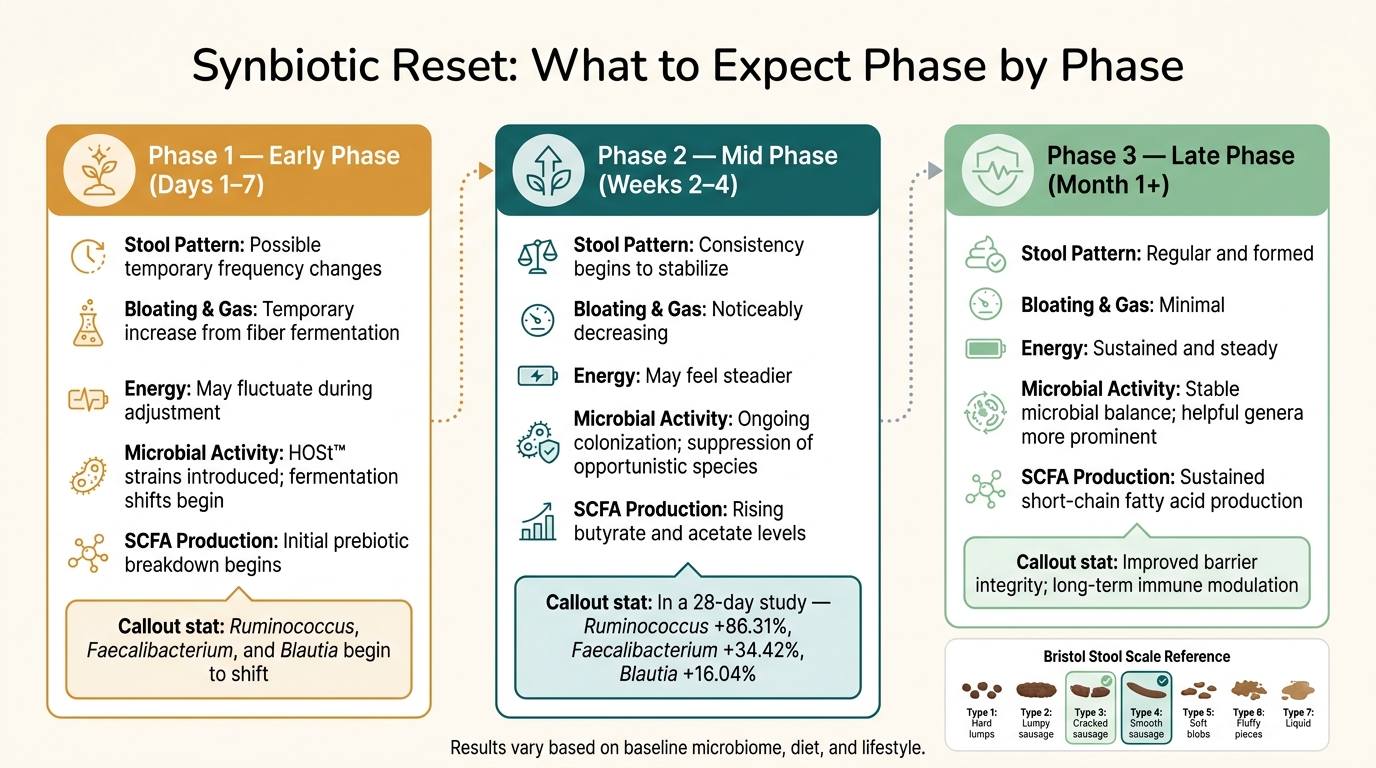
Synbiotic Reset Timeline: What Happens to Your Gut Day by Day
Many probiotic strains don’t stay in the gut for long. So the next step is simple: how do you support the shift long enough for the new pattern to stick?
A microbiome reset isn’t about wiping the slate clean. It’s a structured, time-bound way to gradually shift the gut environment away from dysbiosis and toward eubiosis. The aim is to create the kind of conditions where helpful species can grow and hold their ground.
What to Expect in Each Phase of a Reset
People respond differently based on their starting gut health, diet, and daily habits. That’s why it makes more sense to track progress by phase instead of expecting the same changes every single day.
In the early phase, prebiotic fibers start fermenting in the colon. That can lead to a temporary bump in gas as the gut ecosystem begins to change. Stool frequency may shift for a short time, and some people notice mild bloating. In most cases, that’s a sign fermentation has started - not a sign that anything is off.
In the mid phase, helpful genera begin to settle in more firmly. Stool consistency often starts to even out, and bloating usually begins to calm down. Postbiotics help support the gut environment while this new balance starts to take shape.
By the late phase, things often feel more settled and predictable. A higher relative abundance of helpful species like Faecalibacterium, Blautia, and Ruminococcus is a good sign that the microbiota is moving toward a steadier microbial balance [1]. Stool patterns tend to become more regular, and energy often feels more even.
How Rebirth RE-1 Is Built for a Microbiome Reset
A reset only works if you can use it every day without turning it into a chore.
Rebirth RE-1 combines prebiotics, probiotics, and postbiotics in one daily sachet. Each serving delivers 500 billion CFU of probiotics plus 4.5 g of prebiotic fiber (GOS & Inulin). It uses Human Origin Strains (HOSt™) and a Lyosublime™ delivery system to protect potency without refrigeration.
Rebirth RE-1 comes in three protocol lengths:
| Reset Format | Duration | Price |
|---|---|---|
| 7-Day Reset | 1 week | $79 |
| 4-Week Reset | 4 weeks | $279 |
| 12-Week Reset | 12 weeks | $749 |
Each option uses the same daily sachet protocol, so it’s easy to stay on track no matter which reset length fits your needs.
Reset Phase Tracking Table
Use the table below to compare common reset changes with your own baseline.
| Reset Phase | Stool Pattern | Bloating & Gas | Energy | Microbial Activity | Short-Chain Fatty Acid Production |
|---|---|---|---|---|---|
| Early | Possible temporary frequency changes | Temporary gas increase from fiber fermentation | Energy may fluctuate during adjustment | Introduction of HOSt™ strains; fermentation shifts begin | Initial prebiotic breakdown |
| Mid | Consistency begins to stabilize | Noticeably decreasing | Energy may feel steadier | Ongoing colonization; suppression of opportunistic species | Rising butyrate and acetate levels |
| Late | Regular and formed | Minimal | Sustained and steady | More stable microbial balance; helpful genera become more prominent | Sustained short-chain fatty acid production |
What to Track During a Microbiome Reset
Once you start a reset, pay attention to what changes from one day to the next. At-home tracking can't show exact bacterial shifts. For that, you'd need lab testing such as 16S rRNA sequencing [1].
So the job here is simpler: watch for day-to-day signs that reflect gut function. You're not measuring bacteria directly. You're looking for patterns that suggest things are moving in the right direction.
Daily Markers That Can Reflect Gut Function
Stool consistency is one of the main daily signals to track. The Bristol Stool Scale runs from 1 to 7:
- 1 = hard, separate lumps
- 7 = watery
Writing down your stool form each day can show useful patterns over a 4-week reset.
Bloating, gas, and abdominal comfort also matter. Track each one closely and rate it as none, mild, moderate, or severe [1]. That gives you a simple way to see whether symptoms are easing, staying the same, or bouncing around.
Track energy, mood, and mental clarity each day too. These are subjective, but they can still show clear trends over four weeks.
Lifestyle Factors That Shape Your Results
Diet, hydration, sleep, stress, and movement all affect how you respond. Log them each day next to your symptoms. That extra context helps explain why one day looks fine and the next doesn't - and why results can vary from person to person [2].
Personal Tracking Table for Baseline and Progress
Look for direction, not perfect days.
| Marker | Baseline (Pre-Reset) | Early Phase (Week 1) | Weeks 2–3 | Week 4 |
|---|---|---|---|---|
| Stool Form (Bristol Stool Scale, 1–7) | Record your typical form | Note any shifts in consistency | Look for movement toward Types 3–4 | Aim for stable, regular form |
| Bloating/Gas | Rate severity: None/Mild/Moderate/Severe | Note possible increases from fiber | Monitor for gradual reduction | Assess for sustained comfort |
| Energy/Mental Clarity | Note your typical fatigue level | Track any fluctuations | Look for steadier energy | Assess for sustained improvement |
| Mood/Mental Clarity | Record baseline stress and mood | Note day-to-day changes | Track any shifts in mental clarity | Assess overall resilience |
| Sleep (hours) | Record your typical nightly average | Note any disruptions | Track consistency | Assess for stable sleep patterns |
These markers can help you see whether the reset is moving toward steadier gut function and better balance.
Conclusion: Moving the Gut from Dysbiosis Toward Balance
After the early changes and the first markers you track, the main question is simple: does the gut keep moving back toward balance? Synbiotics can help shift the gut ecosystem by feeding helpful microbes, adding live strains, and supporting the gut environment [2]. A four-week microbiome reset protocol gives those changes time to settle in.
Strains matched to the human gut, such as HOSt™ in Rebirth RE-1™, may help support colonization when paired with prebiotic fiber [2].
That’s why, in day-to-day use, symptoms matter more than bacterial counts. Pay attention to bowel regularity, bloating, energy, mood, and mental clarity. Those signals can tell you whether the reset is heading in the right direction.
FAQs
How long do synbiotics take to work?
Synbiotics often start working within a few days to 1 week. In that first week, many people notice early digestive changes, like shifts in stool patterns.
From there, progress is usually more gradual. Better gut balance and colony establishment often take 2 to 4 weeks, while a fuller microbiome reset and longer-term recovery usually need steady use for 2 to 3 months.
Rebiirth RE-1 is built around that timeline with 7-day, 4-week, and 12-week programs.
Are gas and bloating normal at first?
Yes. Mild gas and bloating are common when you first start synbiotic or eubiotic treatments because your gut microbiome is adjusting to new bacteria. In most cases, these symptoms don’t last long.
To make things easier, start with a lower dose and increase it little by little. It may also help to eat prebiotic-rich foods with meals instead of having them on an empty stomach. If the symptoms stick around or get worse, talk to a healthcare provider.
What should I track during a gut reset?
Track how you feel and what you can measure.
Keep a simple daily log of your energy, bowel movement patterns, and digestive shifts like bloating or gas. Early on, those symptoms can move around a bit as the microbiome starts to rebalance.
If you want a closer read on what’s changing, check blood, stool, or urine biomarkers every 4 to 6 weeks. That can include I-FABP, zonulin, LPS, BDG, MUC2, and occludin.