

If your gut symptoms are active, I’d start with low-FODMAP for short-term relief. If symptoms are calmer, I’d shift to prebiotic fiber for gut and immune support. That’s the short answer.
Here’s the simple version:
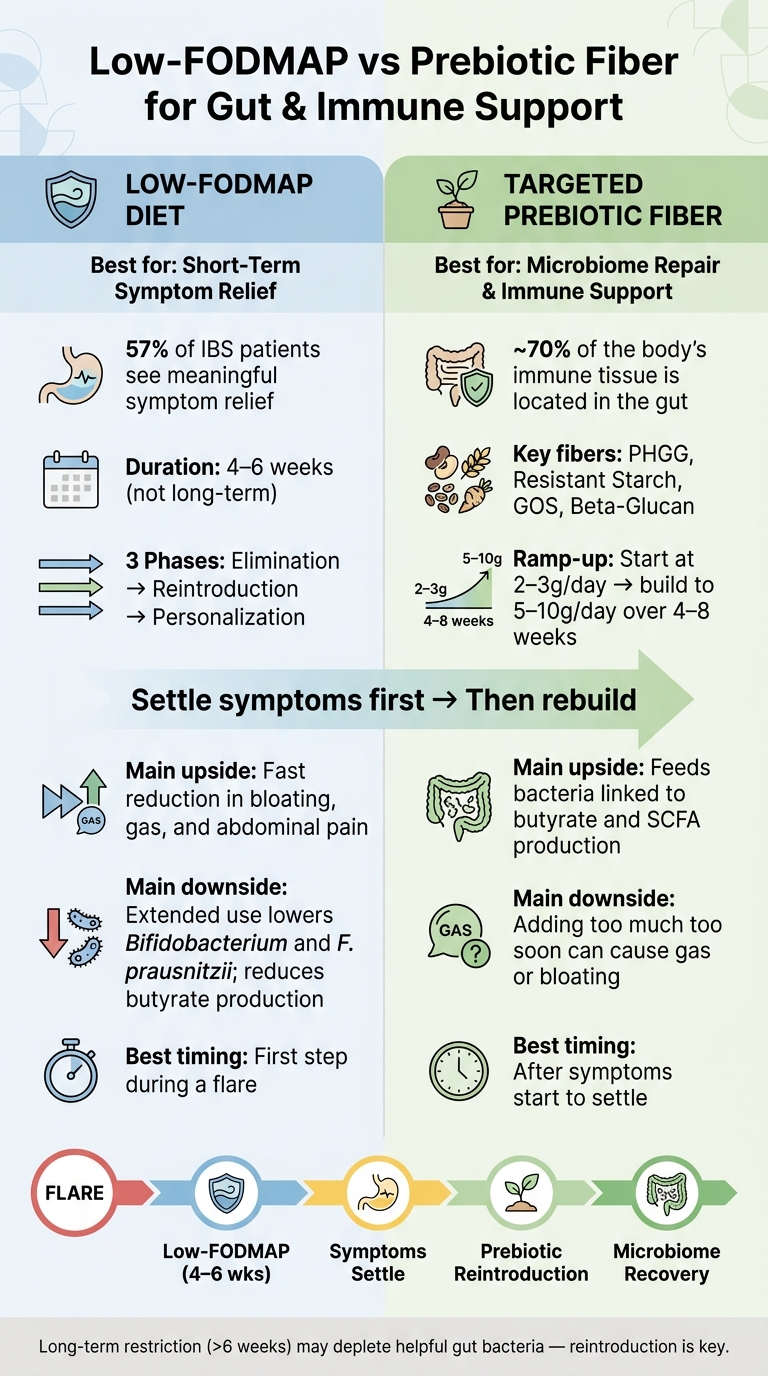
- Low-FODMAP helps cut bloating, gas, pain, and diarrhea in the short term.
- It’s usually used for 4 to 6 weeks, not long term.
- About 57% of people with IBS get symptom relief on it.
- Prebiotic fiber helps feed gut bacteria tied to butyrate production, gut lining support, and immune signaling.
- Around 70% of the body’s immune tissue is in the gut, so gut health and immune function are closely linked.
- Staying too restricted for too long may lower helpful bacteria like Bifidobacterium and Faecalibacterium prausnitzii.
If I had to put it plainly: one approach helps calm the fire, the other helps rebuild after it. This process is similar to restoring gut health after antibiotics, where the focus shifts from protection to repopulation.
What I’d look at first:
- Are symptoms active right now?
- Is the goal short-term relief or long-term gut repair?
- Can fiber be added back slowly without triggering symptoms?
- Is food enough, or would a structured synbiotic help with consistency?
Quick Comparison
| Approach | Best use | Main upside | Main downside | Best timing |
|---|---|---|---|---|
| Low-FODMAP diet | Bloating, gas, pain, diarrhea | Symptom relief can happen fast | Too much restriction for too long may lower helpful microbes | First step during a flare |
| Targeted prebiotic fiber | Microbiome repair and immune support | Feeds bacteria linked to SCFAs like butyrate | Adding too much too soon can cause gas or bloating | After symptoms start to settle |
I see this as a two-step plan: settle symptoms first, then rebuild fiber tolerance and microbiome support over time.
Low-FODMAP vs Prebiotic Fiber: Which Approach Is Right for You?
The Truth About Low FODMAP and Gut Bacteria
If you're ready to transition from symptom management to long-term recovery, following a structured microbiome reset can help you systematically reintroduce prebiotics while repairing the gut lining.
sbb-itb-1bbfe7f
Low-FODMAP: Best for Short-Term Symptom Relief, Not Long-Term Restriction
A low-FODMAP diet cuts back on fermentable carbs, which can ease gas, bloating, and diarrhea [1]. For many people with IBS, that can help fast. In fact, about 57% of IBS patients see meaningful symptom relief with this approach [1].
But here’s the key point: low-FODMAP is meant to be a short-term diagnostic diet, not a forever plan. The goal is to settle symptoms first, then bring fermentable fiber back in without setting off a flare.
How the 3 Phases Work: Elimination, Reintroduction, and Personalization
The process has three phases.
- Elimination lasts 2–6 weeks and removes high-FODMAP foods so symptoms can calm down.
- Reintroduction adds foods back one at a time to spot personal triggers.
- Personalization broadens the diet as much as the person can handle [3][5].
Each phase has a clear job. First, you get symptom control. Then you work toward microbiome recovery.
What Low-FODMAP May Change in the Microbiome
There’s a tradeoff here. Fructans and GOS are major prebiotic fibers that feed helpful species like Bifidobacterium and Faecalibacterium prausnitzii. When you cut those fibers, those bacterial groups can drop, and butyrate production can drop too.
A 2023 systematic review from Monash University found steady reductions in Bifidobacterium, F. prausnitzii, and total bacterial density across nine studies on the low-FODMAP diet [1]. That’s why reintroduction matters so much. It helps stop a short-term symptom plan from turning into a long-term fiber shortfall.
| Feature | Elimination phase (2–6 weeks) | Extended restriction |
|---|---|---|
| Symptom Control | Fast drop in bloating, gas, and abdominal pain [1] | Symptoms can stick around if fiber stays too low [3] |
| Microbiome & SCFAs | Short-term drop in fermentable load; fermentation slows while symptoms settle [1] | Lower Bifidobacterium, lower microbial diversity, and less butyrate production [1] |
| Nutrition | Helps identify food triggers [3] | Risk of low fiber intake and less prebiotic food in the diet [1] |
Low-FODMAP Food Choices That Keep Fiber Intake Up
During elimination, the aim is to calm symptoms without letting fiber intake fall off a cliff. Some low-FODMAP foods can still give you a decent amount of fiber and help support gut recovery and immune function.
- Oats are low-FODMAP at a ½-cup serving and provide beta-glucan, a soluble fiber [1][3].
- Firm, unripe bananas contain resistant starch. One medium banana fits the low-FODMAP limit, while overripe or spotted bananas do not [1][3].
- Cooked-and-cooled potatoes or rice form some resistant starch, which ferments more slowly and may support butyrate production with less gas [1][3].
- Two green kiwis a day may help motility and add fiber [1].
- ½ cup of canned lentils, thoroughly rinsed, fits within the low-FODMAP range and adds a small amount of GOS for people who tolerate it [3].
From there, the next move is adding targeted prebiotic fiber back in.
Targeted Prebiotic Fiber: Better for Microbiome Rebuilding and Immune Goals
Once symptoms settle down, the next step is rebuilding. That’s where targeted prebiotic fiber comes in. The low-FODMAP elimination phase can calm the gut, but it can also cut back the helpful bacteria tied to long-term immune health. Prebiotic fiber helps feed those bacteria again [1].
The hard part is doing that without setting symptoms off all over again.
Which Prebiotic Fibers Matter Most for Immune Support
Not all prebiotic fibers do the same job. A few are especially useful when the goal is gut repair and immune support.
Partially hydrolyzed guar gum (PHGG) is often a good place to start if your gut is touchy. It’s low-FODMAP certified, ferments slowly, and can help both constipation-predominant and diarrhea-predominant IBS. Resistant starch - found in cooked-and-cooled potatoes and unripe bananas - stands out for butyrate production and tends to cause less gas than fructans. Galactooligosaccharides (GOS) are very good at increasing Bifidobacterium levels, though gas can take about three weeks to settle. Beta-glucan from oats is another gentle choice that supports the microbiome and immune function without a high fermentation load [1][3][4].
Why do these fibers matter? Because they help support butyrate production. And butyrate plays a big role in strengthening the gut barrier and immune signaling.
A slow ramp-up works best:
- Start with 2–3 g per day
- Build gradually toward 5–10 g per day
- Take 4–8 weeks to work up as tolerated [4]
Low-FODMAP-Compatible Ways to Add Prebiotics Back In
You can use the same low-FODMAP foods from the elimination phase and add fiber back little by little. Think of it as turning the dial, not flipping a switch.
When a Structured Synbiotic Product May Be Worth Considering
Food-based prebiotics are a solid base. But portions can vary, ripeness changes fiber content, and reaching a daily target through food alone can take a lot of planning. If food-based dosing feels hard to manage, a structured synbiotic may make the rebuild simpler. This approach is also used in SIBO recovery to repair the gut lining.
For a structured option, Rebirth RE-1 combines prebiotics, probiotics, and postbiotics in sachets.
Food Sources and Product Choices: Matching the Strategy to Your Goal
Foods to Cut First vs Foods to Build Back Over Time
Use your current phase to decide what stays out for now and what comes back later. Here’s the tradeoff: the foods that feed gut microbes the most can also be the ones your gut fights the hardest. That tension sits at the center of the plan.
A simple way to handle it is to start with what your gut can manage, then build from there. For instance, try leek greens before the bulb, or use garlic-infused olive oil before adding whole garlic cloves [3]. You’re not trying to avoid prebiotic foods forever. You’re trying to bring back as many as you can without setting off symptoms.
That can look pretty ordinary in daily meals, which is part of the point. Breakfast might move from plain oats with an unripe banana to oats with flaxseeds and berries. Dinner might shift from cooled potato salad to asparagus with garlic-infused oil. Same broad food groups, different stage of tolerance. As your gut calms down, the plan shifts from avoidance to steady reintroduction.
What to Look for in a Microbiome-Support Product
When food alone doesn’t get you where you want to go, a structured synbiotic can help fill the gap. Guts in the recovery stage usually do better with simpler, gentler product picks. A few things matter most:
- low-FODMAP-compatible fiber
- clearly named Lactobacillus and Bifidobacterium strains
- a therapeutic CFU count
- a clean allergen profile [1][2]
Rebirth RE-1 combines prebiotics, probiotics, and postbiotics in sachets for a structured 7-day, 4-week, or 12-week reset. The right product should help you rebuild step by step, not push symptoms back up.
Conclusion: Which Approach to Start With
Start with symptom control if symptoms are active. If you're dealing with severe bloating, cramping, or unpredictable pain that throws off your day, low-FODMAP is the best place to begin. The key is not to stay there too long. Going past 4–6 weeks can deplete helpful bacteria, which pushes against the immune support you're trying to build.
When symptoms settle down, the goal changes. At that point, it's less about putting out fires and more about feeding the microbes that help recovery. Targeted prebiotic fiber is the better fit for microbiome repair and immune support. Microbial diversity matters because immune function tends to track with microbiome health. That's why long-term restriction isn't the endpoint you want.
For many people, the best path looks like this: start with low-FODMAP, then move into a structured prebiotic reintroduction.
If you want a more guided rebuild, a synbiotic can help make that shift easier. Rebirth RE-1 offers a 7-day, 4-week, or 12-week reset with prebiotics, probiotics, and postbiotics.
FAQs
How do I know when to switch from low-FODMAP to prebiotic fiber?
Switch after 4 to 6 weeks of the initial low-FODMAP phase. Staying very strict for longer isn’t advised, because it can cut down helpful bacteria and lower microbial diversity.
Make the shift slowly. Start with gentler, low-FODMAP fibers such as PHGG, psyllium, oats, or resistant starch. Begin with 1 to 2 grams per day, then increase bit by bit while you track symptoms.
Some mild gas for 1 to 2 weeks can be normal. But if pain sticks around or gets worse, stop and talk to your healthcare provider.
Which prebiotic fibers are least likely to trigger bloating?
To cut down on bloating, go with low-FODMAP prebiotic fibers that ferment more slowly in the colon. PHGG and acacia fiber are usually easier to tolerate and are less likely to trigger gas fast compared with inulin or FOS.
Other gentler picks include resistant starch, beta-glucan from oats, and pectin from peeled apples and citrus. Start small, then increase bit by bit.
Can I support immunity without staying on low-FODMAP long term?
Yes. A low-FODMAP diet is a short-term tool for symptom relief, not a plan to follow for months on end.
If you stay on it too long, you may cut back the good bacteria in your gut and reduce microbiome diversity. That can work against both gut health and immune function.
The main goal is to move through reintroduction, figure out your personal triggers, and then slowly bring back a broader mix of low-FODMAP-friendly prebiotic fibers. If you want extra support, synbiotic nutrition such as Rebiirth RE-1 may help restore microbial balance.