

Your gut microbes can push fat metabolism in two directions: toward better appetite control and steadier blood sugar, or toward inflammation, fat storage, and weight gain. In this article, I’d boil it down to 7 key metabolites: postbiotics, SCFAs, secondary bile acids, indoles, LPS, microbial BCAA metabolites, and TMAO.
Here’s the short version:
- SCFAs help with fullness, gut-barrier support, and insulin response.
- Indoles help keep the gut lining in better shape and lower inflammation.
- Secondary bile acids change how the body handles fat and cholesterol.
- LPS can leak into the blood when the gut barrier is weak and drive inflammation.
- BCAA metabolites can shift fuel use toward storage instead of burning.
- TMAO links gut bacteria with cholesterol transport and metabolic risk.
- Postbiotics is the broad group that includes many microbe-made signals, with SCFAs as the best-known example.
A few points stand out right away:
- A high-fat, low-fiber diet often means less SCFA production
- A weak gut barrier can let LPS pass into the bloodstream
- That can affect the liver, fat tissue, muscle, and brain
- The main outcomes are changes in satiety, insulin signaling, inflammation, cholesterol handling, and fat storage
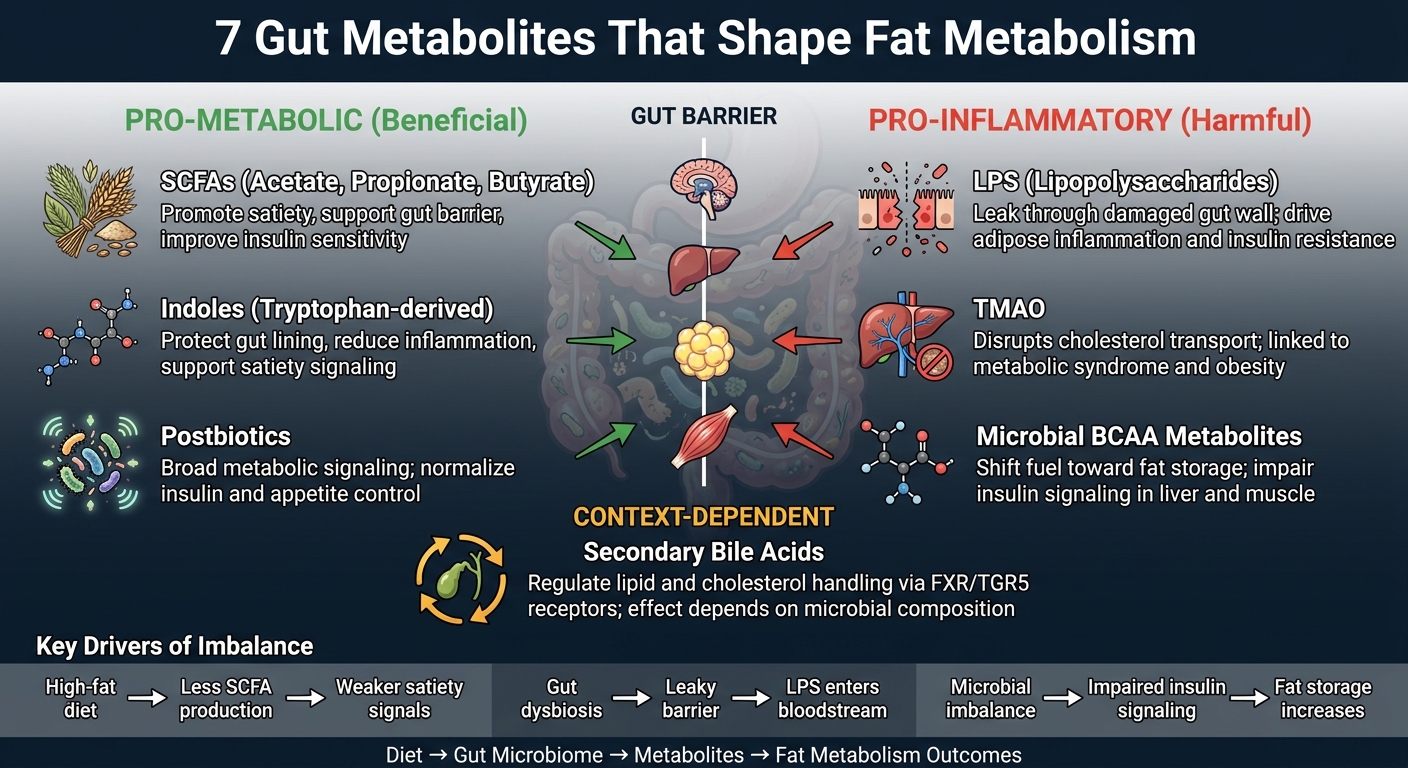
7 Gut Metabolites That Control Fat Metabolism
How Does Your Microbiome Shape Your Metabolism? | Dr Will Bulsiewicz | The Proof Clips EP #275
sbb-itb-1bbfe7f
Quick Comparison
| Metabolite | Main source | Main role | Main risk or upside |
|---|---|---|---|
| Postbiotics | General microbial fermentation | Body-wide metabolic signaling | Lower output may weaken appetite and insulin control |
| SCFAs | Fiber fermentation | Fullness, gut barrier, insulin support | Lower levels may make overeating and weight gain more likely |
| Secondary bile acids | Microbial change of bile acids | Fat and cholesterol handling | Poor signaling may hurt lipid control |
| Indoles | Tryptophan breakdown | Gut-barrier and inflammation control | Lower levels may weaken satiety and insulin response |
| LPS | Gut dysbiosis and barrier leak | Inflammation signal | Higher levels are tied to insulin resistance and fat gain |
| BCAA metabolites | BCAA breakdown by microbes | Fuel use and insulin signaling | Higher disruption may push more fuel toward storage |
| TMAO | Choline and L-carnitine metabolism | Cholesterol transport and lipid signaling | Higher levels are linked with metabolic risk |
If I had to sum up the article in one line, it’s this: the gut doesn’t just help digest food - it helps decide whether your body stores fat, burns it, or gets stuck in an inflammatory state.
Why Gut Metabolites Matter for Fat Metabolism
Gut microbes shape fat metabolism by turning food into signaling molecules that affect the liver, fat tissue, muscle, and brain.
When the gut barrier gets weak, LPS can slip into the bloodstream, drive adipose inflammation, and disrupt insulin signaling.[1] That same microbial signaling doesn't stop there. It also reaches the liver, muscle, and the brain systems that help control appetite.
A microbiome imbalance can weaken insulin signaling in the liver and muscle. That can push the body toward insulin resistance early and change how fat gets stored.
SCFAs also work through gut-hormone and hypothalamic pathways to support satiety and energy balance. If SCFA output drops, that signal can weaken too. That's why specific metabolites matter so much here - not just the microbiome as a whole.
Responses vary based on diet and the microbiome a person starts with.
The main drivers tend to show up through a few repeating pathways:
| Factor | Effect on Fat Metabolism | System Involved |
|---|---|---|
| High-fat diet | Reduces SCFA production; weakens satiety signaling | Gut-hormone signaling / Brain |
| Microbiome imbalance | Impairs insulin signaling in liver and muscle | Liver / Muscle |
| Leaky gut barrier | Lets LPS into the bloodstream; triggers inflammation | Gut barrier / Immune pathways |
| LPS accumulation | Drives adipose inflammation and insulin resistance | Adipose tissue |
| Reduced satiety signaling | Dysregulates energy balance via the hypothalamus | Hypothalamus (CNS) |
The next seven metabolites each affect one or more of these pathways in different ways. Next, each metabolite shows a different route through which microbes influence fat storage, inflammation, and insulin response.
1. Postbiotic Metabolites
Postbiotic metabolites are bioactive compounds made by gut microbes. They’re produced when those microbes ferment dietary compounds. A high-fat diet can cut postbiotic output by shifting the gut microbiota away from helpful fermenters.
Primary Microbial Source
Gut microbes make postbiotics during fermentation of dietary compounds. High-fat diets can lower this output by shifting the gut microbiota away from helpful fermenters.
Fat-Metabolism Pathway Affected
Their main effect is on appetite and energy balance through the hypothalamus. These signals help the hypothalamus regulate appetite, energy intake, and energy expenditure. They also affect how fat cells store and release energy. When this signaling gets weaker, appetite control and energy balance start to slip.
Insulin and Inflammation Impact
Lower postbiotic output can impair insulin signaling in the liver and skeletal muscle. It can also increase inflammation in adipose tissue.
Weight Relevance
These metabolites strengthen satiety, which helps the brain register fullness. By supporting satiety and insulin signaling, postbiotics help regulate fat storage and energy balance.
Among postbiotics, SCFAs are the best-studied signals tied to fat metabolism.
2. Short-Chain Fatty Acids (Acetate, Propionate, and Butyrate)
Short-chain fatty acids, or SCFAs, are the most studied postbiotic metabolites tied to fat metabolism. Gut bacteria make acetate, propionate, and butyrate when they ferment fiber. These compounds also help set up the next group of metabolites, especially the ones that change bile acid and lipid signaling.
Primary Microbial Source
Fiber-rich foods like GOS and inulin help support SCFA-producing bacteria [2].
Main Pathway Affected
SCFAs send signals through the microbiota-gut-brain axis and help tell the hypothalamus when you've had enough to eat. The hypothalamus is the brain's energy control center [1].
When SCFA production drops, a high-fat diet can throw the gut microbiota off balance, and the hypothalamus struggles more to regulate energy intake and energy use [1]. That can make appetite control less steady. SCFAs also affect how the liver and adipose tissue use and store fuel.
Insulin and Inflammation Impact
SCFAs help support the gut barrier, which can limit LPS leakage, inflammation, and insulin disruption [1][2]. They also affect hepatic lipid signaling, which shapes how the body handles cholesterol and triglycerides.
"Dysregulated microbial metabolites can impair insulin signaling in the liver and skeletal muscle, creating a vicious cycle of insulin resistance."
- Lilliana Bartoletti, Author [1]
Weight Relevance
When SCFA output falls, fullness signals get weaker, and weight gain can happen more easily [1].
Next are secondary bile acids, which change how the body processes cholesterol and fat.
3. Secondary Bile Acids
Beyond SCFAs, gut microbes also reshape bile-acid signaling. They convert primary bile acids into secondary bile acids, which changes the messages sent to the liver, fat tissue, and muscle. Those microbial byproducts act through FXR and TGR5 receptors to help regulate bile acid recycling and lipid handling. That same signaling also helps manage cholesterol recycling and liver lipid output, while supporting appetite control and energy use.
Insulin and Inflammation Impact
When this signaling starts to fail, insulin sensitivity drops in the liver and muscle, and adipose inflammation goes up [1].
Weight and Lipid Relevance
When this pathway weakens, fat storage and energy use start moving in the wrong direction, which makes weight control harder [1].
Next, tryptophan-derived indoles shift the focus from lipid signaling to barrier and inflammation control.
4. Tryptophan-Derived Indoles
Tryptophan-derived indoles help regulate appetite, insulin response, and energy balance.
Primary Microbial Source
Gut microbes turn dietary tryptophan into indoles.
Fat-Metabolism Pathway Affected
Unlike bile acids, indoles affect fat metabolism mostly by helping protect the gut barrier and dialing down inflammation.
They help support gut-barrier integrity and appetite signaling, which limits inflammatory spillover. That, in turn, helps protect lipid signaling and cholesterol handling in the liver. When inflammatory pressure stays lower, lipid signaling and cholesterol handling are more stable.
Insulin and Inflammation Impact
When indole output drops, inflammation in fat tissue goes up, and insulin signaling in the liver and muscle gets weaker.
Weight Relevance
Indoles help support satiety signaling through the gut-brain axis. When indole output is lower, satiety control weakens, which makes overeating more likely.
When barrier support drops, LPS leakage rises next.
5. Lipopolysaccharides (LPS)
When gut-barrier support starts to slip, LPS become the next big inflammation signal. LPS are bacterial endotoxins that can move into the bloodstream when dysbiosis and barrier failure open the door. They’re tied most closely to high-fat diets, which speed up both dysbiosis and barrier breakdown.
Fat-Metabolism Pathway Affected
Once LPS get into circulation, they can drive inflammation in adipose tissue and directly affect the hypothalamus. That matters because the hypothalamus helps control energy intake and energy use. When that system gets thrown off, appetite and calorie burn can start moving in the wrong direction.
Insulin, Inflammation, and Weight Impact
LPS-driven inflammation can disrupt insulin signaling in the liver and skeletal muscle. It also throws off hepatic lipid handling and interferes with cholesterol signaling. Put simply, LPS can push metabolic disease further along.
Higher LPS levels are also linked to weaker satiety signals and weight gain.
Next come microbial BCAA metabolites, which affect fuel handling more directly.
6. Microbial Branched-Chain Amino Acid Metabolites
After barrier-driven inflammation, BCAA metabolites show another side of the story: microbial signals don't just stir up inflammation. They can also change how the body handles nutrients.
Gut microbes can convert branched-chain amino acids into metabolites that affect appetite, insulin sensitivity, and how the liver splits fuel between storage and oxidation.
Fat-Metabolism Pathway Affected
When BCAA metabolite levels shift, insulin signaling in the liver and skeletal muscle can weaken. At the same time, hepatic lipid signaling can get thrown off, which sends more fuel toward storage instead of burning.
Insulin and Inflammation Impact
When BCAA metabolite output is disrupted, the liver doesn't manage lipids as well. That can alter cholesterol processing and fat storage, adding to the insulin resistance already set in motion by earlier metabolite imbalances.
Weight and Energy Relevance
These metabolites can also affect gut-brain axis signaling in the hypothalamus. In plain terms, that means they can change hunger, energy use, and body-fat storage.
So BCAA metabolites act as another nutrient-handling signal, setting up the next piece of the puzzle: TMAO.
7. Trimethylamine N-Oxide (TMAO)
TMAO is one of the clearest examples of how gut microbes can affect what happens far beyond the gut. In this case, it ties gut chemistry to the way the liver handles lipids and cholesterol.
Here’s the basic chain: gut bacteria convert choline, L-carnitine, and lecithin into trimethylamine, or TMA. The liver then oxidizes TMA into TMAO.
What makes this especially interesting is how much TMAO levels can shift from one person to another. Two people can eat the same meal and end up with very different TMAO levels because the mix of TMA-producing bacteria in their guts isn’t the same.
Fat-Metabolism Pathway Affected
TMAO affects cholesterol transport and lipid signaling. That gives it a direct link to fat metabolism, especially in how fats are processed and moved through the body.
Insulin and Inflammation Impact
When TMAO goes up alongside dysbiosis and endocrine disruption, lipid handling may get worse. Insulin signaling may also become less stable, which adds another layer to its metabolic role.
Weight and Cholesterol Relevance
TMAO matters because it connects diet, cholesterol transport, and metabolic risk in a very direct way.
The table below compares how all seven metabolites affect fat metabolism.
Visuals and Comparison Table
Two visuals can make the seven mechanisms above much easier to scan.
The first is a Microbiota-Gut-Metabolic Axis flowchart that follows a simple path: Diet (high-fiber vs. high-fat) → Gut Microbiome → Metabolite Production → Gut Barrier (intact vs. leaky) → Target Organs (liver, adipose tissue, pancreas, and hypothalamus).
The second is a satiety-vs-hunger split panel. One side shows how SCFAs signal the hypothalamus to stop eating. The other shows how LPS can slip through a damaged gut barrier and spark inflammation in fat tissue.
The table below compares which metabolites help fat balance, which throw it off, and which sit somewhere in the middle depending on the setting. For color coding, use green for SCFAs, red for LPS, and amber for secondary bile acids and BCAA metabolites.
| Metabolite | Primary Source | Key Receptors / Pathways | Main Effects on Fat Metabolism | Cholesterol Link | Inflammation Profile | Insulin Effects | Weight Management Relevance |
|---|---|---|---|---|---|---|---|
| Postbiotics | General microbial byproducts | Systemic signaling | Rebalances metabolic signaling | Indirect | Supports metabolic balance | Normalizes signaling | Emerging therapeutic frontier |
| SCFAs (Acetate, Propionate, and Butyrate) | Dietary fiber fermentation | Gut-brain axis; hypothalamus | Promotes satiety; signals fullness | Indirect | Anti-inflammatory | Improves insulin sensitivity | Prevents overeating; supports weight loss |
| Secondary Bile Acids | Microbial conversion of primary bile acids | TGR5 / FXR receptors; liver | Regulates lipid absorption and processing | Regulates cholesterol recycling | Context-dependent | Linked to metabolic dysfunction | Linked to overall metabolic health |
| Tryptophan-Derived Indoles | Amino acid metabolism (tryptophan) | Gut barrier signaling | Supports gut barrier integrity | Indirect | Modulates local inflammation | Supports metabolic balance | Influences satiety pathways |
| Lipopolysaccharides (LPS) | High-fat diet; gut dysbiosis | Bloodstream leakage; adipose tissue | Triggers adipose tissue inflammation | Disrupts hepatic lipid handling | Pro-inflammatory - systemic inflammatory signal | Disrupts insulin signaling in the liver and skeletal muscle | Fuels obesity and weight gain |
| Microbial Branched-Chain Amino Acid Metabolites | Branched-chain amino acid breakdown | Skeletal muscle and liver pathways | Shifts energy use | Alters cholesterol processing | Linked to metabolic stress | Can impair insulin signaling | Associated with insulin resistance |
| TMAO | Choline / L-carnitine metabolism | Liver; vascular system | Influences cholesterol handling | Directly affects cholesterol transport | Pro-inflammatory marker | Linked to metabolic syndrome | High levels linked to obesity and weight gain |
How the Seven Metabolites Work Together
These metabolites don’t act alone. They work as a connected network, and when you look at them side by side, two opposing patterns show up: barrier support versus inflammatory disruption. Which side wins has a big effect on fat metabolism.
A simple way to think about it is as a balance.
On one side, SCFAs and indoles help keep the gut barrier intact, reduce inflammation, and support insulin signaling. SCFAs also send fullness signals to the hypothalamus. When these signals lead, the body is more likely to remain metabolically flexible.
On the other side, LPS, TMAO, and microbial BCAA metabolites move things in the opposite direction. LPS fuels inflammation, TMAO makes lipid handling worse, and higher BCAA metabolites point to poorer fuel switching.
Secondary bile acids are a bit different. They can tip the balance either way, depending on which microbes make them.
The comparison table below sums up which signals support fat balance and which work against it.
Conclusion
Put simply, these metabolites fall into two camps: ones that help keep fat metabolism on track, and ones that push it off course through inflammation. The seven covered here - SCFAs, secondary bile acids, indoles, LPS, postbiotics, microbial BCAA metabolites, and TMAO - affect lipid signaling, cholesterol handling, inflammation, insulin response, and weight management.
When gut-lining support wins out - through SCFAs and indoles helping maintain barrier function and steadier insulin signaling - fat metabolism tends to stay more stable. But when inflammatory signals take over - such as LPS, TMAO, and microbial BCAA metabolites driving poorer fuel use and insulin resistance - fat gain becomes more likely.
That’s why microbial metabolites matter in a practical way. They’re not just part of a vague wellness idea. They’re directly tied to how the body handles fat.
FAQs
How can I naturally increase beneficial SCFAs?
Focus on a fiber-rich diet that helps feed gut bacteria. Good picks include prebiotic foods like onions, garlic, asparagus, bananas, oats, legumes, nuts, seeds, and fruit. Fermented foods like yogurt, kefir, sauerkraut, and kimchi can also help support SCFA-producing bacteria.
What you eat day after day matters. Consistency and variety both count, because different types of fiber feed different strains of bacteria.
For extra support, Rebiirth RE-1 combines prebiotic fiber with probiotics to help support your body’s natural SCFA production.
Which foods raise LPS, TMAO, or harmful BCAA metabolites?
The research doesn't point to a direct list of “bad foods” here. Instead, it points to a bigger issue: an imbalanced gut microbiome may lead to higher levels of LPS, TMAO, or harmful BCAA metabolites.
Meal timing seems to matter too. Irregular eating or late-night meals may encourage pro-inflammatory bacteria and make the gut lining more permeable. When that happens, endotoxins can slip into the bloodstream.
What may help? The literature points to a few simple habits:
- Consistent meal timing
- Adequate fiber intake
- Synbiotics like Rebiirth RE-1
The goal is to support a more balanced microbiome and help limit the buildup of these harmful metabolites.
Can improving gut barrier health support weight loss?
Yes. When the gut lining gets damaged, harmful substances such as lipopolysaccharides can pass into the bloodstream. That can spark inflammation, which may interfere with insulin signaling and make weight gain more likely.
Supporting the intestinal barrier may help bring metabolic signaling back into better shape. One key part of that process is SCFAs, which are made when gut bacteria ferment prebiotics. These compounds help nourish the gut lining. Rebiirth RE-1™ combines prebiotics, probiotics, and postbiotics to support the gut lining and help maintain microbial balance.