

Here’s the short answer: gut-made SCFAs - acetate, propionate, and butyrate - may affect the nervous system by shaping immune activity, gut barrier strength, blood-brain barrier signaling, and brain cell inflammation. But most of the strongest data still come from animal and lab studies, not large human trials.
If you want the plain-English version, this article says 3 things:
- SCFAs come from fiber fermentation in the colon, mainly from foods like resistant starch, inulin, legumes, whole grains, fruits, and vegetables.
- They may affect the brain in more than one way: through circulation, receptor signaling, HDAC inhibition, vagal signaling, and immune cross-talk.
- Human research is still early. The science points somewhere interesting, but there are still gaps around dose, long-term safety, and direct CNS outcomes.
A few points stand out right away:
- Acetate is the SCFA most likely to show up in peripheral blood.
- Butyrate is used heavily by colon cells and is linked with Treg activity and lower inflammatory signaling.
- In one human trial, 16 g/day of inulin-oligofructose for 6 weeks increased fecal acetate and propionate.
- In another study of 97 older adults with an average age of about 81 years, a 5 billion CFU daily probiotic blend for 24 weeks increased butyrate and total SCFAs.
Fiber and short-chain fatty acids for cognitive health, with Dr. Boushra Dalile PhD
Quick comparison
| SCFA | Main route after production | Main actions discussed | Main nervous system link |
|---|---|---|---|
| Acetate | More likely to enter peripheral blood | GPCR signaling | BBB crossing and central metabolic signaling |
| Propionate | Much is cleared by the liver | GPCR signaling and HDAC inhibition | Immune-to-brain signaling |
| Butyrate | Mostly used by colon cells | HDAC inhibition, gut barrier support, Foxp3 acetylation | Treg support and lower neuroinflammatory tone |
Bottom line: if you’re looking at SCFAs for brain and nerve health, the case is strongest for mechanism and preclinical data, while the human side is still less settled. The article then walks through how these molecules are made, how they travel, what they do in immune and brain-related pathways, and which diet or synbiotic approaches may shift SCFA output.
How SCFAs Reach the Brain and Affect Neural Signaling
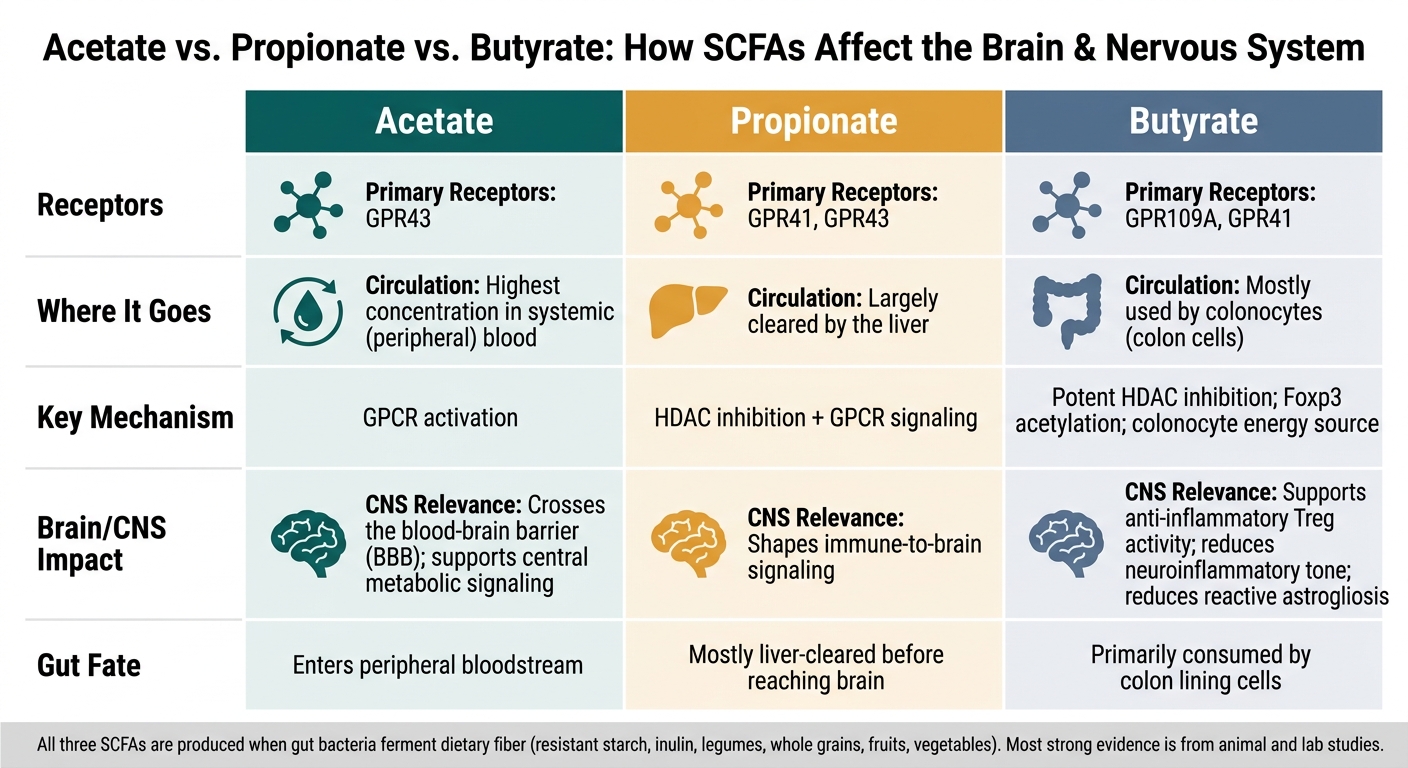
Acetate vs Propionate vs Butyrate: How SCFAs Affect the Brain
From Dietary Fiber to Circulation and Blood-Brain Barrier Signaling
SCFAs are made in the colon when gut microbes ferment non-digestible fiber. From there, colon cells absorb them through passive diffusion and through MCT and SMCT transporters [1]. What happens next depends on the SCFA. Butyrate is mostly used by colonocytes, propionate is cleared in large part by the liver, and acetate is the main SCFA that makes it into peripheral blood [1].
Once in circulation, SCFAs can cross the blood-brain barrier (BBB) through MCTs on endothelial cells in the brain vasculature [1]. They don't act through direct entry alone, either. SCFAs also signal through intestinal receptors that connect with vagal pathways. So the route matters: each SCFA has a slightly different shot at affecting the brain based on how it's absorbed, where it's cleared, and how far it travels.
HDAC Inhibition, GPCR Activity, and Neurotransmitter Pathways
After absorption, SCFAs affect neural signaling in two main ways: receptor signaling and gene regulation. On the receptor side, they activate GPCRs such as GPR41 (FFAR3), GPR43 (FFAR2), and GPR109A. That signaling sets off downstream effects tied to inflammation and neural communication [1].
On the gene regulation side, butyrate and propionate act as histone deacetylase (HDAC) inhibitors. In plain English, they can shift gene expression without changing the DNA sequence itself. Butyrate is a good example. It increases acetylation at the Foxp3 gene promoter, which helps drive the development of regulatory T cells, or Tregs. Those cells help keep systemic inflammation under control, linking HDAC activity to immune balance and neural signaling in a direct way [1]. SCFAs are also linked to neurotransmitter regulation [1].
Acetate vs. Propionate vs. Butyrate: Mechanism Comparison Table
The three main SCFAs don't behave the same way. They differ in receptor preference, clearance, and how much they matter for the CNS.
| SCFA | Primary Receptors | Key Mechanisms | CNS Relevance |
|---|---|---|---|
| Acetate | GPR43 | GPCR activation; highest concentration in systemic circulation | Crosses the BBB and supports central metabolic signaling. |
| Propionate | GPR41, GPR43 | HDAC inhibition; GPCR signaling | Shapes immune-to-brain signaling; largely cleared by the liver. |
| Butyrate | GPR109A, GPR41 | Potent HDAC inhibition; Foxp3 acetylation; colonocyte energy source | Potent epigenetic regulator; supports anti-inflammatory Treg activity. |
sbb-itb-1bbfe7f
Immune Cross-Talk: SCFAs, Gut Barrier Function, and Neuroinflammation
T Cells, Gut Permeability, and Systemic Inflammatory Tone
A big part of the gut-brain link runs through the immune system, and SCFAs help shape that connection right at the gut lining.
Butyrate helps support the colonic barrier. It helps maintain tight-junction proteins and keeps the barrier intact. When that barrier stays stronger, less LPS can slip through into circulation, which can help lower systemic inflammation. SCFAs also tend to support regulatory T-cell activity instead of pro-inflammatory immune responses. That shift can mean a lower inflammatory tone overall, with fewer circulating cytokines setting the nervous system up for trouble. From there, the effects can reach microglia and astrocytes.
Microglia and Astrocytes in Preclinical Nervous System Models
Lower peripheral inflammation seems to change how brain-resident immune cells behave in preclinical models.
In germ-free mice, microglia stay immature and dysregulated. SCFA supplementation restored microglial maturation and homeostatic function [1]. That points to a simple but important idea: normal microglial development may depend, at least in part, on steady SCFA signaling from the gut.
Astrocytes show a similar pattern. Butyrate, through HDAC inhibition, may help reduce reactive astrogliosis and limit pro-inflammatory cytokine production. In depression and stroke models, SCFA-related effects on microglia and astrocytes have been linked to lower neuroinflammatory signaling.
That helps explain the growing interest in diet-based approaches that increase SCFA production.
Immune Cross-Talk Table: Cell Type, Pathway, and Nervous System Outcome
The table below shows how major immune cell types respond to SCFA signaling and what that may mean for the nervous system. These effects can shift based on the disease model, SCFA concentration, and the host immune context.
| Cell Type | Relevant SCFAs | Signaling Pathway | Inflammatory Direction | Reported Nervous System Outcome |
|---|---|---|---|---|
| Regulatory T cells (Tregs) | Butyrate, Propionate | HDAC inhibition; Foxp3 expression; GPR109A | Anti-inflammatory | Enhanced immune tolerance |
| Effector T cells (Th1/Th17) | Acetate, Propionate | GPCR signaling; cytokine modulation | Context-dependent (often reduced) | Reduced risk of autoimmune-driven neuroinflammation |
| Microglia | Acetate, Propionate, Butyrate | HDAC inhibition; GPR41/43 | Pro-homeostatic | Improved maturation, morphology, and immune surveillance; reduced neuroinflammatory signaling in depression and stroke models |
| Astrocytes | Butyrate | HDAC inhibition | Anti-inflammatory | Reduced reactive astrogliosis; improved neuronal support |
Taken together, these effects connect microbial SCFA production with lower neuroinflammatory signaling.
Microbiome Restoration Approaches That May Support SCFA Signaling
SCFAs help shape gut barrier function and immune signaling, so the next step is pretty simple: how do you get more of them?
Dietary Fiber, Prebiotics, and Synbiotics in Human and Preclinical Studies
The most direct way to increase SCFA output is to give gut microbes more fermentable material to work with. The case for colonic SCFA gains is strong, while effects on the nervous system are still indirect and at an early stage.[13][16] In practice, that fermentable material usually comes from plant foods and resistant starch, which serve as the main substrate for colonic fermentation.
Among prebiotics, inulin and galacto-oligosaccharides (GOS) have the best track record. In one randomized trial, taking 16 g/day of inulin-oligofructose for 6 weeks increased bifidobacteria as well as fecal acetate and propionate compared with maltodextrin.[12] There’s a catch, though: starting diet seems to matter. One study found that people who were already eating more fiber saw smaller SCFA gains, which suggests there may be less room for improvement in that group.[15]
Synbiotics build on the same idea by combining a fermentable substrate with live microbes. That pairing may help restore SCFA-producing communities more directly than prebiotics alone. In a clinical study of older adults, with an average age of about 81 years and 97 participants, a probiotic blend at 5 billion CFU once daily for 24 weeks led to significant increases in butyrate and total SCFAs, along with better microbiome diversity.[14] Preclinical studies have also found that, in some models, synbiotics restore intestinal barrier integrity more strongly than probiotics alone.[7] Human CNS outcomes are still preliminary.[6][8]
That same restoration model shows up in more structured reset programs.
Rapid Microbiome Reset Frameworks and Rebirth RE-1
Rebiirth RE-1™ is a 3-in-1 synbiotic formula offered in 7-day, 4-week, and 12-week reset protocols. At this point, direct proof for SCFA-mediated effects on the nervous system has not been established.[3][4][5]
Intervention Comparison Table: Diet, Prebiotics, Synbiotics, and Reset Protocols
| Intervention Type | Primary SCFA Mechanism | Evidence Tier | Example / Key Detail | Nervous System Endpoints Studied |
|---|---|---|---|---|
| Fiber-rich diet | Provides fermentable substrate for colonic bacteria | Strongest evidence | Legumes, whole grains, vegetables, fruits, nuts, resistant starch | Mood, cognition, and neuroinflammation signals; causality still under investigation.[10][11] |
| Prebiotic supplementation | Selectively feeds SCFA-producing taxa | Moderate (RCT-supported for SCFA output) | Inulin/FOS at about 16 g/day increased acetate and propionate[12]; GOS has shown human signals for anxiety and reward-related brain activation[2] | Mood, cognition, and neuroinflammation signals[2] |
| Synbiotic formulation | Adds microbes and substrate simultaneously | Promising, variable | 5 billion CFU probiotic blend for 24 weeks increased butyrate, total SCFAs, and microbiome diversity[14] | Gut-immune outcomes; CNS data remain preliminary[6][8][9] |
| Rapid microbiome reset protocol | Multi-component restoration with prebiotics, probiotics, and postbiotics | Emerging evidence | Rebiirth RE-1™: 7-day to 12-week formats[3][4][5] | Gut-immune outcomes; CNS data remain preliminary[3][4][5] |
The next section looks at how strong the human evidence is and where the main gaps still sit.
What Current Studies Show, Where the Gaps Are, and Key Takeaways
Human Evidence: Promise, Inconsistency, and Measurement Challenges
Once you move past lab and animal findings, the big issue is simple: do the same effects show up in people?
So far, human studies do link SCFA patterns with mood, cognition, and markers tied to neurodegenerative risk. But most of that evidence is correlational. In plain English, researchers can see associations, yet they still can't say with confidence whether low SCFAs cause nervous system problems or whether they just reflect shifts in diet, lifestyle, or disease status.
That's where things get messy. Results change from one study to the next based on study design, the type of sample collected, and what participants were eating at baseline. Put all that together, and it's hard to draw firm conclusions across trials.
Which brings us to the question that matters most: how much of this turns into clinical benefit?
Research Gaps in Dosing, Long-Term Safety, and CNS-Specific Outcomes
The main roadblock isn't mechanism. It's clinical validation.
Researchers have a better handle on how SCFAs may work than on what they consistently do for patients. The field still needs larger controlled trials with direct nervous system endpoints. It also needs clearer data on which ratios of acetate, propionate, and butyrate are required for CNS effects, along with longer follow-up to assess safety over time.
Just as important, studies need to connect microbial shifts to direct nervous system outcomes. Without that link, proving causality in humans remains out of reach.
Key Takeaways for Readers Following Microbiome-Based Nervous System Research
Right now, support is strongest in mechanistic and preclinical research. Microbiome restoration strategies, including dietary fiber, synbiotics, and structured microbiome reset protocols such as Rebirth RE-1, look promising for supporting SCFA signaling while the human evidence catches up.
That's the current boundary of the evidence.
FAQs
Can SCFAs actually reach the brain?
Yes. SCFAs can cross the blood-brain barrier and directly affect brain function. They also send signals to the brain through the vagus nerve, which is a main link between the gut and the brain.
By supporting these pathways and a healthy gut-brain connection, SCFAs may help keep neurotransmitter levels in balance and help manage inflammation across the body.
Which foods raise acetate, propionate, and butyrate?
Acetate, propionate, and butyrate are produced when gut bacteria ferment prebiotic fibers. Foods high in inulin and galactooligosaccharides can help increase this process, including dandelion greens, Jerusalem artichokes, garlic, and leeks.
That said, this only works well when the gut is in good balance. Rebiirth RE-1 is designed to support that process with a 3-in-1 eubiotic synbiotic formula that includes 5 g of galactooligosaccharide and inulin per serving.
What do human studies show so far?
Human studies point to the gut-brain axis as a major communication network. Signals from the gut don’t just stay in the gut. They can affect the brain too.
That helps explain why microbiota-derived SCFAs, certain probiotic strains, and prebiotics may shape neurotransmitters, immune responses, sleep, stress, anxiety, and emotional well-being.
Clinical trials also suggest that targeted interventions may help restore microbial balance. That includes strains such as Lactobacillus gasseri and Bifidobacterium infantis, along with prebiotics such as galacto-oligosaccharides.