

Here’s the short answer: postbiotics may help lower brain oxidative stress, but most support still comes from lab and animal studies, not human trials.
If you want the plain-English version, this article says 4 things:
- Postbiotics are non-live microbial preparations, not the same as probiotics.
- SCFAs like butyrate and propionate have the strongest lab support for antioxidant effects tied to the gut-brain axis.
- Other fractions - like cell wall parts, exopolysaccharides, and cell-free metabolites - also show early effects on inflammation, ROS, and barrier function.
- Human proof is still thin: small studies show shifts in markers like IL-1β and MDA, but there are no large trials showing clear brain or cognitive outcomes.
That matters because oxidative stress in the brain can damage lipids, proteins, DNA, and mitochondria. In theory, postbiotics may help by supporting Nrf2 antioxidant signaling, lowering NF-κB-related inflammation, and helping the gut barrier and blood-brain barrier hold up better.
A few details stand out:
- SCFAs have the best support so far
- Purified butyrate alone is not a postbiotic under the ISAPP definition
- A 7-day stroke trial lowered some blood inflammation and oxidation markers, but did not improve stroke outcomes
- For now, postbiotics fit best as an adjunct, not a treatment for brain disease
If you’re looking for a simple takeaway, it’s this: the idea makes sense biologically, but human evidence is still limited.
How Postbiotics May Reduce Oxidative Stress in the Brain
Antioxidant and Anti-Inflammatory Signaling Pathways
In preclinical models, postbiotics may affect oxidative stress in the brain through antioxidant and anti-inflammatory signaling.
A main target here is the Nrf2–Keap1–ARE pathway. In animal and cell studies, inactivated microbial fractions increased Nrf2-linked antioxidant enzymes and helped protect neuronal cells from hydrogen peroxide damage.[9][10][11][12][13]
Postbiotics may also suppress NF-κB, which can lower TNF-α, IL-1β, and IL-6. At the same time, SCFAs may help calm microglial activation.[2][3][4][5][6][7]
Put simply, these two systems often pull in opposite directions. When Nrf2 activity goes up, NF-κB-driven inflammation may go down. That means postbiotics may help restore redox balance by affecting both pathways at the same time. Those active fractions are covered next.
Practical Differences from Live Probiotics
Postbiotics are easier to standardize, store, and dose because they don't rely on cell viability. That's a big deal in practice, since live probiotics can be more variable during handling outside lab settings.[3][5]
Live probiotics still matter when the goal is microbiome remodeling. But if the focus is consistency in storage and dosing, postbiotics have a clear edge. That leads directly to the specific postbiotic fractions discussed next.
sbb-itb-1bbfe7f
How Probiotics Help Downregulate Oxidative Stress
Short-Chain Fatty Acids, Cell Wall Compounds, and Other Active Fractions
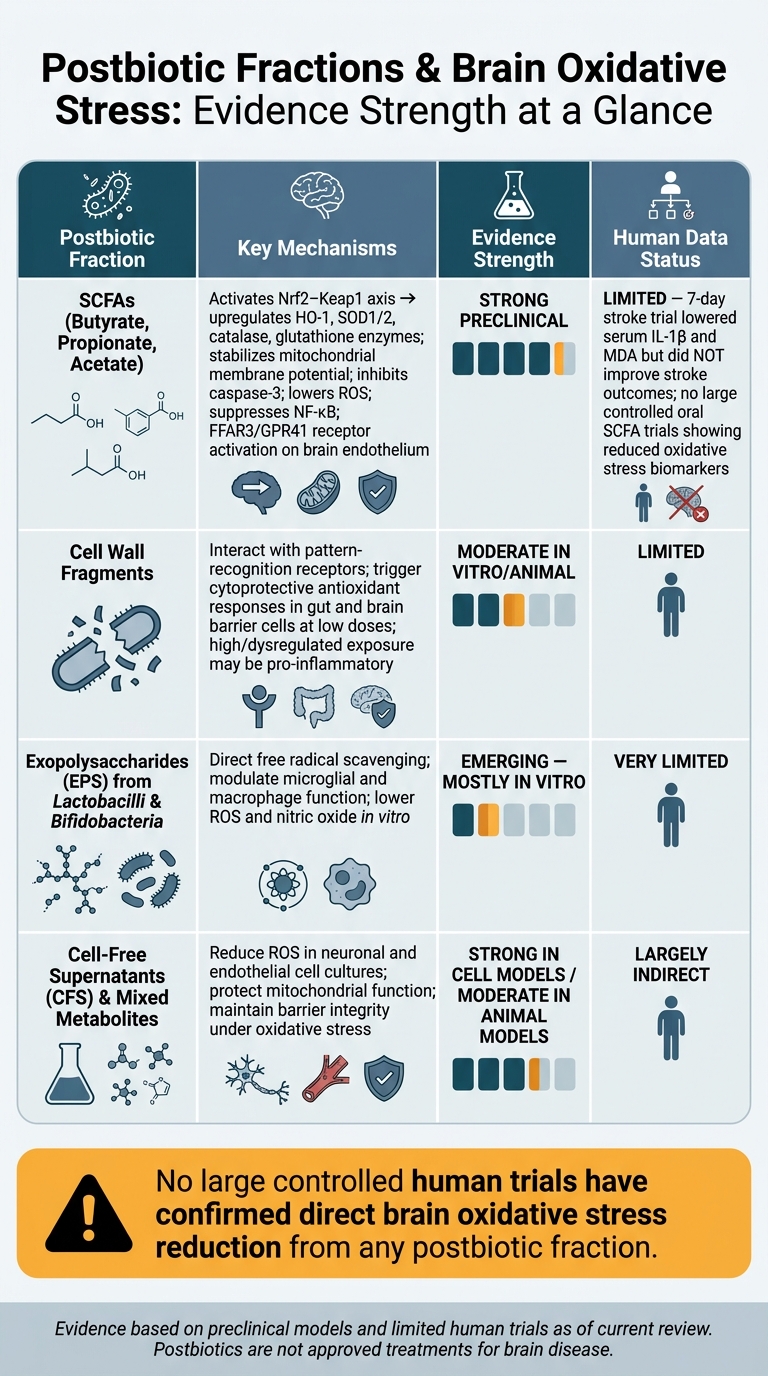
Postbiotic Fractions vs. Brain Oxidative Stress: Evidence Strength Compared
Different postbiotic fractions seem to affect brain redox balance in different ways through the gut-brain axis. SCFAs have the best support so far. Other fractions look promising too, but the research is still at an earlier point.
Short-Chain Fatty Acids and Redox Balance
Short-chain fatty acids (SCFAs) - mainly butyrate, propionate, and acetate - are among the most studied postbiotic fractions for brain oxidative stress. Gut bacteria make these compounds, and some have been found in cerebrospinal fluid, which shows they can reach the CNS.[23]
There’s also a plausible route for how they work. Human brain endothelium expresses the SCFA receptor FFAR3 (GPR41), and propionate at physiologic concentrations has been shown to protect the BBB from oxidative stress through Nrf2 signaling.[19][17] In preclinical models, butyrate and propionate activate the Keap1–Nrf2 axis. That leads to higher levels of HO-1, SOD1/2, catalase, and glutathione-related enzymes. At the same time, they help stabilize mitochondrial membrane potential, inhibit caspase-3 activation, and lower mitochondrial and cytosolic ROS during oxidative stress.[14][15][16][17][19][21][24]
That said, the gap between lab results and human data is still hard to ignore. Human brain-specific evidence remains limited, and no large controlled oral SCFA trials have shown lower brain oxidative stress biomarkers.[20][22][23] A 7-day trial in critically ill stroke patients did lower serum IL-1β and MDA, but it did not change stroke outcomes.[25]
Cell Wall Fragments, Exopolysaccharides, and Cell-Free Metabolites
Evidence for cell wall fragments, EPS, and mixed metabolites is still earlier-stage than the evidence for SCFAs.
Beyond SCFAs, cell wall fragments, exopolysaccharides, and mixed metabolites may also shape oxidative stress. Cell wall fragments interact with pattern-recognition receptors. At low doses, they can trigger cytoprotective antioxidant responses in gut and brain barrier cells, but high or dysregulated exposure may push things in a pro-inflammatory direction.[17][18]
Exopolysaccharides (EPS) from lactobacilli and bifidobacteria can directly scavenge free radicals and modulate microglial and macrophage function, lowering ROS and nitric oxide levels in vitro.[18] Cell-free supernatants (CFSs) appear to combine several of these effects. In neuronal and endothelial cell cultures, they reduce ROS, protect mitochondrial function, and help maintain barrier integrity under oxidative stress.[14][15][17][18]
| Postbiotic Fraction | Evidence Strength |
|---|---|
| SCFAs (butyrate, propionate, acetate) | Strong preclinical; limited human brain-specific data |
| Cell wall fragments | Moderate in vitro/animal; limited human data |
| Exopolysaccharides (EPS) | Emerging; mostly in vitro |
| Cell-free supernatants & mixed metabolites | Strong in cell models; moderate in animal models; human evidence largely indirect |
Gut Barrier, Blood-Brain Barrier, and the Evidence Base
Postbiotics may lower brain oxidative stress in an indirect way: by strengthening the gut barrier and cutting down inflammatory spillover. When that barrier holds up better, fewer inflammatory signals may travel toward the brain. And unlike live probiotics, postbiotics don’t need to survive the gut to affect barrier signaling. That makes the gut barrier a practical place to start when looking at how postbiotics may shape brain health.
Barrier Effects That May Reduce Neurotoxic Signaling
Postbiotics seem to support the intestinal barrier through a few overlapping pathways. Some strains can upregulate tight junction proteins, which act like seals between gut cells. Bifidobacterium breve BR-B3 has been shown to upregulate tight junction proteins in a colitis model and reduce intestinal epithelial damage [26]. Certain postbiotic fractions, such as Lactobacillus paracasei BR-MCC1849, can also activate cytokine signaling that helps regulate systemic inflammation [26].
The idea is pretty simple: if the gut barrier leaks less, fewer inflammatory byproducts may reach the brain. That could mean less neurotoxic signaling. Still, there’s a catch. The strongest support for this comes from preclinical work, while human data are still limited.
What Cell, Animal, and Human Studies Actually Show
Right now, the evidence is strongest in cell and animal studies. Human studies exist, but there are fewer of them and they don’t yet tell the full story.
| Model | Intervention Type | Primary Outcomes | Key Limitations |
|---|---|---|---|
| Colitis model (B. breve BR-B3) | Postbiotic | Upregulated tight junction proteins; reduced intestinal epithelial damage [26] | Animal model |
| Human trial (L. paracasei BR-MCC1849) | Postbiotic powder | Improved resistance to infections and helped maintain mood during stress [26] | Human study |
Taken together, the data point to a barrier-first mechanism. But most human findings are still indirect. Most support comes from cell and animal studies showing barrier and immune effects, not direct brain oxidative-stress outcomes.
Who May Consider Non-Live Biotic Options and What the Research Concludes
Use Cases for Readers Seeking Non-Live Options
Most of the evidence here comes from lab and animal work. So the main draw of postbiotics is practical use, not a proven way to treat brain conditions.
That becomes more relevant when live microbes are tough to use. For example, people taking broad-spectrum antibiotics may lean toward postbiotics. The same goes for people who don’t do well with live probiotics and want a non-live option instead. [32][8]
There’s also some early animal data worth noting. In aging mice, a mix of probiotics and postbiotics lowered markers of oxidative stress in the brain. But that hasn’t been confirmed in people yet. [31]
So the safest way to think about postbiotics is pretty simple: they may fit as an adjunct, not a standalone fix.
Postbiotics are not approved treatments for neurodegenerative or psychiatric disorders. Any brain-related effects are still experimental. [1][30]
Key Points to Take Away
Bottom line: the current data support plausibility, not clinical proof.
- Preclinical mechanisms have solid support: SCFAs, cell wall fragments, exopolysaccharides, and cell-free supernatants interact with antioxidant pathways and gut–blood–brain barrier signaling in cell and animal models. [28][22][2]
- Human evidence is still limited: Small trials report shifts in inflammatory or stress biomarkers, but large controlled trials with cognitive endpoints do not yet exist. [27][29][1][30]
The honest summary is that the lab and animal mechanisms look promising, but the jump to human brain outcomes is still being worked out. For now, postbiotics make the most sense as one part of a lifestyle-based gut–brain approach, not as a direct treatment for brain disease.
FAQs
Are postbiotics better than probiotics for brain oxidative stress?
Not necessarily. Postbiotics and probiotics work side by side when it comes to oxidative stress and the gut-brain axis.
Probiotics add live helpful bacteria to the gut. Postbiotics, on the other hand, are the bioactive compounds those bacteria produce, such as SCFAs.
That difference matters. Postbiotics may offer more targeted anti-inflammatory effects. They also tend to be more stable, which can make them a good fit for people who want non-live biotic options.
Which postbiotics seem most promising for brain health?
Short-chain fatty acids (SCFAs) - mainly butyrate, propionate, and acetate - look especially promising for brain health. These compounds are made by helpful gut bacteria, and they seem to act like signaling molecules that can affect the gut-brain axis, calm neuroinflammation, and help keep neurotransmitters in balance.
Of the three, butyrate gets the most attention. It helps regulate immune responses and supports the gut barrier, which may help limit body-wide inflammation that can spill over and affect the brain.
Who might prefer non-live postbiotics?
Non-live postbiotics may appeal to people who care about safety, shelf stability, and a more controlled way to get support without using live microorganisms.
They may also be a fit for people who want to support gut motility and the gut-brain axis while avoiding fermentation-related side effects, digestive sensitivities, and the storage or shipping demands that come with live cultures.