

My takeaway: postbiotics have not been shown to produce lasting, meaningful weight loss. A 2025 review of 25 randomized trials reported an average waist reduction of 0.58 inches (1.47 cm), but no clear change in weight or BMI. If you try one, I recommend tracking weight and waist size - not treating a lower insulin or inflammation reading as proof of fat loss.
Here’s how I read the research:
- Results depend on the preparation. Small trials of inactivated bacteria reported mixed changes in body fat. Findings from one strain don’t apply to every product.
- Metabolic changes are separate outcomes. Lower insulin, triglycerides, or CRP do not, by themselves, prove weight loss or a healthier gut barrier.
- Combination products need their own trials. Research on individual ingredients does not establish that a prebiotic, probiotic, and postbiotic blend works for weight control.
- Safety still matters. I’d check doses, testing, and side effects, and seek medical advice before use with a serious illness or weakened immune system.
I view postbiotics as an optional add-on, not a replacement for nutrition, activity, sleep, or medical treatment. <u>Choose a goal and a reassessment date before starting.</u> This review also notes that its publication and trial-registry check through October 29, 2026, was incomplete.
Postbiotics: What Human Trials Actually Show
A "postbiotic" supplement boosts the body’s own GLP-1 and weight loss
sbb-itb-1bbfe7f
2. Human Studies on Weight and Body Composition
Weight, BMI, waist size, and fat mass measure different things. A change in one does not mean the others changed, too.
For postbiotics, the key question is whether those changes are large enough to matter clinically - not just whether they meet a statistical threshold.
Pooled Results for Waist Size, Weight, and BMI
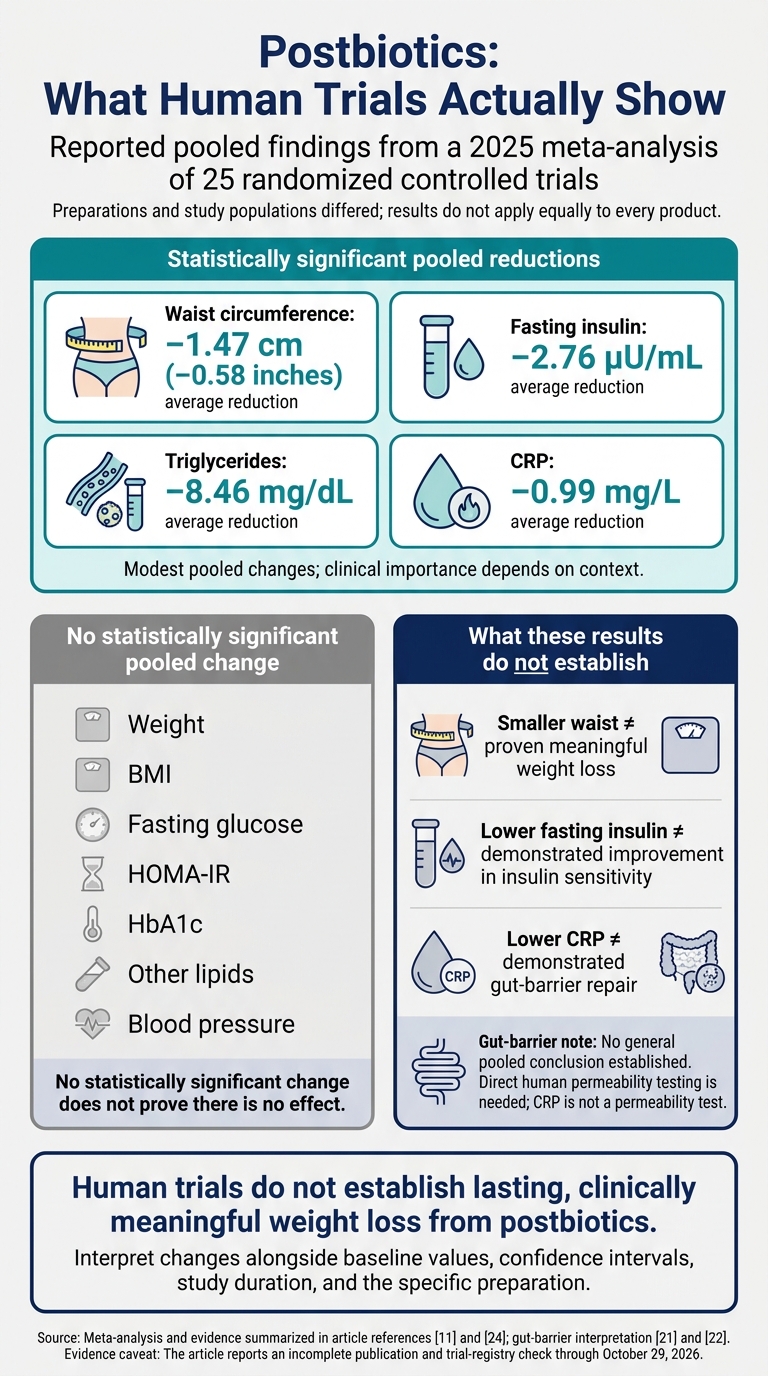
A 2025 meta-analysis of 25 randomized controlled trials found a statistically significant waist reduction of 1.47 cm (0.58 in), but no significant change in weight or BMI.[9][12]
The pooled weight estimate was −0.39 kg (−0.86 lb), with a 95% confidence interval (CI) of −1.22 to 0.43 kg. For BMI, the estimate was −0.42 kg/m² (95% CI, −0.82 to 0.02). Results varied more across studies for BMI (I² = 57.3%) than for weight (I² = 0.0%).[9]
These findings point to a modest average decrease in waist size, not a proven, clinically meaningful weight-loss effect.[9][12]
K8-Lb1 and K71 Trials
In a 12-week trial, inactivated (heat-killed) Limosilactobacillus fermentum K8-Lb1, formerly Lactobacillus fermentum, outperformed placebo on the primary outcome: fat mass. Values were 98.15% ± 3.32% of baseline with treatment versus 100.41% ± 3.39% with placebo (P = .016).[13][15]
That is a 2.26-percentage-point difference in values relative to baseline, not a measure of weight loss. Secondary outcomes also favored treatment for weight (P = .047) and waist circumference (P = .034). The visceral-fat result was borderline (P = .053).[15]
For inactivated (heat-killed) Lacticaseibacillus paracasei K71, formerly Lactobacillus paracasei, the main analysis found no significant differences between groups. Reductions in several fat measures and hip circumference appeared only in participants without major lifestyle changes. Unless that subgroup analysis was planned in advance, those findings should be treated as exploratory.[8]
The trials suggest possible effects on body composition, but the results are too inconsistent to support strong weight-control claims. Changes in waist size or fat mass appear more often than changes on the scale.[8][9][15]
Human Study Comparison Table
These studies differ in their participants, doses, and analyses. They should not be pooled as though they were equivalent.
| Study | Population and trial metadata | Key outcome | Main limitation |
|---|---|---|---|
| K8-Lb1[13][14][15] | Randomized, double-blind, placebo-controlled; 60 overweight adults, 30 per group; BMI 25–32. Research database lists 10 billion cells. | Primary fat-mass outcome favored treatment. | Small sample; administered dose and full primary-report details require confirmation. |
| K71[8] | Randomized, double-blind, placebo-controlled; 80 healthy adults; BMI ≥23 and <30; 50 mg, approximately 1 × 10^11 cells daily for 12 weeks. | No significant differences in the main analysis of CT abdominal fat and standard body-composition measures. | Positive findings were limited to a subgroup. |
| Separate K71 report[10][11] | 66 healthy adults; design, dose, comparator, and duration require verification. | Reported reductions in weight, BMI, body-fat percentage, and triglycerides, with increased HDL cholesterol. | Too little primary-report detail for firm conclusions or pooling. |
Measure waist size at the same site and time of day, and take repeated readings. Do not convert CT fat area or volume into body-weight loss.[8][14][15]
Weight measurements cover only part of the picture; the next section reviews metabolic and inflammatory markers.
3. Metabolic Health, Inflammation, and the Gut Barrier
Insulin, Blood Sugar, Lipids, and CRP
The same trials looked beyond body size to metabolic health and inflammation. A meta-analysis of 25 randomized controlled trials found pooled reductions of 2.76 μU/mL in fasting insulin, 8.46 mg/dL in triglycerides, and 0.99 mg/L in CRP.[9][20] Fasting glucose, HOMA-IR, HbA1c, other lipids, blood pressure, weight, and BMI showed no statistically significant changes.[9][20]
These results suggest modest metabolic effects. They do not establish postbiotics as stand-alone weight-loss treatments. Check the primary reports for intervention type, duration, sample size, statistical model, confidence intervals, and baseline values.
Lower fasting insulin alone does not prove better insulin sensitivity. That requires HOMA-IR, a clamp, or another validated measure. CRP measures systemic inflammation - not intestinal permeability - and can be affected by body fat, infection, medications, smoking, exercise, and other factors. Results also need to be read in light of baseline values, diet, activity, medications, and whether the analyses accounted for multiple comparisons.[9][16][20]
Appetite Signals and Gut Barrier Mechanisms
Short-chain fatty acids (SCFAs) may influence the appetite hormones GLP-1 and PYY. Postbiotic metabolites may also affect mucus, tight junctions, and immune signaling. But direct human evidence for these pathways remains limited for most formulations.[19][21]
Claims about gut-barrier support need direct human testing. Permeability tests, such as lactulose–mannitol, and carefully interpreted endotoxin measures provide more relevant evidence than CRP alone. Changes in appetite hormones do not establish lasting fat loss. Likewise, a biomarker change does not prove that it caused a change in weight.[17][18]
Results and Limits by Outcome
For personal monitoring, work with a clinician to track clinically relevant measures: waist circumference, weight, lipids, glucose, and blood pressure. One favorable marker is not proof of success.[9][20]
The table below shows what researchers measured, what changed, and what remains unproven.
| Outcome | Observed effect | Evidence source | Consistency | Limitations | Clinical interpretation |
|---|---|---|---|---|---|
| Waist circumference | Pooled reduction of about 0.58 inches (1.47 cm) | Meta-analysis of 25 RCTs[9][20] | Results varied across formulations | Verify confidence interval, duration, baseline values, and heterogeneity | Possible modest reduction in central body fat; not equivalent to meaningful weight loss |
| Weight and BMI | No statistically significant pooled change | Meta-analysis[9][20] | Individual trials, including K71, reported favorable findings[10] | Small samples and differences between formulations | Does not establish independent weight-loss efficacy |
| Body fat | Reduction reported in the K71 trial summary | Individual human trial[10] | Needs replication | Confirm measurement method, effect size, and confidence interval | Preliminary finding |
| Fasting insulin | Pooled reduction of 2.76 μU/mL | Meta-analysis[9][20] | May vary by age, formulation, and duration | Lower insulin is not the same as measured insulin sensitivity | Possible metabolic effect; interpret alongside HOMA-IR or clamp data |
| Triglycerides | Pooled reduction of 8.46 mg/dL; a reduction was also reported in K71[10][9][20] | Meta-analysis and individual trial | Results may differ across products | Check fasting status, lipid medications, and baseline levels | Possible modest lipid benefit |
| CRP | Pooled reduction of 0.99 mg/L | Meta-analysis[9][20] | Results varied across studies | CRP is nonspecific and does not measure permeability | May indicate lower systemic inflammation; not proof of barrier repair |
| Glycemic measures | No statistically significant pooled changes in fasting glucose, HOMA-IR, or HbA1c | Meta-analysis[9][20] | Individual interventions may differ | Study duration may be too short for HbA1c; measurement methods vary | Evidence remains inconclusive |
| Gut-barrier outcomes | No general pooled conclusion established | Direct permeability and endotoxin studies must be checked individually[17][18] | Limited and inconsistent clinical evidence | CRP cannot replace permeability testing | Treat barrier support as hypothetical unless directly measured |
4. Postbiotics in a Multi-Biotic Weight Plan
Roles of Prebiotics, Probiotics, and Postbiotics
Human studies show modest, product-specific effects on weight loss. That makes it important to understand where each biotic type fits into a broader plan.
Microbiome products are optional add-ons, not replacements for diet, activity, sleep, or treatment when needed. Each type has a different role.[5][6]
| Biotic type | Weight-control relevance | Evidence limits |
|---|---|---|
| Prebiotic | May support satiety; relevant outcomes include appetite and weight | Effects depend on substrate, dose, diet, and duration; not all fiber is prebiotic |
| Probiotic | May offer strain-specific support for weight or fat-mass reduction | Benefits cannot be generalized across strains, formulations, or populations |
| Postbiotic | May modestly affect waist size and metabolic markers | Pooled findings do not establish meaningful weight loss; benefits are preparation-specific |
When a product combines all three, the finished formula - not just its ingredients - needs testing.
Evidence for individual ingredients doesn't prove that a blend works better. A synbiotic needs evidence that the combination itself provides a health benefit. Weight-control claims require adequately powered, randomized trials of the finished formulation.[5][7][24]
Rebirth RE-1: A Combined Formulation Example
Rebirth RE-1 is an example of this combined-formula approach.
Manufacturer materials describe Rebirth RE-1 as a 3-in-1 prebiotic, probiotic, and postbiotic formula with HOSt™, 4.5 g of GOS and inulin, and 500 billion CFU per serving.[25] CFU measures live microbes, so the 500-billion-CFU figure applies only to the probiotic portion. A controlled human trial of the finished product is needed to support any weight-control claim.
Formulation Quality and Safety
For weight plans, formulation quality matters as much as the ingredient list. Independently verify manufacturer claims and check:
- Strain names, component doses, viable counts through shelf life, storage instructions, and lot testing.
- The postbiotic's source, inactivation method, and retained components.
Use the supporting evidence to set a goal and decide when to reassess.
GOS and inulin can cause gas, bloating, discomfort, or stool changes. Introduce them gradually if the instructions permit, and seek care for persistent or severe symptoms.
Consult a clinician before use if you have major immune compromise, central-line access, a serious illness, or a complex medication regimen. Inactivation does not automatically make a product safe for everyone, and findings in adults do not establish safety or benefit in children.[5][6][22][23]
5. Conclusion
What Human Studies Support
Human trials suggest modest changes in waist measurements and biomarkers, but do not establish a lasting, clinically meaningful weight-loss benefit.[9][12] Results depend on the product. One small K8-Lb1 trial reported improvements across more body-composition and blood sugar measures, but other studies need to confirm those findings.[26]
Research Gaps and Registered Trials
The results show some promise. But small samples, short follow-up periods, varied preparations, and a lack of control over diet and activity mean findings from one product cannot be applied to others. Evidence for gut-barrier and appetite effects also remains limited.
Future trials need preregistration, adequate sample sizes, standardized preparations, dietary assessments, body-composition measurements, validated measures of gut permeability and appetite, and follow-up after treatment ends. Before naming trials currently in progress, verify their registry identifiers, interventions, and current status.
Practical Guidance for Weight Management
Set a goal and a reassessment date before starting. If you use postbiotics, make them part of a broader weight-management plan - not a replacement for it. Track weight and waist measurements consistently. Lower CRP or insulin levels alone do not prove fat loss.
Base your decisions on human evidence for the specific product, safety, and realistic expectations - not promises of guaranteed weight loss. Nutrition, activity, sleep, and obesity treatment when indicated remain the basis of weight management.
FAQs
How long should I try postbiotics before reassessing?
Allow 8 to 12 weeks before reassessing weight control and metabolic markers [1][2]. Some benefits may show up after 4 weeks. However, the largest, lasting results - such as better insulin sensitivity and a smaller waist circumference - typically appear after 12 weeks of consistent use [3][2].
Rebiirth RE-1™ offers structured 7-day, 4-week, and 12-week protocols to support microbiome stabilization and metabolic changes [2][4].
How can I tell if waist changes are meaningful?
Track your waist circumference consistently for 8 to 12 weeks to spot meaningful changes [1][2][3]. Clinical research reports reductions of about 0.4 to 1.6 inches (1.04 to 4.04 cm) with interventions that support gut microbiome stability and metabolic health [3][4]. Focus on your measurements after that window to allow time for measurable metabolic responses and reductions in visceral fat [1][2][3].
What evidence should I look for on a postbiotic label?
Look for clearly identified postbiotic sources and ingredients supported by well-run clinical trials that show health benefits [1]. Check for third-party testing to verify quality and safety, too [1].
The label should list strain profiles, dosage details, and serving specifications. These details help you track your intake accurately, especially if postbiotics are part of your broader microbiome plan [1].