

If your baby was born by C-section, prebiotics may help support gut bacteria like Bifidobacterium in the first 12 weeks, but they do not “replace” vaginal birth microbes.
Here’s the short version:
-
C-section birth changes early gut colonization
- Babies tend to have less Bifidobacterium and Bacteroides
- They may have more skin and hospital-linked microbes
-
Those shifts can last at least 12 weeks
- This is often shaped by feeding and antibiotic exposure
-
Breastfeeding is the top feeding support
- Human milk contains HMOs, which feed helpful gut bacteria
-
If breastfeeding is partial or not possible
- Prebiotic-enriched formula with GOS/FOS may help move the gut closer to a breastfed pattern
-
Synbiotics may help in some cases
- One trial found gains in Bifidobacteria through week 8 and lower Enterobacteriaceae through week 12
- But this is not standard care for every infant
-
Bottom line
- Prebiotics are a support tool
- They help feed microbes that are already there
- They do not fully fix birth-related microbiome shifts on their own
I’d sum it up like this: breast milk is the natural model, prebiotics can help when extra support is needed, and pediatric guidance matters most when antibiotics or formula feeding are part of the picture.
| Option | What it does | What to keep in mind |
|---|---|---|
| Breastfeeding | Feeds helpful bacteria with HMOs | Best-supported first step |
| Prebiotic formula | Can increase Bifidobacterium and gut fermentation products | Best used with clinician input |
| Synbiotics | Pair prebiotics with probiotics | May fit some infants, not all |
Simple takeaway: if you’re looking for the plain answer, prebiotics can help nudge the early gut in a better direction after C-section birth, but they work best as part of a feeding plan, not as a stand-alone fix.
How C-Section Delivery Shapes Early Gut Colonization and Immune Patterns
Microbiome differences: vaginal birth vs. C-section
A C-section changes the first wave of microbes a baby meets. Instead of getting the usual mix of maternal vaginal and intestinal microbes, the baby is exposed more to skin and hospital organisms. That shifts early gut colonization and changes the first microbial signals the gut receives [1].
Studies show a clear pattern. Infants born by C-section tend to have lower levels of Bifidobacterium and Bacteroides, and higher levels of Staphylococcus and Klebsiella [1][2]. Put simply, the early gut mix looks different from the start. This is the setting prebiotics, probiotics, and postbiotics are meant to help improve.
Peripartum antibiotics can add another layer. These drugs are often given during C-sections to help prevent infection, but they can also make early colonization harder [1]. And timing matters here, because immune programming starts right after birth.
Why early microbial shifts affect immune development
The gut does more than digest milk. It also helps train the immune system. Early colonization helps shape immune defenses, support mucosal protection, and keep inflammatory responses in balance [2].
That matters because the first microbes act a bit like early teachers. They help the immune system learn what to react to and what to tolerate. So when the early gut community shifts, immune signaling can shift with it. Moving the gut toward more helpful colonizers may help support healthier immune patterns. Identifying the ideal probiotic strain can be a key step in this process.
How long these differences can last
These birth-related microbiome differences are usually largest in the first days of life, but they do not disappear overnight. The gap between vaginal and C-section births can last for weeks [1].
How fast that gap narrows depends on a few things, especially feeding choices and antibiotic exposure after birth [1]. Studies show that infants born by C-section can have lower Bifidobacterium and higher Enterobacteriaceae through at least the first 12 weeks [1]. That’s why early nutrition can matter so much during that first 12-week window.
sbb-itb-1bbfe7f
Microbes from Mom: Vaginal Birth vs. C-Section
How Prebiotics May Support Microbiome Recovery After C-Section
Prebiotics may help infants born by C-section by feeding helpful gut bacteria and supporting a more balanced early gut setting. These fibers pass through the small intestine without being digested and reach the colon, where gut bacteria ferment them. That matters in the first months of life, when feeding can still shape colonization.
This fermentation supports mucosal defenses and immune balance, which matters most during the window when early colonization is still taking shape [2].
Human milk oligosaccharides: the natural early-life model
The clearest early-life model is breast milk. It naturally contains human milk oligosaccharides (HMOs), which are complex carbohydrates the infant does not digest. Instead, they feed Bifidobacteria and Lactobacilli in the colon [2]. In simple terms, HMOs act like food for the bacteria you want more of, helping shape a more favorable early microbiome.
GOS, FOS, and inulin in formula or supplement use
When extra support is needed, galactooligosaccharides (GOS), fructooligosaccharides (FOS), and inulin are the main prebiotics used in formula or supplements to support Bifidobacteria growth [2]. GOS supports Bifidobacteria growth in term infants. FOS and inulin, often sourced from plants, also support Bifidobacteria, Lactobacilli, and SCFA production [2].
They don't all come from the same source, and they don't act with the same strength. But they point in the same direction: helping rebuild the kind of early gut pattern linked with a healthier microbiome.
Table: Key prebiotic types and their effects
| Prebiotic Type | Typical Source | Primary Microbial Targets | Main Gut or Immune Effects |
|---|---|---|---|
| HMOs (Human Milk Oligosaccharides) | Breast milk | Bifidobacteria, Lactobacilli | Supports mucosal defenses and immune balance; produces SCFAs [2] |
| GOS (Galactooligosaccharides) | Supplements / fortified formula | Bifidobacteria | Increases fecal bifidobacteria; supports fermentation patterns [2] |
| FOS (Fructooligosaccharides) | Plants / supplements | Bifidobacteria | Selective stimulation of commensal bacteria; supports protective role against pathogens [2] |
| Inulin | Chicory root / supplements | Bifidobacteria, Lactobacilli | Supports SCFA production and helpful bacterial growth [2] |
In practice, the effect depends on the feeding pattern and the rest of the recovery plan.
Recovery Support Options for Infants and Families: What the Evidence Shows
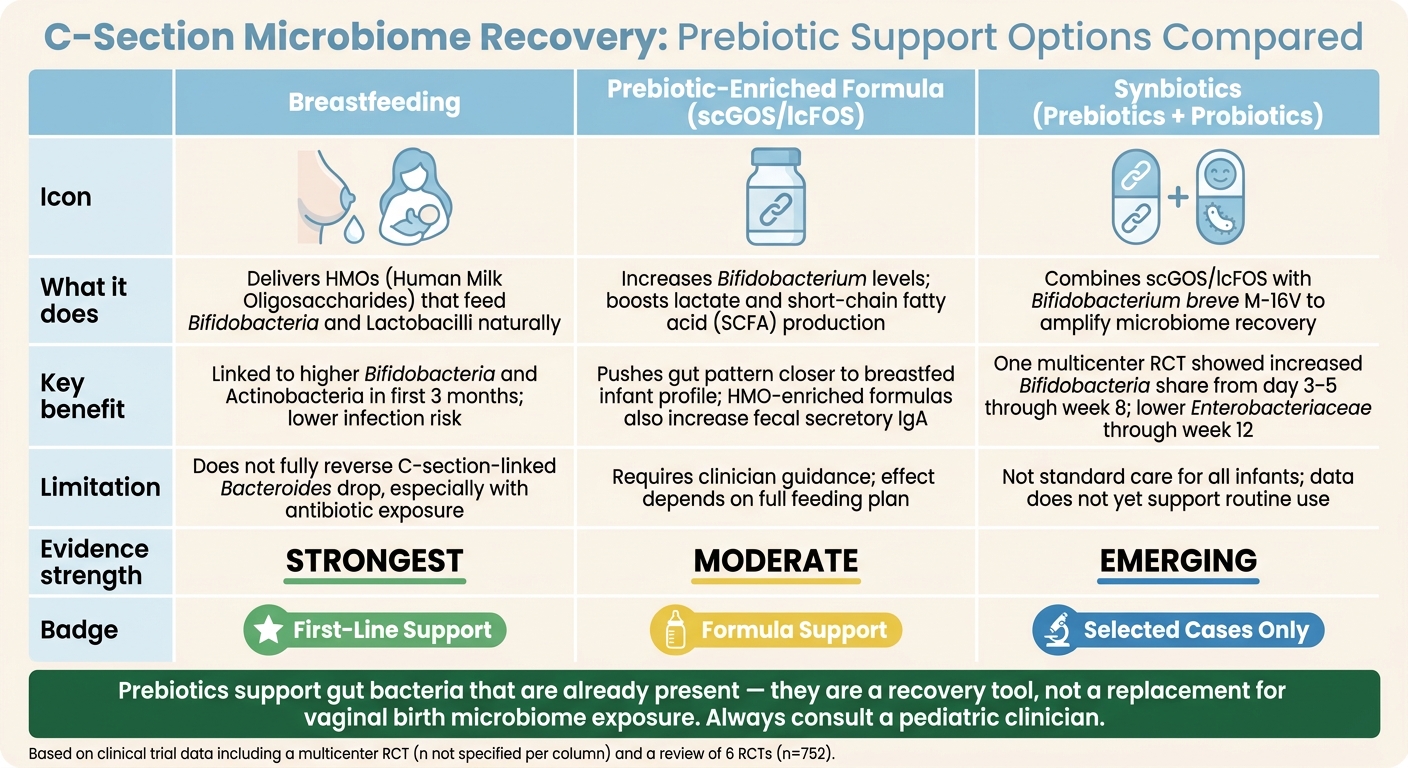
C-Section Microbiome Recovery: Prebiotic Support Options Compared
Once early colonization shifts, the next question is practical: which feeding choices seem to help move the microbiome in a healthier direction?
Breastfeeding, formula choices, and prebiotic support
Breastfeeding is the best-supported first step after a C-section. [4][7] In C-section–born infants, exclusive breastfeeding has been linked to higher Actinobacteria and Bifidobacteria in the first 3 months, and breastfed infants have a lower infection risk than non-breastfed peers. [10]
That said, breastfeeding doesn't fully undo C-section-linked microbiome changes. This is especially true for the persistent drop in Bacteroides seen with intrapartum antibiotic exposure. [5]
If breastfeeding is partial or not possible, the next big factor is formula choice. The main evidence-based option is prebiotic-enriched formula. Formulas with scGOS/lcFOS have been shown to increase Bifidobacterium levels and boost lactate and short-chain fatty acid production. In plain terms, they can help push the gut pattern closer to what is usually seen in breastfed infants. [8]
Formulas with five HMOs at human-like concentrations have also shifted the microbiota of formula-fed infants toward breastfed patterns. They also increased fecal secretory IgA, a key marker of gut immune defense. [11][12] In the U.S., formula or supplement decisions should be guided by a pediatric clinician, with growth, allergy risk, and the infant's full medical picture in mind.
When synbiotics may fit in selected cases
Synbiotics pair prebiotics with probiotics. For C-section infants, one multicenter trial found that a formula containing scGOS/lcFOS plus Bifidobacterium breve M-16V increased the share of Bifidobacteria from day 3–5 through week 8 and lowered Enterobacteriaceae through week 12 compared with controls. [3]
That's a promising signal. It points to a more favorable early gut profile during an important window. But the data still don't support routine synbiotic use for all infants. [6] For now, synbiotics are a clinician-guided option in selected cases, not standard care.
The table below links these supports to common clinical situations.
Table: Recovery pathways by clinical situation
| Clinical Situation | Main Microbiome Pattern | Best-Supported Support Options |
|---|---|---|
| Uncomplicated C-section + exclusive or predominant breastfeeding | Transient Bacteroides reduction and delayed colonization, with relatively favorable Bifidobacterium trends over the first 3 months. [5] | Breastfeeding support, skin-to-skin care, and standard pediatric follow-up. |
| C-section + partial or exclusive formula feeding (no early antibiotics) | Lower Bifidobacterium levels and a microbiome that can resemble exclusively formula-fed infants more than exclusively breastfed infants. [5][8] | Prebiotic-enriched formula with scGOS/lcFOS; clinician-reviewed synbiotic formulas; monitor growth and tolerance. [3][6][8] |
| C-section + early neonatal or intrapartum antibiotic exposure | More pronounced and persistent changes, including Bacteroides depletion that breastfeeding alone may not fully correct. [5][6] | Maximize breastfeeding where possible; consider targeted synbiotic interventions only under pediatric supervision. [6][7] |
A review of six RCTs (n=752) found mixed effects on allergy, vaccine response, and infections, which is why pediatric guidance still matters here. [9]
Conclusion: What Prebiotics Can and Cannot Do in C-Section Microbiome Recovery
Prebiotics can help. They feed helpful bacteria and support a healthier gut setting. But they do not replace the first microbial exposure that comes with vaginal birth. Prebiotics need bacteria that are already there to ferment them, so their role is support, not replacement.
That makes the main question pretty simple: how much support can prebiotics realistically add?
The evidence looks promising, but it is still incomplete. So prebiotics should be framed as a way to support early microbiome recovery, not as a standalone fix.
In practice, breastfeeding remains the strongest baseline. When that is not fully possible, prebiotic-enriched feeding and clinician-guided synbiotics for C-section recovery can still help support recovery.
Bottom line: prebiotics are a support tool in C-section microbiome recovery, not a complete solution. They can help nudge the early gut in a better direction, but they cannot replace the birth-related start.
FAQs
When should prebiotics be started after a C-section birth?
Prebiotic support after a C-section is meant to feed helpful bacteria early on. That said, timing should be tailored to the child, since birth method can shape early microbial exposure.
If you're using Rebiirth RE-1, the suggested use is one sachet per day. For infants and young children, talk with a pediatrician first to confirm the best timing and dose based on the child’s health and stage of development.
How do I know if a prebiotic formula is right for my baby?
Ask your pediatrician first. They can look at your baby’s age, weight, birth method, overall health, and whether things like recent antibiotic use or long-term digestive issues change the need for microbial support.
When you shop, pick a high-quality formula that uses clinically studied strains and has third-party testing for purity and CFU counts. Then keep an eye on any digestive changes. If your baby has a compromised immune system, get medical guidance before you start anything.
Do prebiotics help if my baby had antibiotics?
Yes. Antibiotics can disrupt the gut microbiome by reducing beneficial bacteria. That can lead to diarrhea or dysbiosis.
Prebiotics help feed healthy bacteria, which may support a better-balanced gut as your baby recovers.
A synbiotic such as Rebiirth RE-1, which combines prebiotics, probiotics, and postbiotics, may offer broader gut support during or after antibiotic use. Still, every baby is different, so it’s smart to ask your pediatrician about your child’s specific needs.