

If pesticide exposure has upset your gut, the short answer is this: prebiotics feed gut microbes, probiotics add live strains, postbiotics supply microbial byproducts, and a synbiotic combines all three.
Human data is still limited, and much of the research comes from animal or lab work. So I’d treat these tools as support options, not proof-based fixes. What helps most can depend on the pesticide, dose, length of exposure, your diet, meds, and what your gut looked like before exposure.
Here’s the plain-English version:
- Prebiotics: fiber that feeds microbes already in your gut
- Probiotics: live bacteria meant to help refill missing strains
- Postbiotics: non-living compounds that can help with gut lining and immune signaling
- 3-in-1 synbiotics: one product that combines all three
One key point: if exposure is still happening, cutting that down matters more than adding supplements.
Another key point: if you have red-flag symptoms like blood in stool, severe pain, fever, weight loss, or dehydration, I would look to a doctor first, not more gut products.
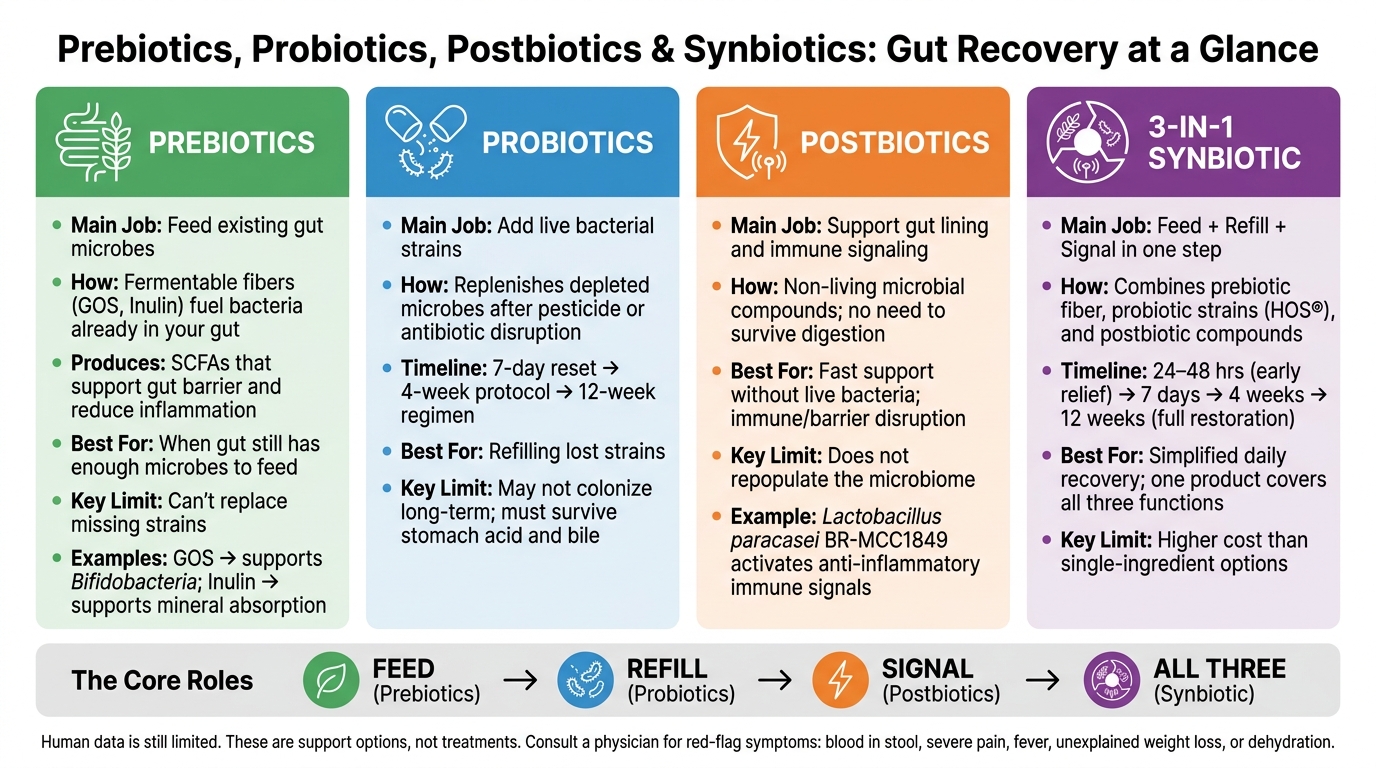
Prebiotics vs Probiotics vs Postbiotics vs Synbiotics: Gut Recovery Comparison
Quick Comparison
| Option | Main Job | What It Can’t Do Well | Best Fit |
|---|---|---|---|
| Prebiotics | Feed existing gut microbes | Can’t replace missing strains | When your gut still has enough microbes to feed |
| Probiotics | Add live strains | May not stay in the gut long | When you want to help refill depleted microbes |
| Postbiotics | Support signaling and gut lining | Don’t repopulate the microbiome | When you want support without live bacteria |
| 3-in-1 Synbiotic | Combine feed, refill, and signal | Often costs more | When you want one simple daily option |
A common time frame in the article is 7 days, 4 weeks, and 12 weeks. Some people may notice changes in 24 to 48 hours, but longer gut recovery usually takes more time.
This article compares each option side by side so you can see what each one does, where it may help, and where it falls short.
sbb-itb-1bbfe7f
1. Prebiotics
Primary Function
Prebiotics are fibers that feed the good microbes already living in your gut. They don't add new microbes. Instead, they give your existing gut bacteria fuel.
Two common examples are Galactooligosaccharide (GOS) and Inulin. GOS, in particular, can increase bifidobacteria. When gut microbes ferment these fibers, they produce SCFAs. Those compounds help support the gut barrier and help regulate inflammation [1].
Best Timing
Prebiotics can help with recovery after regular fiber intake is already in place, but they don't work overnight. Their effects tend to build over time.
Dependencies
There's a catch with prebiotics: they can only feed microbes that are already there. If pesticide exposure has reduced certain strains, prebiotics have less to work with.
Limitations
Their effect depends on the microbes already present. Prebiotics can support recovery, but they do not rebuild what exposure has depleted. That's why they often make the most sense as one part of a broader recovery plan, not a stand-alone fix.
In practice, different prebiotic fibers can support different recovery goals.
| Prebiotic Type | Primary Benefit | Target Microbes |
|---|---|---|
| Galactooligosaccharide (GOS) | Supports immune signaling | Bifidobacteria [1] |
| Inulin (Low Molecular Weight) | Supports mineral absorption | Resident beneficial flora [1] |
2. Probiotics
Primary Function
If prebiotics feed the microbes already living in your gut, probiotics bring in live strains to help refill what’s been lost. That matters after pesticide-related disruption, because pesticide exposure can contribute to microbiome loss and imbalance [1].
Best Timing
Probiotics are usually taken daily, and the effect tends to build over time rather than all at once [1]. A common recovery path breaks into three stages [1]:
- A 7-day reset to help with acute symptoms
- A 4-week protocol to help keep things steady
- A 3-month regimen to support longer-term restoration
Dependencies and Limitations
Not all probiotics do the same job. Strain choice matters, and human-derived strains may be a better fit for the gut and may stick around longer [1].
Delivery matters too. A probiotic has to make it through stomach acid, bile, and the rest of the gut before it can do much of anything [1]. If it can’t survive the trip, the label won’t mean much in practice.
That’s why probiotics tend to work better as one part of a bigger recovery plan. They pair well with prebiotic fiber, which helps support colonization and metabolite production [1].
Once those microbes are fed or replenished, postbiotics are the helpful compounds they produce.
3. Postbiotics
If probiotics add live strains, postbiotics provide the compounds those microbes leave behind, which is why postbiotics matter for metabolic recovery.
Primary Function
Postbiotics are non-living microbial compounds that can work without having to survive digestion first. They include microbial metabolites and cell fragments that help support immune signaling, barrier integrity, and metabolic function.
After pesticide-related disruption, they can support the gut without waiting for live microbes to colonize. One well-studied example is Lactobacillus paracasei BR-MCC1849, which activates immune signals that help regulate inflammation [1]. That makes postbiotics a good fit when the goal is fast support, not full microbial replacement.
Best Timing
Postbiotics tend to work best with steady daily use. The exact time of day matters less than sticking to a routine. Their effects build over time.
Dependencies and Limitations
Postbiotics work well alongside prebiotics, which help helpful microbes produce more metabolites. The tradeoff is simple: postbiotics do not repopulate the microbiome on their own.
That’s why a full recovery plan often includes prebiotics, probiotics, and postbiotics together. In many cases, that overlap is exactly why synbiotics vs. probiotics comparisons show that combined formulas fit recovery goals better than single-ingredient support.
4. Three-in-One Synbiotic Approach
After pesticide-related disruption, a 3-in-1 synbiotic can help with three jobs at the same time: replenishment, nourishment, and microbial support. In simple terms, if prebiotics feed, probiotics refill, and postbiotics send signals, a synbiotic rolls all three into one recovery step.
Primary Function
A three-in-one synbiotic combines live probiotic strains, prebiotic fiber, and postbiotic compounds in a single formula. The aim is to help restore microbial balance by supporting all three functions at once.
What makes this approach different is the use of Human Origin Strains (HOSt®). These strains are selected to match the human gut and are made for better gut persistence. When paired with prebiotic fibers and postbiotic support, the formula works on replenishment, nourishment, and immune signaling together [1].
Best Timing
Use it daily and stick with it. That makes the recovery plan simpler to follow over time. The usual progression looks like this [1]:
| Recovery Phase | Duration | Primary Goal |
|---|---|---|
| 7-day reset | 7 days | Reduce bloating, fatigue, and abdominal pain |
| 4-week protocol | 4 weeks | Maintain stability against daily disruptions |
| 12-week regimen | 12 weeks | Address the root cause of imbalance and establish long-term microbial balance |
Dependencies
Results build over time. Some people notice relief from bloating within 24 to 48 hours, but deeper restoration of the gut's defenses takes longer and may not be obvious right away [1].
Limitations
These formulas are dietary supplements, not treatments for disease. Results vary from person to person. Pregnant or lactating individuals should talk with a physician before use, and children should only use the formula under the supervision of a parent or health practitioner [1].
Rebiirth RE-1™ follows this setup. It is a clinically-backed 3-in-1 synbiotic with HOSt® strains, prebiotic fiber, and postbiotic support, available as a 7-day, 4-week, or 12-week reset [1].
Pros and Cons of Each Recovery Approach
There’s no one-size-fits-all fix here. Each option does a different job, and the best pick often comes down to a simple distinction: do you need fuel, live strains, or microbial signals? That matters even more for people dealing with pesticide-related gut disruption.
| Approach | Main Strengths | Key Drawbacks | Who It May Suit | Major Cautions |
|---|---|---|---|---|
| Prebiotics | Nourishes existing beneficial bacteria and supports SCFA production | Can be slow if key microbes are already depleted | People looking to support bacteria already present in the gut | Use under a health practitioner's supervision if managing major GI disease |
| Probiotics | Replenishes live strains; HOSt® strains are selected for better gut persistence | Transient strains may pass through without colonizing, so gut dysbiosis can persist | People recovering from pesticide or antibiotic exposure | Immunocompromised or seriously ill individuals should consult a physician before use |
| Postbiotics | Supports immune signaling and barrier function without requiring live bacteria | Does not repopulate the gut with live bacteria | Those dealing with pesticide-related immune or barrier disruption | Pregnant or lactating individuals must consult an obstetrician before starting |
| 3-in-1 Synbiotic | Combines prebiotics, probiotics, and postbiotics in one recovery step | Higher-cost formulations | People who want a simpler, combined approach | Follow the labeled dose; keep out of reach of children |
In plain terms, prebiotics feed what’s already there, probiotics add live strains, and postbiotics help with signaling and gut barrier support. A 3-in-1 synbiotic tries to cover all three in one step, though that added convenience can come with a higher price tag.
The trade-offs are pretty clear: match the tool to the kind of gut support you need.
Conclusion
Prebiotics, probiotics, and postbiotics each play a different role: feed, refill, and signal.
Pesticide exposure does not prove dysbiosis. And if exposure is still happening, cutting that down matters more than relying on supplements alone.
If symptoms move past mild discomfort, the next step is medical evaluation, not more supplementation. Seek medical care if you're dealing with persistent diarrhea, blood in the stool, unexplained weight loss, severe abdominal pain, fever, or signs of dehydration. Those are red flags that go beyond what any gut supplement is meant to handle.
For mild gut symptoms, the practical issue is simpler: can one combined formula make recovery easier? A 12-week regimen is often suggested for more complete microbiome restoration [1]. Rebiirth RE-1™ brings all three into one sachet for simpler daily support, lining up with the feed, refill, and signal roles that make this combined approach a sensible fit for pesticide-related gut recovery.
FAQs
How do I know which option fits my gut needs?
The right gut support comes down to your digestive health, your goals, and your own history. Start with what’s going on right now: your symptoms, how long they’ve been around, and how much support you may need.
Rebirth RE-1 keeps things simple with a 3-in-1 synbiotic setup. You can use it as a 7-day reset, a 4-week protocol, or a 3-month regimen, depending on what fits your situation. If you have SIBO, IBS, or immune concerns, talk with your healthcare provider first.
Can these supplements help if pesticide exposure is still happening?
Yes. A targeted synbiotic approach can still support your gut during ongoing pesticide exposure.
A 3-in-1 eubiotic like Rebiirth RE-1 can help refill helpful bacteria, feed them with prebiotic fibers, and add postbiotics that support inflammation control and gut barrier strength. That may help your microbiome stay more balanced and resilient during continued stress from pesticide exposure.
When should I see a doctor instead of trying gut support?
Talk to a healthcare professional before you start gut support if you have any existing health conditions, including SIBO, IBS, or immune system disorders.
You should also get medical advice if you’ve had surgery recently, are dealing with a serious illness, are pregnant or nursing, or are taking antibiotics and need help figuring out supplement timing.