

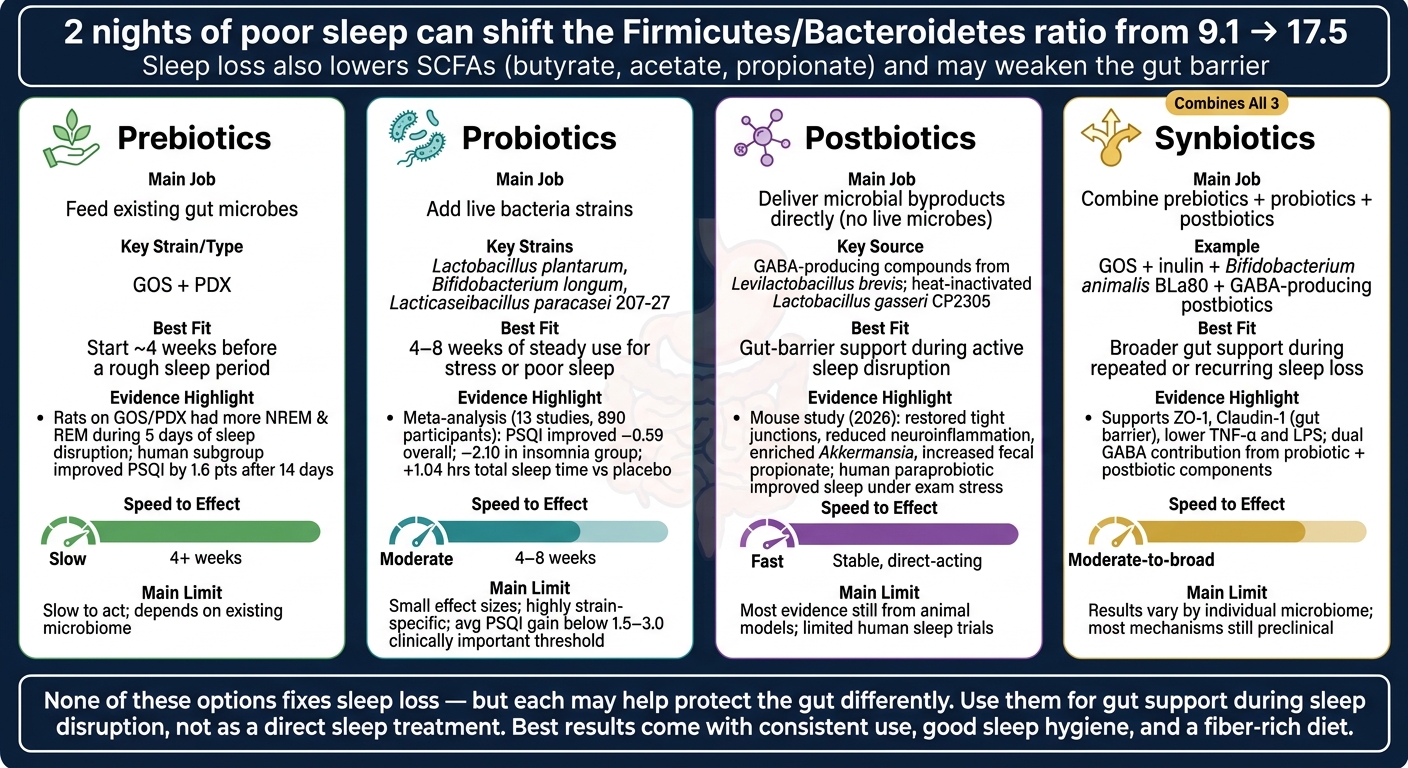
Just 2 nights of short sleep can shift your gut fast. In one study, the Firmicutes/Bacteroidetes ratio jumped from 9.1 to 17.5, which points to a gut environment that may be less stable during sleep loss.
If I had to boil this down into one simple answer, it’s this: none of these options fixes sleep loss, but each may help protect the gut in a different way.
- Prebiotics feed the microbes you already have and fit best for planning ahead
- Probiotics add live strains and may help with modest sleep-score changes after a few weeks
- Postbiotics use non-living microbial compounds and may help support the gut barrier during stress and short sleep
- Synbiotics combine all 3, but they still work best as support, not as a replacement for sleep
A few points stand out right away:
- Sleep loss is linked with lower SCFAs like butyrate, acetate, and propionate
- It may also weaken the gut barrier and allow LPS to move into circulation
- Human sleep results are mostly small, mixed, or tied to very specific strains and formulas
- Most gut-support products make more sense for recurring poor sleep, shift work, travel, or stress, not for a one-night fix
Prebiotics vs Probiotics vs Postbiotics vs Synbiotics for Sleep Loss
How gut microbiome is affected by circadian rhythm and sleep deprivation | Matthew Walker
sbb-itb-1bbfe7f
Quick Comparison
| Option | Main job | Best fit | Main limit |
|---|---|---|---|
| Prebiotics | Feed existing gut microbes | Starting ~4 weeks before a rough sleep period | Often slow to show effects |
| Probiotics | Add live bacteria | 4 to 8 weeks of steady use for stress or poor sleep | Effects are often small and strain-specific |
| Postbiotics | Deliver microbial byproducts directly | Gut-barrier support during sleep disruption | Human sleep data is still limited |
| Synbiotics | Combine pre-, pro-, and postbiotics | Broader gut support during repeated sleep loss | Results vary from person to person |
So when I look at the full picture, the message is pretty clear: use these for gut support during sleep disruption, not as a direct sleep treatment. Understanding the gut microbiome and sleep science helps clarify why these supplements are supportive rather than curative.
1. Prebiotics
How They Work During Sleep Loss
Prebiotics are non-digestible fibers that feed the gut bacteria you already have. During sleep loss, that extra support may help maintain SCFA production and keep the microbiome more stable. Among the options studied, GOS plus PDX has the strongest sleep-related data. It increased Parabacteroides distasonis, which was linked with better sleep measures during recovery after sleep loss [7].
What the Evidence Shows
The best data so far comes from animal studies. In one study, rats fed a GOS/PDX diet for 4 weeks had more NREM and REM sleep during 5 days of sleep disruption, while baseline sleep stayed the same [7]. That detail matters. The prebiotics didn’t act like a sedative. They seemed to help the animals handle sleep disruption better.
Human data is still limited, and the findings are mixed. One trial found no overall PSQI benefit, but a subgroup improved by 1.6 points after 14 days [9].
Limitations and Tolerability
Results can differ a lot based on someone’s starting microbiome, and these effects usually don’t show up fast. A 4-week lead time is the practical minimum before sleep-related changes are likely to appear [7]. Even when sleep scores improve, the change often stays below the PSQI minimum clinically important difference of 1.5 to 3.0 points [6]. So prebiotics fit better as support, not as a stand-alone answer.
Best Role in Preventive Wellness
Prebiotics make the most sense as a long-term tool. If you know a stressful stretch is ahead, starting a GOS/PDX supplement or shifting to a fiber-rich, Mediterranean-style diet at least 4 weeks in advance may help the gut stay steadier when sleep gets disrupted [7][8].
Prebiotics and probiotics take different routes: prebiotics support the microbiome that’s already there, while probiotics add live microbes directly.
2. Probiotics
How They Work During Sleep Loss
During sleep loss, probiotics may help strengthen the gut barrier and cut down LPS leakage. They may also affect the tryptophan-to-serotonin-to-melatonin pathway tied to sleep [1][2]. Put simply, probiotics are the most direct microbe-based option once poor sleep has already started to mess with the gut.
Most of the body’s serotonin is made in the gut [2]. And strains like Lactobacillus plantarum and Bifidobacterium longum have been linked to lower stress signaling and less HPA-axis activity, which matters because sleep loss can push HPA-axis activity up [2].
What the Evidence Shows
The research points to modest gains, not dramatic ones. A meta-analysis of 13 studies with 890 participants found modest improvements in PSQI (−0.59) and ISI (−0.86). In people with insomnia, PSQI improved by 2.10 points. One study on Lacticaseibacillus paracasei 207-27 also found an increase in total sleep time of 1.04 hours versus placebo [6].
Limitations and Tolerability
The big catch is the effect size. The average PSQI improvement of −0.59 is below the minimum clinically important difference of 1.5 to 3.0 points [6]. So yes, the change shows up in the data, but for many people, it may not feel like much in daily life.
Strain specificity is another sticking point. Results from Bifidobacterium longum NCC3001, for example, don’t automatically carry over to other strains or even other genera [2][6]. On top of that, long-term safety data past 12 months is still limited [1].
Best Role in Preventive Wellness
Probiotics make the most sense as a preventive tool or as an add-on for sleep disruption linked to poor sleep, stress, or shift work [6][1]. Most of the clinical gains show up after 4 to 8 weeks of steady use [6][5], which makes them a better fit for steady gut and sleep support than for short-term sleep problems.
Compared with prebiotics, probiotics tend to act faster, but they’re still strain-specific and their effects are modest. For people dealing with stress-related sleep disruption, a multi-strain product with Bifidobacterium and Lactobacillus genera may be a practical pick as part of a broader wellness routine.
Postbiotics use microbial byproducts instead of live microbes.
3. Postbiotics
How They Work During Sleep Loss
Postbiotics work without live microbes. That means they don’t have to survive digestion or rely as much on what’s happening in the gut to do their job. They include bioactive compounds such as microbial metabolites and inactivated cells. In plain English, they’re the most stable option when sleep disruption is already throwing the gut off balance.
During sleep deprivation, postbiotics may help restore tight junctions, reduce intestinal permeability, and blunt inflammation and oxidative stress [3][2].
What the Evidence Shows
So far, the strongest data come from animal models. A March 2026 mouse study found that GABA-producing postbiotics from Levilactobacillus brevis improved gut barrier markers during chronic sleep deprivation. The treatment restored intestinal tight junctions, reduced neuroinflammatory gene expression in the hypothalamus, enriched Akkermansia populations, and increased fecal propionate [3].
There’s also some early human-related support. Heat-inactivated Lactobacillus gasseri CP2305 improved sleep quality under exam stress, which points to a broader role for paraprobiotics [10].
Limitations and Tolerability
The research is still early, especially when it comes to human trials focused on sleep. Data on sleep loss in people remain limited by small trials, inconsistent protocols, and subjective sleep measures [1][4]. Long-term safety, along with effects on the existing gut microbiota, still needs more longitudinal study [1].
Because they are non-viable, postbiotics are generally well-tolerated and may be a safer option for sensitive users [1][4].
Best Role in Preventive Wellness
For preventive wellness, postbiotics may help ease some of the physiological effects of sleep loss, especially in high-stress settings [3][10]. Their main role is helping support gut barrier integrity during continued sleep disruption. And because they’re stable, they can make sense as a practical synbiotic component during circadian disruption and gut microbiome imbalance.
4. Rebirth RE-1 Synbiotic Support
How It Addresses Gut Disruption During Sleep Loss
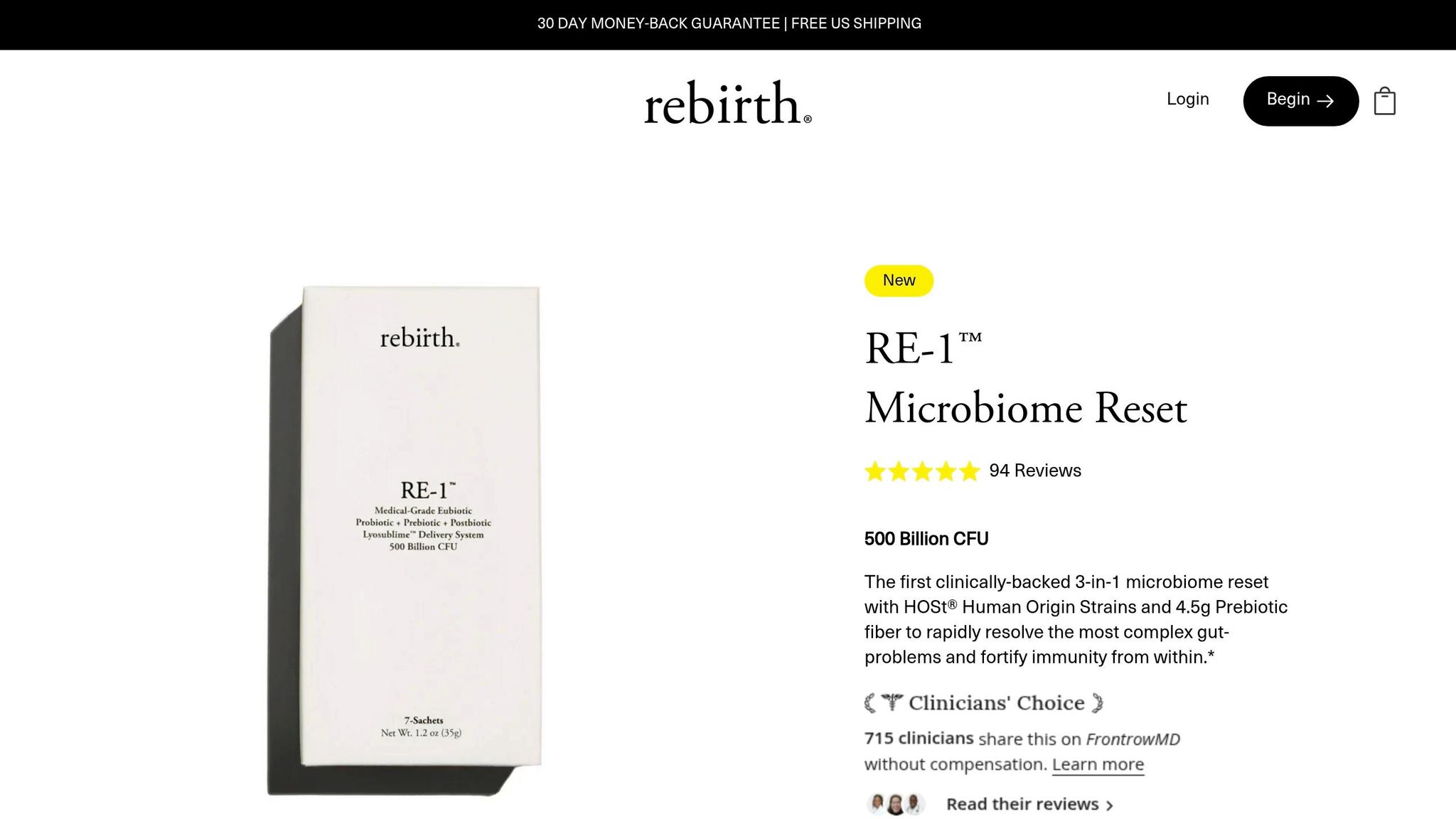
The three pathways above can be brought together in a single synbiotic formula. Rebirth RE-1 combines prebiotics, probiotics, and postbiotics in one product built to support the gut during periods of poor sleep. It includes GOS and inulin prebiotics, Bifidobacterium animalis BLa80 probiotics, and GABA-producing postbiotic components derived from Levilactobacillus brevis. In plain English, that means it’s designed to support the microbiota-gut-brain axis when sleep disruption starts to throw things off balance.
Its probiotic and postbiotic components are tied to support for ZO-1 and Claudin-1, along with lower TNF-α and LPS levels. That may help calm the inflammatory signaling linked with sleep loss. The probiotic and postbiotic parts also both contribute to GABA production. That combo is the main edge of a synbiotic during repeated sleep loss.
Limitations
There’s still an important caveat here. Like much of this field, a lot of the evidence behind these mechanisms comes from preclinical research, and long-term human trials focused on sleep loss are still limited. So RE-1 makes more sense as microbiome support, not as a direct fix for sleep itself.
Its Role as a Preventive-Wellness Option
For preventive use, flexibility matters more than whether a product has a direct sleep effect. RE-1 comes in 7-day, 4-week, and 12-week microbiome resets, delivered in sachets with 500 billion CFU per serving.
That setup gives people a simple way to match use to the kind of disruption they’re dealing with:
- Use the 7-day reset for occasional sleep disruption
- Use the 4-week or 12-week resets for recurring sleep loss
In that sense, RE-1 fits into a preventive gut-support routine for periods of recurring sleep disruption.
Pros and Cons
After looking at each mechanism, the practical question is simple: which option makes the most sense during sleep loss? Sleep loss can shift the gut fast, so the tradeoff comes down to speed, stability, and how much evidence we actually have.
| Option | Pros | Cons |
|---|---|---|
| Prebiotics | Support beneficial microbes and SCFA production | Slower to act; effects depend on existing gut microbes; limited direct clinical trials for acute sleep loss [1][4] |
| Probiotics | May modestly improve sleep quality and insomnia scores; generally safe with no significant adverse events [6][5] | Small effect sizes; highly strain-specific; often fall below the minimum clinically important difference of 1.5–3.0 for PSQI [6] |
| Postbiotics | Stable, direct-acting support; generally better tolerated because they do not contain live microbes [3][4] | Newer category; most evidence still comes from animal models; less clinical research on sleep outcomes specifically [3] |
| Rebirth RE-1 (Synbiotic) | Combines prebiotics, probiotics, and postbiotics for broader preventive support | Efficacy varies by individual microbiome; standardized formulas may not account for large person-to-person microbiome differences [1] |
There’s a clear pattern here. Across all three categories, subjective sleep quality tends to improve more than sleep duration or sleep efficiency.
That point matters. Someone may feel like they slept better without seeing a big change in total hours slept or in sleep-tracking metrics. So these options may help, but they’re not magic.
This is where the main takeaway starts to come into focus. Rebirth RE-1 uses a synbiotic approach that brings together prebiotics, probiotics, and postbiotics for broader gut support. Even so, these options work best as adjuncts, not as stand-alone fixes for serious sleep problems.
Conclusion
These options aim at the same problem, but they go about it in different ways. Prebiotics, probiotics, and synbiotics work in different ways: prebiotics feed gut microbes, probiotics add live strains, and postbiotics deliver active metabolites directly. Even so, none of them fully fixes the gut disruption that can come from poor sleep on its own.
A better path is to tackle sleep loss from several sides at once instead of leaning on just one option [2].
For a broader preventive option, a synbiotic brings all three approaches together. Rebirth RE-1 is one example of this type of formula [2][3].
Synbiotics tend to work best as a preventive wellness tool. Pair them with steady sleep hygiene and a fiber-rich diet if you want better results over time [1][8]. They can help support gut resilience during periods of sleep loss, but they shouldn't stand in for sleep recovery.
The aim here is to ease gut strain during disrupted sleep, not to promise a sleep fix. Results depend on consistency, sleep hygiene, and diet [1][3].
FAQs
Can these supplements make up for lost sleep?
Not directly. Research suggests prebiotics, probiotics, and postbiotics may support the gut-brain axis and help maintain microbiome balance during periods of poor sleep, but they are not a substitute for lost sleep.
Sleep and gut health work like a two-way street. Sleep deprivation can disrupt the microbiome, while a balanced microbiome may help support sleep-wake regulation.
Which option makes the most sense for shift work or travel?
For shift work or travel, both of which can throw off sleep and disturb the gut microbiome, synbiotic support is a smart preventive wellness option.
It combines prebiotics, probiotics, and postbiotics to help restore microbial balance and support the gut-brain axis. Rebiirth RE-1 is a clinically backed 3-in-1 eubiotic synbiotic made for exactly that job.
How long do prebiotics, probiotics, or postbiotics take to help?
In clinical studies, probiotics linked to better sleep quality improved standardized sleep scores over 4 to 16 weeks.
That said, results can differ quite a bit. The strain used, the dose, and a person’s starting health all play a part. So these products are often used as part of a longer-term wellness plan, not a one-week fix.
Rebiirth RE-1 is a 3-in-1 eubiotic synbiotic built for a structured microbiome reset over 7 days, 4 weeks, or 12 weeks.