

Bottom line: psychobiotics may help take the edge off stress, but the effects are usually small, slow, and tied to the exact strain.
If I had to boil this article down fast, I’d say this:
- Some strains helped with stress, mood, sleep, or anxiety scores
- Sleep and day-to-day stress improved more often than cortisol
- Most trials lasted 4 to 12 weeks
- Dose alone didn’t predict results
- Strain names matter more than a label that just says “probiotic”
- The evidence is mixed, with many small studies and narrow groups like students under exam stress
A few strains came up more than once:
- Lactobacillus plantarum P8
- Bifidobacterium longum 1714
- Lactobacillus helveticus R0052 + Bifidobacterium longum R0175
- Lactobacillus casei strain Shirota
What stood out most to me was simple: people often felt better before lab markers changed. In several trials, stress scores, sleep, or mood improved even when cortisol barely moved.
What this means for you: if a product helps at all, it will likely do so gradually over 4 to 8 weeks, and the change may feel more like better sleep, less tension, or slightly better coping than a dramatic shift.
New Study Suggests Daily Probiotics Could Ease Depression and Anxiety Symptoms
sbb-itb-1bbfe7f
Quick Comparison
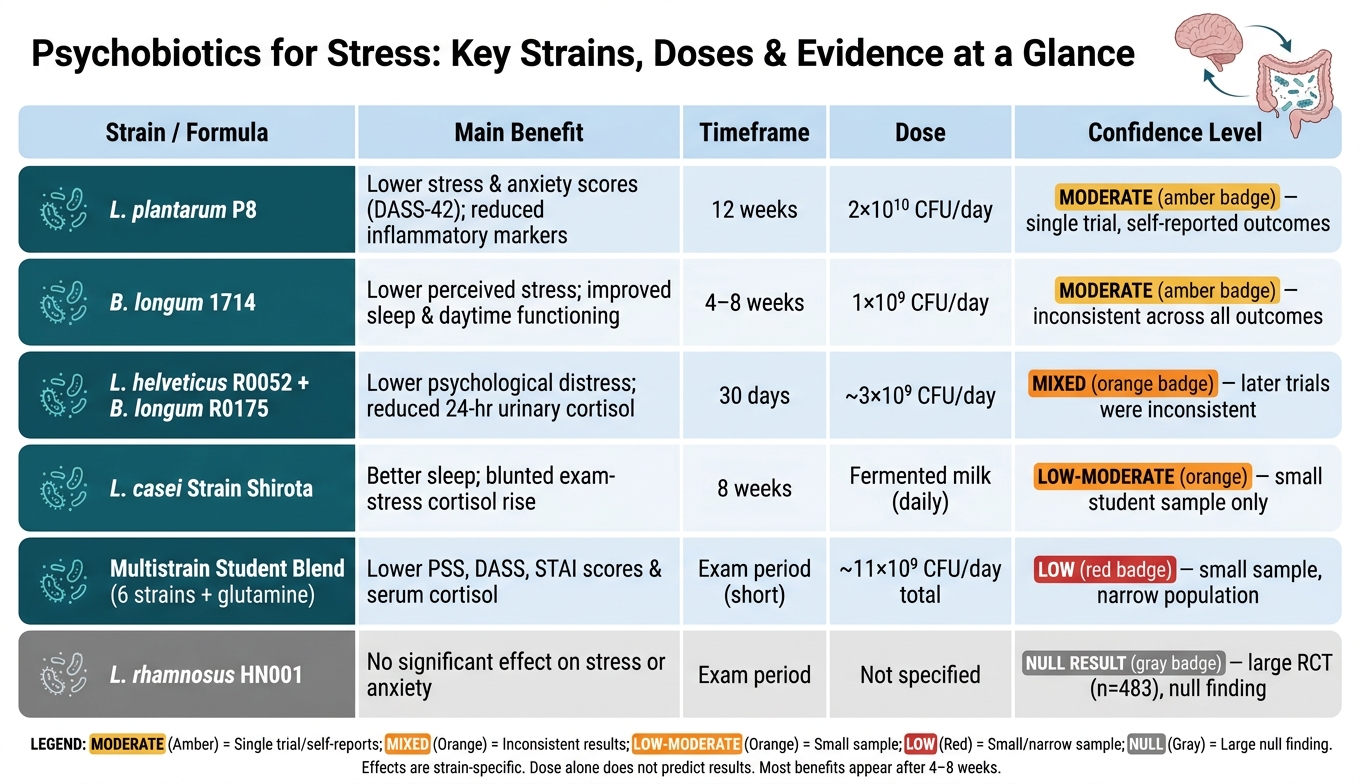
Psychobiotics for Stress: Key Strains, Doses & Evidence at a Glance
| Strain or formula | Main pattern | Time frame | Main limit |
|---|---|---|---|
| L. plantarum P8 | Lower stress and anxiety scores | 12 weeks | Mostly one main trial |
| B. longum 1714 | Lower perceived stress in some trials; sleep/function may improve | 4 to 8 weeks | Results not steady across all outcomes |
| R0052 + R0175 | Lower distress; some cortisol changes | 30 days | Later trials were mixed |
| Strain Shirota | Better sleep and lower exam-stress cortisol | 8 weeks | Small student study |
| Multistrain student blend | Lower stress, anxiety, and cortisol | Short exam period | Narrow group, small sample |
| L. rhamnosus HN001 | No clear effect on stress/anxiety | Exam period | Null result in a large student trial |
So, if I were reading this as a consumer, my takeaway would be: don’t think in terms of “probiotics for stress.” Think in terms of one tested strain, one tested dose, and one tested use case. This specificity is key to understanding how psychobiotics and the microbiota-gut-brain axis interact.
Key Human Trials Organized by Strain and Formula Type
Single strains and blends can lower stress markers, but the results depend on the strain, dose, and who took it. That’s the big takeaway. The strongest signals come from specific strains, not from probiotics as a whole.
Single-Strain Trials: P8, 1714, and Strain Shirota
Three single-strain trials stand out here.
Lactobacillus plantarum P8 was tested in a 12-week randomized, double-blind, placebo-controlled trial involving 103 adults with moderate stress at a daily dose of about 10 billion CFU.[8][9] On the DASS-42, P8 lowered stress and anxiety compared with placebo by week 4, with mean differences of 2.9 and 2.8. Cortisol did not change, but IFN-γ and TNF-α dropped more than they did in the placebo group over 12 weeks.[10][11]
Bifidobacterium longum 1714 has been studied in healthy adults dealing with day-to-day or social stress over 4 to 8 weeks.[13] Doses were in the billion-CFU-per-day range. Participants reported lower perceived stress and anxiety than those on placebo, along with physiologic shifts that matched lower arousal.[13] The effects were modest, and cortisol findings were not consistent across all measures.[13]
Lactobacillus casei strain Shirota (LcS) was studied in Japanese medical students during exam stress. In an 8-week randomized, placebo-controlled trial with a 3-week follow-up, daily fermented milk with LcS blunted exam-related increases in salivary cortisol and improved sleep duration and stage 3 non-REM sleep.[17][18] Students in the LcS group also had fewer and shorter stress-related abdominal symptoms.[15][16] The catch is sample size and setting: this was a small group of healthy students in Japan, so it may not apply as neatly to other groups.
Blends show a similar trend, but the findings are a bit less steady from one study to the next.
Multistrain Trials: R0052 Plus R0175 and Other Blends
The blend of Lactobacillus helveticus R0052 and Bifidobacterium longum R0175 has been tested in healthy volunteers. In a 30-day double-blind, placebo-controlled trial, the formula reduced global psychological distress, somatization, depression, and anger-hostility on the HSCL-90, and it also lowered HADS anxiety scores compared with placebo.[6][21] It also cut 24-hour urinary free cortisol, which points to lower HPA-axis stress activity.[6] Later trials were mixed, though, with some finding no meaningful psychological or biomarker changes.[20]
Another multistrain trial looked at students under exam stress. The capsule contained six strains - Bacillus coagulans Unique IS2, Lactobacillus rhamnosus UBLR58, Bifidobacterium lactis UBBLa70, and Lactobacillus plantarum UBLP40 at 2 billion CFU each, plus Bifidobacterium breve UBBr01 and Bifidobacterium infantis UBBI01 at 1 billion CFU each - along with 250 mg of glutamine.[19] Students taking the formula had lower PSS, DASS, STAI anxiety scores, and serum cortisol than the placebo group, with no adverse events.[19]
Across multistrain trials, daily doses usually fall between 1 billion and 100 billion CFU for 4 to 12 weeks.[12]
Synbiotic and Eubiotic Studies Relevant to Stress
Broader microbiome formulas point in the same general direction, but the evidence is less tied to individual strains.
Meta-analyses that group synbiotics vs. probiotics and prebiotics together report small-to-moderate gains in anxiety and sleep quality in humans.[12] Some synbiotic trials also show better sleep and lower anxiety than placebo.[12] But the results vary, which is why strain- and fiber-level evidence matters most. For stress claims, direct human trial data still carries the most weight.
What the Trials Show on Anxiety, Mood, Sleep, and Stress Markers
Anxiety and Perceived Stress Scores
Across the strains and blends above, self-reported stress tends to improve more often than lab-based stress markers. The effects are usually modest, and not every trial finds a clear difference. The best results tend to show up in multiweek studies using a named strain in adults who already have higher stress at baseline. Recent reviews also show that results vary a lot by product type and by population.[27][26]
An umbrella review from 2026 reported that probiotics showed moderate, consistent benefits on depressive symptoms but only small, inconsistent effects on anxiety.[31] So yes, anxiety effects do show up. But they’re less steady than mood effects.
One pattern stands out: mood and sleep can improve even when anxiety scores don’t.
Mood Changes and Sleep Outcomes
Mood outcomes in these trials go beyond anxiety alone. They often include negative mood, irritability, energy, and coping, and those measures sometimes move more clearly than anxiety scores.
For example, Bifidobacterium longum 1714 improved energy/vitality and social functioning by week 8 in adults with impaired sleep, even when its HADS anxiety and PSS scores did not separate from placebo.[29][22][23] Put simply, psychobiotics may shift perceived stress and day-to-day functioning before they move anxiety scales.
Sleep is one of the steadiest endpoints in this research. The dual-strain formula combining live Lactiplantibacillus plantarum PS128 and heat-treated Lactobacillus paracasei HT-PS23 significantly reduced job stress perception, current anxiety, and insomnia severity in highly stressed workers over 8 weeks.[3] And in a cross-over exam-stress trial, B. longum 1714 did not reduce stress or depression scores, but sleep quality and sleep duration still improved a lot during the probiotic condition.[25]
That matters because better sleep can change how stress feels, even if an anxiety questionnaire barely budges.
Cortisol and Other Physiological Markers
Biomarker results are the weakest part of this evidence base. A few trials do report lower salivary or urinary cortisol. Lactobacillus gasseri CP2305 showed a significant drop in salivary cortisol (p = 0.039) over 24 weeks[28], and the R0052 + R0175 blend reduced 24-hour urinary free cortisol in a 30-day trial.[2] But these findings are the exception, not the pattern.
A systematic review of probiotics in healthy volunteers found no significant effect on cortisol overall, even in studies where subjective stress got better.[30]
Other markers, such as ACTH and norepinephrine, sometimes shift too. In the PS128 + HT-PS23 trial, both fell significantly, even though cortisol did not show a meaningful change.[3] Taken together, psychobiotics seem to change stress symptoms more reliably than they change lab markers. And when biomarkers do move, the effects are small and tough to repeat.
Dose, duration, and trial design likely explain a lot of that variation.
How to Read Dose Levels, Study Limits, and What Results Mean in Practice
After looking at the outcome patterns above, the next step is simpler than it sounds: check the dose, the study length, and how much confidence the study earns.
Dose Ranges, Study Duration, and Why Strain Specificity Matters
Most psychobiotic stress trials use 10⁸ to 10¹⁰ CFU/day for 4 to 12 weeks.[4][8][33][34][32][35] But those numbers only mean something if the same strain was tested in the same kind of people.
This is where many labels fall apart. A product that says “probiotic blend” or even Lactobacillus plantarum is not backed by the same evidence as one that names L. plantarum P8 or B. longum 1714. The strain code is the bridge between the bottle and the study. Without it, you're guessing.
And more CFUs don’t automatically mean better stress results. One of the clearest examples is a large RCT in 483 university students using L. rhamnosus HN001. It found no significant effect on stress or anxiety.[14][41] So a high dose, by itself, doesn’t prove much. What matters is whether you find your ideal probiotic strain based on whether that exact strain showed an effect in human trials.
Timing matters too. Most effects seem to need at least 4 weeks. For sleep, vitality, and cognition, the timeline is often 8 to 12 weeks.
Study Limits That Affect Confidence in the Findings
The research looks promising. Still, it’s not settled.
One big issue is sample size. Across psychobiotic stress studies, the median is about 40 participants per group.[40][42] That’s small, especially if the effect is mild and the people studied are healthy to begin with. Small trials can hint at a pattern, but they can also miss one.
The study groups are often narrow too. Many trials focus on medical students during exams, healthy adults in lab stress tests, or adults with mild self-reported stress. That makes the findings harder to apply to the broader U.S. population.
Another problem: self-reported outcomes do most of the heavy lifting. Tools like the PSS, DASS-42, and STAI show up in many trials. They’re useful, but they’re also open to placebo effects and reporting bias. On top of that, most studies stop at 8 to 12 weeks, so there’s not much data on whether any gains stick after people stop taking the product.
Comparison Table: Trial Patterns by Strain, Dose, Outcomes, and Limits
| Strain / Formula | Participant Type | Dose | Duration | Main Outcomes | Key Limitations |
|---|---|---|---|---|---|
| L. plantarum P8 | 103 moderately stressed adults | 2×10¹⁰ CFU/day | 12 weeks | Lower stress/anxiety; lower cortisol and inflammatory markers; better memory/cognition [8][9][10][11] | Self-reported stress; single trial; no long-term follow-up |
| B. longum 1714 | Healthy adults (crossover) | 1×10⁹ CFU/day | 4-week crossover phases | Lower cortisol response; sleep and daytime functioning improved [37][38][23] | Acute lab stress model; small sample; limited generalizability |
| L. helveticus R0052 + B. longum R0175 | Healthy volunteers | ~3×10⁹ CFU/day | 30 days | Lower distress and urinary cortisol; better coping [7][20][39] | Short duration; healthy volunteers; depends mostly on self-report |
| L. rhamnosus HN001 | 483 university students | Not specified | Exam period | No significant effect on stress or anxiety [14][41] | Large sample but null result; exam-stress model only |
| Multistrain blend (student trial) | 74 students under exam stress | Not specified | Exam period | Lower PSS, DASS, STAI, and serum cortisol vs. placebo | Small sample; narrow population; short follow-up |
| Lactiplantibacillus plantarum Lp815 | Adults with mild to moderate anxiety | 5 billion CFU/day | 6 weeks | Lower anxiety scores; higher dose did not clearly outperform the lower dose [36] | Dose-response unclear; limited biomarker data |
These limits lead straight into the practical takeaway in the conclusion.
Conclusion: What Health-Conscious Readers Can Take From the Evidence
The human trial data on psychobiotics and stress tells a careful, slightly restrained story. The effects tend to be modest, and most of the signal shows up in how people feel rather than in hard biomarkers. Systematic reviews and umbrella reviews point to small effects on perceived stress and mood, while findings on anxiety and cortisol are more uneven.[5][29] That’s promising, but it’s not enough to treat psychobiotics as a standalone fix.
The big point is that these effects look strain-specific, not like a general probiotic class effect. In plain English: you can’t assume any probiotic will help with stress just because it’s labeled as one. The clearest human signals come from a small set of named strains, especially P8, 1714, and R0052 plus R0175.
Anxiety results are also less settled. Some groups, including younger participants, show little to no benefit,[45][24] and the outcomes shift depending on the strain and the group being studied. That makes this area a bit tricky. Two products can sit on the same shelf and have very different evidence behind them.
For readers, the likely gains are gradual and symptom-based. When benefits do show up, they usually build over 4 to 8 weeks and remain subtle.[1][43][44] This isn’t the kind of change most people would describe as night-and-day. It’s more like taking the edge off.
The practical takeaway is pretty simple: results depend on the exact strain, dose, and study length. For moderate to severe anxiety or depression, professional care comes first. Psychobiotics may help with day-to-day stress, but whether they help at all comes down to the strain, the dose, and how long they’re used.
FAQs
How do I pick a psychobiotic strain for stress?
Start with strains that have clinical research behind them for your specific goal, whether that’s mood, sleep, or anxiety.
For example:
- Lactobacillus helveticus for mood
- Lactobacillus gasseri for sleep
- Bifidobacterium longum or B. infantis for anxiety and emotional balance
It also helps to choose a product with a delivery system that protects the bacteria from stomach acid. Then give it time and track your response in a consistent way for 4 to 12 weeks.
How long does it usually take to notice any effect?
You may notice early changes with Rebiirth RE-1 within seven days, especially less bloating and abdominal pain.
For anxiety and sleep, the first shifts often show up after four weeks. More steady results usually take 8 to 12 weeks of daily use.
That said, people don’t all respond the same way, so timing can vary from person to person.
Can psychobiotics help with stress if cortisol does not change?
Yes. Psychobiotics may still help with stress even if cortisol doesn’t change.
That’s because they can work through other gut-brain pathways, not just cortisol. These include neurotransmitters like serotonin and GABA, effects on the immune system and inflammation, and signaling through the vagus nerve.
In plain English: gut-brain support can help improve mood, sleep, and your ability to handle stress without falling apart.