

If you have SIBO, the wrong synbiotic can make bloating, gas, and pain worse. My take is simple: start with tolerated strains, keep fiber low and slow, use stable delivery, and treat synbiotics as one part of care, not the whole plan. This is especially true when planning for long-term gut health after SIBO.
Here’s the short version:
- Tolerance comes first. Fast-fermenting fibers like inulin and GOS may help some people, but they can also trigger symptoms.
- Dose matters. A common starting point is 1–5 billion CFU/day and 2–5 g/day of prebiotic fiber, then move up by 25%–50% every 3–7 days if symptoms stay calm.
- Strain choice matters. Some data point to selected Lactobacillus, Bifidobacterium, Saccharomyces boulardii, and spore-forming Bacillus strains as better fits for SIBO-sensitive users.
- Postbiotics may help support the gut lining and immune response without adding live microbes or extra fermentation load.
- Delivery matters. Delayed-release capsules and sealed sachets tend to protect viability better than open powders or liquids.
- The evidence is mixed. One meta-analysis reported 62.8% pooled SIBO clearance with probiotics, but trial quality was low and study methods varied a lot.
- Use caution. Stop and talk with a clinician if you get severe bloating, strong pain, persistent diarrhea, brain fog, fever, blood in stool, or vomiting.
The Best SIBO Probiotic Protocol
sbb-itb-1bbfe7f
Quick Comparison
| Part of the formula | What I’d look for | Main issue in SIBO |
|---|---|---|
| Probiotics | Strain-specific labels, low starting dose, good tolerance | Some strains may aggravate symptoms |
| Prebiotics | Small doses, slower ramp, careful fiber choice | Fast fermentation can increase gas and distension |
| Postbiotics | Barrier and immune support | Less fermentation risk than live/fiber-heavy options |
| Delivery | Delayed-release capsule or sealed sachet | Poor survival through the upper GI tract |
The main point of the article is not “more is better.” It’s the opposite: in SIBO, a smaller, slower, better-matched formula often makes more sense than a high-dose gut health product built for the general public.
The Core Components of a SIBO-Focused Synbiotic
With SIBO, every ingredient has to do its job without adding more fermentation. That applies to probiotics, prebiotics, and postbiotics alike. The goal isn't just to address gut dysbiosis on paper. It's to support microbial balance without setting off the gas, bloating, and discomfort people with SIBO know too well.
That’s why strain choice, fiber choice, and non-living microbial compounds all matter. Some ingredients may help. Others may simply add fuel to the fire.
Choosing Probiotic Strains for Small-Intestine Tolerance
Not all probiotic strains act the same way in the small intestine. For SIBO, the main categories that come up are selected Lactobacillus strains, Bifidobacterium strains, and Saccharomyces boulardii. One 4-strain formula that combined S. boulardii, B. lactis, L. acidophilus, and L. plantarum reported a 71.3% symptom reduction in SIBO patients.[5]
Spore-forming Bacillus strains also deserve attention, especially Bacillus coagulans and Bacillus clausii. These strains tend to move through the small intestine in a mostly dormant state and become active later in the colon. Put simply, they may be less likely to add to small-intestinal fermentation. In one synbiotic study, Bacillus coagulans was linked to 93% negative breath tests after treatment.[4]
For SIBO, the day-to-day issue is pretty simple: is the strain easy to tolerate, able to remain intact, and a good fit for a sensitive small intestine? A probiotic can look good on a label and still be the wrong match in practice. And even if the strains are well chosen, the fiber paired with them can change the whole experience.
Prebiotic Fiber Options: GOS, Inulin, and Fermentation Risk
Prebiotics such as GOS and inulin can feed helpful microbes, but there’s a catch. They’re also fermented fast, and that can make bloating, gas, and cramping worse in people who are already sensitive.[7][9]
That’s why a low starting dose makes sense. Instead of jumping straight to a full serving, it’s often smarter to start small and increase only if symptoms stay calm. Someone who has reacted badly to fiber before, or who has high visceral sensitivity, will usually have less room for error than someone who’s in a steadier maintenance phase.
In SIBO, prebiotics can’t be chosen on the idea that “more food for good bacteria is always better.” That sounds nice, but the gut doesn’t work like a simple math problem. Fermentation risk has to stay front and center.
Postbiotics: Moving Beyond Recolonization to Gut Function
Postbiotics are non-living microbial parts and byproducts that can support gut function. In a SIBO-focused formula, that matters for one big reason: postbiotics can help support barrier and immune function without adding more live microbes.
Research points to three main ways postbiotics work: protective modulation against pathogens, enhancement of the epithelial barrier, and modulation of inflammatory and immune responses.[8] That changes the job of the formula. Instead of focusing only on recolonization, it also supports the gut environment itself.
In other words, postbiotics add another layer of support without adding to fermentation burden. Once those core pieces are in place, the next issue is dose and delivery - because even a smart formula can fall apart if it isn’t well tolerated in SIBO.
Dose, Delivery, and Tolerance in Practice
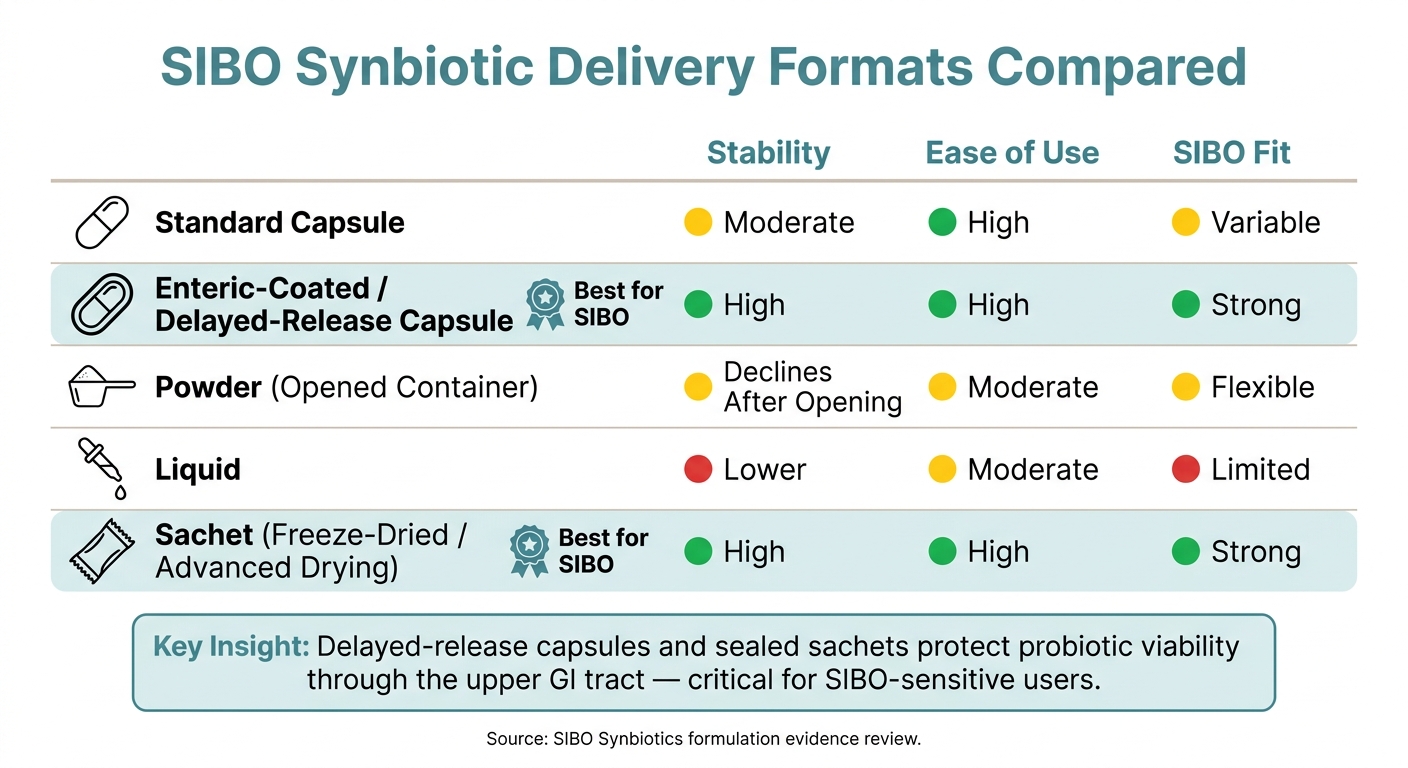
SIBO Synbiotic Delivery Formats: Stability, Usability & Fit Compared
After you pick the ingredients, dose and delivery decide whether the formula is easy to live with. In SIBO, those two factors often make the difference between a product that settles in well and one that sets off symptoms.
CFU Levels, Fiber Amounts, and How to Ramp Up Gradually
Typical adult synbiotic doses in SIBO-prone adults start at about 1–5 billion CFU per day and 2–5 g per day of prebiotic fiber, then move up only if gas, bloating, and stool changes stay steady [22][23][25].
A slow ramp usually works best. Increase by 25% to 50% every 3–7 days. If symptoms flare, switch to alternate-day dosing before going back to daily use [13][15][20]. Taking the synbiotic with a small meal may help cut down on immediate bloating [12][13]. It also helps to avoid adding other new fiber sources during the first 1–2 weeks [14][19].
Mild gas, bloating, or looser stools during the first 1–2 weeks are common and often temporary [21][22]. But there’s a clear line you shouldn’t ignore. Stop the product and talk with a clinician if you get worsening bloating, severe abdominal pain or distention, persistent diarrhea, brain fog, fever, blood in the stool, or intractable vomiting [17][18][20].
Why Delivery Format and Stability Technology Matter
Even the right strains can fall short if they don’t make it through the upper GI tract. Format matters because it affects how many organisms survive transit. Unprotected cells lose viability fast in gastric conditions, while delayed-release capsules improve survival [6][24].
| Format | Stability | Ease of Use | SIBO Fit |
|---|---|---|---|
| Standard capsule | Moderate | High | Variable |
| Enteric-coated or delayed-release capsule | High | High | Strong |
| Powder (opened container) | Declines after opening | Moderate | Flexible |
| Liquid | Lower | Moderate | Limited |
| Sachet (freeze-dried/advanced drying) | High | High | Strong |
Sachets that use freeze-dried or advanced-drying methods keep each dose sealed until you use it. That helps protect against humidity and oxygen, and it also makes dose titration simpler [10][11][16]. Lyosublime™ is designed to support shelf stability without refrigeration, which lines up with that sachet-based setup.
A 3-in-1 Eubiotic Reset Protocol in Practice
Rebirth RE-1 shows how this can look in practice. It uses a high-potency sachet design with 500 billion CFU per serving, 4.5 g of GOS and inulin, and HOSt™ strains in a 3-in-1 synbiotic format. Its 7-day, 4-week, and 12-week formats line up with short reset, consolidation, and longer restoration phases.
Even with that setup, the same ramp-up logic still applies. Protocol length should be picked with a clinician who understands where the person is in their SIBO treatment timeline [17][18][20].
That design logic becomes more important when the goal moves beyond symptom control and toward immune and barrier balance.
Once dose and delivery are stable, the next step is looking at how synbiotics affect immune signaling and stress-related gut imbalance.
Immune Function, Urban Stressors, and the Challenge of Maintaining Gut Balance
How Dysbiosis Affects Gut Barrier Function and Immune Signaling
Once dose and delivery are stable, the next step is figuring out whether the formula also helps repair the gut barrier and improve stress resilience.
In SIBO, extra bacterial byproducts can weaken tight junctions, increase permeability, and trigger inflammatory signaling. That can show up as fatigue, brain fog, skin flares, and food sensitivity.[2][28][30] That’s why SIBO formulas should include strains and postbiotics that support the mucosa without adding too much fermentation load.
sIgA can swing in either direction. It may be low when the mucosal immune system is worn down, or high when it is reacting to ongoing bacterial stress.[26][29] Either way, it points to a mucosal barrier under strain.
That can turn into a nasty loop: permeability fuels inflammation, and barrier damage that doesn’t heal can increase relapse risk.[2][27][28] Zonulin, calprotectin, and sIgA are often looked at together to track dysbiosis-related permeability and immune activation.[26]
Urban Stressors: Stress, Poor Sleep, Processed Diets, and Gut Motility
The migrating motor complex (MMC) sweeps the small intestine every 90–120 minutes, clearing leftover food and bacteria before they build up.[31][32][36] Think of it like the gut’s cleanup crew. The MMC depends on vagal activity, so chronic stress can slow motility and make overgrowth more likely.[33][34][35][37]
Stress, poor sleep, processed food, and low microbial exposure can all work against the gut at the same time. They can suppress motility, lower stomach acid, and weaken barrier function. When stress slows motility, tolerance matters more. The formula should lean on gentler fermentation and ingredients that are easier to handle. In practice, a SIBO synbiotic should fit those pressures with tolerant strains, gently fermentable fiber, and postbiotics that support the gut barrier.
Rebirth RE-1 shows this 3-in-1 setup with HOSt™ strains, 4.5 g of GOS and inulin, and postbiotic support in sachet form. But supplements can’t do all the heavy lifting on their own. Synbiotics tend to work best when they’re paired with better sleep, lower stress, and diet changes.
The next part is where things get more practical: what the evidence supports when this is put to use.
Evidence, Safe Use, and Key Takeaways
What the Research Supports and Where the Gaps Remain
Now that the ingredients and dosing are set, the next step is simple: does the research back up those choices?
The short answer is maybe, but with limits. A 2017 meta-analysis found that probiotics improved SIBO clearance rates and lowered hydrogen levels on breath tests, with a pooled clearance rate of 62.8% across studies.[3] That sounds promising. But the full picture is a lot messier.
Results across studies don't line up cleanly. A GRADE review was only able to pool 3 trials and rated the evidence low quality.[39] There are a few big reasons for that. Studies used different breath-test substrates and cutoffs. Strains and CFU counts varied a lot. Follow-up was often short. And sample sizes were often under 50 participants.[38][39][1] So even when one study looks good, it doesn't automatically apply to another product. A result for one Lactobacillus strain at one dose doesn't tell you much about a different formula at a different dose.
The data on synbiotics and prebiotics are even thinner. One often-cited trial paired Bacillus coagulans with fructo-oligosaccharides alongside cyclic antibiotic therapy over 6 months and reported symptom improvement plus negative breath tests in many patients, but the study design had clear limits.[4] In another study, partially hydrolyzed guar gum (PHGG) used with rifaximin increased eradication rates from 62.1% to 87.1%.[40] Still, that doesn't mean every fiber works the same way. In people with SIBO, poorly chosen or high-dose fermentable fibers can just as easily ramp up gas and bloating.
That’s why tolerance and patient fit matter more than flashy top-line numbers. Start low. Watch for more gas, bloating, or brain fog. And bring in a clinician for harder cases or if someone is immunocompromised. In rare cases, probiotics have been linked to D-lactic acidosis, brain fog, gas, and bloating in vulnerable people, and symptoms often improved after stopping the supplement and using antibiotics.[1] That's not a reason to write off synbiotics. It just means they need to be used with care.
Conclusion: What a Better SIBO Synbiotic Formula Should Include
When you put the data together, the brief gets pretty narrow.
A SIBO synbiotic should put tolerance first. That means strain-specific probiotics with human data in SIBO or closely related conditions, with labels that clearly list genus, species, and strain ID. It also means using selectively dosed fibers that tend to be easier to handle, like GOS or PHGG, instead of leaning on high-dose inulin. And it should include postbiotic components that help support barrier function without depending only on live microbes.[38][4][1]
Delivery matters too. A formula has to make it through gastric acid, stay stable without refrigeration, and come in a format that works inside a structured protocol. Otherwise, what looks good on paper may fall apart in day-to-day use.
Stress, poor sleep, and processed diets can affect gut motility and barrier function. That changes how well a synbiotic is tolerated. So a formula built for SIBO should reflect that reality, with gentler fermentation substrates, well-tolerated strains, and stable delivery.
Rebiirth RE-1 combines HOSt™ strains, 500 billion CFU per serving, prebiotics, postbiotics, and Lyosublime™ sachets in 7-day, 4-week, and 12-week formats. It makes the most sense as one part of a bigger plan, not a solo fix. Used with diet changes, stress support, and antimicrobial therapy when needed, it can play a meaningful role.
The best SIBO synbiotic formula focuses on strain specificity, low-fermentation substrates, and stable delivery.
FAQs
How do I know if a synbiotic is making my SIBO worse?
Mild, short-term gas, bloating, or abdominal discomfort can be normal when you start a synbiotic. Your gut microbiome may need a little time to adjust.
But there’s a line.
If symptoms are persistent, severe, or getting worse, that synbiotic may not be the right fit for your SIBO right now.
Track your symptoms each day. If discomfort ramps up, try lowering the dose or using a shorter protocol. If the problem sticks around, talk with a healthcare professional.
What fibers are usually easiest to tolerate with SIBO?
With SIBO, GOS and inulin are common prebiotic fibers. They feed helpful gut bacteria and can support a gut environment that may make things harder for methane-producing microbes.
That said, they can still trigger early bloating or digestive discomfort. Starting with a small dose and increasing it slowly may make them easier to tolerate.
Should I take a SIBO synbiotic during or after treatment?
Yes. A synbiotic can be especially helpful after SIBO treatment because it may help restore microbiome balance and lower the risk of recurrence. That matters because about 45% of patients have SIBO come back after antibiotic therapy.
To ease early digestive discomfort, start with a lower dose and increase it slowly while watching your symptoms. A synbiotic like Rebiirth RE-1™ can help support that process. Always check with your healthcare provider about the right dose and how long to take it.