

Kids do not need the same gut-immune support at every age. In this article, I’d boil it down like this: toddlers need gentler gut support and stool help, school-age kids need steady daily support during high germ exposure, and pre-teens need a simple routine that fits diet changes, stress, and busy schedules.
Here’s the short version:
- Toddlers (1–3): the gut microbiome is still forming, so lower-dose, easy-to-mix powders often make the most sense
- School-age kids (4–8): daily exposure goes up, and many kids get 4 to 8 illnesses per year
- Older kids and pre-teens (9–12): immune function is more settled, but diet gaps and schedule stress matter more
- Across all ages: about 70%–80% of immune cells are in gut-associated lymphoid tissue (GALT), so gut support plays a big role
- Format matters: powders, chewables, and capsules each fit different ages
- Tolerance matters too: too much fiber or the wrong dose can lead to gas, bloating, cramps, or loose stools
A synbiotic here means a 3-in-1 mix of prebiotics, probiotics, and postbiotics. The main takeaway is simple: the best pick depends on age, gut tolerance, symptom pattern, and whether a child will take it every day.
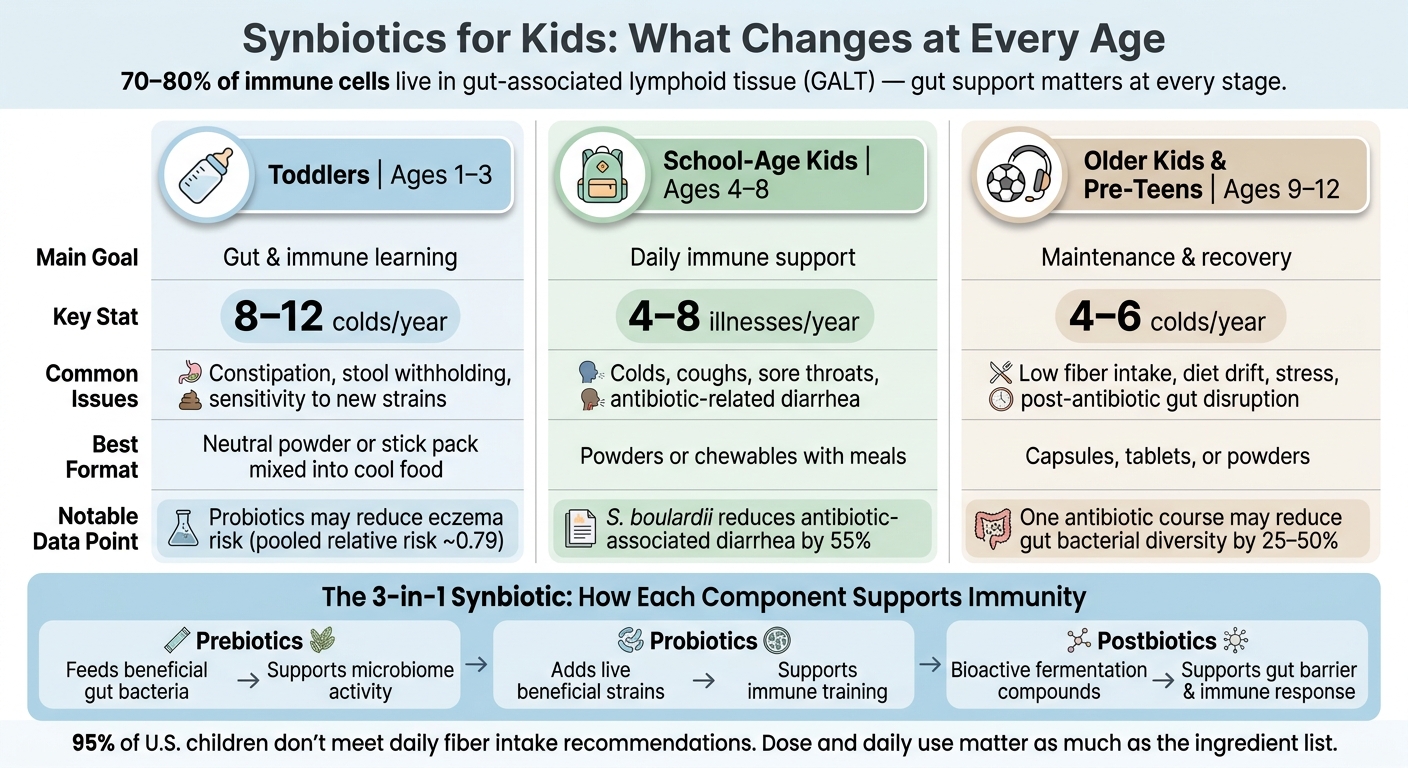
Synbiotics for Kids by Age: Immune Support Guide
Quick Comparison
| Age Group | Main Goal | Common Issues | Best Format Fit |
|---|---|---|---|
| Toddlers (1–3) | Gut and immune learning | Constipation, stool withholding, sensitivity to new strains | Neutral powder or stick pack mixed into cool food |
| School-age kids (4–8) | Daily immune support | Colds, coughs, sore throats, irregular stools, antibiotic-related diarrhea | Powders or chewables with meals |
| Older kids and pre-teens (9–12) | Maintenance and recovery support | Low fiber intake, stress, diet drift, post-antibiotic gut disruption | Capsules, tablets, or powders |
One more thing I’d keep in mind: dose and daily use often matter just as much as the ingredient list.
sbb-itb-1bbfe7f
1. Toddlers (Ages 1–3)
Toddlers are in a key gut-immune development window. Their gut microbiome is still taking shape, and by ages 2–3, it starts to settle into patterns that often carry into later childhood [1].
Immune Development Needs
At this age, the gut immune system is there, but it’s still maturing [1]. That’s why strain choice matters. Synbiotics made for toddlers often use strains such as Lactobacillus rhamnosus GG, Bifidobacterium infantis, and Bifidobacterium lactis [1][7].
The aim isn’t just to add more microbes. It’s to help the immune system learn the difference between friendly microbes and possible threats. In plain terms, the toddler years are less about volume and more about teaching tolerance.
Gut Tolerance and Sensitivity
A toddler’s microbiome is more easily thrown off than the more settled microbiomes seen in school-age kids. If the dose is too high or the strains aren’t a good fit, kids may end up with cramping, bloating, or loose stools [7].
Starting slowly can make the adjustment easier as the microbiota gets used to the change. During this stage, a 3-in-1 synbiotic can help support both digestion and immune function without making things too complicated.
Exposure and Symptom Patterns
Toddlers often deal with constipation and stool withholding. Once stools get hard, that problem can turn into a cycle that’s hard to break [6]. Low fiber intake can make it worse.
Because of that, synbiotics for this age group often focus on two things at once:
- stool regularity
- immune support
Prebiotic fibers such as inulin or golden kiwi powder are often used to help gut transit [6][3]. The yeast Saccharomyces boulardii is also used to support stool consistency, including during antibiotic use [8][3].
Steadier stools can be a sign that the gut environment is settling down, too. In the next age group, the focus starts to shift away from stool regularity and more toward day-to-day immune support.
Format and Daily Fit
Toddlers usually do best with child-friendly delivery systems that slide into foods they already eat. Neutral-flavored powders or stick packs can be mixed into cool yogurt, applesauce, or smoothies. Hot foods should be avoided because heat can damage live strains [3].
It also helps to give them with meals. Later on, when school routines take over, the challenge becomes less about mixing and more about steady day-by-day use.
2. School-Age Kids (Ages 4–8)
Once kids start school, they’re around more people every day. That means more exposure, right as immune training is still in progress. At this stage, the goal shifts a bit: less about settling the gut and more about helping the body keep up with day-to-day immune demands.
Immune Development Needs
Ages 4–8 are still an important immune-training window [4][5]. Adaptive immunity is still maturing, while innate defenses become more efficient.
Gut Tolerance and Sensitivity
School-age kids need more fiber than toddlers [3]. That’s why synbiotics for this age group often include plant-based prebiotic fibers like green banana flour or oat fiber. These fibers can help support regularity as meals, routines, and school schedules change [3].
There’s another plus here. Prebiotic fiber can also help probiotics make it through stomach acid [3].
Exposure and Symptom Patterns
School-age kids usually get sick 4 to 8 times per year [10]. The usual pattern includes colds, sore throats, coughs, and irregular stools, especially in group settings or when routines shift [5][10][11][12]. Classroom exposure plays a big part because the adaptive immune system is still finishing its training during these years [4][5].
Saccharomyces boulardii can be useful during antibiotic courses because it’s naturally antibiotic-resistant and has been shown to reduce antibiotic-associated diarrhea in children by 55% [9].
Format and Daily Fit
By this age, many kids can handle chewables or powders mixed into cold or room-temperature foods [4][9]. Powders work best in cool foods like yogurt or applesauce. Heat should be avoided so live strains stay intact [3].
Taking probiotics with meals can make them easier to stick with and easier on the stomach [3][11]. And daily use matters. Probiotics are transient, so they need to be taken each day to keep interacting with gut and immune cells [11].
3. Older Children and Pre-Teens (Ages 9–12)
By ages 9–12, immunity is mostly mature. At this stage, the goal shifts from teaching the immune system to helping it stay steady day to day. That’s the big difference between pre-teens and younger kids: most immune training is already done, so the focus is now on maintenance and bounce-back.
Immune Development Needs
Gut immunity still plays a big part at this age. Strains such as Lactobacillus rhamnosus GG, Lactobacillus acidophilus DDS-1®, and Bifidobacterium lactis UABLa-12® often show up in formulas aimed at respiratory and skin support.
Gut Tolerance and Sensitivity
Older children can usually handle more fiber, which makes it easier to fill common diet gaps. And that matters a lot, because 95% of children in the U.S. don’t meet their daily recommended fiber intake [11].
Food choices also play a role. Diets high in ultra-processed foods can cause gut dysbiosis, putting pressure on the intestinal barrier and reducing helpful bacteria [1]. A synbiotic with soluble and insoluble fibers, such as inulin, apple pectin, or oat fiber, can help close that gap and support regularity. During packed school weeks and sports seasons, that kind of steady daily support often fits better than a stop-and-start routine.
Exposure and Symptom Patterns
Pre-teens usually get 4 to 6 colds per year, which is lower than the 8 to 12 often seen in toddlers [13]. Even so, busy schedules can make recovery drag out a bit. Sports, later bedtimes, and stress all add up during high-demand periods [5].
Antibiotics can also hit the gut hard. A single course may reduce gut bacterial diversity by 25% to 50%, which makes steady synbiotic use extra helpful after illness [13]. For this age group, ease of use matters just as much as potency.
Format and Daily Fit
By ages 9–12, many kids can reliably swallow capsules or tablets. Those formats often offer higher potency and less sugar than gummies. Powders are another easy option, especially for kids with shifting routines or picky tastes. They can be mixed into:
- smoothies
- yogurt
- milk
Shelf-stable options that don’t need refrigeration tend to work well for school, sports, and travel. Mix powders into cold or room-temperature foods, never hot, and take them with meals.
Why a 3-in-1 Synbiotic May Matter for Immune Support
Roughly 70%–80% of a child's immune cells are housed in GALT, which makes gut support central to immune development. That’s why the three parts of a synbiotic matter most when they work together, not in isolation.
A 3-in-1 synbiotic brings together prebiotics, probiotics, and postbiotics. Each one plays a different role in the gut, and each supports the immune system in its own way.
| Component | What it does in the gut | Why it may matter for immune development |
|---|---|---|
| Prebiotics | Selectively feeds beneficial bacteria already living in the gut | Supports microbiome activity and metabolite production |
| Probiotics | Introduces live beneficial strains to support microbial balance | Supports immune training and balance |
| Postbiotics | Provides bioactive compounds made during fermentation | Supports the gut barrier and immune response |
This mix doesn’t matter in the same way at every age. In early childhood, the focus is more on microbial education. Later, in school-age years, the goal shifts toward day-to-day support. By the pre-teen stage, barrier support becomes a bigger part of the picture [1][14].
Used together, these three parts cover more ground. Prebiotics feed helpful bacteria, probiotics add live strains, and postbiotics supply the compounds those microbes produce that can help support the gut barrier [1][9]. That kind of broad support can be useful, but the best fit still depends on a child’s age, tolerance, and daily routine.
Those age-based differences also shape the trade-offs around benefits, tolerance, and ease of use.
Pros and Cons of Synbiotic Support by Age Group
Synbiotic trade-offs shift with age. Toddlers usually need gentler support. School-age kids tend to do best with steady, day-to-day use. Older children often need a maintenance approach as diet, stress, and routine start to change.
The main ingredients may stay similar, but the best fit changes as kids grow.
| Age Group | Potential Benefits | Common Challenges | Best Uses |
|---|---|---|---|
| Toddlers (1–3) | Supports microbiome development and immune education; may help reduce the risk of eczema and atopic dermatitis (pooled relative risk about 0.79) [2] | High sensitivity to new strains; difficulty with pill or tablet formats; risk of stomach upset from high-dose strains or fiber [7] | Post-antibiotic recovery; early allergy prevention [1][2] |
| School-Age (4–8) | May shorten the duration of respiratory infections and support immune memory as children encounter new pathogens in school environments [4][7] | Gummy formats can be high in sugar; consistency of use can be hard to maintain [4] | Cold and flu season; daily immune support and nutritional gap coverage [1][7][15] |
| Older Children and Pre-Teens (9–12) | Helps maintain microbial balance during diet drift and stress; supports more stable microbial diversity [1] | Increasing dietary autonomy can make consistency harder; higher fiber or CFU doses can cause initial stomach upset [2][7] | Exams or sports; skin health support; long-term microbiome maintenance [1][3] |
Across all age groups, dose and format matter just as much as the ingredient list. A synbiotic can look good on paper and still be a poor match if the dose is too high or the format is hard for a child to take.
That’s why it makes sense to start slow. Higher-dose strains or fiber can lead to cramping, bloating, gas, or diarrhea while the gut adjusts [7]. For some kids, that adjustment is mild. For others, it’s enough to make parents stop after a day or two.
The same age-fit idea applies to any 3-in-1 synbiotic. Rebirth RE-1 shows what the 3-in-1 synbiotic model looks like, but children still need age-appropriate strain selection, dose, and format.
Conclusion
While prebiotics, probiotics, and synbiotics all support the gut, The same synbiotic blend can play different roles at different ages: immune education in the early years, day-to-day exposure support in the middle years, and maintenance later on. That’s why the right pick comes down to a child’s stage, tolerance, and daily routine.
Use age-appropriate formulas, and talk with a pediatrician before starting - especially if a child is immunocompromised, has a serious illness, was born prematurely, or has known allergies [16].
A couple of use tips matter too. Keep synbiotics and antibiotics at least two hours apart, and mix powder formulas only into cold or room-temperature foods or drinks [3][16].
If you want a 3-in-1 synbiotic format that lines up with this approach, Rebirth RE-1 is one option to consider. In children, the best synbiotic is the one that fits both developmental needs and daily use.
FAQs
How do I choose the right synbiotic for my child’s age?
Start by asking your pediatrician if a synbiotic makes sense for your child’s health needs and stage of development.
Then look for age-appropriate dosing, clearly named strains backed by research, and a format that’s simple to use, like powder sachets for younger kids. Rebiirth RE-1™ is a 3-in-1 synbiotic made for children ages 12 months and older.
What side effects can happen when kids start a synbiotic?
Kids who start a synbiotic can have mild, short-term digestive changes while their gut microbiome adjusts. The most common side effects are gas, bloating, constipation, diarrhea, and stomach discomfort.
These reactions tend to show up more often in children with sensitive digestion or when a product uses higher-dose strains. In rare cases, allergic reactions, skin irritation, or serious infections can happen in children with weakened immune systems, severe illness, or central venous catheters. That’s why it’s smart to talk with a pediatrician before starting any supplement.
When should a child take a synbiotic with antibiotics?
Ask your pediatrician about the right timing and dose, especially if antibiotics are part of the picture.
Some probiotics are used early during antibiotic treatment. Other guidance suggests starting synbiotic support as soon as the antibiotic course ends to help replenish helpful bacteria.
Kids’ needs can differ quite a bit, so professional guidance matters here.