

If you want simple gut support, synbiotics aim to cover three jobs at once: feed gut bacteria, help live strains make it through digestion, and support immune and gut-lining signals.
Here’s the short version: prebiotics feed helpful bacteria, probiotics add live microbes, and postbiotics are the compounds or cell parts linked to gut lining and immune support. In the article, I explain 7 key roles this mix can play, including support for strain survival, postbiotic output, gut barrier function, immune balance, and day-to-day gut comfort.
Key points at a glance:
- Prebiotics like GOS and inulin feed gut bacteria
- Probiotics need to survive stomach acid and bile to do much
- Postbiotics are tied to immune signaling and inflammation balance
- Combined formulas are made to support the full chain in one serving
- One small study cited in the article found 94% of 35 adults reported less bloating and abdominal pain after 7 days
- The article also compares single probiotics, basic synbiotics, and 3-in-1 synbiotic systems
Quick Comparison
| Option | What it includes | Main focus | Limits |
|---|---|---|---|
| Single probiotic | Live bacteria | Adds strains | No fiber support, no postbiotic layer |
| Basic synbiotic | Probiotic + prebiotic | Adds strains and feeds them | Less support than a 3-part formula |
| 3-in-1 synbiotic | Probiotic + prebiotic + postbiotic | Supports feeding, survival, and signaling | Results still depend on strain, dose, and daily use |
So if you’re trying to understand whether a synbiotic is more than “just a probiotic,” the article’s answer is yes: the value comes from how all three parts work together, not from one ingredient alone.
What Synbiotics Mean for Daily Gut Health
A synbiotic pairs live beneficial bacteria with the prebiotic fibers those bacteria feed on. Some 3-in-1 formulas also add postbiotics to support the gut barrier and immune function.[1]
That combo matters. Prebiotics can help beneficial strains survive and do their job better. Put together, these formulas are meant to support the survival, recolonization, and activity of beneficial microbes.[1]
Everyday life can throw the gut off balance. Diet changes, stress, travel, and antibiotics can all disrupt the microbiome. Antibiotics, in particular, can change the gut microbiome fast, which can make recovery and long-term microbial balance harder to keep.[1]
Next, a quick primer on how prebiotics, probiotics, and postbiotics work together.
sbb-itb-1bbfe7f
Prebiotics, Probiotics, and Postbiotics: A Quick Primer
Synbiotics work because each part has a different job.
Probiotics are live helpful microbes, such as Bifidobacterium longum and Lactobacillus gasseri, that help support microbial balance. Prebiotics are fermentable fibers, such as GOS and inulin, that feed helpful bacteria. Postbiotics are microbial metabolites and inactivated microbial components that help support immune signaling and inflammation balance.
Put simply, they work like a chain. Prebiotics feed probiotics, and probiotics support postbiotic production. That link helps explain why combined formulas can support daily microbiome balance.
With those basics in place, the next section shows how prebiotics feed probiotic strains.
1. Prebiotics Feed Beneficial Probiotic Strains
Prebiotics are non-digestible fibers that feed helpful gut bacteria and help probiotic strains stick around. That selective feeding effect is what makes synbiotics more effective than prebiotics on their own.
GOS and low molecular weight inulin selectively nourish helpful strains, especially Bifidobacteria. This selectivity helps those strains grow and supports a steadier gut setting before problems build. [1]
In synbiotic formulas, that fuel helps probiotic strains become active and support microbial balance. Once these fibers support probiotic growth, the next step is how synbiotics help those strains survive and take hold.
2. Synbiotics Improve Probiotic Survival and Colonization
Probiotics have to make it through stomach acid and bile before they ever reach the colon. That sounds simple on paper, but in practice, it’s a tough trip.
This is where synbiotics can help. Microencapsulation can shield live strains from stomach acid and bile, which gives them a better shot at making it through the digestive tract alive. On top of that, the delivery system and the strain itself both shape how many live microbes actually reach the colon.
When more live strains survive that trip, they have a better chance of colonizing the gut.
You can see why this matters when you look at strain-level evidence. Some strains, such as Bifidobacterium breve M-16V, have shown persistence in the gut for weeks.[1] That staying power matters because it helps beneficial microbes remain active for longer.
And when those microbes stick around, they can keep producing postbiotics, which adds another layer of support.
3. Combined Formulas Increase Postbiotic Production
Once live strains reach the colon, they ferment fiber and produce postbiotic compounds. Postbiotics are metabolites, or inactivated microbial parts, that help support immune signaling and keep inflammation in check. That fermentation step is what turns daily synbiotic use into measurable postbiotic output.
When the right fiber is present, probiotic strains can produce more of these compounds. Put simply, probiotics need prebiotic fiber to make postbiotics. Without GOS or inulin, fermentation drops. Clinical studies on Bifidobacterium breve M-16V found higher fecal acetate and lower fecal pH.[1]
This is why pairing prebiotics with probiotics helps support steadier fermentation. Rebiirth RE-1™ includes 4.5 g of prebiotic fiber per serving to support this process.[1]
A 3-in-1 setup can also include a direct postbiotic strain, Lactobacillus paracasei BR-MCC1849, which supports immune signaling on its own. That matters because postbiotics also help reinforce the gut barrier.[1]
4. Synbiotics Strengthen the Gut Barrier
The gut lining acts like a filter. It helps decide what gets through to the bloodstream and what stays out. When that barrier starts to weaken, intestinal permeability can go up.
A big part of this barrier comes down to tight junction (TJ) proteins. These proteins help keep the lining sealed the way it should be. Some strains can help support that job. For example, Bifidobacterium breve BR-B3 may help limit epithelial damage and support tight junction proteins.[1]
This is where synbiotics come in. They pair barrier-supporting strains with the fibers those strains ferment. That pairing helps support epithelial integrity in a more direct way.
Postbiotics also play a part here. They can help calm inflammation at the lining, which helps support barrier integrity. And when inflammation is kept in check, the barrier is in a better position to do its job. That same link between barrier support and inflammation also sets up the next piece: immune support and regulation.
Barrier support and immune regulation are closely linked, which leads to the next role.
5. Microbiome Support Helps Regulate Immune Function
The gut barrier and the immune system are closely linked. So when you support the microbiome, you also help regulate immune function. But when that gut ecosystem gets thrown off by stress, antibiotics, or a poor diet, that balance can slip.
Prebiotics feed helpful bacteria. That, in turn, supports postbiotic production and the immune signals that follow. Postbiotics matter here because they help regulate cytokine signaling and inflammation. And some fibers and bacterial strains can lead to measurable immune effects.
Research also shows that GOS can support NK cell activity and IL-10 production. [1]
That strain-level support is part of why a combined daily formula makes sense. Rebiirth RE-1™ brings together prebiotics, probiotics, and postbiotics in a daily sachet to support gut balance and immune function.
6. Daily Synbiotic Use Supports Microbial Balance and Resilience
Your gut microbiome deals with pressure every day. Antibiotics, ultra-processed foods, chronic stress, and pesticides can throw that balance off fast. That’s exactly why a daily routine matters.
Using a synbiotic every day tends to do more than taking it once in a while. Daily use helps reinforce the gut ecosystem and supports postbiotic output.
That steady, build-over-time effect is what gives daily synbiotic use more value than occasional use.
In a single-arm observational study of 35 healthy adults, 94% reported feeling less bloating and abdominal pain after 7 days of daily use[1].
That effect tends to be strongest when prebiotics, probiotics, and postbiotics work together as part of one routine.
7. 3-in-1 Synbiotic Systems Deliver Broader Support
Put together, these benefits make 3-in-1 systems the fullest daily option in this series. A 3-in-1 synbiotic system combines probiotics, prebiotics, and postbiotics to support several parts of microbiome balance at the same time[1].
Postbiotics help support immune signaling and inflammation balance. When paired in one formula, these three parts offer broader day-to-day support for digestion, gut barrier integrity, and immune function. Short-term use has been linked with broader daily support[1]. That’s why delivery and strain selection matter just as much as the ingredient list.
Human Origin Strains (HOSt) are human-derived strains made for gut compatibility and persistence. Specific prebiotic fibers, such as GOS and inulin, help feed helpful flora and support postbiotic metabolite production[1].
Delivery plays a big role too. Technologies like Lyosublime™ help protect live strains as they move through digestion, without refrigeration[1].
One example is Rebiirth RE-1. Rebiirth RE-1 combines 500 billion CFU, 4.5 g of prebiotic fiber, and postbiotics in one daily sachet[1].
Why Combined Formulas Work Better Than Single-Ingredient Approaches
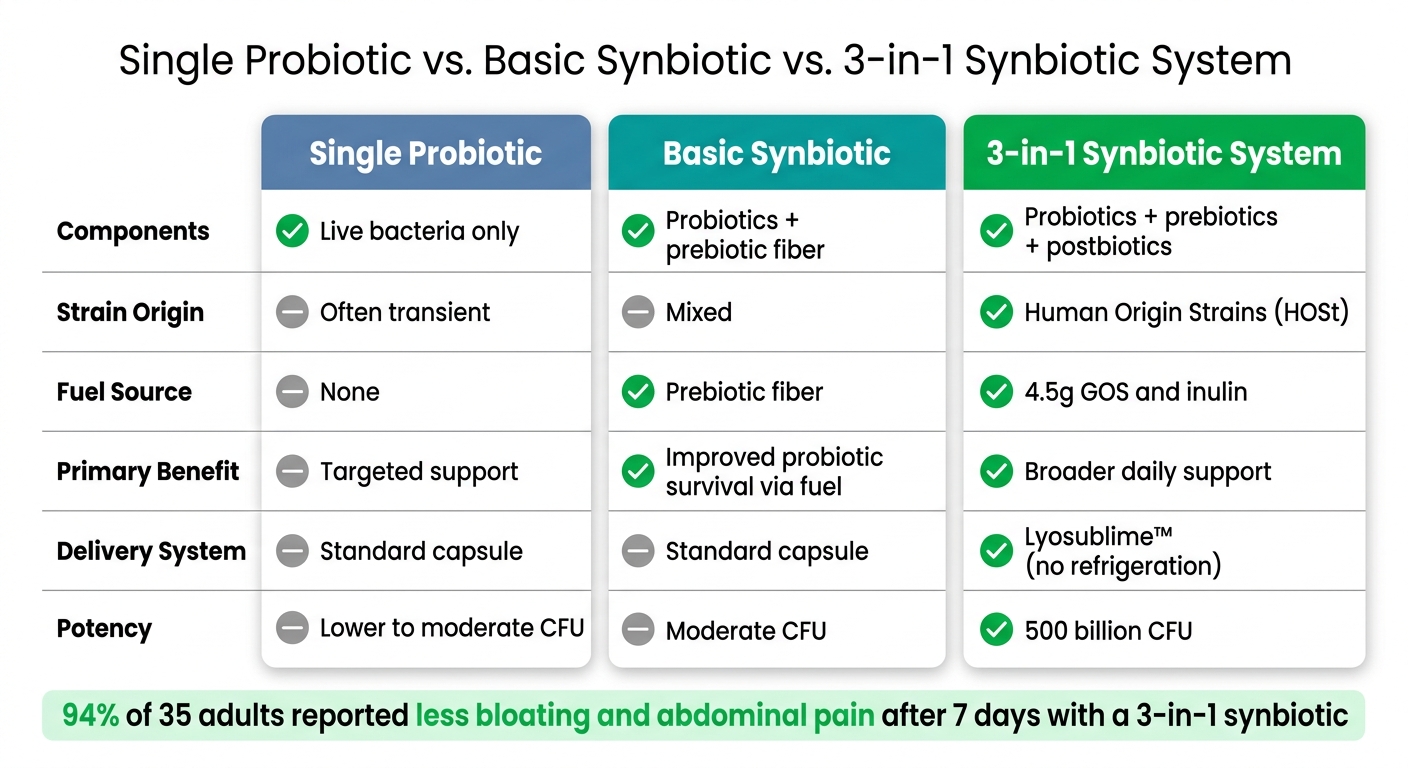
Single Probiotic vs. Basic Synbiotic vs. 3-in-1 Synbiotic: Full Comparison
When you look at how gut support works day to day, a combined formula makes more sense because it helps with each step in the same serving.
A single-ingredient probiotic gives you live bacteria. That can help. But if there’s no prebiotic fuel and no postbiotic support, the effect is narrower. A combined formula covers all three at once.
Fibers like GOS and inulin feed helpful microbes and can increase postbiotic production. Add a postbiotic piece, and you expand support for the gut barrier and immune function. Put simply, combined formulas link feeding, survival, and metabolite production in one move.
The table below shows how these options compare in practice:
| Feature | Single-Ingredient Probiotic | Basic Synbiotic | 3-in-1 Synbiotic (e.g., Rebiirth RE-1™) |
|---|---|---|---|
| Components | Live bacteria only | Probiotics + prebiotic fiber | Probiotics + prebiotics + postbiotics |
| Strain Origin | Often transient | Mixed | Human Origin Strains (HOSt) |
| Fuel Source | None | Prebiotic fiber | 4.5g GOS and inulin [1] |
| Primary Benefit | Targeted support | Improved probiotic survival via fuel | Broader daily support |
| Delivery System | Standard capsule | Standard capsule | Lyosublime™ |
| Potency | Lower to moderate CFU | Moderate CFU | 500 billion CFU [1] |
Rebiirth RE-1™ is one example of this setup. In a self-assessment study of 35 adults, 94% reported less bloating and abdominal pain after 7 days, and 87% noticed fewer allergies and infections within the first week [1].
That matters because preventive gut support tends to work better when feeding, survival, and signaling happen together.
So the next step is practical: how to fit synbiotics into a daily routine.
How to Add Synbiotics to a Preventive Daily Routine
When it comes to preventive care, consistency matters more than intensity. Take your synbiotic every day with water, and follow the label directions.
What you eat and drink each day also shapes how well it fits into your routine. Pair the supplement with fiber-rich foods to help support gut balance. At the same time, it helps to limit ultra-processed foods, artificial sweeteners, and high-fructose corn syrup, which can work against microbiome balance.
Hydration matters too. Drinking enough water can help keep stools moving more comfortably when using synbiotic supplements [1].
Results usually build in stages. Some people notice better regularity within 24 to 48 hours [1]. Changes in the microbiome tend to take longer and often build over a period of weeks, while bowel habits may shift sooner.
Daily habits outside of food matter as well. Sleep, exercise, stress management, and time outdoors can all support microbial resilience. Synbiotics work best as one part of a daily gut-support routine.
Conclusion
Synbiotics do more than add bacteria. The seven roles covered here all lead to one main idea: prebiotics, probiotics, and synbiotics work together: prebiotics feed probiotic strains, probiotics help produce metabolites, and postbiotics help support the gut lining and immune signaling. That chain is the whole point.
Short-term human data also points to noticeable day-to-day effects from a 3-in-1 synbiotic [1].
A probiotic on its own can add bacteria. But without prebiotic fuel, those strains are less likely to stick around. And without postbiotics, immune signaling may not get the same immediate support. A 3-in-1 system brings those three layers together, which helps explain why combined formulas can support more in a single daily serving.
In plain terms, that means looking for a formula that includes all three layers in one serving. For preventive gut care, the goal is to support the full cycle of microbiome balance, not just one part of it. Rebiirth RE-1™ combines prebiotics, probiotics, and postbiotics in one daily sachet with 500 billion CFU and 4.5 g of GOS and inulin per serving [1].
FAQs
How long do synbiotics take to work?
Synbiotics can start working fast, but the timeline depends on what you’re trying to fix. Some people notice less bloating, smoother digestion, and better immune support within the first week. Others see milder shifts sooner, like more regular bowel movements within 24 to 48 hours.
A 7-day reset can help get your microbiome back on track. 4 weeks may help support more steady balance. And a 3-month regimen is often used for deeper gut issues and longer-term gut health.
Can I take synbiotics after antibiotics?
Antibiotics can throw off your natural microbiome and sometimes leave things out of balance. That’s why it’s smart to talk with your healthcare provider about when to take synbiotics, especially if you’re taking antibiotics now or just finished a course.
Medical guidance can help make sure any supplement plan lines up with your own health needs and recovery goals.
What should I look for in a 3-in-1 synbiotic?
Look for a formula that combines prebiotics, probiotics, and postbiotics for more complete gut support. And don’t stop at the front label. Check for full strain identification and a CFU count that’s guaranteed through the expiration date, not just at the time of manufacture.
It also helps to pick a product with an advanced delivery system that shields bacteria from stomach acid and helps more of it reach the colon. Shelf-stable options can make daily use a lot easier, especially if you don’t want to deal with refrigeration.