

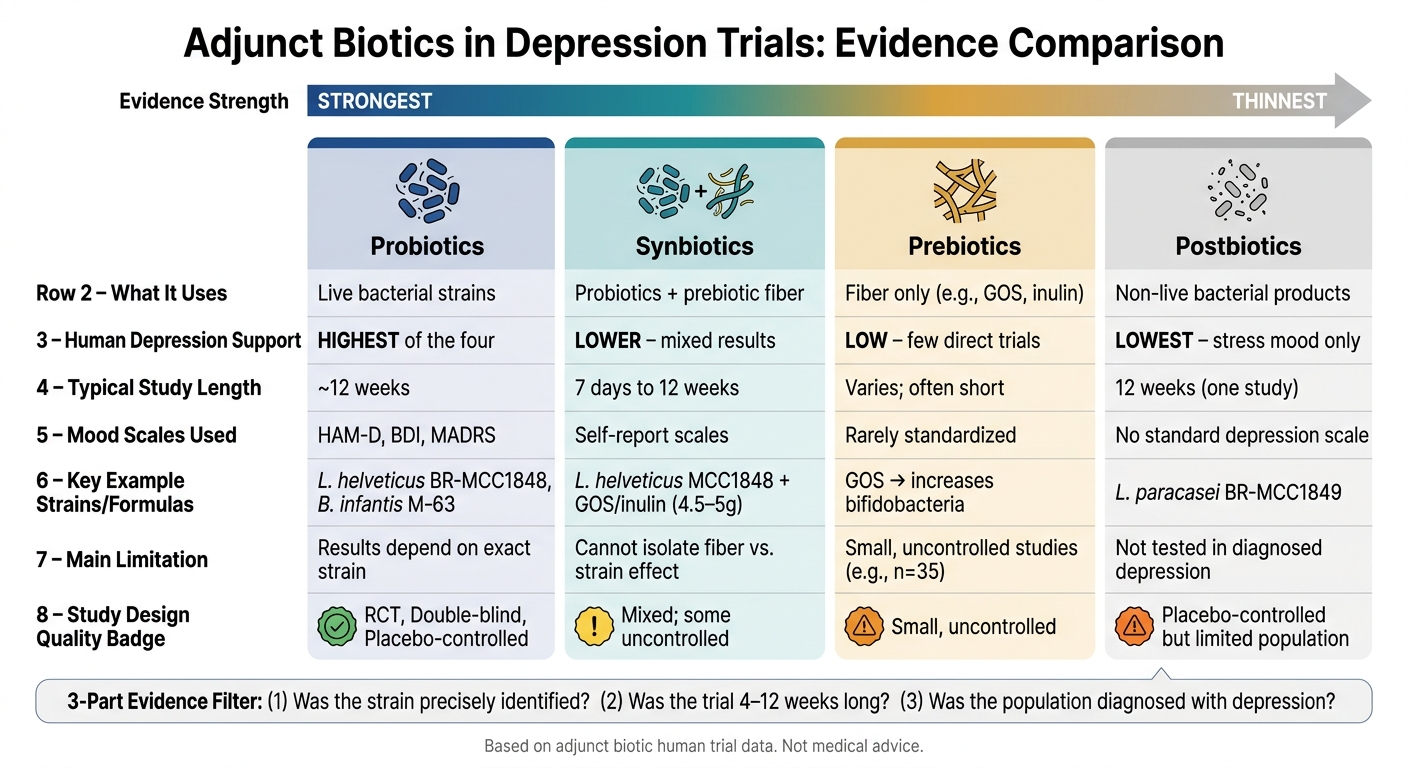
If you want the short answer: probiotics have the clearest human signal, and the other three groups have much thinner support. Across these studies, the main things to check are the exact strain or formula, daily dose, study length, mood scale used, and whether the trial was randomized, blinded, and placebo-controlled.
Here’s the article in plain terms:
- Probiotics: strongest human data in this comparison
- Synbiotics: mixed formulas, so it’s hard to tell what part drove the result
- Prebiotics: few direct depression trials, often small and uncontrolled
- Postbiotics: thinnest evidence, mostly stress-related mood work, not clinical depression
You should also watch for trial length. 7-day studies may show GI changes, but mood outcomes usually need 4 to 12 weeks, and many trials run about 12 weeks. And a 35-person single-arm study can hint at a signal, but it can’t settle the question.
Quick Comparison
| Category | What it uses | Human depression support | Common study pattern | Main issue |
|---|---|---|---|---|
| Probiotics | Live strains | Highest of the four | Often around 12 weeks; mood scales like HAM-D, BDI, MADRS | Results depend on the exact strain |
| Synbiotics | Probiotics + fiber | Lower | 7 days to 12 weeks; GI outcomes often reported | Hard to separate fiber vs. strain effect |
| Prebiotics | Fiber only | Low | Small, often uncontrolled studies | Few direct depression trials |
| Postbiotics | Non-live bacterial product | Lowest | One 12-week placebo-controlled stress study | Not tested in diagnosed depression; no standard depression scale |
So if you’re comparing these options, I’d read the evidence in a simple order: probiotics first, then synbiotics, then prebiotics, then postbiotics. This hierarchy reflects the current mental health benefits supported by gut-brain axis research. That gives you the clearest view of what human trials do - and do not - show.
Adjunct Biotics for Depression: Evidence Comparison (Probiotics vs Synbiotics vs Prebiotics vs Postbiotics)
New Study Suggests Daily Probiotics Could Ease Depression and Anxiety Symptoms
sbb-itb-1bbfe7f
1. Adjunct Probiotic Human Trials
Adjunct probiotic trials in depression look at probiotics used alongside antidepressants, which is why they matter in day-to-day care. In these studies, a few things shape how useful the results are: the exact strain, how long treatment lasts, which mood scale researchers use, and how the trial is set up.
Formulation
These trials are most helpful when they name the exact strain instead of talking about probiotics in broad terms. For example, L. helveticus BR-MCC1848 has been studied for stress-related depressive symptoms. B. infantis M-63 has also been studied in IBS-linked mood symptoms [1].
That detail matters. It keeps the focus on strains tied to adjunct depression care, not broad microbiome claims.
Once the strain is clear, the next thing to look at is treatment length.
Dose and Duration
A 12-week treatment period shows up often in adjunct probiotic studies when researchers want to track shifts in mood state [1]. Put simply, twelve-week trials are common.
But duration on its own doesn’t tell you much. It matters more when researchers pair it with validated mood scales and, when possible, gut-related measures.
Mood Outcomes and Study Credibility
Most trials track mood with tools like HAM-D, BDI, or MADRS. Confidence is highest when a study is randomized, double-blind, and placebo-controlled, and when the strain is clearly named. Biomarkers such as cytokines can also help explain how a strain may be working [1]. When reported, gut outcomes usually include microbiome shifts and changes in IBS-related symptoms.
These probiotic trials give you the baseline for judging whether combined formulas add anything extra in synbiotic studies. In that sense, they work as the reference point for evaluating mixed formulations. Understanding the mechanisms of synbiotic modulation helps clarify how these combinations differ from single-strain probiotics.
2. Synbiotic Human Trials
Synbiotic trials in depression combine probiotics with prebiotic fibers in the same product. The goal is simple: see whether adding fiber changes the response compared with probiotics alone. In this area, the trial design matters just as much as the ingredient list, because results often reflect one specific product blend rather than a general synbiotic effect.
Formulation and Duration
Common synbiotic formulas pair probiotics with prebiotic fibers such as GOS or low-molecular-weight inulin, usually at 4.5–5 g per serving. Reported strains include L. helveticus MCC1848, B. longum BB536, and B. breve M-16V [1][2]. Trial lengths range from 7 days to 12 weeks, and some products use 500 billion CFU per serving [1][2].
Mood Outcomes and Study Credibility
Mood outcomes are usually measured with self-report scales. GI outcomes show up more consistently across studies, including bloating, abdominal pain, stool consistency, ease of bowel movements, and gas production [1][2]. In one 7-day, nonrandomized, single-arm study of 35 adults, 94% reported less bloating and abdominal pain [1][2].
That sounds promising. But there’s a catch: the study design puts a hard limit on how much weight the result can carry. Some studies are uncontrolled, and the product mix often changes from one trial to the next. So even when results look good, it’s tough to know whether the effect came from the fiber, the probiotic strains, the full blend, or something else.
Overall, product-level evidence is weaker than strain-level evidence because formulas vary and some studies are uncontrolled [1][2]. That remains the main limit in synbiotic depression research.
Prebiotic-only trials isolate the fiber component on its own.
3. Prebiotic-Only Human Trials
After mixed synbiotic formulas, prebiotic-only trials try to strip things back and look at the fiber part on its own. In depression research, these trials mostly focus on GOS and low-molecular-weight inulin [1][2].
Formulation
GOS has been linked with increases in bifidobacteria [1]. Low-molecular-weight inulin also shows up in the prebiotic formulas discussed in this research.
Dose, Duration, and Mood Outcomes
Direct prebiotic-only depression trials are uncommon [1][2]. A lot of the evidence comes from mixed products, which makes it tough to tell how much of any mood change comes from the prebiotic itself [1][2].
Study Credibility
Confidence here is low. The studies are small and uncontrolled, and one included just 35 adults [1][2]. Without a control group, it's hard to rule out placebo effects. That means mood-scale changes are harder to read with confidence, and better trial designs are still needed.
So at this point, prebiotics show less mood support than probiotics and synbiotics. And that sets up the even thinner evidence base for postbiotics.
4. Postbiotic Human Evidence
Postbiotic human evidence is the smallest and most indirect of the four groups. Right now, human data is limited to a single postbiotic: Lactobacillus paracasei BR-MCC1849 powder. The paper describes it as a Human Origin Strain (HOSt) with immune-active effects that may affect inflammation through cytokine signaling [1].
That said, there’s a big catch. This study was not about using postbiotics as an add-on for depression treatment. It looked at stress-related mood maintenance instead [1].
Dose and Duration
The main study used daily intake for 12 weeks [1].
Mood Outcomes
In the 12-week placebo-controlled study, participants showed better maintenance of a desirable mood state under mental stress. But the study did not test people with diagnosed depression, and it did not use standard depression scales [1].
Study Credibility
The placebo-controlled design gives the study more weight on its own terms. But the study group was made up of people under stress, not people with clinical depression. So the link to adjunct depression treatment is still indirect [1].
That leaves postbiotics as the most indirect category in this comparison.
Strengths, Limits, and Trade-Offs Across Trial Categories
This section brings the human trial data together across the four categories. And one thing stands out right away: they do not carry the same weight in adjunct depression research.
Across the four trial types above, the evidence is uneven. Probiotic trials have the strongest human data because they use named strains and more consistent methods. When a strain like Lactobacillus helveticus MCC1848 has been studied for chronic-stress-induced depression, the link is more direct and strain-specific [1]. The other categories have a thinner and less isolated base of evidence.
Synbiotics vs. probiotics findings are harder to pin down because both the probiotic and prebiotic parts can change from one product to the next [1][2]. That makes it tough to tell which part is doing the work. Prebiotics have an even narrower base of evidence.
Prebiotic-only trials are sparse, small, and mostly indirect, so mood effects are harder to separate from other factors [1][2]. Postbiotics narrow the picture even more.
Postbiotic evidence is the thinnest and most indirect. Human data are limited to a single compound, Lactobacillus paracasei MCC1849 [1]. The placebo-controlled design gives the study more weight, but it still focused on stress rather than diagnosed depression and did not use a standard depression scale [1].
Trial design can make or break confidence in the results. Randomization and blinding are the clearest dividing lines. Double-blind, placebo-controlled RCTs cut down placebo effects and investigator bias. Single-arm observational studies, by contrast, are better for spotting early signals than for drawing firm conclusions.
Sample size matters too. A 35-person study can point to a hypothesis, but it does not have enough power to confirm broad psychological effects [1][2]. Study length matters just as much. A seven-day trial may show fast gastrointestinal changes, but mood and depression outcomes usually need more time - often 12 to 16 weeks - to show a meaningful cumulative effect [1][2].
The trade-offs are easiest to see side by side:
| Category | Evidence Base | Major Strength | Main Limitation |
|---|---|---|---|
| Probiotics | Strongest; strain-specific [1][2] | Best-defined human-origin strain data [1] | Some strains may not permanently colonize without prebiotic support [1] |
| Synbiotics | Growing; mixed-formula [1][2] | Multi-targeted approach [1] | Hard to isolate which component drives the effect [1][2] |
| Prebiotics | Sparse; supportive [1] | Feeds resident microbes; high stability [1] | Indirect; rarely used alone for depression [1] |
| Postbiotics | Emerging; thinnest [1] | Highly stable; no refrigeration required [1] | Fewest human trials; no standard depression scale used [1] |
Conclusion
Put side by side, the four trial categories show a clear evidence gradient. In adjunct biotic trials, probiotics and prebiotics have the clearest human signal. Synbiotics, prebiotics, and postbiotics still look thinner and more indirect. That difference matters when you judge claims that a biotic improved depression scores. A positive result on its own doesn't say much without the strain, dose, duration, population, and validated mood scale.
The most credible depression signals come from named, placebo-controlled trials that use validated mood scales. When looking at any biotic trial, use a simple three-part filter: Was the strain or formulation precisely identified? Was the trial long enough - usually 4 to 12 weeks - to capture mood-level changes? And was the population one with diagnosed depression rather than healthy adults under mild stress? [1][2]
In adjunct depression research, the strongest signal comes from the most specific biotic and the most rigorous trial.
FAQs
Which probiotic strains look most promising for depression?
Research points to a few promising strains for stress-linked depression and mental well-being, with Lactobacillus helveticus BR-MCC1848 and Lactobacillus paracasei BR-MCC1849 standing out most.
Other strains worth noting include Bifidobacterium infantis BR-M63, which supports microbial balance, and Lactobacillus gasseri, which may help with sleep. These strains are included in the Rebiirth RE-1 formulation, which is built to support the gut-brain axis.
How long should a depression biotics trial run?
There’s still no standard trial length for depression biotics research.
So far, studies have tested timeframes ranging from 7 days to 3 months. Some have also reported meaningful results within 6 weeks.
That range makes things a bit messy. When study lengths differ this much, it’s hard to judge long-term mental health outcomes with confidence. Researchers are now comparing these timelines to better define treatment standards for the gut-brain axis.
What makes one depression biotics study more reliable than another?
A study tends to carry more weight when it includes a larger, well-matched sample, uses a clear and steady design, and adds strong controls like randomized, double-blind, placebo-controlled methods. Those guardrails help cut down bias and placebo effects.
Confidence also goes up when researchers use validated mood scales, look at objective or clinically relevant outcomes, and track gut changes with modern methods. That matters because it helps link microbiome shifts to changes in symptoms, instead of leaving that connection as a guess.