

Air pollution can affect your gut, not just your lungs. If you breathe traffic fumes, wildfire smoke, cooking smoke, or dust, some of those particles can end up in your digestive tract and stress the gut lining.
Here’s the short version:
- Pollutants can reach the gut after you inhale them and swallow mucus, or through food, water, and dust.
- They can shift gut bacteria, often lowering diversity and cutting SCFA output like butyrate.
- They can weaken the gut barrier by thinning mucus and lowering tight junction proteins such as occludin and ZO-1.
- They can add inflammation in the gut and across the body through compounds like LPS.
- You can lower strain with cleaner indoor air, AQI checks, fiber-rich foods, sleep, stress control, and synbiotics for urban gut health support.
A few data points stand out. A 2023 systematic review linked particulate pollution with lower gut microbial diversity and more permeability, oxidative stress, and inflammation. A 2024 study found chronic PM2.5 exposure lowered occludin and ZO-1 and shifted 35 bacterial species toward a more inflammatory pattern.
If I were boiling this down to action, I’d focus on 3 things first:
- Cut exposure: watch AQI, use HEPA filtration, close windows during smoke events, and vent cooking outdoors.
- Feed the microbiome: eat more beans, oats, lentils, vegetables, and other fiber-rich foods that help make SCFAs.
- Track the basics if needed: ask a clinician about fecal calprotectin and hs-CRP if gut inflammation is a concern.
This guide explains how pollution reaches the gut, what it may do to the microbiome and barrier, which lab markers researchers use, and which daily habits may help the gut hold up better over time.
How Pollutants Reach the Gut and Disrupt Microbial Balance
How pollutants travel from airways and mouth to the gut
Inhaled pollution doesn't stay in the lungs. Fine particles settle along the airways and get stuck in the mucus that lines the respiratory tract. From there, cilia push that mucus up toward the throat, where it's swallowed without you even noticing. That sends the particles into the esophagus and then the gut.[1][5][6][10][11][14] Once they arrive, they can alter the gut environment itself.
So air pollution can turn into swallowed exposure. Cigarette smoke and particles from synthetic materials add to that load too. They get inhaled, cleared from the airways, and then swallowed.[10] And that's only part of the picture. Pollutants also land on crops and food surfaces, get into drinking water through aging pipes or industrial runoff, and build up in household dust. That dust often ends up in the mouth through hand-to-mouth contact, especially in children.[1][10][11] The result is a steady, multi-source flow into the gut, and it affects more than what's physically there. It can also alter the microbes living there.
What research shows about microbiome shifts under pollution exposure
Once pollutants reach the gut, they can drive oxidative stress and push the microbiome out of balance. Across both animal and human studies, the same pattern shows up again and again: lower microbial diversity, more endotoxin-producing bacteria, and fewer helpful species.[1][2][12]
A 2023 systematic review on ambient particulate air pollution and the intestinal microbiome found negative links between diversity indices and pollution levels in most of the studies it included. It also reported more Proteobacteria and less Verrucomicrobiota, a group that includes Akkermansia.[2] That matters because Akkermansia helps maintain mucus thickness and barrier integrity. A 2026 review found a similar trend. It reported that PM2.5 and heavy metals such as cadmium and lead lowered the abundance of Faecalibacterium, Roseburia, and Akkermansia, while allowing opportunistic groups like Desulfovibrio and Enterobacteriaceae to expand.[16]
A mouse study on PM10 exposure found major shifts in Bacteroidetes, Firmicutes, and Verrucomicrobia. In susceptible mice, the microbiome moved even more toward a pro-inflammatory profile.[15] That's a big deal because those changes cut down the metabolites that help protect the gut barrier.
Why SCFAs and microbial metabolites matter for gut defense
You can see that loss of defense first in microbial metabolism. Pollution often reduces bacteria that make SCFAs, especially those tied to butyrate, acetate, and propionate. These metabolites do a lot of the gut's day-to-day support work. They fuel colon cells, strengthen tight junctions, support mucus production, and help control inflammation through GPR41 and GPR43.[4][7][8][9][13]
When SCFA output falls, colonocytes lose their main fuel source. Tight junctions become less stable, and anti-inflammatory signaling in the gut gets weaker. In the PM10 mouse study, cecal butyrate levels dropped in both wild-type and susceptible mice, while branched-chain fatty acids went up, a sign that fermentation had been disrupted.[15] The 2026 review tied these microbial shifts directly to lower butyrate and propionate levels, which impaired the GPR41/43–AMPK axis involved in epithelial metabolism and immune balance.[16]
What's striking is that this can happen even if diet doesn't change. The microbiome becomes less able to make these protective metabolites on its own, which leaves the gut with less backup when everyday stress hits, whether that's a high-fat meal, psychological stress, or an infection that a healthier microbiome might have handled with less trouble.[1][5][7][9]
sbb-itb-1bbfe7f
How Air Pollution Damages the Gut Barrier and Drives Inflammation
Tight junction injury, mucus thinning, and increased permeability
Once SCFA support drops, the gut barrier is easier to damage. PM2.5-driven oxidative stress can disrupt tight junction proteins like occludin, claudins, and ZO-1. When those proteins break down, the gut becomes more permeable.
The mucus layer can thin too. And that matters. A thinner mucus layer leaves the epithelium more exposed to particles and microbes, which adds even more stress to the barrier.
How immune signaling changes inside the gut
Barrier damage doesn’t stay limited to the barrier itself. It can also shift immune signaling inside the gut and weaken the gut’s ability to recover.
As tight junctions loosen and mucus thins, immune cells in the lamina propria come into contact with more microbial products. That pushes signaling toward a pro-inflammatory state and makes it harder for the gut to regulate its own immune response.
How local gut damage leads to systemic inflammation
When barrier integrity breaks down, microbial products can pass into circulation and add to systemic inflammation. Lipopolysaccharide (LPS) and other bacterial components that cross a leaky gut epithelium can trigger immune activation far beyond the intestine.
That creates a direct link between ongoing pollutant exposure and whole-body inflammatory burden.
Researchers often track this kind of damage using markers of permeability, injury, and inflammation.
The Connection Between Indoor Air Quality and Gut Health That You Might Be Missing
Lab Markers Used to Track Gut Barrier Damage
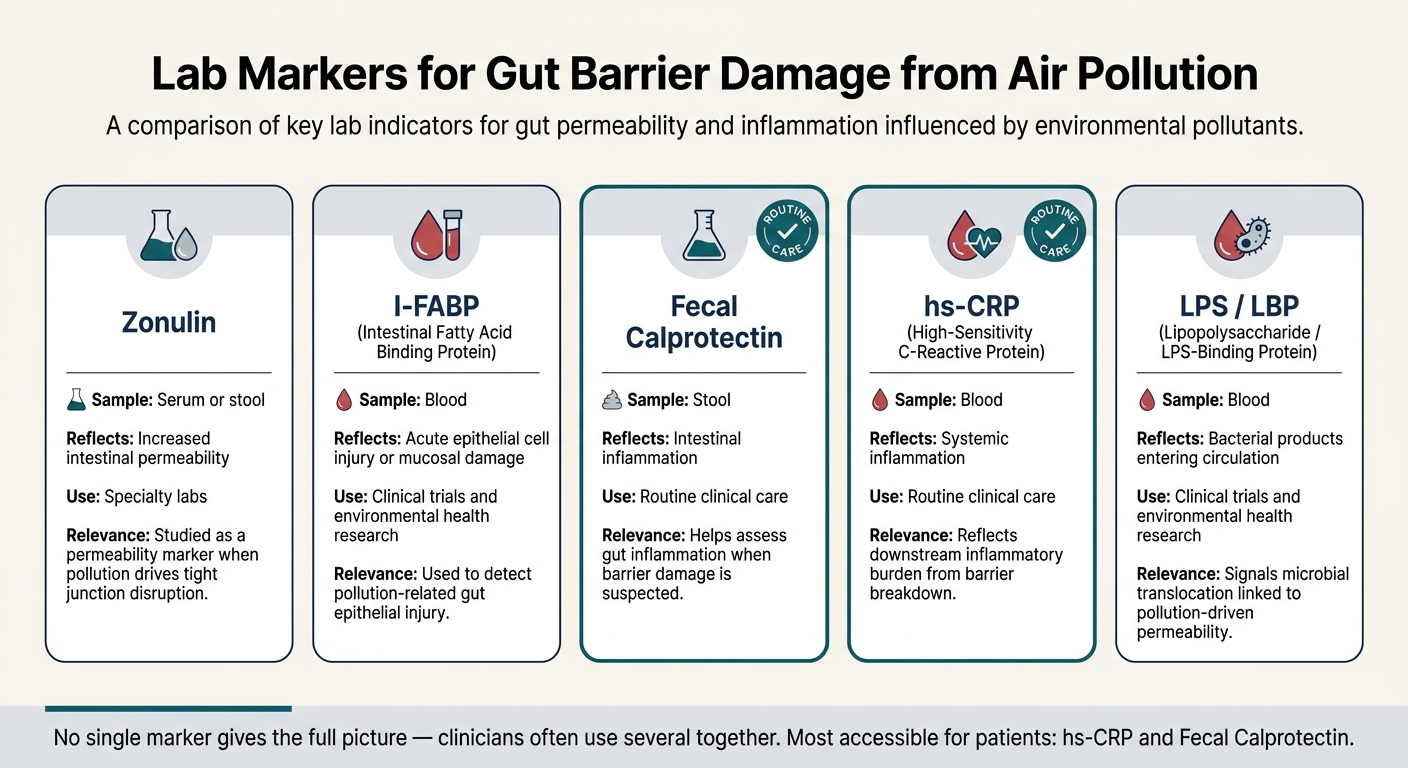
Lab Markers for Gut Barrier Damage from Air Pollution
Researchers and clinicians use a handful of lab markers to check for gut-barrier damage tied to pollution exposure. Some are part of routine care. Others show up more often in specialty labs or research settings. And that matters, because each marker tells you something a little different. Put them together, and pollution-linked barrier injury becomes something you can actually measure.
Markers linked to permeability and epithelial injury
Zonulin helps regulate tight junctions. When it shows up at higher levels in serum or stool, it can point to increased intestinal permeability. Specialty labs such as Genova Diagnostics and Cyrex Laboratories offer it.
I-FABP (intestinal fatty acid binding protein) is found inside mature intestinal cells. When those cells are injured or die, I-FABP leaks into the blood. That makes it a useful sign of acute epithelial damage and a common measure in pollution-related gut barrier studies.
Markers of inflammation and bacterial products entering the bloodstream
Fecal calprotectin tracks intestinal inflammation. hs-CRP tracks systemic inflammation. LPS and LBP reflect bacterial products entering circulation.
Comparison table: what each marker measures and where it is used
Use the table below to match each marker to what it measures and where it is used.
| Marker | Sample Type | What It Reflects | Typical Use | Relevance to Pollution-Related Gut Changes |
|---|---|---|---|---|
| Zonulin | Serum or stool | Increased intestinal permeability | Specialty labs | Studied as a permeability marker when pollution drives tight junction disruption |
| I-FABP | Blood | Acute epithelial cell injury or mucosal damage | Clinical trials and environmental health research | Used to detect pollution-related gut epithelial injury |
| Fecal Calprotectin | Stool | Intestinal inflammation | Routine U.S. care | Helps assess gut inflammation when barrier damage is suspected |
| hs-CRP | Blood | Systemic inflammation | Routine U.S. care | Reflects downstream inflammatory burden from barrier breakdown |
| LPS / LBP | Blood | Bacterial products entering circulation | Clinical trials and environmental health research | Signals microbial translocation linked to pollution-driven permeability |
No single marker gives the full picture, so clinicians often look at several together. For most readers, hs-CRP and fecal calprotectin are the most practical tests to bring up with a clinician. Once you know what to track, the next move is support: diet, sleep, stress control, synbiotics for urban living, and lower exposure.
How to Support Gut Barrier Recovery: Synbiotics, Diet, Sleep, Stress, and Exposure Reduction
Recovery has a few moving parts: lower exposure, support the microbiome, and help the gut barrier heal.
Where synbiotics fit in microbiome and barrier support
Synbiotics combine prebiotics, probiotics, and postbiotics to support microbiome balance and barrier strength.
For pollution-related gut support, synbiotics matter because they may help bring back SCFA production. Some multi-species synbiotic studies increased SCFA-producing microbes and boosted acetate and butyrate levels, though pooled results are mixed. That means strain choice and your starting microbiome status both matter.[17][18][19] Synbiotics may help with resilience and barrier repair, but they do not remove pollution itself.
Rebiirth RE-1™ is one example of this approach. It’s a 3-in-1 synbiotic with prebiotics, probiotics, and postbiotics in sachets, including HOSt™ strains and 500 billion CFU per serving.
One thing to know: synbiotics work best when your diet gives those microbes fiber to ferment.
Diet, sleep, and stress habits that support barrier integrity
A high-fiber, plant-forward diet is one of the most useful tools for barrier support. Beans, lentils, oats, and vegetables provide fermentable fiber that gut microbes turn into SCFAs. Polyphenol-rich foods like berries, tea, coffee, olive oil, dark cocoa, and colorful vegetables may help support tight junction proteins and lower inflammation.[25][26][28] Fermented foods such as yogurt or kefir may add microbial diversity, although not everyone tolerates them the same way. And cutting ultra-processed foods matters just as much as adding more fiber.
Barrier recovery also depends on the repair signals that come from sleep and stress control.
Sleep and stress sit right at the center of barrier health. Acute sleep loss in animal models reduced intestinal integrity, lowered propionate-producing bacteria, increased LPS translocation, and raised systemic inflammation.[29] Chronic psychological stress lowers helpful Lactobacillus and Bifidobacterium, increases gut permeability, and turns up inflammatory signaling through cortisol and autonomic changes.[27][30][31]
A few daily habits can help:
- Keep a fixed wake time
- Limit late-night light
- Avoid heavy meals and alcohol close to bedtime
- Use regular walking, breathwork, mindfulness, or CBT-based tools
Lowering exposure helps stop new damage from piling on faster than the gut can repair it.
Steps to reduce daily pollutant exposure
Even good diet and sleep habits do more when daily pollutant exposure is lower. Reducing exposure is the first line of defense. Use AQI to guide activity: skip outdoor exercise on unhealthy days and cancel outdoor events during smoke spikes.[20][22][23] During wildfire smoke or heavy-traffic periods, keep windows closed and run a HEPA air purifier in the bedroom or main living area.
Indoors, cut down combustion sources. Use a range hood that vents outside when cooking, avoid indoor smoking, and limit high-heat frying or charring. A layered approach works better than relying on any single fix: monitor AQI, filter indoor air, and cut indoor particle sources.[3][21][24]
Key takeaways
Air pollution can disrupt the gut microbiome, weaken the barrier, and drive both local and systemic inflammation. Lab markers can help track that pattern over time. Recovery depends on steady daily inputs: cleaner air, a fiber- and polyphenol-rich diet, steady sleep, active stress management, and targeted microbiome support when it makes sense.
FAQs
Can air pollution really make a leaky gut worse?
Yes. Air pollution can make a leaky gut worse by damaging helpful gut bacteria and throwing off the microbial balance that helps keep the intestinal barrier strong.
When that barrier starts to weaken, the tight junctions can break down. That opens the door for substances like LPS and bacteria to pass into the bloodstream. Once that happens, it can spark system-wide inflammation and put extra strain on the immune system.
What symptoms might suggest pollution is affecting my gut?
Pollution-related gut effects can show up as ongoing digestive issues like bloating or abdominal pain.
But it may not stop there. When pollution disrupts the gut microbiome, weakens the gut barrier, and affects immune and gut-brain signaling, the effects can ripple out into daily life. You might notice fatigue, more frequent recurring infections, new allergy sensitivities, or shifts in stress resilience, sleep quality, or overall mental well-being.
Which gut inflammation tests are most useful to ask about?
Common markers to review with your healthcare provider include CRP, which can point to body-wide inflammation, along with immune signals like TNF-α, IL-6, IL-8, IL-10, and TGF-β.
You may also want to ask about tests tied to gut permeability or LPS in the bloodstream. These can help show whether the gut barrier has been compromised.