

Not all probiotics do the same thing. The main point is simple: the strain shapes the immune response. One strain may push IL-10 and calm gut inflammation, while another may push IL-12 or shift macrophages toward microbe clearing. At the same time, microbial byproducts like butyrate, propionate, p40, and indole compounds can help the gut lining stay intact and help immune cells avoid overreacting.
If I boil the article down, here’s what matters most for you:
- Dendritic cells read probiotic signals first and can steer the gut toward tolerance or activation
- Macrophages can shift between inflammatory and repair states depending on the strain
- T cells can move toward Treg, Th1, Th2, or Th17 patterns based on cytokines and microbial metabolites
- Epithelial cells respond by tightening junctions, making more mucus, and sending local immune signals
- Postbiotics can act even when live microbes do not colonize well
- Prebiotics + probiotics + postbiotics may work better together because they cover feeding, signaling, and direct cell effects
A few clear examples from the article make the pattern easy to see:
- B. infantis 35624 was linked to IL-10 and Foxp3+ Treg activity
- L. rhamnosus GG was linked to TLR2/MyD88/MAPK signaling and barrier support
- Butyrate was tied to Foxp3 expression, MUC2 mucus output, and lower NF-κB activity
- L. reuteri made tryptophan-derived compounds that act through AhR on T cells
- Some strains increased brake proteins like Tollip, A20, IRAK-M, and Bcl-3, which help limit excess inflammatory signaling
In other words: probiotic–immune cross-talk is a cell-by-cell signaling system, not a one-size-fits-all effect. The article shows how strains, doses, viability, and metabolites can change outcomes across dendritic cells, macrophages, T cells, and the gut lining.
That’s the frame I’d use for the rest of the piece: match the microbe or metabolite to the immune job you want done.
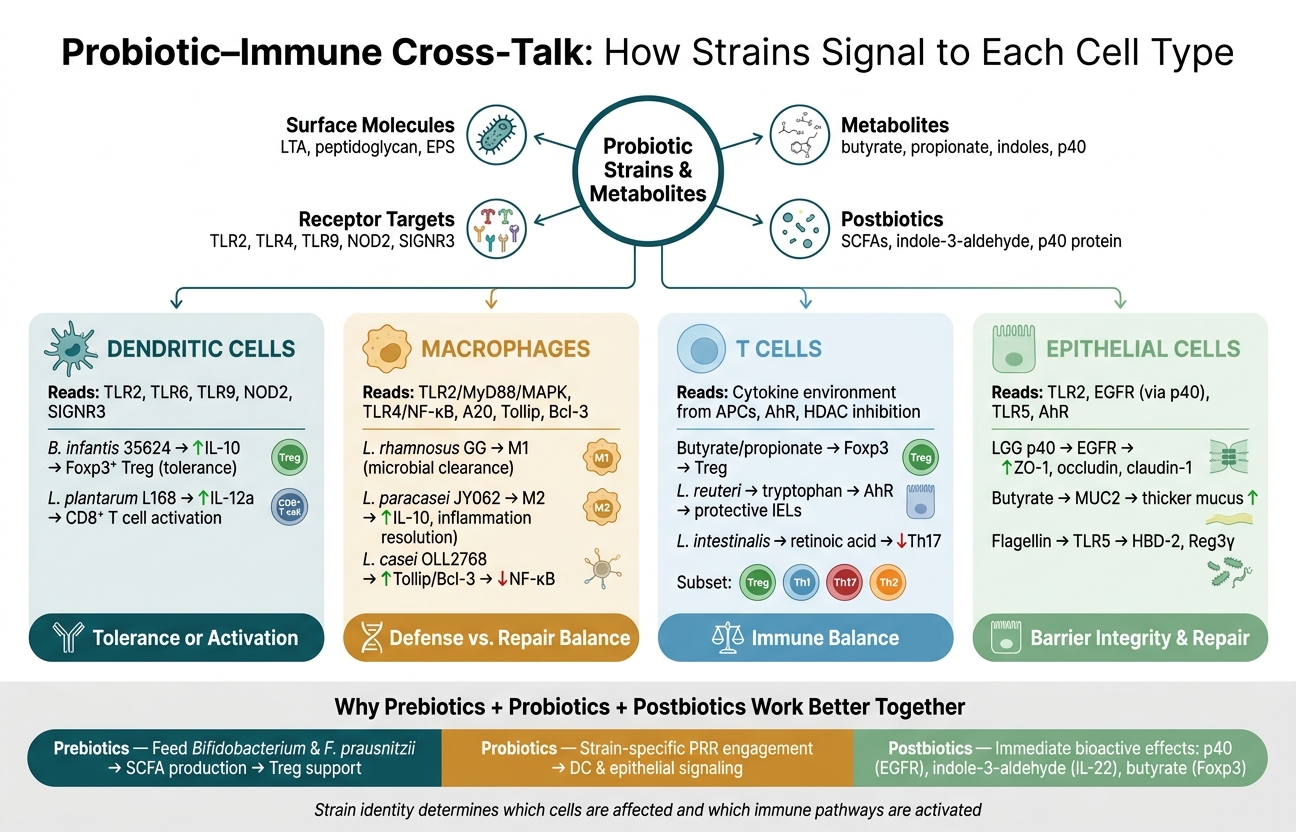
Probiotic–Immune Cross-Talk: How Strains Signal to Each Cell Type
Episode 6: Mechanisms of action for probiotics
How probiotics signal to dendritic cells and macrophages
Building on receptor-level sensing, DCs and macrophages turn probiotic signals into immune instructions. In plain English, these cells help decide whether contact with a probiotic leads to tolerance, defense, or tighter control of inflammation, which is critical when gut dysbiosis affects your health. They’re the first major interpreters of those receptor-level cues, and they set the tone for what happens next.
Dendritic cells: how they sense probiotic components and shape immune tolerance
DCs detect probiotic components such as lipoteichoic acid, peptidoglycan, surface layer proteins, and exopolysaccharides through the PRRs already discussed, including TLR2, TLR4, TLR9, NOD2, and C-type lectin receptors like SIGNR3. Once a DC picks up one of these signals, it changes its cytokine output and co-stimulatory signals. That shift then shapes downstream T-cell responses.
Different strains can push DCs in very different directions. Bifidobacterium infantis 35624 engages TLR2, TLR6, and TLR9 to drive IL-10 production, which promotes immune tolerance through Foxp3+ regulatory T cells. By contrast, Lactobacillus plantarum L168 uses indole-3-lactic acid (ILA) to increase IL-12a, priming CD8+ T cells for antitumor activity.
| Probiotic Strain | Receptor Target | Cytokine Outcome | T-Cell / Immune Outcome |
|---|---|---|---|
| Bifidobacterium infantis 35624 | TLR2, TLR6, TLR9 | ↑ IL-10 | Foxp3+ Treg induction (tolerance) [5] |
| Lactobacillus salivarius Ls33 | NOD2 | ↑ IL-10 | Development of CD103+ DCs and Foxp3+ Tregs [5] |
| Lactobacillus plantarum L168 | N/A (metabolite: ILA) | ↑ IL-12a | CD8+ T cell priming (antitumor immunity) [1] |
| Lactobacillus acidophilus NCK2187 | SIGNR3 (C-type lectin) | Regulatory signals | Colitis mitigation; barrier protection [5] |
There’s another twist here. Even within the same species, peptidoglycan structure can change the DC response. L. salivarius Ls33 shows an anti-inflammatory pattern, while other strains may not produce that same IL-10 phenotype. So yes, receptor choice matters, but the fine details of molecular structure matter too.
Macrophages: balancing pathogen defense with inflammation control
If DCs help shape tolerance, macrophages help decide whether that response stays under control or tips into inflammation. Intestinal macrophages clear microbes, release cytokines, and switch between defense and resolution. Probiotics can shift this balance by influencing macrophage polarization between M1 states, which are pro-inflammatory and geared toward pathogen clearance, and M2 states, which are anti-inflammatory and linked to tissue repair.
Lactobacillus rhamnosus GG activates TLR2/MyD88/MAPK signaling to drive M1 polarization, which supports microbial clearance [7]. L. paracasei JY062 pushes macrophages toward M2 polarization, increasing IL-10 and helping resolve inflammation [7].
Probiotics can also dial macrophage signaling up or down to keep things in check. Lactobacillus casei OLL2768 upregulates Tollip and Bcl-3, which restrain NF-κB and reduce IL-6 and IL-8 output triggered by enterotoxigenic E. coli (ETEC) [6]. Bifidobacterium longum BB536 induces A20, suppressing IL-8 and MCP-1 through targeted degradation of TRAF6 [6].
| Probiotic Strain | Signaling Shift | Functional Outcome |
|---|---|---|
| L. rhamnosus GG | ↑ TLR2/MyD88/MAPK | M1 polarization; enhanced microbial clearance [7] |
| L. paracasei JY062 | M2 polarization | ↑ IL-10; inflammation resolution [7] |
| L. acidophilus KLDS 1.0738 | ↓ TLR4/NF-κB | ↓ TNF-α, IL-6; anti-inflammatory [7] |
| L. casei OLL2768 | ↑ Tollip, ↑ Bcl-3; ↓ NF-κB | Inhibits ETEC-induced inflammation [6] |
| B. longum BB536 | ↑ A20 (via TLR2) | ↓ IL-8, ↓ MCP-1; reduced inflammatory signaling [6] |
These early signals set up what comes next in T-cell polarization and epithelial defense.
How probiotics reshape T cells and gut epithelial defenses
Those same probiotic signals also shape T cells and epithelial defenses. In simple terms, innate sensing helps decide how adaptive immunity behaves and how strong the gut barrier stays.
T cells: shifting the balance between Treg, Th1, Th2, and Th17 responses
Naïve CD4+ T cells change course based on the cytokine setting created by probiotic-conditioned antigen-presenting cells. That matters because these shifts help decide whether the gut lining stays tolerant or drifts toward inflammation.
Tregs increase when probiotic-conditioned antigen-presenting cells and SCFAs push IL-10, TGF-β, and Foxp3. Butyrate and propionate add to that effect by acting as HDAC inhibitors, which promote Foxp3 expression and Treg differentiation [1][4].
Th1 responses can help with antiviral defense when they stay in check. Th17 cells, on the other hand, are tied to gut inflammation when control slips. Lactobacillus intestinalis turns down Th17 activity by promoting retinoic acid synthesis, which suppresses RORγt+ cell development [1].
| T-Cell Subset | Key Cytokines / Transcription Factors | Probiotic / Postbiotic Influence |
|---|---|---|
| Treg | IL-10, TGF-β / Foxp3 | Induced by B. infantis 35624, L. salivarius Ls33, butyrate, and propionate [1][4] |
| Th1 | IFN-γ, IL-12 / T-bet | Enhanced by B. longum for antiviral defense; restrained by F. prausnitzii [1][4] |
| Th17 | IL-17, IL-22 / RORγt | Downregulated by L. intestinalis via retinoic acid synthesis [1] |
| Th2 | IL-4, IL-5, IL-13 / GATA3 | Balanced by B. adolescentis to improve chronic colitis responses [1] |
There’s also a direct route. Lactobacillus reuteri produces indole derivatives from tryptophan that activate the aryl hydrocarbon receptor (AhR) on T cells. That signal reprograms them into protective intraepithelial lymphocytes [2].
The same strain-specific signals also strengthen the epithelial barrier.
Epithelial cells: tight junctions, mucus, and local immune signaling
The epithelium isn’t just a wall. It’s an active immune interface that expresses pattern recognition receptors, responds to probiotics and their metabolites, and sends signals both ways: toward the lumen and toward the immune tissue underneath.
Tight junctions are the seals between epithelial cells. Probiotics like L. rhamnosus GG (LGG) and L. plantarum increase structural proteins such as ZO-1, occludin, claudin-1, and JAM-1 through MAPK (ERK and p38) and PI3K/Akt signaling [2][6]. LGG also secretes a soluble protein called p40, which transactivates the epidermal growth factor receptor (EGFR) and helps protect epithelial cells from cytokine-induced apoptosis [6].
Mucus adds another layer of defense. Butyrate promotes AP-1 binding to the MUC2 promoter in goblet cells, which thickens the mucus layer and keeps bacteria farther from the epithelial surface [2][4]. Akkermansia muciniphila also stimulates goblet cell activity, reinforcing that barrier [4]. When the barrier is stronger, less antigen leaks through, and the microbiome tends to stay more stable, helping to prevent gut dysbiosis.
| Epithelial Function | Probiotic / Metabolite Action | Resulting Effect |
|---|---|---|
| Tight Junctions | TLR2 activation; EGFR transactivation by LGG p40 [2][6] | Increased transepithelial resistance and reduced paracellular permeability |
| Mucus Layer | Butyrate promotes MUC2 expression; A. muciniphila stimulates goblet cells [2][4] | Thickened barrier preventing pathogen attachment and translocation |
| Antimicrobial Defense | Flagellin triggers TLR5 to induce HBD-2 and Reg3γ [2][6] | Direct inhibition of pathogenic bacteria colonization |
| Immune Signaling | sIgA induction via TGF-β and APRIL signaling; AhR activation for IL-22 [3][5] | Enhanced mucosal immunity and accelerated barrier repair |
At the epithelial surface, these same brakes help preserve tolerance to commensals without weakening pathogen defense.
Because these effects are strain-specific, microbiome restoration depends on matching the right microbial inputs to the right immune target.
sbb-itb-1bbfe7f
Strain-specific actions, microbiome restoration, and the role of a synbiotic reset
Probiotic effects are strain-specific, so formula choice matters. L. rhamnosus Lr32 has shown colitis protection in murine models, while other strains do not share the same anti-inflammatory profile [8]. In plain English, not all probiotics do the same job.
Why the gap? It comes down to each strain’s surface signals and the receptors they switch on. That same strain-level match can make microbiome rebuilding work well after disruption - or fall flat. After dysbiosis, antibiotics, diet shifts, or stress, restoration depends on hitting the right immune and barrier pathways.
Why combining prebiotics, probiotics, and postbiotics can strengthen immune cross-talk
Once you know the target, the next step is picking the right input class for each immune layer. A balanced synbiotic approach works because each part does a different job.
- Prebiotics selectively feed helpful taxa like Bifidobacterium and F. prausnitzii, which supports SCFA production and Treg balance [3].
- Probiotics deliver strain-specific microbial surface signals that engage pattern recognition receptors on dendritic cells and epithelial cells [2][4].
- Postbiotics give more immediate bioactive effects. Indole-3-aldehyde stimulates IL-22 for epithelial repair [5], and p40 activates EGFR signaling to protect intestinal cells from cytokine-induced apoptosis [2][5].
This matters when the gut isn’t ready to support stable colonization yet. In that setting, postbiotics can act right away, while prebiotics and probiotics help set up the next phase.
Rebiirth RE-1 and the idea of a rapid microbiome reset
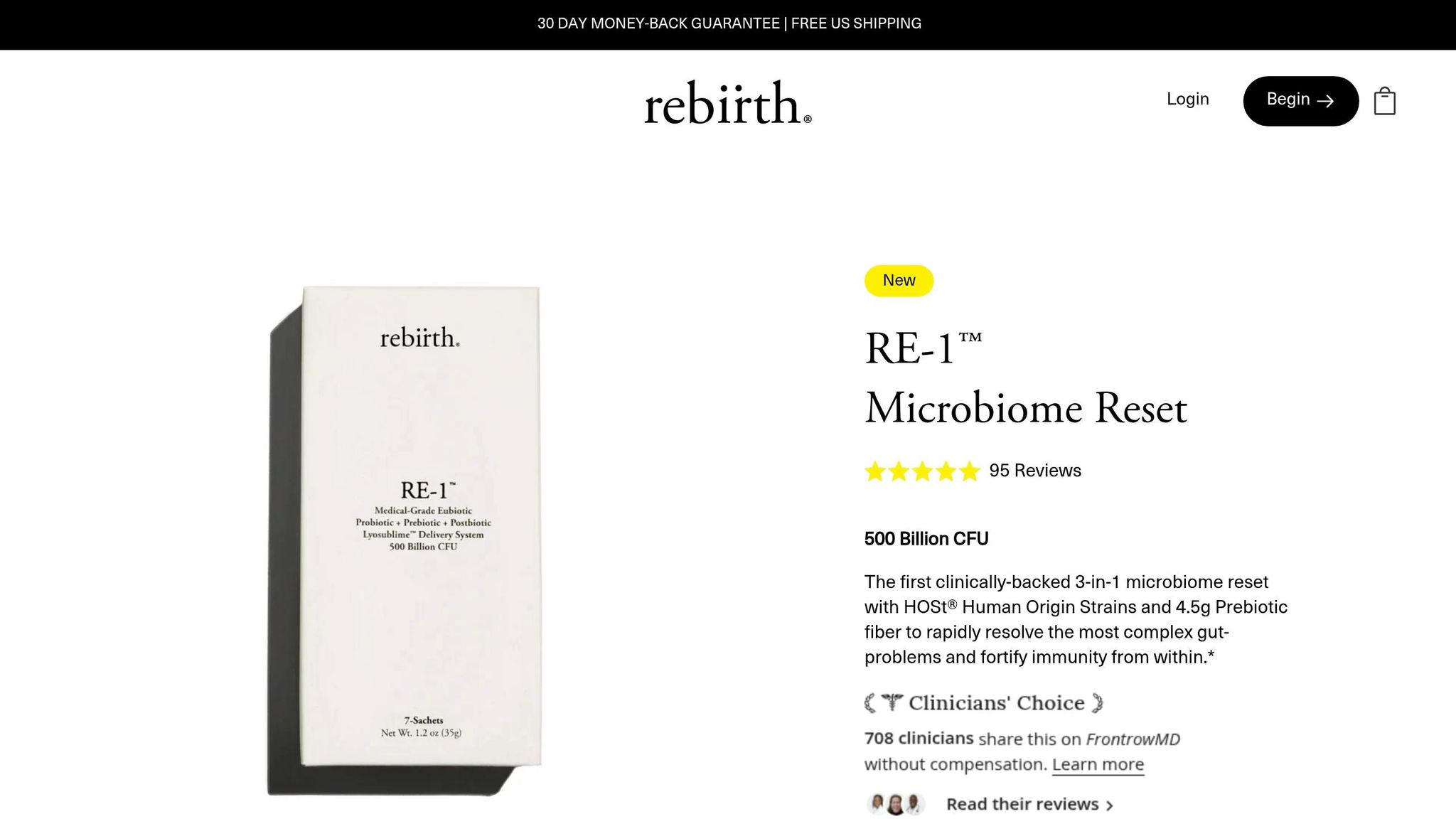
This layered logic is the model behind Rebiirth RE-1. Rebiirth RE-1 is a 3-in-1 eubiotic synbiotic that combines prebiotics, probiotics, and postbiotics in a staged 7-day, 4-week, or 12-week microbiome reset.
A staged reset lines up these inputs with different immune targets:
| Cell Type | Synbiotic Mechanism | Restoration Phase |
|---|---|---|
| Dendritic Cells | Probiotics (HOSt™) target TLR2/NOD2 to induce tolerogenic states [8] | 7 Days: Early signaling shift toward immune tolerance |
| Epithelial Cells | Postbiotics (SCFAs, p40) strengthen tight junctions and mucus layer [2][5] | 4 Weeks: Structural barrier repair and reduced permeability |
| T Cells | Prebiotics and microbial metabolites help shift Th17/Treg balance [1][5] | 12 Weeks: Longer-term immune balance |
| Macrophages | Postbiotics and microbial signals support balanced phagocytosis and inflammatory control [3] | Ongoing: Balanced pathogen defense vs. inflammation control |
The 7-day format focuses on early signaling. The 4-week format leans into barrier repair. The 12-week format is built to reinforce longer-term immune balance.
Conclusion: What probiotic–immune cross-talk means for gut and immune health
After looking at these cell-by-cell effects, the big point comes into focus. Probiotic–immune cross-talk is strain-specific signaling: microbial molecules interact with host receptors and guide different immune outcomes.
Dendritic cells, macrophages, T cells, and epithelial cells each read probiotic signals in their own way. The result can be tolerance, defense, barrier repair, or local immune control. Put together, these responses help explain why restoration has to address both the microbes themselves and the host signaling they influence.
That’s the key takeaway: strain identity shapes which cells are affected and which immune pathways get switched on.
Microbiome restoration matters only when it brings back both microbial balance and immune signaling. Butyrate supports colonocytes and suppresses NF-κB activity [4][2].
FAQs
How do I choose the right probiotic strain?
Choosing the right probiotic strain matters because its health and immune effects are strain-specific. One strain can act very differently from another. That’s because each one interacts with immune cells and gut pathways in its own way.
So the best pick depends on what you want help with, whether that’s immune support, gut balance, or a more targeted health goal.
For a broader approach, Rebiirth RE-1 is a 3-in-1 eubiotic synbiotic with Human Origin Strains made to help restore microbiome balance and support immune health.
Can postbiotics work without live probiotics?
Yes. Postbiotics can work without live probiotics because probiotic-derived factors - such as metabolites, secreted proteins, and cell wall components - can help regulate host responses and support intestinal homeostasis.
These factors interact with immune and epithelial cell receptors to influence signaling, cytokine production, and gut barrier strength, even without live organisms.
How long does immune and gut barrier support last?
Probiotics don’t permanently colonize the gut. In most cases, they stay active while you’re taking them and for a short period after.
That matters because their effects depend on temporary contact with intestinal and immune cells. So immune and gut barrier support usually continues with steady use. While they’re present, they can help maintain homeostasis, tight junctions, and mucus production.