

If synbiotics are not protected, many probiotic cells can be lost before they reach the gut. The core idea is simple: edible films and microcoatings help shield, hold, and release probiotics, prebiotics, and postbiotics in a way that supports survival, storage, and use.
Here’s the short version:
- Edible films are thin, food-grade layers placed around or within a synbiotic system.
- They help protect live strains from stomach acid, bile, and enzymes.
- They also help carry prebiotics like GOS and inulin in the same system.
- Postbiotics do not need to stay alive, but they still need to be held in place until use.
- In sachets, coatings need to do two jobs at once: support shelf stability and then release the actives fast after mixing.
- One example in the article is RE-1, which delivers 500 billion CFU per 5 g sachet, includes 9 strains, and uses lipid microencapsulation on 7 of those 9 strains.
What matters most? Not just the ingredients, but the delivery format. Understanding how to compare probiotic delivery systems is essential for ensuring efficacy. A synbiotic can look strong on the label and still lose a large share of its live cells without a solid coating system.
How Encapsulation Helps Probiotics Survive the Gut
sbb-itb-1bbfe7f
Quick comparison
| Part of the formula | Main job | What the film/coating does |
|---|---|---|
| Probiotics | Live bacteria | Helps shield them during digestion |
| Prebiotics vs Probiotics | Feed gut bacteria | Helps support the matrix and the bacteria |
| Postbiotics | Non-living microbial parts | Holds them in the system until release |
| Sachet format | High-dose single serving | Supports storage, mixing, and fast release |
If I had to sum up the article in one line, I’d say this: edible film coatings are not just a layer around synbiotics - they are part of how the formula works.
How Edible Films Carry Prebiotics, Probiotics, and Postbiotics
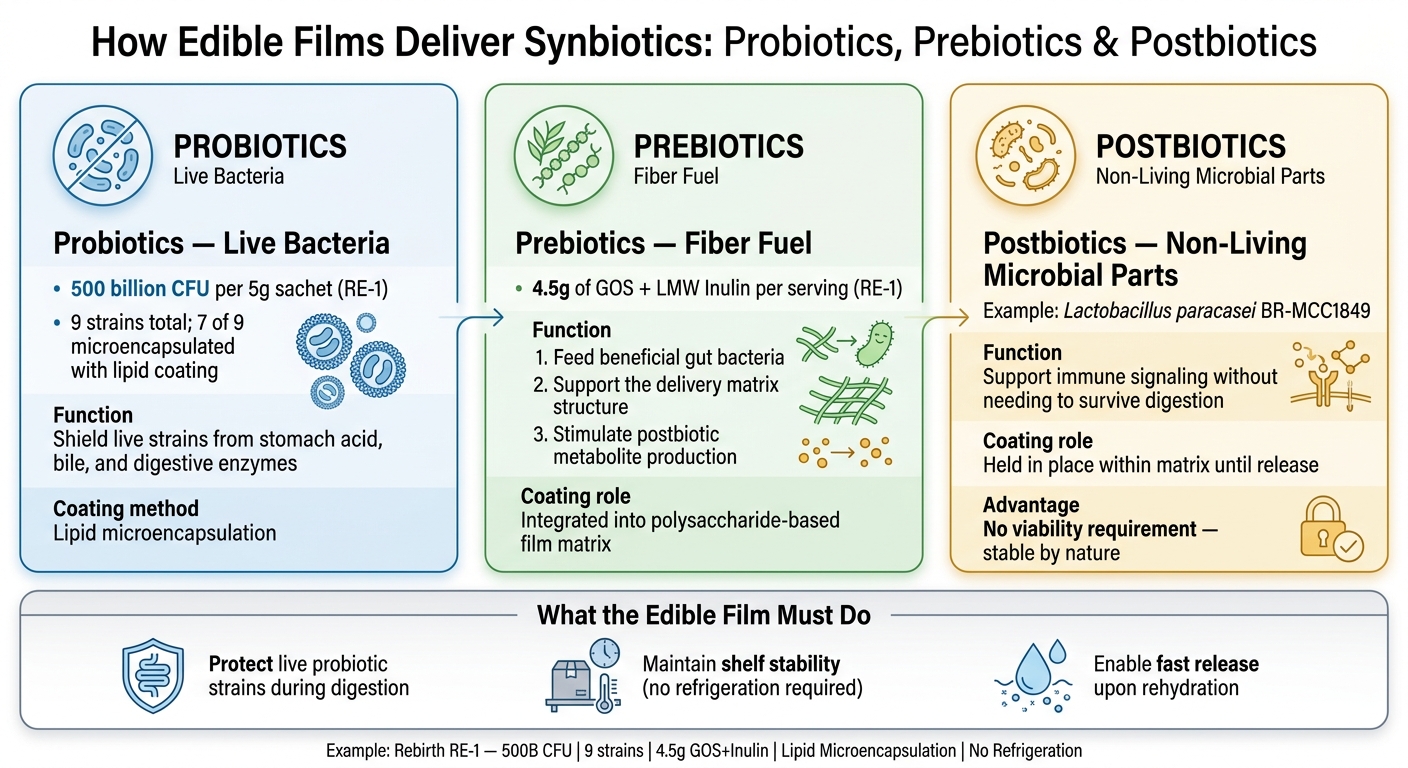
Probiotics vs Prebiotics vs Postbiotics: Edible Film Delivery Roles
Edible films work as the delivery matrix. Their job is to protect synbiotics until release. Inside that system, each active plays a different part: probiotics, prebiotics, and postbiotics each bring something different to the formula.
How Probiotics Are Protected Inside Film Matrices
Probiotic strains need protection if they’re going to make it through digestion. That’s where microencapsulation comes in.
Lipid coatings used in microencapsulation shield probiotic strains within the matrix during digestion [1]. In RE-1, 7 of the 9 strains are microencapsulated with a lipid coating for added protection [1].
In plain English, the film isn’t just holding the probiotics. It also helps guard them while they move through the digestive process.
The same matrix must also keep the prebiotic fraction stable until release.
How Prebiotics Support the Formula and the Film
Prebiotics do double duty in this setup. They help feed beneficial bacteria, and they also support what happens inside the matrix itself.
Prebiotic fibers like galactooligosaccharide (GOS) and low molecular weight (LMW) inulin are integrated into delivery matrices to nourish beneficial bacteria and support postbiotic metabolite production [1]. In the RE-1 formula, 4.5 grams of GOS and inulin per serving support the delivery matrix [1].
So the prebiotic side of the formula isn’t just filler. It helps support the bacteria and the system carrying them.
That leaves the final piece: postbiotics, which do not need to stay alive to remain useful.
Where Postbiotics Fit in Film-Based Delivery Systems
Postbiotics play a different role because they’re non-living. That changes what the matrix needs to do for them.
Postbiotics are microbial-derived components, such as Lactobacillus paracasei BR-MCC1849, included within the delivery matrix [1]. Postbiotics add a non-living component that can support immune signaling [1].
Put together, these three actives share one delivery system. The film has to do a lot at once: protect living strains, hold and carry fibers, and keep non-living microbial components in place until release. Those functions depend on the film material itself, which shapes protection, release, and stability.
Key Edible Film Materials Used in Synbiotic Delivery
Material choice shapes almost everything here: how well synbiotic ingredients stay protected, how they release, and how stable they remain during storage. In sachet-based formats, that trade-off gets tighter because the film has to do two jobs at once. It needs to guard the actives while the product sits on the shelf, then let them go fast once the sachet is mixed.
Polysaccharide-Based Films
Polysaccharide-based matrices can incorporate low molecular weight inulin and galactooligosaccharide (GOS). These fibers also help form the matrix.
Protein-Based Films
Protein-based films add strength and flexibility. That makes them a good fit when the matrix needs to hold actives in place and release them in a more controlled way.
How Material Choice Affects Film Performance
The best material depends on the main goal of the formula. Some systems are built for stronger storage protection, while others focus more on shielding probiotics during digestion. Lipid coatings prioritize probiotic survival through digestion [1]. Well-designed coatings can improve room-temperature stability and reduce refrigeration dependence [1]. At very high CFU levels, material choice directly affects viability and shelf life [1].
This becomes most important in sachet delivery, where the coating has to protect actives during storage and then release them fast on rehydration.
Sachet-Based Synbiotics and Film-Coated Delivery
Why Sachets Work Well for High-Potency Synbiotics
After you pick the coating material, the next big choice is the delivery format. That choice shapes two things: how much you can fit into each dose and how well the formula holds up in storage.
Sachets work well for high-potency synbiotics because they can carry high CFU counts plus prebiotic fiber in one serving. That’s often too much for a single capsule or tablet. They also pair well with protective coatings or microencapsulation, which help keep the probiotic strains alive until the powder is mixed with liquid.
How Protective Matrices Improve Storage and Rehydration
Many high-potency sachet formulas use lipid microencapsulation to help shield probiotic strains during digestion. In sachets, these protective matrices also help the powder stay stable on the shelf and disperse well when mixed.
Once rehydrated, the coating should break apart fast so the actives are ready right away. That’s a big reason sachets make sense for formulas that need both shelf stability and fast release. You get room for a larger dose without slowing down availability after mixing.
Example: Rebirth RE-1 Sachet Delivery Design
RE-1 is a good example of how this setup works in practice. Rebirth RE-1 is a sachet-based 3-in-1 eubiotic synbiotic that delivers 500 billion CFU of Human Origin Strains (HOSt™) per 5 g sachet, with 7 of 9 strains microencapsulated using a lipid coating to support survivability through digestion [1]. The formula combines live probiotics, 4.5 g of GOS and inulin as prebiotics, and postbiotics in a single serving, with no refrigeration needed [1]. Its Lyosublime™ delivery system supports rapid dispersion after mixing [1].
Why Delivery Format Matters for Gut and Immune Support
What the Digestive Tract Does to Unprotected Synbiotics
Film and matrix choices matter because the digestive tract is a tough place for unprotected synbiotics. Stomach acid, bile, and digestive enzymes can cut viability hard before those ingredients ever reach the colon. In plain English: without protection, a lot can be lost on the way. Edible films help form a protective layer, which can mean the difference between loss in transit and usable delivery.
How Protected Delivery Can Improve Gut and Immune Outcomes
Once that protective layer is in place, the next step is looking at what it changes in day-to-day use. Lipid-based microencapsulation helps live strains stay viable through digestive stress, while also supporting faster release after mixing and more efficient movement through the digestive tract [1]. Postbiotics add a non-living component that can support immune signaling without needing to survive digestion [1].
For sachet-based formats like Rebirth RE-1™, that combination supports high-potency delivery with no refrigeration required [1]. That’s why delivery format isn’t just packaging. It’s part of the formula itself.
Key Takeaways
Edible film coatings can improve synbiotic survivability, help control release, and support stable sachet delivery. In protected sachet-based systems, those functions come together in a format made for steady daily use.
FAQs
How do edible film coatings protect probiotics?
Edible film coatings help protect probiotics by forming a physical barrier around the bacteria. That barrier can shield them from stomach acid, digestive enzymes, and bile salts.
Many coatings use pH-responsive materials. They stay intact in the stomach, then dissolve or become porous in the intestines, which helps release probiotics where they can survive and thrive.
What makes sachets a good format for synbiotics?
Sachets work well for synbiotic delivery because they’re convenient, stable, and easy to use. Since there’s no capsule shell to get in the way, they may support faster assimilation throughout the gastrointestinal tract. They can also help preserve potency and shelf life without refrigeration.
They’re also a good fit for precise dosing, especially in high-count formulas like the 500 billion CFU in Rebiirth RE-1. On top of that, sachets can be mixed into liquids while helping protect the synbiotic blend for gut and immune support.
How do prebiotics and postbiotics fit into the coating system?
In synbiotic coating systems, prebiotics and postbiotics are built into the protective matrix to support stability and effectiveness.
Prebiotics like inulin and galactooligosaccharides help shield beneficial microorganisms during processing and transit. Then, once they reach the gut, they can act as an energy source.
Postbiotics are added to that same matrix to help keep them stable and functional.