

If I approve a prebiotic ingredient with only a COA, I’m missing most of the risk. A sound review checks 4 things at once: source records, labor records, lot-level traceability, and raw-material screening.
Here’s the short version:
- I need proof of where the ingredient started, not just what the final lot tested for.
- I need labor records that cover farms, brokers, processors, and the final plant.
- I need traceability that links one raw batch to one finished lot.
- I need screening records for identity, fiber content, microbiological limits, purity, allergens, and label claims.
- If a supplier cannot show the paper trail, the claim should stop there.
A few facts shape the review:
- A COA confirms a batch met spec. It does not prove labor controls or full chain of custody.
- Labels like plant-based, natural, Non-GMO, and vegan are descriptions, not proof by themselves.
- A basic approval flow has 4 steps: supplier qualification, spec review, COA check, and follow-up monitoring.
- The strongest file ties origin, audits, process logs, and test data to the same lot number.
| Area | What I ask for | What it tells me |
|---|---|---|
| Source | Origin records, processor logs, lot records | Where it came from and how it was handled |
| Labor | Social audits, code of conduct, closeout records | Whether worker checks reach upstream suppliers |
| Traceability | Lot-to-lot logs, QA/QC records, third-party tests | Whether one finished lot links back to source |
| Screening | COA, allergen reports, purity and micro results | Whether the material meets safety and label needs |
My rule is simple: no document, no claim. The rest of the piece explains what to request, what each record proves, and where buyers often miss gaps.
Where do prebiotic ingredients come from?
Most prebiotic ingredients come from a handful of source groups: plant-derived materials like chicory root or agave, corn, potato, yeast, and fiber-rich byproducts. They're often made into forms like inulin and other prebiotic fibers or galactooligosaccharides (GOS). And source alone isn't the whole story. Processing form matters too. For example, LMW inulin is a processed variant, so buyers need to check both where the ingredient started and how it was handled.
A lot of teams make the same mistake here: they look at the finished-product COA and call it done. That leaves a chain-of-custody gap.
Buyers should ask for records from three stages across the farm-to-finished-lot path:
- Raw source stage: origin records that show the country of origin and the specific farm or supplier
- Processor stage: processing logs with pH, temperature, and fermentation medium composition for fermentation-derived ingredients
- Finished-ingredient stage: lot-level records that connect one raw batch to one finished lot
That processor-stage paperwork matters more than it may seem. For fermentation-derived ingredients, pH, temperature, and fermentation medium composition can affect allergen and vegan claims. Lot-to-lot testing at each stage gives buyers a stronger way to check processor-stage records. Put simply, the file trail should show a clean path from raw source to finished lot.
Why natural and plant-based labels do not prove ethical sourcing
"Natural" and "plant-based" tell you what the ingredient is. They do not tell you how it was sourced.
That's why buyers should lean on records like GMP, HACCP, and third-party test reports instead of marketing language. The same goes for labels like Non-GMO and vegan. Those can be useful descriptors, but they should be backed by testing records, not taken at face value.
Table: Source information buyers should verify from farm to finished ingredient
| Document | What It Verifies | Who Maintains It |
|---|---|---|
| Farm or raw source origin records | Country of origin, supplier or farm, crop or material type | Raw material supplier |
| Processing logs | pH, temperature, and fermentation medium composition | Processor or manufacturer |
| GMP & HACCP certifications | Manufacturing safety and quality control standards | Manufacturer / third-party auditor |
| Lot-level traceability records | Path from one raw material batch to one finished lot | Supply chain / procurement team |
| Certificate of Analysis (COA) | Purity, potency, and absence of contaminants | Quality control department / third-party lab |
| US/EU protocol compliance records | Alignment with food safety and allergen standards | Regulatory affairs team |
Once origin records are clear, buyers can move upstream and check whether labor controls extend to suppliers.
sbb-itb-1bbfe7f
How do suppliers document labor and human-rights practices?
Labor and human-rights review starts with documents that show who was audited, which labor standards were checked, and whether corrective actions were closed. Those records help buyers see if labor controls go beyond the final facility.
Documents that carry the most weight in a sourcing review
Ask for records that speak directly to labor oversight:
- Supplier code of conduct - A written commitment to labor standards that applies across all supply-chain tiers
- Third-party social audit reports - Independent checks of labor conditions at facilities, not just product quality
- Corrective action closeout records - Proof that labor violations were fixed and closed
- Grievance-policy records - Documents showing worker reporting channels and how complaints are handled
- Subcontractor and agent disclosure - A full list of entities involved in production, including brokers and farms
If quality records such as GMP certifications or traceability logs show up in a supplier file, treat them as supporting context. They can help, but they do not stand on their own as proof of ethical sourcing.
How buyers check whether labor controls reach upstream suppliers
Once origin records are confirmed, buyers should check whether upstream suppliers fall under the same labor oversight. The core issue is simple: does labor review reach farms, brokers, and processors, or stop at the final plant?
Third-party social audit reports and corrective action records give the clearest signal. Traceability logs support that review by linking each supplier in the chain to a specific lot. That makes it easier to confirm which entities were audited and when. After labor oversight is mapped, the next move is to confirm the traceability path lot by lot.
Table: Which labor-practice evidence offers stronger assurance
| Evidence Type | Assurance Level | What It Shows |
|---|---|---|
| Third-party social audit reports | High | Independent verification of labor conditions at supplier facilities |
| Corrective action closeout records | High | Proof that labor violations were identified and resolved |
| Supplier code of conduct | Moderate | Written labor standards applied across supply chain tiers |
| Grievance-policy records | Moderate | Worker reporting channels and complaint resolution processes |
| Subcontractor and agent disclosure | High | Full visibility into which entities are involved in production |
| Traceability logs | Supporting | Links each supply chain entity to a specific lot for audit coverage confirmation |
These records matter most when they tie worker oversight to the same chain-of-custody file used in traceability review.
What traceability means for prebiotics
Traceability shows whether a prebiotic ingredient’s origin and labor records connect to a specific finished lot. That’s the key idea. It’s not enough to review where the ingredient came from or how labor was handled on paper. Buyers also need to see whether those same records stay linked to the ingredient all the way into one finished lot.
One-step-back, upstream, and batch-level traceability explained
These levels show how far back a buyer can verify the chain.
One-step-back traceability means a supplier can identify its immediate source.
Upstream traceability goes farther back to earlier handlers, such as processors, brokers, or farms.
Batch-level traceability is the most exact. It links a finished lot to the raw material batch and the production records used to make it. Suppliers that perform lot-to-lot testing at every production step help support this level [1].
Records that prove a traceable ingredient path
Traceability is a linked set of records, not a single document. In plain terms, one file won’t cut it.
Buyers should expect lot-to-lot testing records, QA/QC checkpoint logs, and third-party testing reports that connect each step in the chain to a specific lot. When those records line up, they show that the ingredient’s origin and labor review tie back to the same finished lot that is under approval.
Table: How buyers verify the path from source material to finished lot
Buyers should check the paper trail in sequence: incoming material, process control, and final lot release.
| Verification Step | Record Reviewed | Risk Addressed |
|---|---|---|
| Raw material intake | Lot-to-lot testing records | Contamination or quality issues |
| Fermentation process monitoring | pH, temperature, and process logs [1] | Reduced ingredient performance or contamination risk |
| Finished lot confirmation | Third-party lot testing reports | Discrepancies in potency, purity, or label claims |
| Regulatory alignment | EFSA compliance documentation | Regulatory non-compliance |
Once the lot path is clear, buyers can move to raw-material screening before approval.
How prebiotic raw materials are screened before use
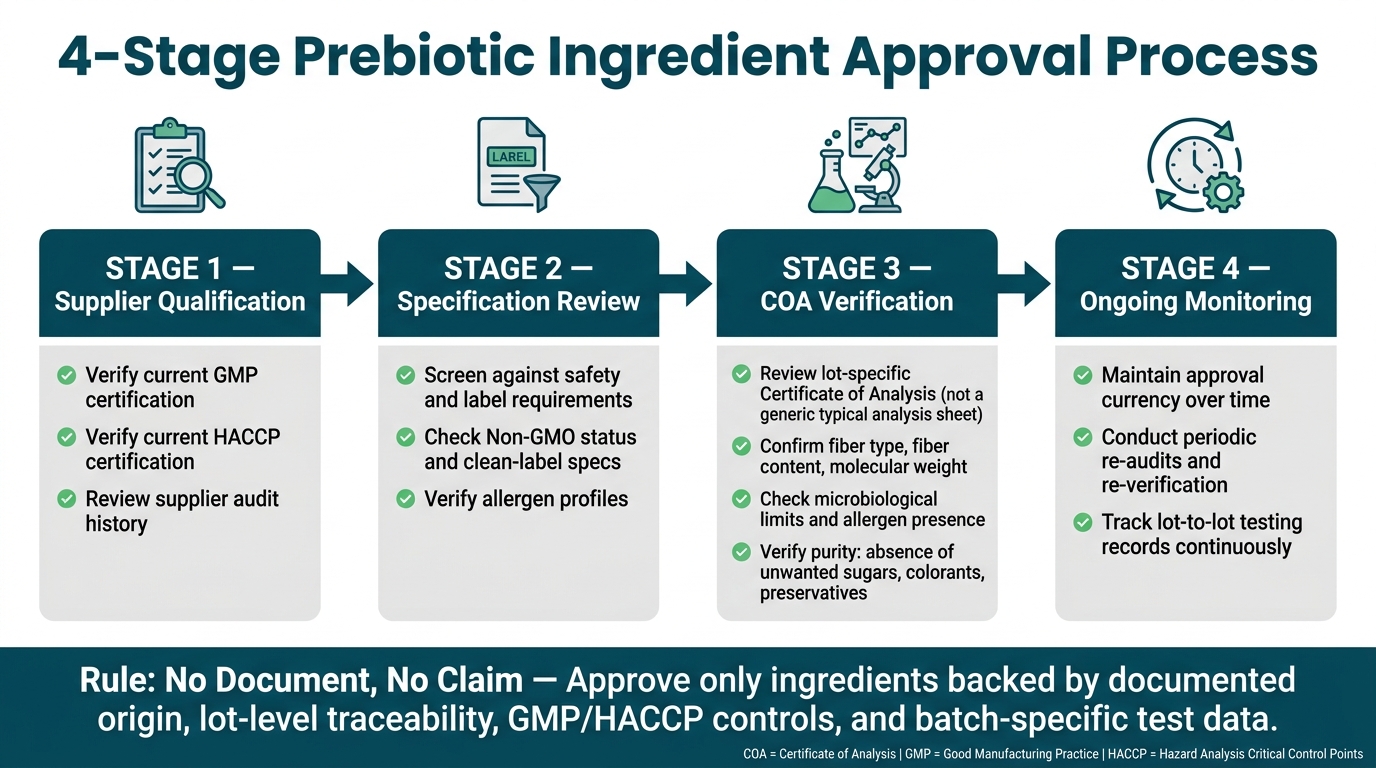
4-Stage Prebiotic Ingredient Approval Process for Ethical Sourcing
Once source and traceability are documented, raw-material approval should move to quality screening.
Before a prebiotic raw material is approved for use, it should pass a four-stage quality review.
The 4-stage approval process buyers should follow
The process moves in a clear sequence: supplier qualification, specification review, COA verification, and ongoing monitoring. [1]
Supplier qualification comes first. Buyers should check current GMP and HACCP certifications and review the supplier’s audit history. [1]
Specification review comes next. Ingredients should be screened against safety and label needs, including Non-GMO status, clean-label specs, and allergen profiles. [1]
COA verification focuses on the lot being reviewed. That means checking lot-specific data, not relying on a generic typical analysis sheet. [1]
Ongoing monitoring keeps approval current over time. [1]
What a COA can confirm and what it cannot confirm on its own
A COA is a lot-specific document. For GOS or inulin, it can confirm fiber type, fiber content, molecular weight, microbiological limits, and allergen presence. [1]
It can also support purity checks, such as the absence of unwanted sugars, colorants, and preservatives. [1]
But a COA has limits. It cannot replace GMP and HACCP records or 100% traceability logs that track the ingredient from source material to the finished lot. [1]
Table: Buyer screening checklist for ethical and quality approval
| Question | Evidence Requested | Risk Addressed | Approval Status |
|---|---|---|---|
| Is the ingredient what it claims to be? | COA confirming specific fiber type and molecular weight [1] | Mislabeling or substitution | Required before approval |
| Does fiber content meet label claims? | Lot-specific fiber content per gram; independent third-party lab results [1] | Sub-potent ingredient reaching consumers | Required before approval |
| Are microbiological limits within range? | COA microbiological results; third-party verification [1] | Contaminated raw material entering production | Required before approval |
| Are purity checks complete? | Results for unwanted sugars, artificial colorants, preservatives, and Non-GMO status [1] | Chemical safety and clean-label compliance | Required before approval |
| Are allergen controls verified? | EFSA-defined allergen screening reports [1] | Cross-contamination and consumer safety risk | Required before approval |
| Is traceability documented beyond the COA? | 100% traceability logs from source material to finished lot [1] | Gaps in ingredient path | Final sign-off required |
Conclusion: What buyers should confirm before approving a prebiotic ingredient
Approving a prebiotic ingredient is a sourcing decision, not just a quality check.
By the time a buyer gets to approval, the job goes past a basic pass/fail review. You’re looking at origin, labor practices, traceability, and raw-material screening together. And the rule is pretty simple: approve only ingredients backed by documented origin, lot-level traceability, GMP/HACCP controls, and batch-specific test data.
That paper trail is the approval threshold. If a supplier can’t produce GMP and HACCP certifications, lot-to-lot testing data, and source-to-lot traceability logs, don’t accept the claim.
What brands should disclose about sourcing decisions
Brand disclosures should clearly state which records were reviewed and which controls were used before release.
The disclosure needs to match the evidence file. If the supplier can’t show the underlying QA/QC records under US and EU protocols [1], the ingredient should not move forward.
No document, no claim.
FAQs
Why isn’t a COA enough?
A Certificate of Analysis (COA) usually shows a product’s specs at the time it was made. It does not usually prove potency all the way through the end of shelf life. That difference matters.
Why? Because natural die-off can happen between production and the moment you actually use the product. So if you rely on a COA alone, you may get an incomplete picture.
It’s smarter to look for brands that also run lot-to-lot testing and maintain strong quality control. One example is Rebiirth RE-1™, which uses 50+ protocols to track purity and strength.
How can I verify lot-level traceability?
Choose brands that test each lot at every stage of production, all the way through the final product. The best manufacturers back this up with clear QA/QC checkpoints and established protocols like GMP and HACCP.
It also helps to look for brands that share third-party testing certifications. For Rebiirth RE-1, we maintain 100% traceability through these testing protocols across manufacturing.
What documents prove ethical sourcing?
Documents cited here include third-party testing, 100% traceability records, and quality/compliance documentation that shows GMP + HACCP monitoring, along with lot-to-lot testing for purity and strength.
For buyer transparency, the claims are backed by verified third-party testing and clear label details. That includes a guaranteed CFU count through expiration and specific strain identification.