

My takeaway: gut microbes may affect mood, but stool tests cannot diagnose depression or anxiety. Keep psychotherapy and prescribed medication in place; discuss supplements with your clinician.
A review of 23 trials with 1,401 diagnosed participants found lower average depression and anxiety scores with probiotics - but results varied. Lower scores do not necessarily mean recovery.[46]
Here’s how I’d sum up the seven findings:
- Microbial patterns differ: Depression and anxiety studies report changes in gut bacteria, but no single pattern identifies either condition.
- Microbial products may affect stress: Short-chain fatty acids may influence cortisol responses; that does not establish a mood treatment.
- The gut barrier may play a role: Barrier changes could connect gut signals with inflammation, but human results are mixed.
- Tryptophan pathways may shift: Microbes and inflammation may affect how the body uses this serotonin precursor. Gut-made serotonin does not enter the brain.
- Animal studies suggest nerve links: Vagal and neurotransmitter findings help explain possible routes - not treatment effects in people.
- Shared signals cannot separate diagnoses: Similar microbial changes appear across psychiatric conditions.
- Treatment results vary: Probiotics, prebiotics, synbiotics, and dietary changes do not produce the same results across studies.
<u>I’d judge any intervention by symptoms, daily function, and safety - not a stool report or CFU count.</u> That includes RE-1: the supplied material contains no independently verified human mood trial of the finished product. Food, sleep, and exercise can support care, but microbiome products should not replace it.
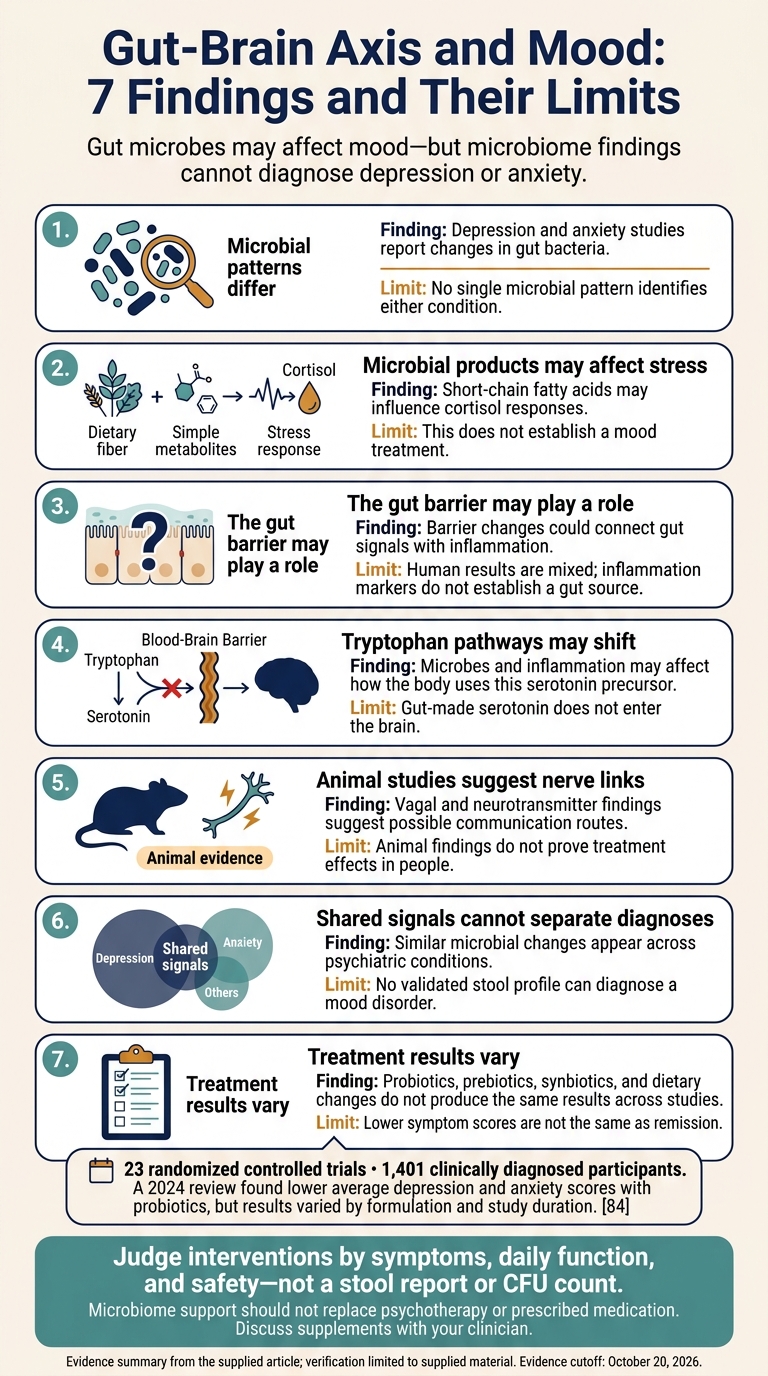
Gut-Brain Axis and Mood: 7 Findings and Their Limits
2-Minute Neuroscience: Gut-Brain Axis
sbb-itb-1bbfe7f
How to Read Gut-Brain Studies
For each finding, check the study type, population, sample size, outcome, pathway, and date. Keep anxiety and depression separate from everyday stress unless the study enrolled people with that diagnosis.[4][9]
Observational studies show links. Prospective studies also help establish which came first. Randomized controlled trials compare an intervention with a control, but small samples, short follow-up, and weak blinding can limit what the results tell us. Systematic reviews and meta-analyses combine studies without erasing their underlying biases. Animal experiments test mechanisms, such as vagal signaling, but animal behavior is not the same as a human diagnosis.[6][7][9]
Watch for reverse causation and confounding. Symptoms can change eating habits, sleep, and medication use - and those changes can affect gut microbes. Check whether researchers measured and adjusted for diet, sleep, antidepressants, antibiotics, geography, and gastrointestinal or other health conditions.[4][7]
Keep measured results separate from proposed explanations. A statistically significant change in a score may not translate into clinical benefit.[4][7]
Evidence cutoff: October 20, 2026. Verification here is limited to the supplied material. Sources that are inaccessible or incomplete are not treated as confirmed evidence.[7][4] Apply these checks to the seven findings below.
1. Depression and Anxiety Are Linked to Different Gut Microbe Patterns
With those study limits in mind, the first finding is that gut microbe patterns differ by disorder.
Depression studies point to shifts in certain bacteria - not one “depression microbiome.” A 2023 systematic review and meta-analysis found lower levels of butyrate-associated genera, including Faecalibacterium and Coprococcus, and higher levels of organisms such as Eggerthella. These links do not show that the bacteria cause depression.[4]
Findings for anxiety are less consistent. Smaller studies sometimes report more Enterobacteriaceae and less Faecalibacterium or Butyricicoccus. Many of these studies measure anxiety symptoms in people with IBS rather than people with diagnosed anxiety disorders.[12][8]
Alpha diversity measures variety within a sample; beta diversity compares microbial communities between people. Neither shows a dependable pattern. A 2025 review found no significant alpha-diversity difference in 16 of 21 depression studies. Beta-diversity differences appeared in about half of the depression and anxiety studies reviewed.[2]
Commercial microbiome tests cannot diagnose depression or anxiety. Neither condition has a validated microbial profile or diagnostic cutoff. Treat stool results as research signals - not a reason to change medication.[4][11] The next findings look at possible mechanisms, not diagnosis. This includes how synbiotics and probiotics impact the gut-brain axis differently.
2. Short-Chain Fatty Acids May Affect Stress Responses
Which microbes live in the gut is only part of the picture. The substances they produce may matter more. Short-chain fatty acids (SCFAs) form when gut microbes ferment fiber and may affect how the body responds to stress. Anxiety studies report fewer SCFA-associated bacteria, including Lachnospira and Eubacterium rectale. Some depression studies also report lower SCFA levels, though results vary.[14][15]
Butyrate fuels colon cells and may support tight junctions that help seal the gut barrier. Acetate and propionate affect immune and metabolic signaling.[13][14]
SCFAs may also affect the hypothalamic-pituitary-adrenal (HPA) axis, which controls stress hormones such as cortisol. In a randomized, placebo-controlled study of healthy men, SCFAs delivered to the colon reduced the cortisol response during an acute stress test. This finding does not establish that SCFAs can treat depression or anxiety.[17]
Fewer SCFA-associated bacteria doesn't necessarily mean less SCFA production. Diet, differences between strains, gut transit time, and interactions among microbes all affect output. Stool and blood levels also reflect how much the body absorbs and uses in its tissues.[14][15]
No validated SCFA thresholds diagnose depression, anxiety, or stress. Stool and blood SCFA results are research signals - not treatment targets - and should not guide mental health treatment. Fiber-rich foods can support microbial fermentation, but increasing SCFAs is not an established mood treatment.[15][16]
Part of SCFAs' role may come from helping protect the gut barrier.
3. Gut Barrier Changes May Link Inflammation and Mood
A weaker gut barrier may let bacterial products enter the bloodstream, building on the barrier effects described above. One of these products, lipopolysaccharide (LPS), can activate immune cells. This can trigger inflammatory signals that affect brain signaling, stress, sleep, and motivation.[18][3][21]
That immune response involves markers such as IL-6 and TNF-alpha. A 2025 review found higher levels of both in major depressive disorder, with standardized effect sizes of about 0.62 and 0.64, respectively. These differences do not establish a gut source or provide diagnostic cutoffs.[15]
C-reactive protein (CRP) is another marker, but it reflects inflammation indirectly. The liver makes CRP in response to signals such as IL-6. CRP does not measure gut permeability or show that inflammation comes from the gut. Infection, obesity, smoking, autoimmune disease, and injury can also increase it.[18][19][20]
Human studies have linked some gut-barrier markers with depressive symptoms, but the findings are inconsistent. Stress can also affect how the barrier is regulated, so the relationship may work in both directions.[20][21][22]
If mood changes occur alongside persistent digestive symptoms, discuss both with a clinician. Do not use CRP or cytokine tests to self-diagnose. Results need to be interpreted alongside sleep, medications, infection, and other conditions.
4. Gut Microbes May Alter Tryptophan and Kynurenine Pathways
Inflammation can change how the body uses tryptophan, which helps make serotonin, kynurenine, and microbial indoles. Most absorbed tryptophan enters kynurenine pathways. Indoles may affect the gut barrier and immune signaling.[23][24]
Inflammatory signals can activate indoleamine 2,3-dioxygenase (IDO), an enzyme that steers more tryptophan toward kynurenine. Kynurenine can cross the blood-brain barrier and form metabolites with different effects. Quinolinic acid can increase glutamate signaling and inflammation, while kynurenic acid may offer protection in some contexts. These changes may affect immune signaling and brain-related metabolites linked to mood.[24][25][26]
Gut serotonin cannot cross the blood-brain barrier. The brain makes its own serotonin from tryptophan. Gut dysbiosis may influence that process indirectly by changing precursor availability, immune signals, and microbial metabolites - not by sending gut-made serotonin to the brain.[24][27]
Some depression studies report higher Bacteroidetes, including Parabacteroides and Alistipes, but results are inconsistent. Neither genus is universally harmful or beneficial, and abundance alone does not show pathway activity or explain mood effects.[26][28][29]
Look for measured metabolites, not just bacterial names. Stool and blood tests cannot diagnose depression or show brain serotonin.[8][29]
Animal studies next test whether these pathway changes affect behavior through nerves and neurotransmitters.
5. Animal Studies Show Vagal and Neurotransmitter Links
Building on the SCFA and tryptophan findings above, animal studies test how gut signals may reach the brain. The vagus nerve may carry microbial signals to the brain. In rodents, blocking vagal signaling reduced the effects of some probiotic strains. That points to a communication route - not proof that these strains help humans.[32][37][38]
Animal research also links microbial changes to GABA and glutamate. Intestinal neuropod cells can release glutamate and send signals through the vagus nerve. This helps explain how neurotransmitter changes in the gut could matter without gut-made glutamate entering the brain.[33][35]
Germ-free animals show changes in serotonin-related measures and dopamine turnover in certain brain regions. Results vary, though, by species, brain region, and experimental conditions.[32][33][35] Microbes may affect brain signaling through nerves, immune activity, and the supply of neurotransmitter precursors - not by transferring neurotransmitters directly.[31][34][36]
Researchers also measure brain-derived neurotrophic factor (BDNF), a protein linked to neuronal plasticity - the ability of neurons to change. Some microbiome interventions alter hippocampal BDNF in rodents, but that does not prove they improve mood in humans.[37][39]
When a product cites this research, check whether human studies tested the same strain, dose, formulation, and duration.[30][31][34] These signals still cannot identify who has a mood disorder, which the next finding addresses.
6. Shared Microbial Signals Cannot Diagnose Mood Disorders
Shared microbial changes cannot tell mood disorders apart. A 2021 meta-analysis of 59 case-control studies found lower Faecalibacterium and Coprococcus and higher Eggerthella across psychiatric diagnoses. Studies of depression, anxiety, and stress also report overlapping metabolic signals.[40][15]
In other words, different disorders can show similar microbial patterns and gut dysbiosis.
| Symptom domain | Reported pattern |
|---|---|
| Depression | Lower butyrate-associated bacteria and higher taxa linked with inflammation.[40] |
| Anxiety | No consistent anxiety-specific profile.[10] |
“SCFA-associated” describes possible metabolic capacity - not measured activity. Bacterial abundance does not tell us butyrate output, barrier function, or inflammation levels. And a link with inflammation does not mean every member of a bacterial group causes harm.[40][2]
The testing method matters, too. 16S rRNA sequencing and shotgun metagenomics can produce different results, making samples look more or less different from one another. This limits claims about disorder-specific profiles.[40][2]
No validated stool profile can diagnose a mood disorder. Microbiome results belong in a research context, not in place of a mental-health evaluation.[5][40] Shared signals also cannot establish who will respond to treatment - a limit to keep in mind when interpreting microbiome-based interventions. This includes understanding the role of psychobiotics and the gut-brain axis in mental health.
7. Microbiome Interventions Show Mixed Effects on Symptoms
Promising psychobiotic pathways don’t always lead to symptom relief. Clinical trials put the pathways described above to the test. A 2024 review of 23 randomized controlled trials, involving 1,401 clinically diagnosed participants, found that probiotics lowered average depression and anxiety scores. But results differed by formulation and study duration.[46] Another review found improvement on the Beck Depression Inventory, but not on most other scales.[44]
| Intervention type | Studied population | Symptom findings | Evidence limitations |
|---|---|---|---|
| Probiotics | Adults with depression, anxiety, or mixed symptoms. | Meta-analyses usually find lower symptom scores.[42][46] | Strains, doses, and scales differ; remission data are limited. |
| Prebiotics | Small depression trials. | Three trials in the review of clinically diagnosed participants found no statistically significant depression benefit.[46] | Few trials; fiber type, dose, and baseline diet differ. |
| Synbiotics | Adults with mixed mood symptoms. | Reviews that combine intervention categories report some improvements.[42] | Mixed formulations make it hard to tell which component helps. |
| Dietary changes | Adults with mood or stress symptoms. | Some studies report mood improvements. | Diet, behavior, and adherence may explain the benefit. |
Lower symptom scores aren’t the same as remission. Many trials don’t report how many participants stopped meeting diagnostic criteria or stayed well after treatment ended. Even statistically significant differences may not produce a noticeable benefit for every patient.[43][46]
Most trials lasted 2–24 weeks, leaving limited data on long-term benefits and relapse.[45] Baseline diet and medication use also affect results.
Before applying a finding, check the exact strain, dose, formulation, and trial length - and whether medications stayed stable. CFU count alone doesn’t predict mood benefit. Discuss supplements or diet changes with your clinician, and track progress with one validated symptom scale.
The next section compares how these effects differ across depression, anxiety, and stress.
How Research Differs Across Depression, Anxiety, and Stress
Diagnosis and timing matter. Depression, anxiety, perceived stress, and short-term mood studies measure different outcomes. Their microbiome findings should not be treated as findings about the same condition.[2][4] The proposed mechanisms also overlap across diagnoses, making study design important.
| Condition or symptom domain | Recurring microbial or metabolic signal | Proposed pathway | Strength of human evidence | Key limitation |
|---|---|---|---|---|
| Diagnosed depression | Fewer SCFA-associated bacteria in some studies.[2] | SCFA, barrier, inflammation, and tryptophan pathways | Moderate, inconsistent | Medication, diet, sleep, and illness severity can influence findings. |
| Diagnosed anxiety disorders | Overlapping SCFA-related signals, with varying bacterial findings.[2][41] | Microbial metabolites, immune signaling, vagal signaling, and stress hormones | Limited to moderate; heterogeneous | Studies often combine diagnosed participants with people who have symptoms but no confirmed diagnosis. |
| Perceived stress | Subjective stress and cortisol often do not match.[41] | Gut-stress and immune signaling | Limited | Sleep, work pressures, diet, and illness can affect both measures. |
| Short-term mood changes | No validated microbial pattern.[41] | Rapid metabolite, vagal, and hormonal signaling | Exploratory | Changes over hours or days cannot establish a chronic disorder or its cause. |
A meta-analysis of 1,146 healthy participants found that probiotics reduced self-reported stress but had no effect on cortisol. That finding applies to perceived stress in healthy people - not diagnosed anxiety.[41]
Shared signals do not clearly distinguish these conditions. Microbiome patterns remain group-level findings, not markers for specific disorders. A 2023 meta-analysis found no statistically significant overall difference in alpha diversity - the variety of microbes within a sample - in depressive disorder.[4] Location also affects how well findings apply elsewhere: one review found that 20 of 24 studies came from China, limiting their relevance to the United States.[2]
When reading a study, check whether participants had a confirmed diagnosis, high questionnaire scores, or temporary symptoms. Also check whether researchers measured metabolites or inflammation directly, rather than inferring them from stool bacteria. The next section looks at what these research differences mean for microbiome-based care.
What the Research Means for Microbiome-Based Care
The seven findings point to possible research targets, not treatment rules. Care should focus on symptoms, daily function, and diet quality. Microbiome support can complement mental-health care, not replace it. A 2024 meta-analysis of 12 trials with 707 participants found a mean difference of -2.69 points on the Beck Depression Inventory, but not on Hamilton Depression Rating Scale, Montgomery–Åsberg Depression Rating Scale, or DASS outcomes.[44]
Start with food changes: add vegetables, fruit, beans, whole grains, nuts, and seeds. Drink enough fluids, cut back on excess alcohol and ultra-processed foods, and include fermented foods if you tolerate them. Avoid restrictive “microbiome diets,” especially if you have food intolerances or a history of an eating disorder.
Here’s how these pathways relate to everyday care - and where the evidence falls short. They are research targets, not proven treatments.
| Proposed pathway | Practical action | Evidence limitation |
|---|---|---|
| Short-chain fatty-acid production | Gradually add fiber-rich foods; consider a studied prebiotic with clinician guidance. | Changes in stool SCFAs do not prove mood benefits; responses vary with diet and baseline microbiome. |
| Gut-barrier and inflammatory signaling | Improve overall diet quality; discuss specific interventions when indicated. | Inflammation markers are nonspecific and may not reflect brain mechanisms. |
| Tryptophan and kynurenine metabolism | Eat a balanced diet; avoid supplements meant to alter this pathway without medical advice. | Metabolite associations do not establish cause and effect or treatment targets. |
| Microbial diversity | Eat a variety of plant foods; discuss a strain-specific probiotic or synbiotic when appropriate. | There is no universally accepted “healthy” microbiome profile or psychiatric cutoff. |
| Stress-response signaling | Prioritize sleep, exercise, psychotherapy, diet, and standard stress-management care. | Cortisol depends on timing, collection method, sleep, medications, and acute stress. |
Track symptoms and daily function, not just lab changes. Change one thing at a time. With a clinician, record baseline PHQ-9 or GAD-7 scores, sleep, daily functioning, and digestive symptoms. Also record the exact product, strain, dose, duration, and treatment goal. Agree on a follow-up after several weeks.
Do not use stool profiles, metabolites, inflammation markers, or cortisol to make psychiatric decisions or choose probiotics. Do not change psychiatric medication or delay care because of a stool report.
Microbiome products are not low-risk by default. Increasing fiber too fast or using microbiome products can cause gas, bloating, constipation, or diarrhea. Make changes gradually and seek advice if symptoms are severe or persist. People who are severely ill, immunocompromised, hospitalized, have central venous access, or have major intestinal disease need clinician guidance before using live-microorganism products. Rare serious infections have occurred.[47][48][49] Pregnancy, childhood, and taking multiple medications also call for review.
Worsening mood, suicidal thoughts, mania, or psychosis need prompt professional assessment - not more microbiome experimentation.
The same caution applies when a branded product makes microbiome claims.
Rebirth RE-1: Claims and Research Limits
Given the evidence limits above, Rebirth RE-1 should be viewed as a product claim, not a proven way to treat mood symptoms. The manufacturer markets it as a synbiotic blend of prebiotics, probiotics, and postbiotics, with 4.5 grams of GOS and inulin prebiotic fiber and 500 billion CFU per serving. Those amounts don't establish mood benefits.
The supplied material contains no independently verified human mood trial of the finished product. To support a mood claim, the product needs a human trial using validated symptom scales and reporting safety data. Changes in stool measurements or digestive symptoms alone don't show that it helps mood.
The 7-day, 4-week, and 12-week schedules are usage options - not proven reset timelines. Likewise, the CFU count describes the amount of viable microorganisms supplied at a stated point. It doesn't measure mental-health effects.
If you're considering RE-1 for a mood-related goal, ask for published human trials of the finished product, not just its ingredients, and review them with your clinician. Plausible ingredients aren't a substitute for human data on the blend itself. RE-1 is not an established treatment for mood disorders.
Conclusion: Gut-Brain Links Do Not Prove Treatment Effects
The seven findings point to microbiome signals, not clinical answers. Results from interventions are mixed, and effects vary by formulation, dose, duration, and patient group.[52][53][51]
If symptoms persist or worsen, seek a professional assessment. Don’t self-diagnose based on stool results or gut symptoms, replace psychotherapy, or stop prescribed medication without medical guidance.[50]
If you have suicidal thoughts or cannot stay safe, seek immediate help.
Gut-brain links are real, but they don’t provide a diagnosis or prove that a treatment works.
FAQs
How can I tell if gut symptoms are affecting my mood?
Pay attention to whether digestive issues, such as bloating or irregular bowel movements, happen alongside mood swings, low motivation, anxiety, sensitivity to stress, or poor sleep. These patterns may point to the gut-brain connection, but they don’t prove that gut symptoms cause mood changes.
Track your digestion and mood as your diet, sleep, and stress levels change. This can help you spot patterns.
What counts as meaningful mood improvement?
Meaningful mood improvement means measurable reductions in depression and anxiety symptoms. Clinical trials often track response rates - how many people’s symptoms improve - and remission rates - how many people have few or no symptoms. This is especially common in mild-to-moderate cases.
Changes may go beyond how people report feeling. They may also show better cognitive function, memory, and ability to cope with stress, often alongside lower levels of inflammation markers such as CRP, TNF-α, and IL-6.
What should I ask my doctor before trying a synbiotic?
Talk with your doctor about whether a synbiotic fits your health needs and current mental health treatment [1]. Tell them if you have a weakened immune system, a heart condition, or a central venous catheter. Live microbes carry a small risk of systemic infection [2].
If you take prescription medications, ask about possible interactions. The gut microbiome can affect how your body processes psychiatric medications [2].