

My takeaway: Mediterranean-style eating may help with depressive symptoms, but studies haven’t proved that gut microbes explain the change. Start with simple swaps - beans, whole grains, vegetables, and olive oil - and increase fiber slowly.
Here’s how I read the research:
- Gut microbes and inflammation: A review identified 23 microbiome trials, including 19 randomized trials. Some found changes in microbes and inflammation markers, but overall microbial diversity did not consistently increase.
- Depression: Results vary. SMILES found symptom improvement over 12 weeks, while PREDIDEP found no clear reduction in depression returning over 2 years.
- Cognition and cause: Memory findings are less clear. A 2026 analysis suggests microbes might help explain mood changes, but it does not prove that pathway.
I’d focus on steady food habits, not a microbiome “reset.” <u>Diet should support - not replace - medical care.</u> If you have bowel disease or persistent digestive symptoms, plan changes with your clinician. These studies also did not test Rebirth RE-1, so they cannot support claims that the product resets your gut or treats mental-health symptoms.
Studies on Gut Microbes and Inflammation
NU-AGE: Gut Microbiome Changes in Older Adults
The NU-AGE microbiome substudy followed 612 adults ages 65–79 across five European countries.[9] Participants ate a Mediterranean-style diet tailored to older adults for 12 months. Researchers profiled their microbiota before and after the intervention.[9]
Closer adherence to the diet tracked with microbial profiles linked to lower hsCRP, lower IL-17, less frailty, and better gait.[9][12][13] These findings point to a possible connection, but they don't prove that specific bacteria caused the changes. The analyses examined associations within the intervention cohort.
Diet-associated organisms included Faecalibacterium prausnitzii, Roseburia, and Anaerostipes. The summaries do not report direct short-chain fatty acid (SCFA) measurements.[9][10]
Other Trials and Reviews of Gut Microbiome Changes
The table separates what the studies reported from what they could not establish.
| Study | Main result | Key limitation |
|---|---|---|
| NU-AGE microbiome substudy[9][12][13] | Diet-adherence-linked profiles tracked with inflammation, frailty, and gait measures, but do not prove causation. | The summaries do not report IL-6, TNF-α, or barrier outcomes. |
| 2023 systematic review[8] | Evidence for changes in overall diversity was limited. Findings on microbial composition and SCFAs were more suggestive. | Populations and study durations varied, and no uniform inflammatory biomarker pattern was reported. |
Across studies, Bifidobacterium, Roseburia, and Faecalibacterium respond differently depending on baseline diet, age, medications, disease, geography, and adherence. Neither alpha nor beta diversity alone establishes a clinical benefit. Look for health outcomes measured alongside microbial changes, rather than judging a diet by whether one genus increased.[8]
Inflammation Markers and Quiescent Ulcerative Colitis
Blood inflammation and gut inflammation are different endpoints. CRP, cytokines such as IL-6 and TNF-α, fecal inflammatory markers, and direct permeability tests answer different questions. They aren't interchangeable.
The quiescent ulcerative colitis trial is harder to compare with other studies because disease activity and medications affect both microbiome and inflammation measures.[11] The disease-specific evidence is encouraging, but it remains small and mixed.[11]
People with ulcerative colitis should plan dietary changes with their clinician, not treat these findings as a reason to replace treatment.[11] Without paired metabolite and clinical data, the mechanism remains unproven. The next question is whether these microbiome and inflammation shifts line up with mood and cognition. Understanding how short-chain fatty acids impact brain health may provide the missing link in this pathway.
sbb-itb-1bbfe7f
Studies on Depression and Cognition
SMILES and Other Depression Trials
Better depression scores do not prove that the microbiome caused the improvement. SMILES found greater symptom improvement with dietary support, but it did not test whether microbiome changes explained that result.[14]
| Study | Population and sample size | Dietary support | Control | Outcome instrument | Microbiome assessment | Main result |
|---|---|---|---|---|---|---|
| SMILES | Adults with major depressive disorder; 67 randomized; 12 weeks | Dietitian-supported Mediterranean-style diet | Social-support sessions | Montgomery–Åsberg Depression Rating Scale (MADRS); remission | Not assessed in the primary trial report | Greater symptom improvement; Cohen’s d = −1.16 (95% CI, −1.73 to −0.59).[14] |
| PREDIDEP | Adults recovered from depression; 196 analyzed, 103 intervention and 93 control | Mediterranean diet enriched with extra-virgin olive oil | No equivalent Mediterranean-diet prescription | Depression recurrence; secondary symptom scores | Secondary microbiota analysis planned/included; mechanism not established | Recurrence hazard ratio: 0.91 (95% CI, 0.39–2.13).[15][16][19] |
PREDIDEP tested whether diet could prevent depression from returning - not just improve symptoms. After 2 years, the Mediterranean-diet group showed no statistically significant reduction in recurrence risk. Lower symptom scores were secondary findings.[15][16] The trial’s design matters more than headline symptom scores alone.
Reviews of Depression, Anxiety, and Stress Outcomes
Observational links do not prove cause and effect. Results from randomized trials also differ by diagnosis, level of support, control condition, and follow-up period.[6][14][15] Depression findings should not be applied to anxiety, stress, or quality of life unless the studies measured those outcomes.
For gut-brain pathways, the key question is whether dietary changes go hand in hand with microbiota changes and endocrine pathways - not simply whether symptom scores improve.
NU-AGE and PREDIMED: Cognitive Outcomes
Cognition is a separate outcome, with weaker evidence than the depression findings. NU-AGE found no clear cognitive benefit at 1 year. Higher diet adherence was linked to better global cognition and episodic memory, but adherence was not randomized.[21][22] An analysis of 612 participants linked diet-responsive taxa with selected memory and constructional-praxis scores. It did not establish that microbes explained those links.[18]
PREDIMED’s secondary cognitive analyses suggest possible benefits for memory, executive function, and global cognition.[20][23] Those same analyses did not establish microbiota measurements, so the findings do not demonstrate a gut-brain mechanism.[20][23]
How The mediterranean Diet Improves Your Mood - What The Science Shows
Evidence Quality and Research Gaps
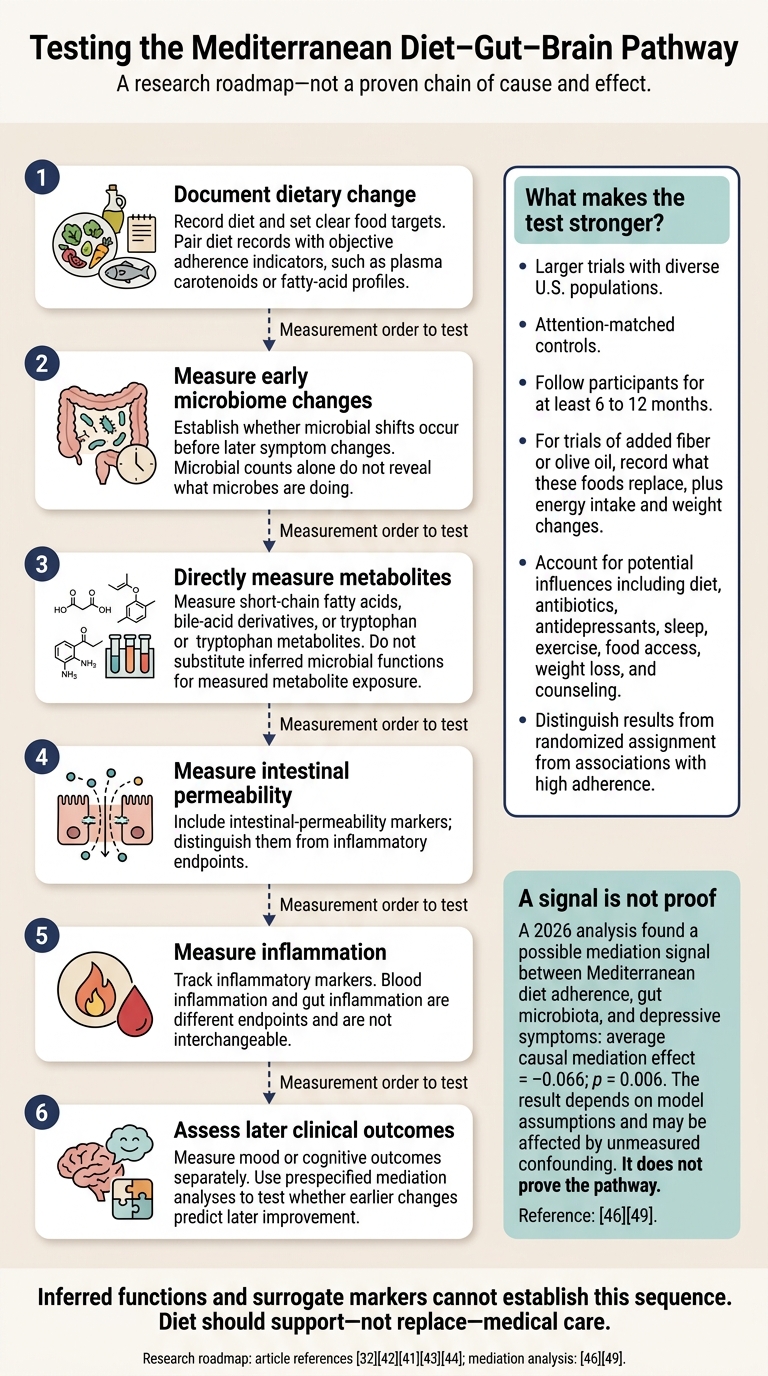
Testing the Mediterranean Diet–Gut–Brain Pathway
The main question isn’t whether Mediterranean eating is linked to better outcomes. It’s which studies can test how that link works.
Which Studies Test Cause and Effect?
NU-AGE offers randomized evidence that a Mediterranean-style diet intervention can change microbiome patterns in older adults. Its metabolic profiles predicted more short- and branched-chain fatty-acid production and less production of several potentially harmful metabolites. But researchers inferred those profiles rather than directly measuring the full range of metabolite exposure. Links between microbial taxa, C-reactive protein, and interleukin-17 were associations. That makes the pathway plausible, but does not prove causation.[29][13]
A newer analysis goes a step further by testing mediation - whether gut microbiota might help explain the link between diet and symptoms. The 2026 analysis found a possible mediation signal between Mediterranean diet adherence, gut microbiota, and depressive symptoms (average causal mediation effect = −0.066, p = 0.006). Still, the result depends on model assumptions and may be affected by unmeasured confounding.[30][31]
Study Limits and Other Influences
Small samples, short follow-up periods, and inconsistent sequencing methods make studies hard to compare. Microbial counts don’t tell us what those microbes are doing. Diet, antibiotics, antidepressants, sleep, exercise, and food access can affect both microbes and health outcomes. Weight loss and counseling may also help explain improvements.[25][17][18]
When reading a trial, check whether the control group received similar attention. Also check whether results reflect randomized assignment or only high adherence. Focusing on people who closely followed the diet can favor those who have other healthy habits.[25][17][18]
What Future Trials Should Measure
Larger trials should include diverse U.S. populations and set clear food targets. They should pair diet records with objective adherence indicators, such as plasma carotenoids or fatty-acid profiles, use attention-matched controls, and follow participants for at least 6 to 12 months. Trials focused on individual diet components should record what added fiber or olive oil replaces, along with energy intake and weight changes.[18][26][25]
Testing mediation requires measurements in time order: early microbiome changes; directly measured short-chain fatty acids, bile-acid derivatives, or tryptophan metabolites; then intestinal-permeability markers, inflammatory markers, and mood or cognitive outcomes. Prespecified mediation analyses could test whether these changes predict later improvement - and whether microbiome shifts occur before symptoms change. Inferred functions and surrogate markers cannot establish that sequence.[27][28]
Conclusion: Practical Steps and Evidence Limits
Mediterranean-style eating may modestly change gut microbes, affect inflammation markers, and improve some depressive symptoms. But the gut-brain pathway connecting these outcomes remains unproven.[24][32] Focus on long-term habits, not a guaranteed reset. Consistency matters more than speed.
Start with simple food swaps to put the evidence into practice.
Mediterranean-Style Eating at Home
Build meals around oats, beans, vegetables, whole grains, olive oil, and fish. Aim for beans several times a week and vegetables at two meals a day. Canned beans and frozen produce can make this easier.
Increase fiber gradually over several weeks, and track what you eat and how you feel. If you have inflammatory bowel disease, irritable bowel syndrome, or persistent digestive symptoms, talk with a physician or registered dietitian. Diet should support - not replace - prescribed medication, psychotherapy, or other care.
Rebirth RE-1: Product Evidence Is Separate
Product claims need separate evidence. Rebirth RE-1 is presented as a sachet synbiotic containing prebiotics, probiotics, and postbiotics.[33][34] The Mediterranean-diet studies reviewed here did not test this product. They do not show that it resets the microbiome or treats mental-health symptoms.
Prebiotic ingredients may cause gas, bloating, or changes in bowel habits, and tolerance varies from person to person. People with immune deficiencies or serious health conditions should seek clinician guidance before taking a supplement that contains probiotics. It is not a substitute for medical care, a prescribed diet, psychotherapy, or medication.
FAQs
How can I tell if dietary changes are helping my mood?
Track your mood and gut health, noting any improvements in fatigue, low mood, bloating, or gas [1]. A daily journal of your energy levels and emotional state can help you spot patterns over time [3].
You can also consider professional biomarker testing to monitor gut barrier repair. Inflammatory markers often decrease before you notice changes in how you feel [2].
Can a gut microbiome test guide my food choices?
Yes. Microbiome testing can help guide personalized nutrition by showing your bacterial profile, identifying missing microbes, and tracking how your microbiome responds to dietary changes [1][2]. The results can help you adjust your eating habits or choose strains based on your needs [2][3].
Used with tools like a microbiome diet planner, these results can guide changes such as eating more prebiotic fiber to help restore microbial balance and support the gut-brain axis [4].
How can I increase fiber without worsening digestive symptoms?
Add fiber-rich whole foods - such as legumes, whole grains, fruits, and vegetables - a little at a time [1][2][3]. Eat at consistent times and stay hydrated while your digestive system adjusts [1][7][3].
Rebiirth RE-1 is a targeted, medical-grade synbiotic that can help restore microbiome balance and reduce bloating [4][5]. Each serving provides 4.5 grams of prebiotic fiber, along with probiotics and postbiotics. Its specialized delivery system supports absorption [4][5][6].