

If you want to build a postbiotic product that works the way you expect, you need to track its chemistry - not just its strain name. In this article, I’d sum it up like this: metabolomic profiling helps me see what a microbe makes, when output peaks during fermentation, which tools can measure those compounds, and how those results connect to testing, formulation, and batch checks.
Here’s the short version:
- I use metabolomics to compare strains by output, not just species label.
- I check fermentation over time because metabolite levels can peak and drop.
- I use untargeted work early to map many compounds, then targeted work later to measure known markers like acetate, propionate, and butyrate.
- I match the platform to the compound:
- GC-MS for SCFAs
- LC-MS for broad liquid-phase profiling
- UHPLC-QTOF-MS/MS for unknown-feature discovery
- NMR for structure checks and batch fingerprinting
- I do not treat a detected metabolite as proof of host effect. I still need bioassays, in vivo work, and stability testing.
- I use the final metabolite fingerprint as a batch reference during manufacturing.
One data point stands out: in one consortium study, adding butyrate-producing strains increased butyrate output by 56%. Another point: some fermentation programs tune 28 more growth factors beyond pH and temperature to keep output in range.
Quick comparison
| Area | What metabolomics helps answer |
|---|---|
| Strain screening | Which strain makes the compounds I care about |
| Fermentation timing | When metabolite output is highest |
| Platform choice | Which tool fits which compound class |
| Bioactivity review | Which detected compounds should move into testing |
| Formulation | Which fibers pair best with target outputs in prebiotic-probiotic synergy |
| Manufacturing | Whether batch chemistry stays in line during postbiotic production |
Put simply, I’d read this topic one way: chemistry tells me what is in the preparation, testing tells me what it does, and production control helps keep it consistent.
sbb-itb-1bbfe7f
How Metabolomics Supports Strain Selection and Fermentation Screening
Metabolomics helps teams screen strains early, before scaling postbiotic production locks in the wrong producer. That shifts early screening toward function-first decisions, not taxonomy-first ones.
Identifying Strain-Specific Metabolite Profiles
Function matters more than a species name, so strain selection should center on metabolic output.
Two strains from the same species can look the same on paper but act very differently in a fermentation vessel. One may produce high levels of short-chain fatty acids (SCFAs). Another may make a different set of bioactive metabolites. Without metabolomic data, that gap stays hidden.
That’s why strain selection is moving toward a function-first selection approach. Teams evaluate candidates as functional building blocks, not just labels. In one consortium study, metabolomic analysis showed that butyrate output fell short of human fecal levels. Researchers then added butyrate-producing strains and increased output by 56%. [1]
Substrate choice changes SCFA output too, so strain and substrate screening should happen together. [Prebiotic fibers such as galactooligosaccharides (GOS) and inulin directly affect SCFA production](https://www.rebiirth.com/en-en/blogs/news/prebiotics-and-short-chain-fatty-acids-link-to-inflammation) and other postbiotic metabolites.
Once you find the best producer, the next job is figuring out when its output hits the high point.
Finding the Right Fermentation Harvest Point
Metabolite concentrations do not stay flat during a fermentation run. They rise, peak, and sometimes fall as the culture moves forward. If a team relies only on cell count or final pH to choose a harvest point, it can end up collecting a batch after peak bioactive output has passed - or before it arrives.
Targeted metabolomic profiling during fermentation lets teams follow the concentration of specific compounds across the run and spot the window where bioactive yield is highest. That matters a lot for postbiotic preparations, where the goal is to capture the highest concentration of the intended bioactive compounds.
Fermentation tuning also goes past pH alone. Temperature, oxygen exposure, and passage frequency all shift the metabolite profile. Some biofermentation programs tune pH, temperature, and 28 other critical growth factors to keep metabolite potency and batch-to-batch consistency in check. [2]
Those time-course data also help answer a practical question: do you need broad discovery, or do you need tight measurement?
Targeted vs. Untargeted Metabolomics
Untargeted metabolomics takes a broad view. It maps the full metabolite profile of a fermentation broth, which makes it useful during early strain screening when the key compounds are still unclear. This is often how teams find unexpected metabolites that may play a role in bioactivity.
Targeted metabolomics focuses on known compounds like butyrate and acetate and measures them with precision. Teams use it to validate bioactivity, confirm harvest timing, and support quality control during manufacturing.
| Feature | Targeted Metabolomics | Untargeted Metabolomics |
|---|---|---|
| Primary Goal | Quantifying known, specific compounds (e.g., butyrate, acetate) | Broad mapping of all detectable molecules in a sample |
| R&D Use Case | Validating bioactivity and ensuring batch consistency | Discovering new metabolites and comparing strain-specific profiles |
| Data Output | Precise concentration metrics for specific markers | Global metabolite profile of the fermentation broth |
| Manufacturing Role | Quality control and harvest point optimization | Early-stage strain screening and substrate selection |
Used together, these two approaches show teams which metabolites deserve attention and when they should be measured with precision. The next step is picking the platform that can detect those targets at the level of detail the study needs.
Analytical Platforms for Mapping Postbiotic Compounds
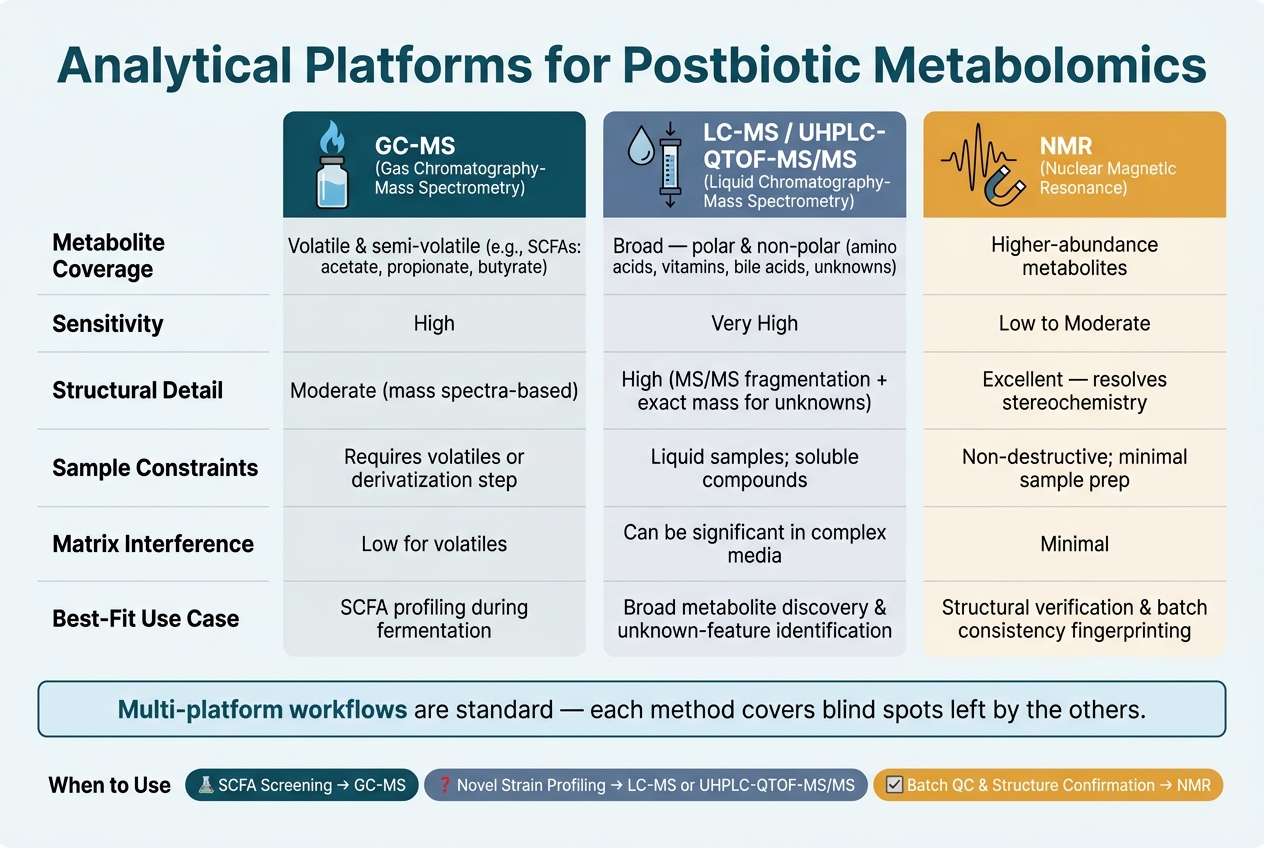
Metabolomics Platforms for Postbiotic Development: GC-MS vs LC-MS vs NMR
Once target metabolites and harvest timing are set, the next step is picking the right platform to detect them. And that choice only works if the tool matches the metabolite class.
It comes down to a few plain questions: What is the compound? How much of it is there? What does the study need to learn?
GC-MS, LC-MS, UHPLC-QTOF-MS/MS, and NMR: What Each Platform Does
GC-MS (Gas Chromatography-Mass Spectrometry) works best for volatile and semi-volatile metabolites, especially SCFAs such as acetate, propionate, and butyrate [1]. If the compound is non-volatile, it usually needs a derivatization step before analysis.
LC-MS (Liquid Chromatography-Mass Spectrometry) handles a much broader set of compounds. It can measure both polar and non-polar metabolites in liquid samples. That makes it useful for amino acids, vitamins, and secondary bile acids. The catch is that complex fermentation broths can create matrix effects that skew signals, so method validation matters [3].
When the job moves beyond routine quantification and into unknown-feature discovery, higher-resolution MS starts to matter. UHPLC-QTOF-MS/MS is used for high-resolution untargeted profiling [3]. Exact mass data and fragmentation patterns help researchers identify unknown compounds from novel strains or changed fermentation conditions that other platforms may miss. It also costs more and needs bioinformatics support to handle the data.
NMR (Nuclear Magnetic Resonance) works on a different detection principle. It offers structural confirmation and reproducibility [3], but it needs higher compound concentrations than MS and is less useful for trace metabolites. In practice, NMR is often used to confirm compound structure and support batch checks before formulation.
How Platform Choice Affects Detection Outcomes
Platform choice shapes what you see and what you miss.
A GC-MS-only workflow will miss the non-volatile fraction. An LC-MS workflow may pick up more compounds but still leave structural gray areas that NMR can clear up. The sample matrix matters too. A fermentation broth and a processed postbiotic extract don't behave the same way, and background components can interfere with signal quality in MS-based methods.
That is why teams usually match the tool to the compound class:
- For SCFA screening during fermentation, GC-MS is often the go-to.
- For broad profiling on a novel strain, LC-MS or UHPLC-QTOF-MS/MS makes more sense.
- For structure confirmation or manufacturing consistency checks, NMR is often the better fit.
In many labs, a multi-platform workflow is the norm because each method covers a blind spot left by the others.
Comparison Table: GC-MS vs. LC-MS vs. NMR
The table below sums up the practical differences.
| Feature | GC-MS | LC-MS | NMR |
|---|---|---|---|
| Metabolite Coverage | Volatile and semi-volatile (e.g., SCFAs) | Broad range - polar and non-polar | Higher-abundance metabolites |
| Sensitivity | High | Very High | Low to Moderate |
| Structural Detail | Moderate (mass spectra-based) | High (with MS/MS fragmentation) | Excellent - resolves stereochemistry |
| Sample Constraints | Requires volatiles or derivatization | Liquid samples; soluble compounds | Non-destructive; minimal prep |
| Matrix Interference | Low for volatiles | Can be significant in complex media | Minimal |
| Best-Fit Use Case | SCFA profiling | Broad metabolite discovery | Structural verification and batch consistency |
From Compound Mapping to Bioactivity and Product Design
After compound mapping, the next step is figuring out which metabolites lead to a measurable effect.
Metabolite Classes Linked to Postbiotic Activity
Different metabolite classes often line up with different jobs in the body. Short-chain fatty acids (SCFAs) like butyrate, acetate, and propionate are some of the most studied. Butyrate stands out because it helps support the gut epithelial barrier and works as an immunomodulator by affecting cell surface receptors and signaling cascades that control inflammation [1].
Other classes play different roles. Organic acids can lower local pH, which may help slow pathogen growth and support mineral uptake. Peptides and amino acids may play a part in gut-brain signaling. Phenolic derivatives act as antioxidants, and exopolysaccharide fragments can stimulate cytokines that modulate immune signaling.
| Metabolite Class | Likely Bioactivity | Functional Outcome |
|---|---|---|
| Short-Chain Fatty Acids (SCFAs) | Anti-inflammatory, Immunomodulatory | Regulates gut barrier and immune signaling |
| Organic Acids | Antibacterial, pH Regulation | Inhibits pathogens; supports mineral uptake |
| Peptides / Amino Acids | Neurotransmitter synthesis | Supports gut-brain signaling |
| Exopolysaccharide Fragments | Immunomodulatory | Modulates immune signaling |
| Phenolic Derivatives | Antioxidant | Protects cells from oxidative stress |
For formulation work, the full metabolite profile matters more than any one marker. In plain terms, you want to look at the whole pattern, not just a single standout compound. That pattern then helps decide which compounds and combinations move into bioassay testing.
Using Bioactivity Data to Guide Formulation Decisions
Profiling should be paired with in vitro or in vivo testing to confirm function. Identified metabolites are useful as markers for downstream testing, but they do not prove function on their own. That confirmation step helps make sure formulation decisions are based on measurable functional outcomes, not just inference [1].
Once bioactivity is confirmed, the data can also shape how ingredients are handled during manufacturing. Drying and encapsulation can expose compounds to stress that breaks down sensitive metabolites. Metabolomic profiling across multiple processing stages shows which compounds stay stable and which ones need added protection. One example is lipid-based microencapsulation, which protects sensitive bioactives from stomach acid and bile while helping keep the product shelf-stable [2].
How Metabolomics Informs Synbiotic Formulation
Once target metabolites are known, that same profile can help with choosing compatible prebiotic fibers.
Metabolite data does not just support postbiotic design on its own. It also helps guide how postbiotic preparations are paired with prebiotic substrates in a synbiotic format. This is sometimes called a function-first design approach: strains are selected based on their specific metabolic outputs rather than their general abundance in a reference microbiome [1]. From there, profiling can show which prebiotic fibers, such as GOS or inulin, are converted most efficiently by those strains into the target metabolites. That makes the pairing based on target metabolism instead of guesswork [2].
For example, a synbiotic can pair a postbiotic with the fibers that best drive its target metabolites, then use protective delivery to help preserve stability.
That formulation logic feeds directly into batch validation and manufacturing control.
Validation Limits, Quality Control, and Key Takeaways
Limits of Metabolomic Interpretation
After mapping compounds and tying them to bioactivity, the next step is being clear about what metabolomics cannot prove by itself.
Metabolomics can't always tell apart closely related species or explain how a whole consortium behaves. And spotting a metabolite doesn't prove it helps the host. You still need to confirm function with bioactivity testing, in vivo work, and stability testing. Simplified consortia can also produce less SCFA than human fecal samples, so in vitro output doesn't directly predict human response [1].
Metabolomics can show what is present, but it can't fully predict host-specific microenvironment interactions or long-term shelf-life. Those gaps still need in vivo testing, such as germ-free animal models, plus dedicated stability studies [1][2].
Batch Consistency and Manufacturing Reproducibility
Once a target profile has been validated, that same fingerprint becomes the release standard for future batches.
In manufacturing, metabolomics is most useful for batch-to-batch consistency. A metabolomic fingerprint from a validated fermentation batch gives you a chemical reference point for checking future batches and confirming that fermentation and processing stay chemically consistent over time, which is vital for postbiotics to restore gut balance [3][2].
Bacterial viability and metabolite production are sensitive to small shifts in growth factors, including pH and temperature, so those variables need tight control [2]. For multi-strain postbiotics, keeping fast-growing and slow-growing strains in sync adds another layer of difficulty. Specialized culture protocols help maintain a consistent metabolite profile across the consortium [1].
Conclusion: What Metabolomic Profiling Adds to Postbiotic Development
Metabolomics is one part of a broader validation system. It shows which strains produce the most relevant metabolite profiles, pinpoints productive fermentation windows, maps the compounds present in a finished preparation, and gives manufacturers a chemical fingerprint to check consistency across batches.
Put simply, chemistry shows what's there, biology confirms what it does, and manufacturing control makes sure it stays that way. Each layer sharpens the decisions made before clinical validation.
FAQs
How do I know which metabolites matter?
The metabolites that matter most are the ones with proven clinical relevance to human health and disease. Researchers look for them by measuring how these compounds interact with host cells and how they shape the gut microbial community.
Two key examples are short-chain fatty acids such as butyrate and neurotransmitter precursors such as tryptophan. With metabolomic profiling, researchers can map these compounds and pinpoint which ones may help restore microbial balance or deliver therapeutic effects.
When should fermentation be harvested for the best output?
For the best fermentation output, harvest microbial biomass during the exponential (log) growth phase. That’s the point when cells are most active and producing the highest levels of metabolites and fermentation compounds.
If you’re co-culturing strains that grow at different rates, you may need coordinated precultures. The goal is simple: make sure each strain reaches the exponential phase at the right time before harvest.
Which metabolomics platform should I use first?
Start with LC-MS-based metabolomics (liquid chromatography coupled to mass spectrometry). It works especially well for measuring non-volatile and thermally labile metabolites that other methods can miss.
It also lets you analyze a broad range of metabolites tied to postbiotic strain selection, fermentation output, compound mapping, and bioactivity-to-formulation decisions.