

I’d Find your ideal probiotic strain based on dose, delivery, and human evidence - not the biggest CFU number. My first checks: human research that matches your goal, live-cell counts guaranteed through expiration, and storage instructions you can follow.
Here’s how I’d sort the options:
- Format: Choose capsules, sachets, powders, liquids, or foods that fit your routine.
- Protection and release: Check what strategies for protecting probiotics like freeze-drying, coatings, or encapsulation actually do. Lab survival does not prove symptom relief.
- Personal fit: Consider digestive goals, prebiotic tolerance, age, and health risks - not microbiome test results alone.
- Product claims: Rebirth RE-1 lists 500 billion CFU per serving, but the supplied material does not establish results from a trial of its finished formula.
- Progress: Track symptoms, side effects, and cost over the period studied.
My bottom line: <u>more CFUs and more complex delivery do not guarantee better results</u>. If you’re medically fragile or immunocompromised, get clinician guidance before use.
Probiotic Formats, Protection, and Release
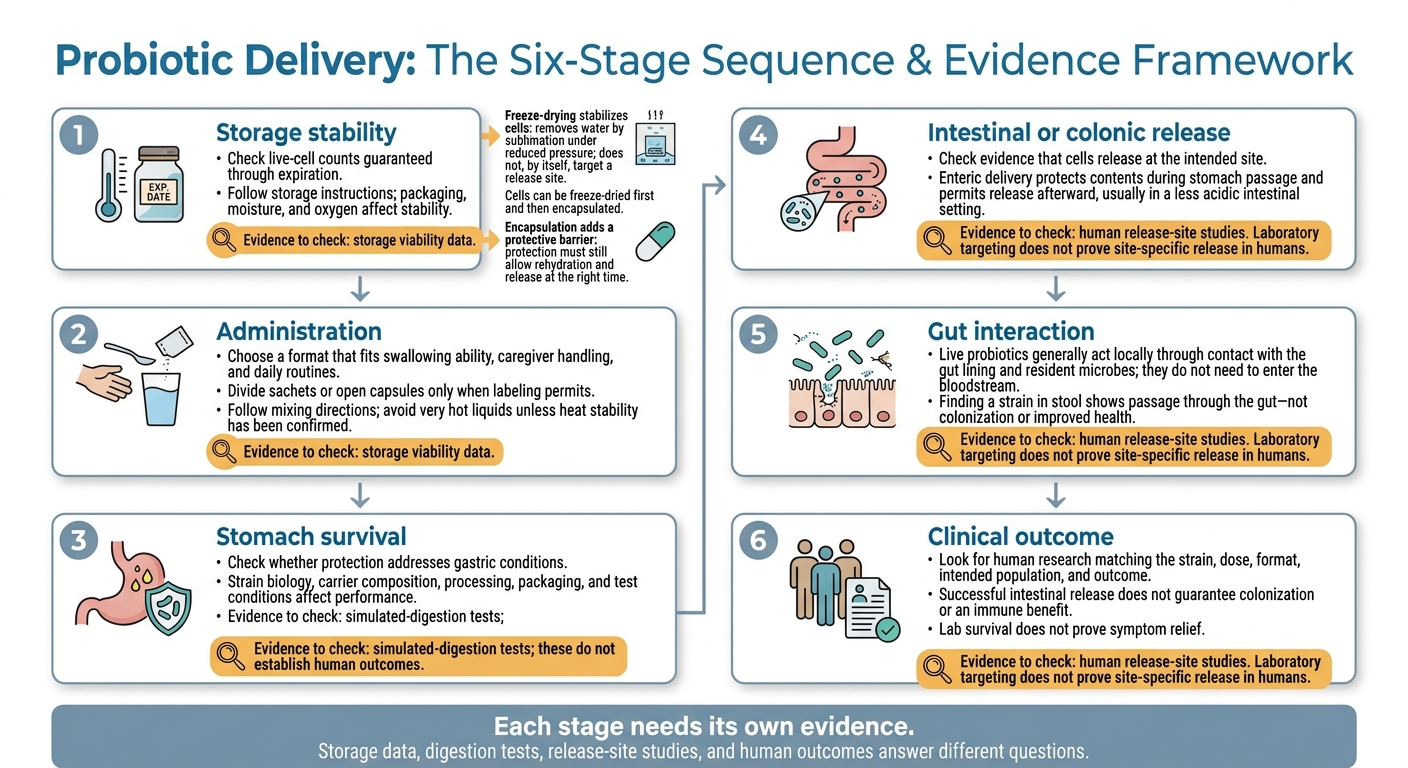
Probiotic Delivery: Six Stages of Evidence
Assess delivery in sequence: storage stability, administration, stomach survival, intestinal or colonic release, gut interaction, and clinical outcome. Each stage needs its own evidence. Storage data, digestion tests, release-site studies, and human outcomes answer different questions.
Finding a strain in stool shows that it passed through the gut - not that it colonized the gut or improved health. In personalized care, the best format fits the person, their routine, and the intended gut site. Use these separate types of evidence to check whether a product’s format and release claims support its intended use.
Sachets, Capsules, and Other Formats
Choose a format that suits swallowing ability, caregiver handling, and daily routines. A sachet does not automatically allow dose adjustment: divide it only when the manufacturer gives instructions. Keep single-dose packaging sealed until use, avoid hot or damp storage, and follow mixing directions. Don’t mix probiotics into very hot liquids unless heat stability has been confirmed.
The simplest suitable format is one that protects the strain and fits the user’s routine.
| Format | How it is taken | Dose flexibility | Stability | Best fit | Limitations |
|---|---|---|---|---|---|
| Powders and sachets | Mix or take directly, as labeled | Adjust only when permitted | Need protection from moisture and oxygen | Caregiver use; swallowing difficulties | Taste, incomplete mixing, and partial servings can affect dosing |
| Capsules | Swallow intact | Usually fixed units | Depends on shell and packaging | Portable, premeasured dosing | Can be hard to swallow; open only when labeling permits |
| Tablets | Swallow as directed | Usually fixed | Compression can stress cells | Convenient transport | Crushing may disrupt protection or release |
| Mouth-dissolving formats | Chew or dissolve in the mouth, as labeled | Fixed units or strips | Need moisture protection | People who avoid swallowing pills | Check sweeteners, allergens, and age suitability; films and disintegrating tablets hold limited amounts; dissolving in the mouth does not prove intestinal protection |
| Liquids | Measure with the supplied device | Flexible if labeled | May need refrigeration or special stabilization | Caregiver administration | Measurement errors and loss of live cells during storage |
| Food-based formats | Eat the specified serving | Depends on serving size | Food matrix and storage matter | Established eating routines | Allergens, variable portions, and uncertain strain protection |
Format is only part of the picture. Also compare how each product protects cells before release.
Freeze-Drying and Encapsulation
Freeze-drying stabilizes cells; encapsulation adds a protective barrier. Freeze-drying removes water by sublimation under reduced pressure, but it does not, by itself, target a release site.
Encapsulation uses materials such as alginate, chitosan, pectin, starch, proteins, or synthetic polymers. Cells can be freeze-dried first and then encapsulated. Either way, the protection must still let them rehydrate and release at the right time.
| Method | Mechanism | Stresses addressed | Release effects | Formulation complexity | Evidence maturity |
|---|---|---|---|---|---|
| Freeze-drying | Low-temperature, vacuum-assisted drying | Limits heat exposure during drying | Often rehydrates readily; does not target a site by itself | Needs protectants and barrier packaging | Established processing method |
| Protective matrices | Embed cells in polymers or proteins | Acid, bile, oxygen, or dehydration, depending on material | Release through diffusion, swelling, or breakdown | Strain–material compatibility matters | Extensive formulation research; human outcomes vary |
| Spray drying | Fast drying in heated air | Matrix may protect during storage and transit | Dense matrices may slow exposure | Can be scaled up; heat and drying require control | Established process; survival depends on the strain |
| Extrusion | Drop a cell–polymer mixture into a gelling bath | Can reduce gastric exposure | Beads swell or break down | Gentle processing; particle size can be limiting | Established research method |
| Emulsification | Form droplets, then gel or solidify them | Depends on the resulting carrier | Adjustable through carrier design | Requires control of phases and surfactants | Established research method |
| Hydrogels and core-shell microgels | Water-containing networks or layered particles | May protect against gastric and surrounding conditions | Can respond to local conditions | Consistent layers and scale-up can be difficult | Developing; limited clinical validation |
| Electrospun structures | Embed cells within fine fibers | May protect during storage and transit | Depends on fiber dissolution or degradation | Processing conditions require close control | Emerging |
| Single-cell nanocoatings | Coat individual cells | May protect against acid and bile | Depends on coating breakdown | Safety and manufacturing need validation | Experimental |
| Microalgae-based carriers | Use algae-derived carrier structures | Protection depends on the material | Designed for controlled release | Compatibility and reproducibility can be difficult | Experimental |
One survival percentage cannot rank these methods. Strain biology, carrier composition, processing, packaging, and test conditions all affect performance. Check whether the results measure storage viability, simulated digestion, human release, or clinical outcomes. These support different claims.
Release Triggers and Target Sites
Targeted release matters when it helps a strain reach the intended gut conditions. Enteric delivery protects contents during passage through the stomach and permits release afterward, usually in a less acidic intestinal setting.
“Targeted” describes a design goal unless release has been shown in humans. Live probiotics generally act locally through contact with the gut lining and resident microbes; they do not need to enter the bloodstream. Successful intestinal release still does not guarantee colonization or an immune benefit.
| Trigger | Intended site | Mechanism | Main limitation | Evidence status |
|---|---|---|---|---|
| pH-responsive | Small intestine or colon | Coating dissolves, swells, or becomes permeable at higher pH | Meals, disease, and transit alter pH | Established concept; human targeting depends on the formulation |
| Enzyme-responsive | Intestine or colon | Host or microbial enzymes degrade the carrier | Enzyme activity varies | Developing; often supported by simulated-digestion or preclinical evidence |
| Microbiota-responsive | Colon | Resident microbes break down the carrier | Relevant microbes may be depleted or absent | Developing; human validation is not uniform |
| Redox-responsive | Selected intestinal or inflamed regions | Materials respond to reducing conditions or oxidative signals | Local conditions vary; safety needs validation | Experimental; limited human targeting evidence |
| Pressure-responsive | Usually colon | Mechanical pressure deforms or ruptures the carrier | Pressure and transit are inconsistent | Experimental; mainly laboratory or preclinical evidence |
| Time-dependent | A planned stage of transit | Water entry, diffusion, swelling, or erosion delays release | Elapsed time does not reliably identify location | Established design approach; site accuracy is not guaranteed |
Laboratory targeting does not prove site-specific release in humans. The next step is to match these delivery features to digestive and immune goals, such as addressing gut dysbiosis.
sbb-itb-1bbfe7f
Matching Delivery to Gut and Immune Goals
Once you understand how a product releases its contents, match its delivery system to your goal. Choose the strain, dose, format, release site, and supporting ingredients accordingly. Evidence for one ingredient does not prove the finished formula works.
Digestive Comfort, Dysbiosis, and Maintenance
Keep a weekly log of stool frequency and form, bloating, discomfort, urgency, and gas. Note diet changes, medications, illness, stress, and how consistently you take the product. Review progress over the duration studied for the formulation.
Judge whether the delivery system helps by symptoms and stool patterns - not microbiome test changes alone.
| Goal | Formulation choice | Delivery priority | Measure | Evidence limit |
|---|---|---|---|---|
| Occasional digestive discomfort | A clearly identified, studied strain or combination; consider less prebiotic exposure at first if sensitive | Tolerance, stability, and consistent daily use | Bloating, discomfort, gas, and stool pattern | Results are strain-specific and may not apply to unexplained or persistent symptoms |
| Irregular bowel patterns | An evidence-matched probiotic and, when appropriate, a gradually introduced prebiotic | Accurate dosing and consistent use | Stool frequency, consistency, urgency, and quality of life | Fiber can worsen gas; microbiome diversity is not a treatment target on its own |
| Maintenance after a dietary or medication disruption | A product with documented viability through its shelf life and a defined use period | Storage, moisture protection, and repeatable dosing | Return to baseline bowel pattern and tolerance | Long-term effects and the best point to stop maintenance may be uncertain |
| Immune-function support | Strains with human evidence for the relevant population and outcome | Viability and strain identity | A validated immune-related clinical or laboratory endpoint | Immune support does not mean infection treatment or prevention |
HOSt Strains and Immune Support
For a branded formula, look past the label and check human outcome data. For Rebirth RE-1, HOSt™ means human-sourced strains. It does not prove individual matching or guarantee a response. Look for evidence that the exact strains, dose, and sachet delivery help people similar to the intended user.
Postbiotics also need evidence of benefit in the intended host. A plausible effect from a metabolite is not enough. Immune support does not mean infection treatment or prevention, and it cannot replace vaccination, diagnosis, or medical care.
Tolerance, Family Use, and Safety
Fermentable prebiotics, such as inulin or GOS, may increase gas or bloating. Follow the labeled serving and avoid adding several new fermentable products at once. Introduce them gradually only when the labeling permits. Persistent or severe symptoms are not proof that a product is working.
Check ingredient sensitivities and age-appropriate dosing. Seek clinician guidance for children; people who are pregnant or breastfeeding; older adults with serious illness; hospitalized patients; people with central venous catheters; and anyone who is immunocompromised or medically fragile. Rare serious infections have been reported primarily in vulnerable patients.[6][7][9]
Bloody stools, fever, severe abdominal pain, dehydration, or unexplained weight loss require medical assessment.
Rebirth RE-1: Formula and Sachet Delivery
The 3-in-1 Formula and Lyosublime Delivery
Rebirth RE-1 combines a probiotic, prebiotic, and postbiotic formula in a sachet. The label lists 500 billion CFU per serving, 4.5 grams of GOS and inulin, and seven HOSt™ strains. But CFU counts and ingredient categories alone don’t prove that a product works. Check whether the CFU count is guaranteed through expiration or measured only at manufacture.[8][10]
Lyosublime™ is the manufacturer’s proprietary name for its delivery system - not proof of release performance. Available information does not independently establish its release profile, survival through digestion, or results in humans.[8] Delivery claims also depend on the sachet staying stable until use.
Sachet Use, Storage, and Ingredients
The manufacturer lists a 5-gram, single-serving sachet that requires no refrigeration. That makes dosing simple, but it doesn’t prove better delivery or results.
The manufacturer also lists the product as vegan, gluten-free, dairy-free, soy-free, nut-free, and non-GMO. Check the current ingredient and allergen statements: these claims don’t establish protection against cross-contact.[8]
Reset Plans, Prices, and Research
The schedule and price matter less than whether human research supports the finished formula.
| Plan | Marketed duration | Supplied one-time price |
|---|---|---|
| 7-Day Reset | 7 days | $79 |
| 4-Week Reset | 4 weeks | $279 |
| 12-Week Reset | 12 weeks | $749 |
These prices have not been verified as current offers. The schedules are marketing plans, not validated treatment timelines.[8]
Ask for a peer-reviewed human trial that tests the finished formula, dose, preparation method, and schedule. No independently verified trial of the finished formula was identified in the supplied material, so that material does not prove its marketing claims.[8]
Conclusion: Choose Delivery Based on Evidence
Once you’ve chosen a strain, format, and release method, set a clear goal, such as fewer loose-stool days or less abdominal discomfort. Judge the product by results, and look for human studies that match its exact strain, dose, format, and duration. Higher CFU counts and more complex delivery don’t guarantee better results.[11][10]
Selection and Progress Checklist
Before buying, check the full strain identifiers, CFU, and storage instructions and daily serving schedule. Look for human data on the finished formula to support release claims - not just lab tests.[11][10] Review allergens and medication compatibility, then calculate the total cost, including shipping and any testing.
U.S. dietary supplements are not FDA-approved for safety or effectiveness before marketing.[12][13] Get clinician advice before use if you’re immunocompromised, seriously ill, pregnant, or managing a complex medical condition.
Before starting, record one or two measures, such as weekly stool frequency, loose-stool days, or abdominal pain on a 0–10 scale. Track how well you tolerate the product and use a validated symptom questionnaire. Reassess after the trial length used in the research, focusing on symptom improvement, validated clinical measures, and medical evaluation. If symptoms worsen, stop and seek medical advice rather than automatically increasing the dose.
Use microbiome testing for context only. Base decisions on strain, dose, format, release site, and human outcomes.
FAQs
How can I verify probiotic delivery claims?
Check that colony-forming unit (CFU) counts are guaranteed through the end of shelf life, not just at manufacture. Labels should also list the genus, species, and strain number [1][2][3].
Look for third-party testing for purity and potency, plus accessible clinical research that supports the product’s specific health claims. Check for protective delivery methods, such as lipid-based microencapsulation or Lyosublime, designed to shield live cultures from stomach acid and keep them viable [2][3][4][5].
Can I take probiotics with my medications?
If you take antibiotics, wait 2 to 3 hours after your antibiotic dose before taking your probiotic powder. This helps keep the antibiotic from killing the good bacteria in your probiotic [1].
If you take other medications or have a health condition, ask your healthcare provider about the best plan for your needs [2].
How do I distinguish prebiotic intolerance from probiotic side effects?
Prebiotic intolerance typically causes gas, bloating, or abdominal discomfort as gut bacteria ferment fibers, including the GOS and inulin in Rebiirth RE-1. Early probiotic side effects often reflect a temporary shift in your gut’s microbial balance as your body adjusts to new strains of helpful bacteria.
If discomfort persists or is severe, consult a healthcare provider. They can help determine whether the fiber content or specific bacterial strains may be causing your symptoms.