

My starting point after SIBO: eat enough, keep tolerated foods on hand, and track symptoms without assuming relapse. I use a 7-day food and symptom log to help guide changes and discussions with my clinician.
My checklist covers:
- Meals and shopping: Stock familiar foods, eat regularly, and drink fluids that fit my needs.
- Food trials: Add variety, prebiotics, probiotics, and fermented foods one at a time, starting with small portions.
- Travel: Pack backup meals and keep perishable foods at 40°F or below.
- Follow-up: Review repeated symptoms with a clinician rather than self-treating.
<u>Food choices, fasting, and supplements are not proven to prevent SIBO relapse.</u> I seek urgent care for severe pain, bleeding, persistent vomiting, or signs of dehydration - not wait for my food log to provide an answer.
Meal Timing and Hydration
Once you've chosen your staple foods, use meal timing and hydration to build a routine you can repeat. The goal is to check comfort and consistency - not force fasting. Neither meal spacing nor overnight fasting has an established benefit for preventing SIBO relapse[9][10]. Track your routine to spot patterns and analyze your digestive symptoms and food tolerance.
Plan Regular Meals and Drinks
☐ Eat breakfast, lunch, and dinner.
☐ Add snacks to meet your nutrition needs.
☐ Drink fluids regularly, staying within any limit set by your clinician.
☐ Space meals 3–4 hours apart only if your clinician recommends it and you're still getting enough food.
Stop or adjust the routine if you develop dizziness, weakness, inadequate intake, or anxiety about food.
If eating late worsens nighttime bloating, reflux, pain, or sleep, discuss moving your evening meal earlier without reducing total intake. Get guidance before changing meal timing if you're pregnant, breastfeeding, underweight, losing weight, have diabetes or a history of an eating disorder, or take medication that requires food or set dosing times[5][8][11].
Compare Meal Timing and Fluid Needs
| Routine | Purpose | How to use it | When to get clinician guidance |
|---|---|---|---|
| Meal spacing | Check whether eating frequency affects symptoms | Follow clinician-recommended spacing between meals and snacks while getting enough food | Health conditions, medication timing, weight loss, or worsening symptoms |
| Optional overnight fasting | Check comfort with overnight eating patterns | Don't force a fasting window or skip needed food | Any condition or medication affected by fasting; dizziness or weakness |
| Hydration | Support normal body function and replace fluid losses | Drink regularly; record cups or fl oz | Kidney, heart, or liver disease; fluid restrictions; persistent vomiting or diarrhea |
Fluid needs change with heat, activity, illness, and stool losses. For persistent diarrhea or vomiting, ask about electrolyte replacement rather than simply drinking more water[6][7]. Keep a 7-day record to review with your clinician or registered dietitian.
☐ Routine selected: ______ | Meal/snack times, foods, and portions: ______ | Fluids, cups or fl oz: ______
Bowel movements: time, consistency, urgency: ______ | Bloating and pain, each 0–10: ______
Tolerance, energy, and medication notes: ______ | Change for tomorrow: ______
sbb-itb-1bbfe7f
Fermented Foods and Prebiotic Fiber
Once your baseline meals are steady, try fiber-rich and fermented foods one at a time. Adding fiber too fast may worsen symptoms, so follow a guide to long-term gut health after SIBO to manage the transition. Neither fermented foods nor prebiotic fiber is proven to prevent SIBO relapse.[15][16][4]
Try One Food at a Time
Use only foods you tolerate.
Trial options include oats, legumes, asparagus, plain kefir, yogurt with live cultures, or sauerkraut.
Fermented foods aren't always probiotic foods. Processing and storage may leave few live cultures.[12] Check labels for added garlic, onion, inulin, sugar alcohols, sweeteners, or carbonation.
- Start when the rest of your routine is steady.
- Choose one food and measure a small starting portion.
- Track symptoms for several days before adding another food.
- Log the food, amount, date, symptoms, and bowel changes.
Watch for repeated reactions rather than one-off symptoms. Stop the trial if symptoms worsen, and seek clinician guidance for persistent or severe symptoms. Introduce any combined supplement just as slowly.
Review Rebirth RE-1 Before Use
Treat a combined synbiotic product like any other fiber trial. Rebirth RE-1 contains approximately 4.5 g of fermentable GOS and inulin fiber per serving. Introduce it cautiously and monitor symptoms.[13][14]
- Discuss it with a clinician before use.
- Start with a clinician-guided amount rather than assuming a full serving is suitable.
- Stop and reassess with your clinician if symptoms worsen.
Travel Meals and Backup Foods
Start with foods you tolerate, then plan for delays, restaurant meals, and safe food storage on the road.
Pack and Order Foods You Know
- Before departure: Eat a familiar meal. Pack two or three tolerated, easy-to-carry foods in your usual portions, plus enough for several hours of delay. Bring utensils, napkins, resealable bags, and a written list of known triggers.
- Plan drinks and meals: Mark water refill points and backup meal stops. Take an empty refillable bottle through security, then fill it afterward. Save snacks for delays.
- Order familiar ingredients: Ask for your usual portion. Request sauces, dressings, and known trigger ingredients on the side or left out. Confirm how the food is prepared when possible.
- Know where to get care: Save nearby care locations. Seek prompt care for dehydration, blood in stool, fever, repeated vomiting, or severe or worsening abdominal pain.
A food you tolerate still needs safe temperature control. Keep perishable foods at 40°F or below in an insulated cooler with ice or frozen gel packs. Discard them after more than 2 hours without safe temperature control, or 1 hour when temperatures exceed 90°F.[17][19] Choose shelf-stable foods if you’re unsure refrigeration will be available.
Choose Backups for Each Travel Setting
Plan around each setting’s main risk: delays, lack of refrigeration, or hidden ingredients, as stress disrupts gut microbiota and can worsen travel-related symptoms.
| Setting | Likely challenge | Preparation strategy | Familiar backup foods |
|---|---|---|---|
| Air travel | Delays and limited meals | Check screening rules; pack shelf-stable foods with clear ingredient labels | Tolerated crackers, rice cakes, or dry cereal |
| Road travel | Long gaps between stops; heat | Plan water and bathroom stops; keep a cooler in the passenger area | Chilled meal portions and shelf-stable snacks |
| Hotels | Late arrival; uncertain refrigeration | Confirm refrigerator access and locate a grocery store | Shelf-stable oatmeal or single-serve breakfast foods |
| Restaurants | Hidden ingredients; large portions | Confirm ingredients, request sauces separately, and ask for your usual portion | Plain grilled protein with rice, potatoes, or tolerated cooked vegetables |
- Check ingredient labels: Keep packaging intact so you can review ingredients.
- Check travel rules: Review current Transportation Security Administration (TSA) rules for liquids, gels, ice packs, and medically necessary foods. Ordinary carry-on liquids generally have a 3.4-ounce (100 mL) limit.[22]
- Check border restrictions: Review your destination’s customs and agricultural rules. When entering the United States, declare agricultural items and be ready to discard restricted foods.[18][20]
Where tap water may be unsafe, use unopened, factory-sealed bottled water or properly disinfected water for drinking, brushing teeth, preparing food, and making ice. Choose fully cooked food served hot. Avoid raw or undercooked foods and unpasteurized dairy.[21]
During travel, record the setting, food, portion, time, fluids, delays, and activity, along with symptom timing, severity, and bowel changes. After returning, label each option worked, uncertain, or avoid for now. You can also take a microbiome balance quiz to evaluate your overall gut health progress. Save restaurant names, packing quantities, and hotel details.
Review Symptoms and Plan Follow-Up
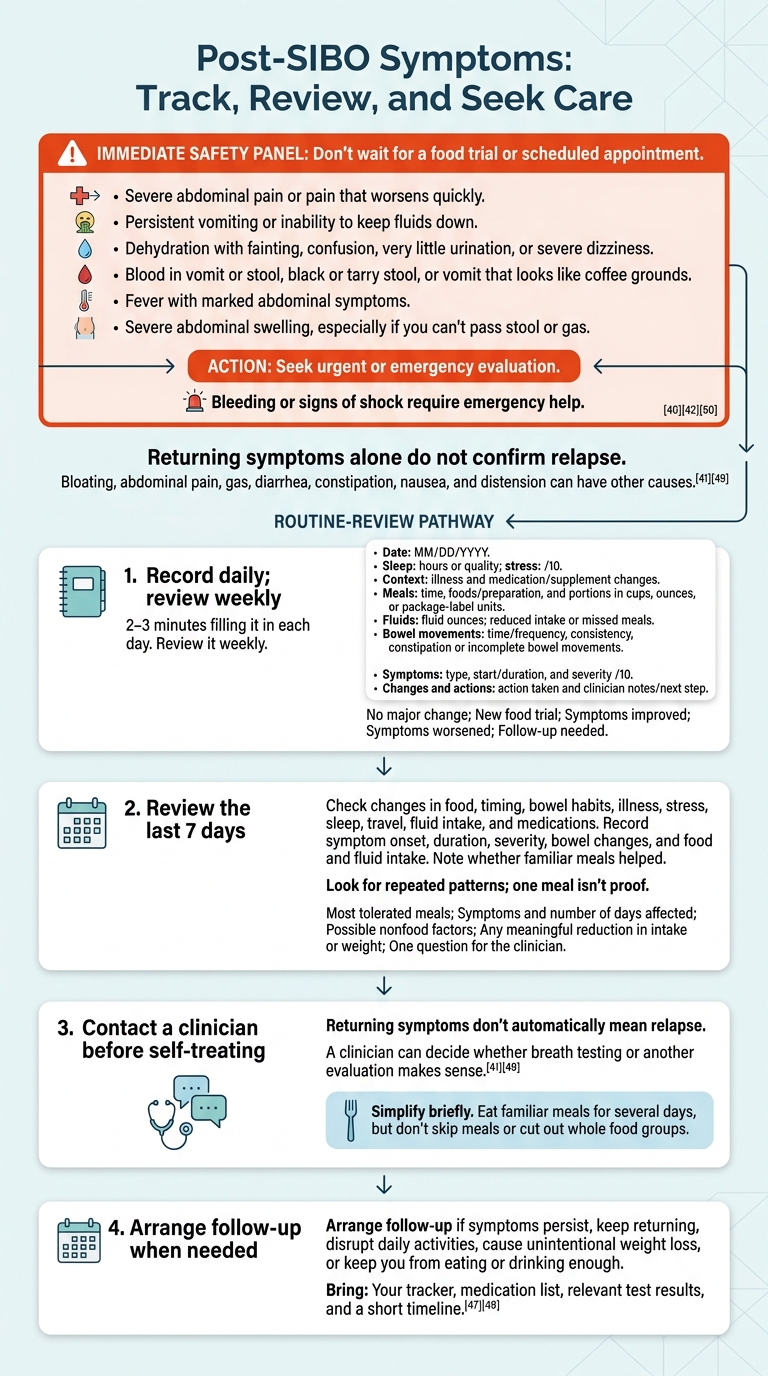
Post-SIBO Symptoms: Track, Review, and Seek Care
Returning symptoms alone do not confirm relapse. Bloating, abdominal pain, gas, diarrhea, constipation, nausea, and distension can have other causes. If symptoms return, review their patterns and contact a clinician. They can decide whether breath testing or another evaluation makes sense, rather than having you self-treat.[24][27] Use the checklist below to plan your follow-up.
Check Patterns and Know When to Seek Care
- □ Review the last 7 days. Check for changes in food, timing, bowel habits, illness, stress, sleep, travel, fluid intake, and medications. Record when symptoms started, how long they lasted, their severity, bowel changes, and food and fluid intake. Note whether familiar meals helped. Look for repeated patterns; one meal isn't proof.
- □ Contact a clinician before self-treating. Returning symptoms don't automatically mean relapse.
- □ Simplify briefly. Eat familiar meals for several days, but don't skip meals or cut out whole food groups.
- □ Arrange follow-up if symptoms persist, keep returning, disrupt daily activities, cause unintentional weight loss, or keep you from eating or drinking enough. Bring your tracker, medication list, relevant test results, and a short timeline.[26][27]
Don't wait for a food trial or scheduled appointment if you have any of these symptoms:
- □ Severe abdominal pain or pain that worsens quickly.
- □ Persistent vomiting or inability to keep fluids down.
- □ Dehydration with fainting, confusion, very little urination, or severe dizziness.
- □ Blood in vomit or stool, black or tarry stool, or vomit that looks like coffee grounds.
- □ Fever with marked abdominal symptoms.
- □ Severe abdominal swelling, especially if you can't pass stool or gas.
Seek urgent or emergency evaluation. Bleeding or signs of shock require emergency help.[23][25][28]
Print a Daily Food and Symptom Tracker
Print this template and spend 2–3 minutes filling it in each day. Review it weekly. Short notes bring meal, hydration, and symptom patterns together in one place. Include the same details you checked during your symptom review.
| Field | Entry |
|---|---|
| Date | __/__/____ (MM/DD/YYYY) |
| Sleep and stress | Sleep: ____ hours or quality ____ · Stress: ____/10 |
| Context | Illness: ____ · Medication/supplement changes: ____ |
| Meals | Time: ____ a.m./p.m. · Foods/preparation: ____ · Portion: ____ cups, ounces, or package-label units |
| Fluids | ____ fluid ounces · Reduced intake or missed meals: ____ |
| Bowel movements | Time/frequency: ____ · Consistency: ____ · Constipation or incomplete bowel movements: ____ |
| Symptoms | Type: ____ · Start/duration: ____ · Severity: ____/10 |
| Changes and actions | Action taken: ____ · Clinician notes/next step: ____ |
| Daily | □ No major change □ New food trial □ Symptoms improved □ Symptoms worsened □ Follow-up needed |
| Weekly | □ Reviewed · Most tolerated meals: ____ · Symptoms and number of days affected: ____ · Possible nonfood factors: ____ · Any meaningful reduction in intake or weight: ____ · One question for the clinician: ____ |
Conclusion: Keep Your Food Plan Flexible
After reviewing symptoms and following up, leave room to adjust your food plan. Stock staples you tolerate, plan regular meals, and drink enough fluids for your needs. Reintroduce foods gradually in portions you can tolerate, and pack backup foods for travel.
Record symptoms without assuming relapse. Keep getting enough calories and protein, along with a variety of foods. Avoid rigid fasting or permanent food bans unless a clinician directs them.
Don't rely on supplements to prevent relapse. Before trying a supplement or microbiome product, review it with a clinician - especially if symptoms are active, medications have changed, pregnancy is possible, or you are immunocompromised.
This week's one adjustment: _____. Follow-up needed and when: _____.
FAQs
How can I tell food intolerance from SIBO relapse?
Keep a food and symptom journal for at least two weeks. Note ingredients, portion sizes, meal times, and any digestive symptoms that occur within two hours of eating.
Bloating, gas, or pain after foods you previously tolerated can have several causes. These symptoms alone don’t establish increased intestinal permeability. Recurring digestive problems despite an unchanged diet may point to a SIBO relapse, but they don’t confirm it. Review your journal with a healthcare provider to help sort out the cause.
When should I retry a food that caused symptoms?
Bring foods back into your diet slowly. Try one new food every 3 to 4 days, starting with small portions to reduce the chance of a reaction [1][2]. Keep a detailed food diary to track how your digestion responds [3][2].
If symptoms continue or you're unsure how you're doing, talk with a healthcare professional or dietitian. They can offer advice tailored to you as you work toward a stable, balanced diet you can follow long term [2][4].
How can I expand my diet without losing weight?
To add variety to your diet while maintaining your weight, try one new food every 3 to 4 days. Start with a small portion, then watch how your body responds over 72 hours. Choose nutrient-dense foods that are easy to digest, such as well-cooked vegetables and lean proteins.
For extra support, consider the Rebirth RE-1 protocol, a 3-in-1 synbiotic formula intended to help restore microbiome balance and support digestive comfort.