

Gut microbes make chemicals that may affect memory - but human studies have not established memory gains from taking them. My starting point: choose fiber-rich foods you tolerate, aim for at least 7 hours of sleep, and don’t treat a supplement label as proof.
Here’s how I separate the science from the claims:
- Terms: Microbial metabolites are chemicals made or changed by microbes. Purified metabolites alone aren’t postbiotics under the formal definition.
- Possible pathways: Short-chain fatty acids, tryptophan-related signals, inflammation, and gut barriers may affect learning. Most support comes from lab and animal studies.
- Research limits: <u>A change in gut chemicals does not prove better memory.</u> Diet, medications, sleep, and mental health can all affect results.
- Daily choices: Fiber, sleep, movement, and stress care support general health - not guaranteed memory gains.
- Supplements: I would look for human trials of the exact formula and dose, including RE-1, that measure memory and report safety.
Persistent memory loss needs medical evaluation. Sudden confusion needs urgent medical attention - not a supplement.
Brain-Relevant Microbial Metabolites
sbb-itb-1bbfe7f
How Metabolites May Affect Memory and Learning
The balance of microbes in the gut shapes which metabolites they produce, in what amounts, and how strongly those metabolites may affect the brain. They may influence memory through changes in brain plasticity, signaling, and inflammation.
Short-Chain Fatty Acids: Acetate, Propionate, and Butyrate
Gut bacteria ferment fiber into short-chain fatty acids (SCFAs). Their effects depend on the type of fiber, the microbes involved, absorption, and dose.[3][4]
| SCFA | Proposed actions | Relevance to cognition | Evidence limits |
|---|---|---|---|
| Acetate | May affect immune, metabolic, and neural signaling | Could indirectly support brain energy regulation, inflammation control, and gut–brain communication | Effects vary by tissue, dose, and model; human memory benefits are not established |
| Propionate | May activate SCFA-responsive receptors and affect immune and metabolic signaling | Could affect inflammation levels and gut–brain communication | Experimental administration may differ from normal intestinal production; cognitive findings depend on the model |
| Butyrate | Supports the intestinal lining’s barrier function and has anti-inflammatory activity | HDAC inhibition is linked to BDNF-related signaling and memory-associated behavior in laboratory and animal studies.[4][9] | BDNF changes do not prove better recall; experimental dosing differs from intestinal production, and no validated human cognitive dose exists |
SCFAs are one route through which gut microbes may affect the brain. Microbes also influence pathways linked to neurotransmitters.
Neurotransmitter Signals and Tryptophan Metabolites
Microbes may affect how the body uses tryptophan, directing it toward serotonin, microbial indoles, or the kynurenine pathway. Tryptophan crosses the blood–brain barrier, but serotonin outside the brain is not the same as brain serotonin.[2][8][10]
| Pathway | How communication may occur | Evidence and limits |
|---|---|---|
| Serotonin regulation | Changes in precursor availability and host enzymes affect intestinal serotonin production | Laboratory, animal, and mechanistic human research; intestinal production does not establish brain effects |
| GABA-related signaling | Microbial products may act through intestinal nerves, immune cells, or vagal pathways | Mainly preclinical evidence; gut production does not prove delivery to the brain |
| Tryptophan-derived indoles | Activate host receptors involved in immune and barrier signaling | Mainly laboratory and animal research; human memory effects remain uncertain |
| Dopamine and acetylcholine regulation | Possible changes in precursors, receptors, immune activity, and neural signaling | Emerging research; human learning benefits are not established |
A change in blood metabolites or receptor activity is not proof of better performance on validated memory tests. Associations seen in human studies may also reflect medications, sleep, dietary patterns like ultra-processed food intake, or illness.
These chemical signals also interact with the body’s barriers and inflammation levels.
Inflammation, Gut Barriers, and Brain Plasticity
When the intestinal barrier is disrupted, exposure to lipopolysaccharide (LPS) may increase, triggering TLR4/NF-κB signaling. NLRP3 inflammasome activity offers another route to inflammation. These signals may change blood–brain barrier function, microglial activation, synaptic maintenance, and learning-related plasticity.[5][6][7]
Most of these findings come from laboratory and animal research. They do not prove that a single metabolite can reverse cognitive disease.
The next section looks at what drives these metabolite patterns and what human studies can actually show.
Microbiome Function and Cognitive Research
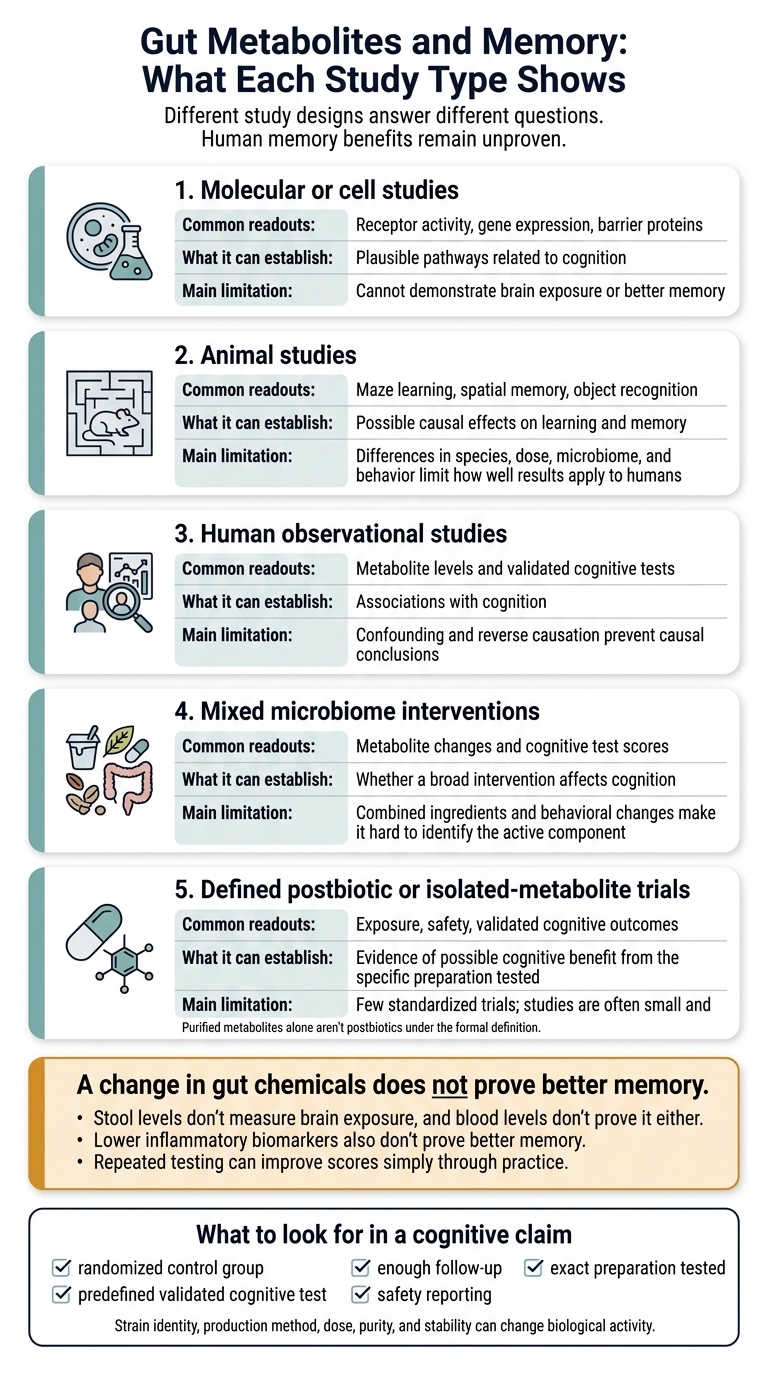
Gut Metabolites and Memory: What Each Study Type Shows
What Shapes Metabolite Production?
Fiber and resistant starch fuel microbial fermentation. But what that fermentation produces depends on cross-feeding, tryptophan and bile-acid pathways, transit time, pH, oxygen, and which microbes are present. The same food can produce different metabolites in different people.[4] That helps explain why metabolite studies rarely point to one cognitive effect that applies to everyone.
What microbes can do may matter more than whether a single named species is present. Use dysbiosis to describe a specific disruption - not low diversity alone. More isn’t always better: effects depend on concentration, location, timing, clearance, and the host’s underlying condition.
Diet, medications, age, stress, sleep, physical activity, metabolic health, infection, and gastrointestinal conditions can also change microbial composition and activity.
What Laboratory, Animal, and Human Studies Show
Different study designs answer different questions. Cell studies, animal maze tasks, and human cognitive tests each offer a different kind of evidence.
| Evidence type | Common readouts | What it can establish | Main limitation |
|---|---|---|---|
| Molecular or cell studies | Receptor activity, gene expression, barrier proteins | Plausible pathways related to cognition | Cannot demonstrate brain exposure or better memory |
| Animal studies | Maze learning, spatial memory, object recognition | Possible causal effects on learning and memory | Differences in species, dose, microbiome, and behavior limit how well results apply to humans |
| Human observational studies | Metabolite levels and validated cognitive tests | Associations with cognition | Confounding and reverse causation prevent causal conclusions |
| Mixed microbiome interventions | Metabolite changes and cognitive test scores | Whether a broad intervention affects cognition | Combined ingredients and behavioral changes make it hard to identify the active component |
| Defined postbiotic or isolated-metabolite trials | Exposure, safety, validated cognitive outcomes | Evidence of possible cognitive benefit from the specific preparation tested | Few standardized trials; studies are often small and short |
These differences help explain why human findings remain harder to interpret than cell or animal results.
Why Human Memory Findings Remain Uncertain
Repeated testing can improve scores simply through practice. Preparation standards matter, too: strain identity, production method, dose, purity, and stability can change biological activity.
Stool levels don’t measure brain exposure, and blood levels don’t prove it either. Lower inflammatory biomarkers also don’t prove better memory.
To assess a claim, look for a randomized control group, a predefined validated cognitive test, enough follow-up, safety reporting, and the exact preparation tested.
These limits lead to the next practical question: how to assess daily habits and product claims.
Daily Habits and Supplement Choices
Human evidence on memory remains limited. Start by supporting the microbiome through daily habits, then assess any supplement based on human research - not its label promises.
Fiber, Sleep, Exercise, and Stress
Start with fiber-rich foods you tolerate. Gradually add beans, oats, vegetables, and whole grains, along with fluids unless your clinician has restricted them. These foods can influence postbiotic metabolite production, but the effects differ from person to person. NIDDK cites an adult fiber range of 22–34 grams daily[17], though individual needs vary. If bloating, diarrhea, constipation, or abdominal pain persists, seek guidance rather than continuing to add fiber.
Pair dietary changes with a consistent sleep schedule and at least 7 hours of sleep each night[19]. Choose physical activity that fits your health status. A common adult target is 150 minutes of moderate activity per week, plus muscle-strengthening activity.[20][21] Relaxation and social connection can also help with stress. These habits support overall health, but they don’t guarantee specific metabolite changes or memory gains.
If you choose a supplement, check its exact formula - not just the promises on the label.
Rebirth RE-1: Ingredients and Research
Rebirth RE-1 is marketed as a 3-in-1 synbiotic that combines prebiotics, probiotics, and postbiotics to support microbiome balance. Treat claims about clinical backing and absorption as marketing unless human research supports the exact formula. Product listings differ on fiber content, so check the current label.[16][18]
| Stated component or feature | What to check |
|---|---|
| Human Origin Strains (HOSt) | Live strains in the formula; verify their identities |
| 500 billion CFU per serving | Viable microbe count; confirm whether it applies at manufacture or expiration |
| GOS and inulin: 4.5 grams per serving | Fermentable prebiotic fiber; confirm the current label.[16][18] |
| Postbiotic components or metabolites | Nonliving microbial material; verify the compounds, dose, and human evidence |
| Lyosublime delivery system | Manufacturer-described delivery system; requires direct evidence |
| 7-day, 4-week, and 12-week protocols | Recommended use periods; duration alone does not prove benefit |
An ingredient list alone cannot support claims about memory or learning. Those claims need direct human evidence.
Checking Cognitive Claims and Supplement Safety
For RE-1, a memory or learning claim requires a randomized human trial of the exact formula and dose. The trial should use validated memory or learning tests, report safety outcomes, and control for diet, sleep, and medications.[14][15] Digestive changes do not establish a memory benefit.
GOS and inulin may cause gas, bloating, cramps, or bowel changes.[11] Rare serious infections linked to probiotic use have been reported in vulnerable people.[12] If you’re immunocompromised, seriously ill, or managing a serious gastrointestinal disorder, ask a clinician before taking a high-dose probiotic or prebiotic product.
Persistent memory loss, a decline in daily functioning, or sudden confusion needs medical evaluation. Sudden confusion with weakness, speech trouble, or reduced alertness needs urgent care.[13]
Conclusion: What We Know and What Remains Unclear
Postbiotic metabolites may affect memory and learning, but benefits in humans remain unproven. Research centers on four possible pathways: SCFAs, neurotransmitter and tryptophan signaling, inflammation and barrier integrity, and overall microbiome function. None is a proven route to better memory. Finding a signaling molecule in the gut doesn’t show that it reaches the brain or improves learning.[24]
Promising lab and animal results haven’t established memory or learning benefits in humans. That’s why human trials matter most: they need to test defined preparations and measure memory and learning directly - not just changes in the microbiome or inflammation.[23][24][25]
Postbiotic metabolites are an active area of research, not a proven way to improve cognition or a substitute for diagnosis or treatment. Persistent memory loss, confusion, or changes in learning call for medical evaluation.[1][22]
For now, this science can guide research and habits, but it cannot support promises of memory gains.
FAQs
Can gut testing explain my memory problems?
Gut testing may help identify microbiome imbalances that interfere with gut-brain communication. Research links an unhealthy gut to inflammation and problems with the blood-brain barrier associated with memory issues. Looking at microbiome and metabolite profiles may also help explain effects on neurotransmitter production and inflammation in the brain.
Rebiirth RE-1’s 3-in-1 synbiotic formula is designed to restore microbiome balance, strengthen the gut barrier, and support healthy gut-brain communication.
How can I support gut health if fiber causes bloating?
If fiber makes you feel bloated, increase your intake slowly to give your digestive system time to adjust. Talk with a healthcare provider before making major changes to your diet.
You could also consider Rebirth RE-1, a 3-in-1 synbiotic that combines prebiotics, probiotics, and postbiotics to help restore microbiome balance and support digestive comfort. Clinical findings showed that 94% of participants reported less bloating and abdominal pain after seven days of use.
What would prove a postbiotic improves memory?
Researchers would need controlled human trials that show consistent gains on direct memory tests - not just broader measures of thinking skills. Combining those tests with microbiome profiles, metabolite data, and inflammatory markers would help researchers determine whether the postbiotic drove the gains, rather than sleep, stress, or other factors.
Postbiotics show promise in animal and cell studies, but human evidence is still limited and mixed.