

If you want the short answer: prebiotics feed gut bacteria, probiotics add live strains, and postbiotics deliver microbe-made compounds right away. That matters because each one affects gut-to-brain signaling in a different way.
I’d sum it up like this:
- Prebiotics help gut microbes make more compounds like SCFAs
- Probiotics add live bacteria that may support immune and nerve signaling
- Postbiotics provide non-living microbial parts and metabolites without needing to grow first
- Timing matters in a reset plan: feed, rebuild, then steady the system
The main idea is simple: these are not the same tool. One helps the gut ecosystem shift over time, one adds live support, and one sends signals more directly through the gut barrier and immune system.
Quick Comparison
| Type | What it is | Main job | How it may affect brain signals | Typical timing in a reset |
|---|---|---|---|---|
| Prebiotics | Fibers like GOS and inulin | Feed gut microbes | Indirectly, through fermentation and SCFAs | Early and long term |
| Probiotics | Live microorganisms | Add strains to the gut | Through immune, metabolic, and neurotransmitter pathways | Rebuilding and maintenance |
| Postbiotics | Non-living cells, parts, and metabolites | Deliver ready-made microbial signals | More directly, without colonization | Early support and later steady use |
A useful stat to keep in mind: the human gut contains trillions of microbes, and many gut-brain effects are linked to immune signals, SCFAs, and barrier function rather than one single “mood microbe.” So when I look at a reset plan, I don’t treat prebiotics, probiotics, and postbiotics as interchangeable. I see them as three different levers.
That’s the core of this article: what each one does, how they differ, and where each may fit in a gut-brain reset plan.
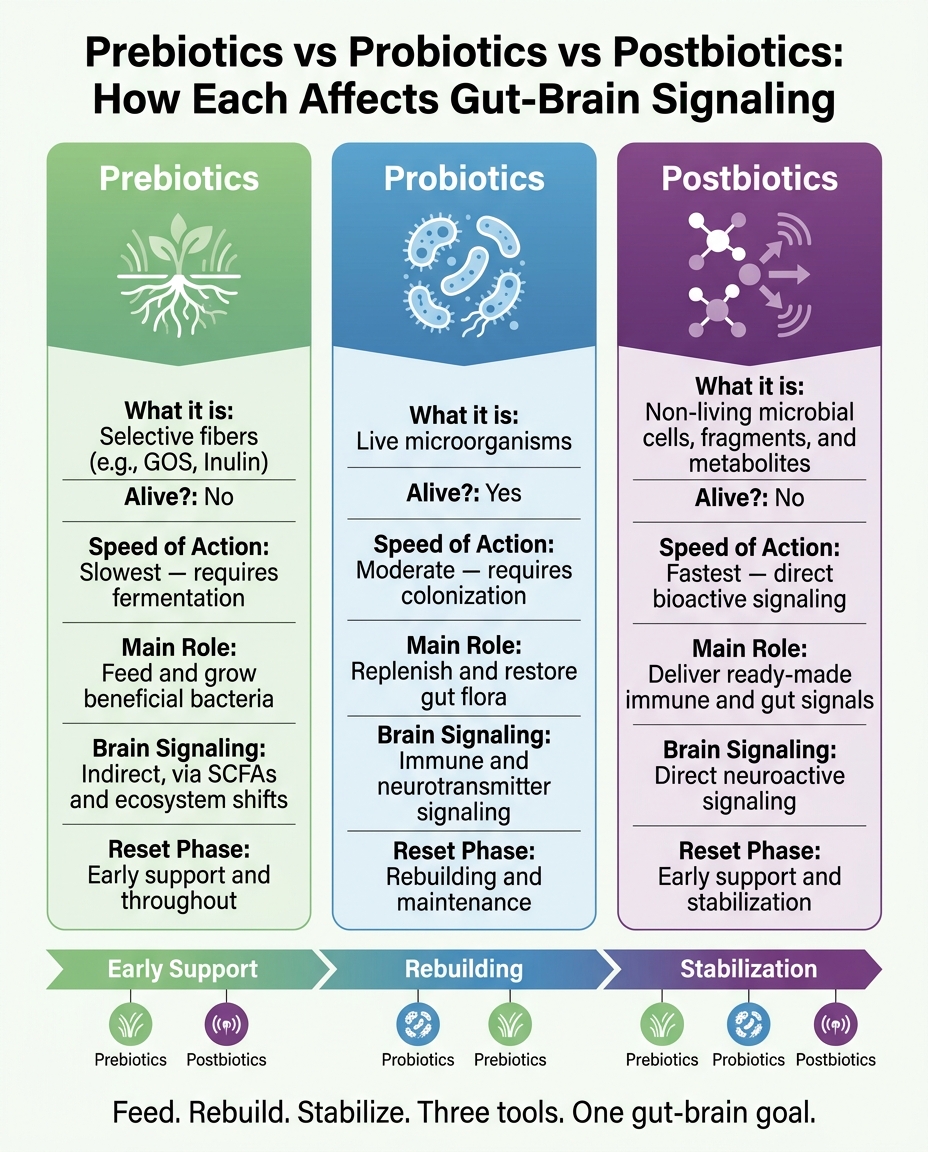
Prebiotics vs Probiotics vs Postbiotics: Brain Signal Roles Compared
Prebiotics, Probiotics, and Postbiotics Explained | Dr. Will Bulsiewicz
sbb-itb-1bbfe7f
Prebiotics vs. Probiotics vs. Postbiotics: What Each One Does
These three tools do different jobs. Each one affects the gut-immune-brain axis at a different point: prebiotics feed, probiotics replenish, and postbiotics signal directly.
| Feature | Prebiotics | Probiotics | Postbiotics |
|---|---|---|---|
| What they are | Selective fibers (e.g., GOS, Inulin) | Live microorganisms | Non-living microbial cells, fragments, and metabolites |
| Are they alive? | No | Yes | No |
| Speed of action | Slower - requires fermentation | Moderate - requires colonization | Fastest - direct bioactive signaling |
| Main role | Feed and grow beneficial bacteria | Replenish and restore gut flora | Deliver ready-made immune and gut signals |
| Brain signaling | Indirect, via ecosystem shifts | Immune and neurotransmitter signaling | Direct neuroactive signaling |
Put simply, prebiotics help shape the gut environment, probiotics add live support, and postbiotics deliver the signal itself.
Prebiotics: Feeding the Right Microbes
Prebiotics are selectively fermented fibers such as galactooligosaccharides (GOS) and inulin. Your body doesn't digest them. Instead, beneficial bacteria ferment them, which helps support microbial growth.
That fermentation also increases short-chain fatty acid (SCFA) output. And that matters because SCFAs can help support a healthier gut environment and a steadier inflammatory tone.
The brain link here is less direct, but it's still there. As SCFAs build up and beneficial bacteria increase, they can indirectly affect neurotransmitters like serotonin and GABA. This tends to be a slower process. Think of it as building the soil before anything else can grow.
That shift in the gut sets up the next two layers: live strains and ready-made compounds.
Probiotics: Adding Live, Signal-Sending Strains
Probiotics are live microorganisms that help reinforce microbial balance. They work through the gut-immune-brain axis to support immune and neurotransmitter signaling.
In plain English, probiotics don't just show up and sit there. They add live support to the system and help restore gut flora.
When live strains aren't the main driver, postbiotics step in and provide the signal directly.
Postbiotics: Delivering Ready-Made Bioactive Signals
Postbiotics are inanimate, so they don't need to survive digestion or colonize the gut to work. They contain microbial components and metabolites that support immune function and gut barrier integrity.
That's what makes them different. They act directly because they don't need fermentation or colonization first. No waiting for microbes to settle in. No extra step.
From a brain-signaling angle, postbiotics can directly influence neuroactive molecules. That gives them a fast, targeted signaling role within the gut-immune-brain axis.
How Prebiotics, Probiotics, and Postbiotics Differ in Brain Signaling
Each one works at a different stage in the gut-immune-brain chain: feed, rebuild, or signal directly.
Microbial Balance and Immune Tone
Prebiotics shape the gut environment by feeding the microbes that are already there. Probiotics take the next step by adding live strains that can help restore balance and compete with harmful microbes. Postbiotics work differently. They don’t need to colonize the gut to do their job.
Instead, postbiotics can help support barrier integrity and calm immune signaling even before the gut ecosystem has fully recovered. That shift can change cytokine signaling, and in turn, affect brain signaling.
The next difference comes down to microbial output.
Metabolites and Neurotransmitter Support
A lot of the gut-brain conversation moves through metabolites. This is where the three groups split most clearly.
Prebiotics increase SCFAs and brain health indirectly through fermentation. Probiotics can produce neuroactive metabolites as they begin to establish themselves. Postbiotics deliver those signals directly, which helps explain why they can act faster.
Those timing differences shape where each one fits in a reset plan.
Where Each One Fits in a Microbiome Reset Plan
Once the mechanism is clear, the next step is timing: when does each tool make the most sense?
A microbiome reset tends to work best in stages. The basic flow is simple: feed first, then rebuild, then stabilize.
Early Support, Rebuilding, and Stabilization
In the early support stage, the focus is on raising fiber and resistant starch to feed helpful microbes and support SCFA output. That’s where prebiotics come in first. Postbiotics can help here too, since they deliver ready-made bioactive signals when the gut may not be ready to support live bacteria well yet.[2][3]
In the rebuilding stage, targeted probiotics come into the picture alongside prebiotic fiber. The goal here is to support balance, butyrate production, and immune signaling.[1][2][3]
Stabilization is about keeping the routine steady over time. That usually means sticking with fiber and resistant starch, with occasional probiotic or postbiotic support as needed.[2][3][4]
The table below shows where each one fits.
| Category | Reset Phase | Main Goal | Expected Response Type |
|---|---|---|---|
| Prebiotics | Early support and throughout | Feed beneficial microbes, boost SCFA production, prep the gut for probiotics | Improved stool regularity; possible transient gas or bloating as fiber increases |
| Probiotics | Rebuilding and maintenance | Reintroduce beneficial strains, support microbial diversity and immune regulation | More stable digestion, fewer flares; short-term adjustment symptoms possible |
| Postbiotics | Early support and stabilization | Deliver ready-made metabolites, support barrier function and immune tone | Steady improvements in gut comfort and inflammatory symptoms; fewer GI side effects |
How Rebirth RE-1 Uses a 3-in-1 Reset Approach

Rebirth RE-1 follows this staged model in one daily sachet. It combines prebiotics, probiotics, and postbiotics with HOSt™ strains and Lyosublime™ delivery. Put simply, the product is built around the idea that these tools tend to work better together as part of one reset plan.
Conclusion: Different Tools, One Gut-Brain Goal
Prebiotics, probiotics, and postbiotics work together to feed microbes, add live strains, and deliver bioactive compounds straight to the gut. A reset plan tends to work best when each tool lines up with the gut’s current stage of recovery. In plain English: timing matters just as much as the ingredients.
As Dr. David Rakel notes, a fiber-rich diet helps build a diverse microbiome that supports host health. Gut-brain support comes from steady microbial balance over time. That’s the aim of a structured 3-in-1 reset approach such as Rebirth RE-1.
FAQs
How do I know which one I need most?
It depends on what you’re trying to fix, how your digestion is doing, and what your body needs right now.
Prebiotics, probiotics, and postbiotics each do a different job. Prebiotics feed the good bacteria already living in your gut. Probiotics add helpful strains. Postbiotics give you direct metabolic support right away.
Because these three work as a team, a 3-in-1 synbiotic like Rebiirth RE-1 is often the best place to start. If you have SIBO, IBS, or immune sensitivities, talk with a healthcare provider.
Can I take prebiotics, probiotics, and postbiotics together?
Yes. Taking prebiotics, probiotics, and postbiotics together can work well because prebiotics feed the live bacteria in probiotics, while postbiotics offer more direct support for gut barrier integrity and immune function.
Research suggests this combined approach may work better than using each one on its own. Rebiirth RE-1 is a 3-in-1 eubiotic that brings all three together in one sachet.
How long does gut-brain support usually take?
It depends on how long you stick with the plan. Some people notice early relief, like less bloating and less abdominal discomfort, within 7 days.
A 4-week commitment can help steady gut flora. But a 3-month regimen is often needed for deeper, longer-term repair and to address dysbiosis.
That’s why consistency matters. Fuller microbiome recovery and more meaningful health gains usually take about 12 weeks.