

Bottom line: I’d read the research on synbiotics for constipation as mixed but somewhat promising. In adults with functional or chronic constipation, some studies report more bowel movements, softer stools, and shorter transit time. But results are not consistent, and they depend a lot on the exact strains, the fiber used, the dose, and how long the product is taken.
If you want the short version, here it is:
- Synbiotics = probiotics + prebiotics
- Studies track bowel movement frequency, stool form, transit time, bloating, and pain
- Some people may notice changes in about 2 to 4 weeks
- Many studies use a 4-week check-in, with more data out to 8 to 12 weeks
- Label details matter more than big CFU numbers alone
- Mild gas or bloating can happen at the start
- Adults with GI disease, immune problems, or other major health issues should talk with a clinician first
What I take from the article is simple: synbiotics may help some adults, but they are strain-specific and product-specific. So I wouldn’t assume one product matches a study unless the label shows the same strain names and fiber type.
| What to focus on | What the article says |
|---|---|
| Main effect seen in studies | More stool water and, in some groups, faster colonic transit |
| Best match for study data | Adults with functional or chronic constipation, without major GI disease |
| When results may show up | Around weeks 2 to 4, sometimes tracked through 12 weeks |
| Why study results vary | Strains, fiber type, CFU dose, study length, and baseline fiber intake |
| What to check on a label | Full strain name, named prebiotic fiber, CFU through shelf life, storage instructions |
So if you’re comparing options, I’d keep it simple: look for the exact strain, the type and amount of prebiotic fiber, and the time frame used. That gives you a much clearer way to judge whether a synbiotic lines up with the adult constipation studies discussed here.
What clinical trials and reviews show
Which outcomes researchers measure in constipation studies
Researchers don't just count bowel movements. Constipation studies usually track a few different outcomes so they can see what's changing with stool frequency, stool form, and transit time.
The main measures are bowel movement frequency, stool consistency, and intestinal transit time.
Researchers also look at symptoms that matter in day-to-day life, like bloating, abdominal pain, and how easy it is to pass stool. Some studies include quality-of-life measures too, such as discomfort and ease of passing stool [3][1]. Here's how those outcomes are usually grouped:
| Outcome Category | What Gets Measured |
|---|---|
| Bowel Function | Movement frequency, stool consistency, ease of passing stool |
| Physiological | Intestinal transit time |
| Symptom Relief | Bloating, abdominal pain, occasional discomfort |
What benefits studies have reported
Studies in this area have reported softer stools, easier stool passage, shorter transit time in some groups, and symptom relief such as less bloating and pain [3][1].
Some of the strains studied include Bifidobacterium longum BB536, Bifidobacterium breve M-16V, and Bacillus coagulans [3]. One key point: these results are strain-specific. So if one formula shows an effect, that doesn't mean every synbiotic product will do the same thing.
Why results differ across studies
This is where things get messy. No two synbiotic formulas are the same.
Results can shift based on:
- the probiotic strains used
- the prebiotic fiber type, such as GOS, inulin, or resistant dextrin
- the CFU dose
- how long people take the product
- who gets included in the study
Baseline diet matters too. People with higher baseline fiber intake often show a stronger microbiota response to prebiotic supplementation than people eating less fiber [2].
Study length also changes what researchers see. Some trials look for early shifts within 7 days, while others follow people for up to 12 weeks [3][1]. That leads to two practical questions: who actually matches the people in these trials, and how long might changes take to show up? The next part looks at which adults line up with these study groups and when they may notice changes.
Who may use synbiotics and how long they may take to work
Adults most similar to participants in constipation trials
These findings apply most directly to adults who look a lot like the people included in constipation trials. In most studies, that means adults with functional constipation or chronic constipation, no major gastrointestinal disease, and the ability to take the product every day for several weeks [1].
When changes may become noticeable
Synbiotics don’t tend to act overnight. They work by shifting the gut microbiome, and that process takes time. When taken consistently, changes often start to show up around weeks 2 to 4, with effects continuing to build through weeks 8 to 12 as the gut adjusts [2][1].
RE-1 includes a 4-week protocol, which lines up with the time frame often used to judge changes in constipation studies [1].
When to check with a clinician before use
Some adults should check with a clinician before starting. That includes people with serious gastrointestinal disease, weakened immune systems, or major medical conditions [1].
It’s also common to have mild gas or bloating during the first few days as the gut adjusts. That part can be annoying, but it’s often short-lived. If symptoms are more than mild, or if they last past the early adjustment period, check with a healthcare provider [1].
sbb-itb-1bbfe7f
How to read synbiotic labels and strain counts in the U.S.
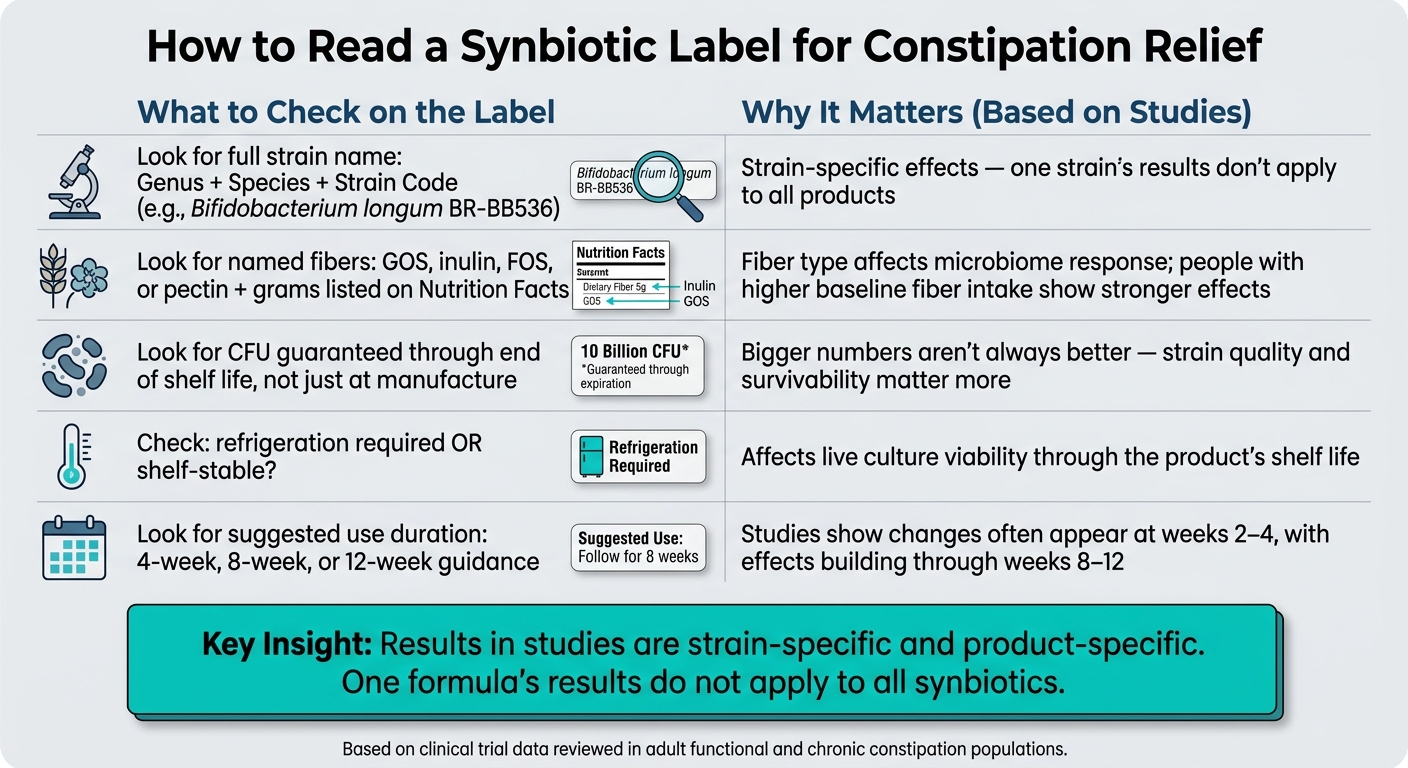
Synbiotics for Constipation: What to Look for on a Label vs. What Studies Show
What to look for on a synbiotic label
If you're comparing synbiotics, the label gives you the fastest read on whether a product lines up with formulas studied for constipation. Focus on four things: the strain, the fiber, the CFU count, and storage details.
Start with the probiotic strain names. A full strain name includes the genus, species, and strain code, such as Bifidobacterium longum BR-BB536. If a product lists only Bifidobacterium and skips the strain code, it doesn't tell you which strain you're getting [4].
Then check the prebiotic side of the formula. Look for named fibers such as galactooligosaccharides (GOS), inulin, fructooligosaccharides (FOS), or pectin. You should also check how many grams of prebiotic fiber are in each serving on the Nutrition Facts panel [1][4].
Storage matters too. See whether the product needs refrigeration or is shelf-stable. And look closely at the CFU statement. The better labels say the CFU count is guaranteed through the end of shelf life, not just at the time of manufacture.
How to interpret CFU counts and strain combinations
CFU stands for colony-forming units. That's the measure of how many live microbes are in one serving.
It's easy to assume a bigger number is better, but that's not always how this works. What matters more is whether the exact strains have research behind them, whether they make it through digestion, and how they work with the prebiotic fiber in the formula [4].
You'll also sometimes see a 3-in-1 label. That means the product includes prebiotics, probiotics, and postbiotics.
A practical label example: Rebirth RE-1
RE-1 puts all of these label checks in one formula.
| Label Feature | What to Look For | RE-1 Example |
|---|---|---|
| Strain names | Genus + species + strain code | Listed with specific BR- codes [4] |
| Prebiotic fiber | Named fibers + grams on Nutrition Facts | 4.5 g GOS & inulin per serving [4] |
| CFU count | Stated through end of shelf life | 500 billion CFU per serving [4] |
| Storage | Refrigeration needed or shelf-stable | Shelf-stable without refrigeration [4] |
| Protocol guidance | Suggested duration of use | 7-day, 4-week, and 12-week options [4] |
That table gives you a simple way to scan a label without getting lost in the marketing. You're checking for exact strain naming, named fibers, a clear CFU statement, storage info, and directions on how long to use the product [4].
Key takeaways from the evidence
When you put the trial data side by side, a few practical points stand out. In adults, studies show modest and uneven gains. Some trials report better stool frequency, stool consistency, and transit time, but the results change based on the population studied, the strains used, and the formula itself.
The biggest pattern is consistency. These products usually don’t work overnight. In many trials, benefits take weeks to show up, and a lot of studies use a 4-week checkpoint.
That’s why label details matter more than marketing language. When you read a synbiotic label, pay attention to the exact strains and the prebiotic fiber source, not just the CFU count. Rebirth RE-1 provides 4.5 g of GOS and inulin per serving. A 3-in-1 formula also adds postbiotics for gradual microbiome support.
Synbiotics also aren’t a substitute for medical evaluation if constipation is chronic. But they can make it easier to read the evidence and compare labels with a clearer eye.
FAQs
Can synbiotics help all types of constipation?
Synbiotics may help with chronic functional constipation by increasing how often people have bowel movements, improving stool consistency, and easing symptoms like bloating.
That said, results can differ from person to person. Age, diet, and the mix of bacteria in someone's gut can all shape how well synbiotics work. So while they may help some people, they may not work the same way for every type of constipation.
How do I know if a synbiotic matches the research?
Check for clear labeling and manufacturing backed by research. You want to see full strain names listed by genus, species, and strain number - not vague blend names - and the CFU count should be guaranteed through the expiration date, not just at the time of manufacture.
It also helps to look for third-party testing for purity and potency, along with claims that are backed by research. Medical-grade formulations that use Human Origin Strains (HOSt™) and shelf-stable delivery systems like Lyosublime™) can also point to this level of quality.
What should I do if gas or bloating gets worse?
Mild gas and bloating are often temporary. They can be signs that your gut microbiome is adjusting to a new synbiotic routine. In some cases, that means the product is starting to do its job.
If you want to ease the discomfort, start with a lower dose and increase it slowly over time. If the symptoms stick around or get a lot worse, talk to a healthcare provider.