

Yoga may help ease stress that affects digestion by addressing stress and the gut-brain axis - but it isn’t a treatment for gut disease. My starting point: 5–10 minutes of comfortable breathing and gentle movement, followed by rest.
The research calls for caution. A 2025 review of 11 randomized trials with 535 participants found no clear overall benefit. Feeling better also doesn’t prove your gut microbiome has changed.
Here’s the approach I outline:
- Start gently: Slow breathing, four easy poses, and a short rest. Stop if symptoms worsen.
- Build gradually: Choose a repeatable time, allow space after meals, and track symptoms over several weeks.
- Keep daily care in place: Regular sleep, meals, hydration, and a clinician’s advice on natural solutions for gut issues.
- Know when to seek care: Persistent symptoms need evaluation; severe pain or heavy bleeding needs urgent attention.
My bottom line: use yoga as support, <u>not a replacement for medical care</u>.
Regulate Your Nervous System | 15 Minute Yoga Practice
sbb-itb-1bbfe7f
Step 1: Try a Gentle Yoga Routine
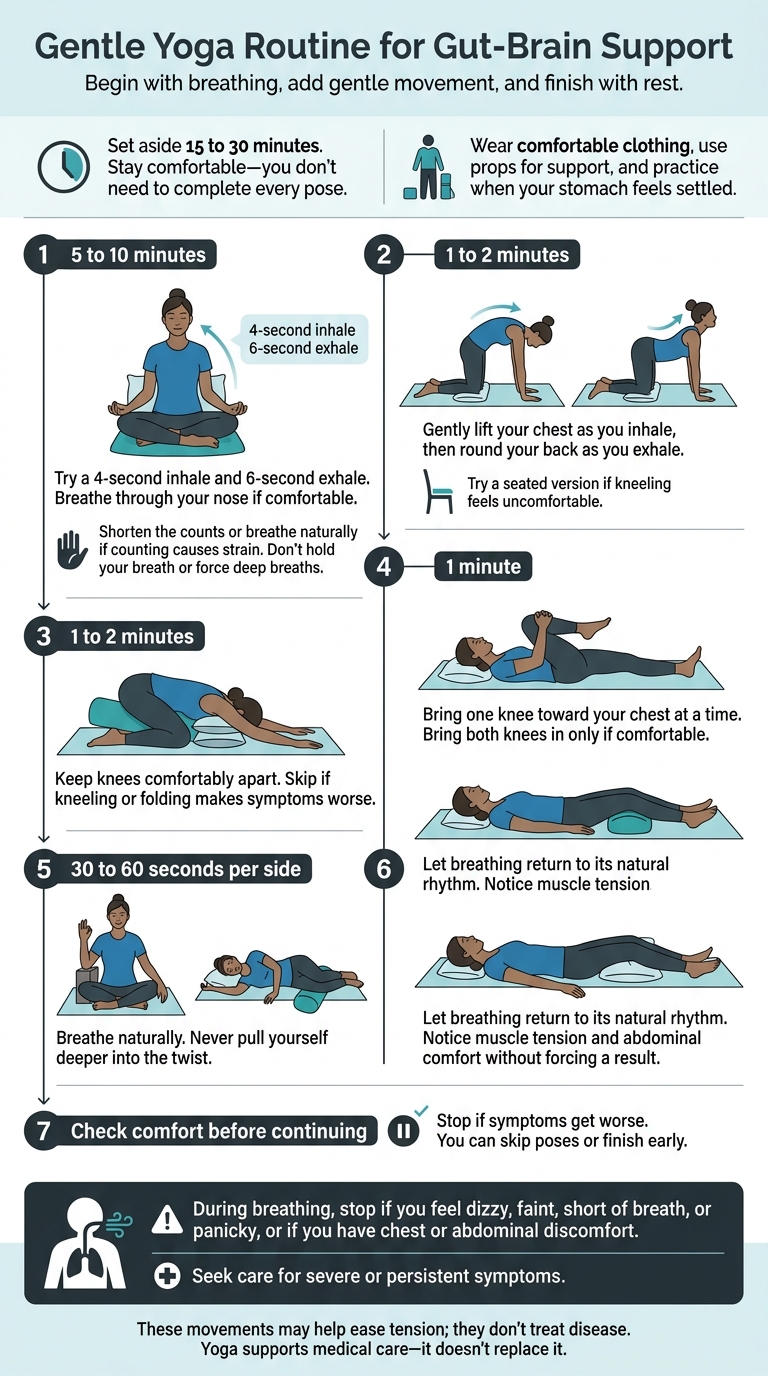
Gentle Yoga Routine for Gut-Brain Support
Begin with breathing, add gentle movement, and finish with rest. Set aside 15 to 30 minutes. Stay comfortable - you don’t need to complete every pose.
Wear comfortable clothing, use props for support, and practice when your stomach feels settled.[5][9] Stop if symptoms get worse, and seek care for severe or persistent symptoms.[4][6]
Start With Slow, Comfortable Breathing
Sit or lie down with support. Breathe through your nose if that feels comfortable. Try a 4-second inhale and 6-second exhale for 5 to 10 minutes.
If counting causes strain, shorten the counts or breathe naturally. Don’t hold your breath or force deep breaths. Stop if you feel dizzy, faint, short of breath, or panicky, or if you have chest or abdominal discomfort. The goal is steady relaxation, not effort. This practice is a key part of a gut microbiome reset to improve digestion.[7][8]
Then move through 4 gentle poses.
Once your breathing settles into a comfortable pace, try these four poses to ease tension.
- Cat-Cow, 1 to 2 minutes: Start on your hands and knees, with hands under shoulders and knees under hips. Cushion your knees if needed. Gently lift your chest as you inhale, then round your back as you exhale. Try a seated version if kneeling feels uncomfortable.
- Supported Child’s Pose, 1 to 2 minutes: Kneel with your knees comfortably apart. Rest your torso on pillows, a bolster, or a chair without putting pressure on your belly. Skip this pose if kneeling or folding makes symptoms worse.
- Knees-to-chest, 1 minute: Lie down with your knees bent. Gently bring one knee toward your chest at a time. Bring both knees in only if it feels comfortable.
- Easy twists, 30 to 60 seconds per side: Sit with support and turn slightly, or lie with bent knees and let them move a little to each side. Use cushions, breathe naturally, and never pull yourself deeper into the twist.
These movements help ease tension; they don’t treat disease.[6][8]
Finish With 3 to 5 Minutes of Rest
Let your body settle without forcing a result. Lie with a cushion under your knees, rest on your side with support between your knees, or sit in a supported chair.
Let your breathing return to its natural rhythm. Notice any muscle tension, your abdominal comfort, and how your body feels. Rest can help settle the nervous system and mood, though results vary.[4]
Step 2: Plan When and How Long to Practice
Aim for 2 to 5 sessions a week, with comfort and consistency taking priority over intensity.[10][11] Once the routine feels easy to stick with, choose a time you can repeat.
Choose a Morning, After-Work, or Evening Session
Pick a practice time that fits your schedule.
| Practice time | Goal | Suggested duration | Meal timing |
|---|---|---|---|
| Morning | Gentle movement and breathing | 5–10 minutes | Before breakfast if comfortable; drink water as needed |
| After work | Gentle movement and a transition away from work stress | 15–30 minutes | Wait 1 to 2 hours after eating; longer after a large meal |
| Evening | Restorative movement and relaxation | 10–20 minutes | Avoid practicing immediately after dinner; allow more time if reflux flares |
Allow 1 to 2 hours after eating and longer after a large meal. Delay practice if reflux flares.[13][14] If meals or reflux make practice uncomfortable, adjust your timing before adding more minutes.
Build Slowly and Track Symptoms
Begin with 5 to 10 minutes of breathing and gentle movement. After several easy sessions, add 5 minutes at a time, working toward 20 to 30 minutes. Increase duration or frequency - not both at once. Cut back on either if symptoms worsen during or after practice.[11][12]
Use a gut health improvement tracker to record when you practice, how long you spend, and which poses you do, along with any changes to food, medications, or supplements. Track digestive discomfort, bowel habits, stress, sleep, and energy before and after each session. Look for patterns over several weeks rather than treating one good or bad day as proof.
Next, pair your routine with sleep, meals, and other daily gut-care habits.
Step 3: Pair Yoga With Daily Gut Care
Use yoga as an anchor for daily habits that affect digestion: sleep, meals, and recovery. Practice works best alongside a steady routine, not apart from it. Sleep, meals, and supplements can all affect the gut-brain signals that this routine aims to calm.
Keep Sleep and Meals Consistent
Stick to consistent bedtimes and wake times, and cut back on late-night screens. Eat regular meals, stay hydrated, and add fiber-rich foods like oats, beans, fruit, and vegetables gradually. The National Institute of Diabetes and Digestive and Kidney Diseases suggests adding about 2–3 grams of fiber a day to limit gas and bloating.[22][24]
If symptoms get worse, slow down or pause the fiber increase. If food-related symptoms persist, talk with a clinician or registered dietitian instead of cutting out broad groups of foods. A steady routine can reduce symptom swings, making it easier to assess yoga’s effects.
Once that routine is in place, use it to guide discussions about supplements.
Discuss Supplements With Your Clinician
If you choose a probiotic or microbiome supplement, including Rebirth RE-1, review its ingredients, dose, and supporting evidence with your clinician.
Prebiotic fiber and probiotics can cause gas, bloating, abdominal discomfort, or bowel changes.[15][17] Rare probiotic-related infections have been reported, mainly in medically vulnerable people.[21][23] Avoid starting several gut supplements at once. Supplements should not replace nutrition, sleep, or prescribed care.
If a supplement or pose makes symptoms worse, address that before adding more practice time.
Adjust Your Practice and Know When to Seek Care
Get medical advice tailored to you and qualified yoga instruction during pregnancy, after surgery, or if you have injuries, cardiovascular conditions, severe reflux, or an inflammatory bowel disease flare. You may need to avoid forceful breathing, strong belly pressure, inversions, or deep twists.
Arrange medical evaluation for blood in the stool, unexplained weight loss, persistent vomiting, fever, nighttime symptoms, signs of anemia, or a lasting change in bowel habits.[16][18][19]
Seek urgent medical attention for severe abdominal pain or pain that worsens quickly, fainting, heavy bleeding, black or tarry stools, or signs of dehydration.[20] Do not try to manage these warning signs with yoga or diet changes alone.
Conclusion: Keep Yoga Gentle and Consistent
Consistency matters more than intensity. Aim for 10–20 minutes of yoga several times a week. Keep it gentle: easy breathing, light movement, and a short rest. This routine may help calm your nervous system and support the gut-brain connection.
Track changes rather than relying on assumptions. For 2–4 weeks, note your stress, sleep, bloating, and abdominal discomfort. Symptom relief does not prove microbiome change.[25]
Pair yoga with regular sleep, regular meals, hydration, and clinician-guided microbiome care. Yoga supports medical care - it doesn’t replace it.[6][26] Seek medical evaluation for severe symptoms. If symptoms persist, bring your notes to a clinician.
FAQs
How does slow breathing affect gut-brain signals?
Slow, focused breathing stimulates the vagus nerve, which carries signals between your brain and gut. Diaphragmatic breathing, 4-7-8 breathing, and box breathing help switch your body into “rest-and-digest” mode.
These techniques can help lower stress hormones like cortisol, which can interfere with digestion and the gut barrier. That supports digestion and a balanced gut environment. A microbiome reset with Rebiirth RE-1 may offer further support for that balance.
Can breathing alone help if yoga poses hurt?
Yes. Breathing exercises can support your gut-brain connection without yoga poses [1]. Deep breathing helps activate the parasympathetic nervous system, countering the stress response that slows digestion and increases gut tension [2][1].
If a pose hurts or feels uncomfortable, stop. The goal is relaxation, not strain [3]. Instead of movement, try diaphragmatic belly breathing, 4-7-8 breathing, or box breathing to help soothe digestion and support vagal tone [1].
How can I tell whether yoga is helping my digestion?
Track how your digestion feels each day, along with your overall well-being. Watch for less bloating, fewer episodes of heartburn, or more regular bowel movements [1][2]. Pay attention to changes in energy, mood stability, and sleep quality, too. These are closely linked to the gut-brain connection [3][2].
Give your digestive comfort a daily score from 1–10 to help you spot patterns over time [3][1].