

I’d check expiration-date counts and human study results before choosing a biotic supplement by its delivery format. A label showing 500 billion CFU doesn’t tell you whether the product works better. I look for testing on the packaged formula - and follow its storage and mixing instructions.
Here’s how I group the eight trends:
- Synbiotic sachets: Premeasured powders that combine biotics in one serving.
- Sustained-release and enteric coatings: Systems that spread release over time or delay it until after the stomach.
- Microencapsulation and core-shell carriers: Small shells or matrices that protect ingredients.
- Low-moisture and freeze-dried powders: Dry formats that need moisture barriers and tested mixing instructions.
- Strain protection and survival testing: Checks that track each strain through processing, storage, and digestion.
- Layered systems and multi-phase release: Separate compartments designed to release ingredients in stages.
- Portable formats without refrigeration: Packs tested for storage outside the fridge - not unlimited heat exposure.
- Targeted intestinal delivery: Systems designed to release ingredients in a chosen gut region.
My bottom line: <u>protection, release, and health results are separate checks.</u> Lab survival alone doesn’t prove a health effect. I’d ask whether the human studies match the formula, strains, dose, and intended use - not just the delivery method.
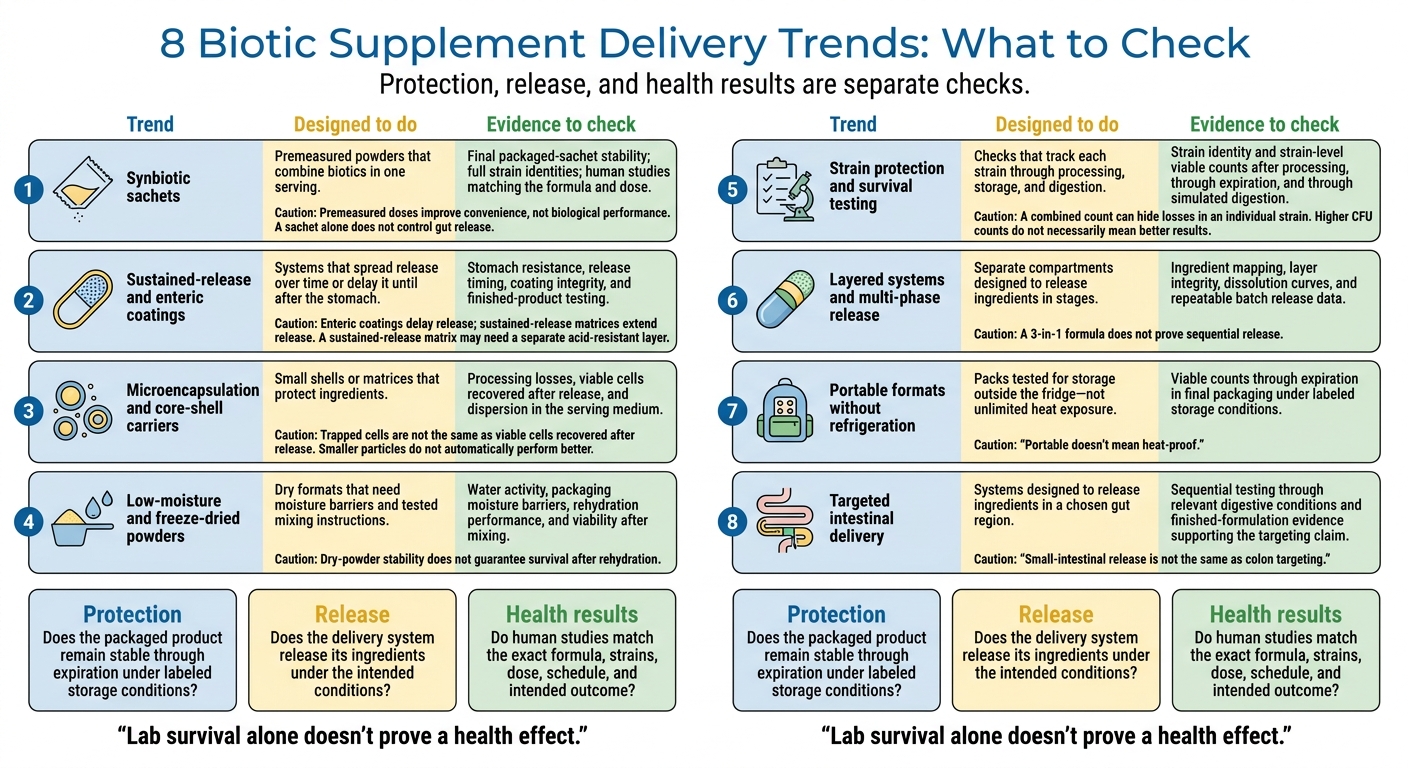
8 Biotic Supplement Delivery Trends: What to Check
1. Synbiotic Sachets and Single-Dose Powders
Single-dose sachets take measuring out of the equation and fit into work or travel routines. Follow the label’s mixing instructions. Premeasured daily doses make use more convenient, but they don’t improve biological performance.
Payload and Protection
Synbiotic sachets combine ingredients in one daily serving.
According to supplied product information, Rebirth RE-1 is a 3-in-1 synbiotic with prebiotics, probiotics, and postbiotics. Its daily sachets provide 500 billion CFU per serving and 4.5 grams of GOS and inulin, plus Human Origin Strains (HOSt™).[9]
Release Timing and Location
A sachet protects the formula before use. It doesn’t control where or when the formula releases in the gut unless its delivery system is designed to do that.
Rebirth names its delivery system Lyosublime™ and markets it as an absorption aid.
Storage and Handling
Rebirth’s supplied information states that RE-1 requires no refrigeration.
Keep sachets away from heat and humidity. Stability still depends on the package barrier and the powder’s moisture content.[8][11] This need for protection also carries over to controlled-release formats.
Finished-Product Evidence
Ask for full strain designations and postbiotic composition, along with stability and strain-survival testing for the final packaged sachet. Check whether the 500 billion CFU figure covers the total blend or each strain.
Also ask for human studies that used the exact formula, dose, and duration. Those studies should measure clinical outcomes - not just microbiome shifts.[9][10]
sbb-itb-1bbfe7f
2. Sustained-Release and Enteric Coatings
Enteric coatings delay release until the intestine. Sustained-release matrices spread release over time.[19][8] Both help protect live ingredients as they pass through the gastrointestinal tract, but storage protection still matters.
The key test: Comparing probiotic delivery systems reveals whether the coating can survive the stomach and release its contents on schedule.
| System | Mechanism | Intended benefit | Main limitation | Evidence status |
|---|---|---|---|---|
| Enteric coating | Resists stomach conditions, then dissolves or opens at an intestinal pH | Protects acid-sensitive strains and targets release beyond the stomach | Results depend on pH, coating integrity, strain sensitivity, and transit conditions | Strong in vitro evidence; human data remain product- and strain-specific.[19][21] |
| Time-controlled matrix | Releases contents through diffusion, erosion, swelling, or gradual matrix breakdown | Extends release over a defined period and may reduce an immediate burst | May not protect against stomach acid without an acid-resistant layer | Formulation and simulated-GI evidence; limited standardized human data.[12][16] |
| Combined system | Pairs an acid-resistant outer layer with an internal sustained-release matrix | Provides stomach protection followed by prolonged intestinal release | More complex manufacturing, a larger dosage form, possibly lower payload density, and more variables to validate | Promising experimental evidence; finished-product and clinical confirmation still needed.[12][15][16] |
Payload and Protection
Test coatings against gastric acid, pepsin, bile salts, and intestinal enzymes. Also measure losses during processing. Coating thickness involves a trade-off: more protection can come at the cost of release speed and payload density.[13][18][20]
Release Timing and Location
Ask where release should occur, how long the lag lasts, and how long release continues. A higher pH alone doesn't guarantee delivery to an exact spot in the intestine. Combined systems must show both acid resistance and gradual release after the intestinal trigger.[12][19]
Storage and Handling
Packaging must still block oxygen, moisture, light, and heat. Shelf-life tests should check both live-cell survival and coating integrity.[8][20]
Finished-Product Evidence
For the finished formula, report strain identity, starting and recovered CFU, pH, enzymes, temperature, exposure time, and the percentage released.[14][18]
When protection needs to move inside the particle, the next trend is microencapsulation and core-shell carriers.
3. Microencapsulation and Core-Shell Carriers
Payload and Protection
Microencapsulation uses a matrix or shell to protect biotics during processing, storage, and gastric exposure. Calcium alginate, protein films, and starch matrices help protect cells. Chitosan can reduce porosity, but it doesn’t always improve survival. Check allergen risks and whether chitosan is compatible with the strain.[17][27][29][31]
Extrusion, emulsification, spray drying, and freeze-drying involve trade-offs between production scale and stress on cells. Measure viable-cell loss after every process step - not just encapsulation yield. These losses also affect how particles release cells in the gut.[23][25]
Release Timing and Location
Larger beads create longer diffusion paths, while smaller particles may disperse more easily. Shell thickness, porosity, and composition also affect hydration and release.
Test cell recovery after gastric exposure, not just survival. A dense shell that survives but stays clumped hasn’t delivered its payload. The goal is recoverable cells at the right time and place - not simply smaller particles. Nanoscale size alone doesn’t guarantee better performance.[26][27][29][30] Particle structure also affects rehydration during sachet preparation.
Storage and Handling
Check that stored particles still rehydrate and disperse in the serving medium. Measure rehydration time, clumping, and sedimentation alongside water activity. Freeze-dried particles can absorb moisture, while dense or hydrophobic shells can resist wetting.[25][29]
Finished-Product Evidence
Distinguish trapped cells from viable cells recovered after release. Report encapsulation yield, processing recovery, particle-size distribution, and dispersion results for the finished formula. Compare the same strain with and without encapsulation to check whether the carrier improves recovery after release. Laboratory survival supports a delivery claim, not a health claim.[24][27][28]
When stability relies more on moisture control than on shells, the next trend is low-moisture and freeze-dried powders.
4. Low-Moisture and Freeze-Dried Powders
Payload and Protection
When dryness - not a shell - protects the payload, water activity (a_w) is the main control point. Delivery performance also depends on shelf life, rehydration, and survival after mixing.
Freeze-drying removes water through sublimation, leaving a porous matrix that slows degradation. A water activity below about 0.25 is a common stability target. Values below about 0.15 may provide more protection, but the right specification depends on the strains and excipients.[32][33][8]
Reconstitution and Use
Instructions should state the liquid volume, temperature, mixing method, and how soon to consume the dose. Avoid very hot liquids unless testing supports their use.
Test dispersion, reconstitution time, clumping, sedimentation, and viability after mixing. Stability in a dry powder doesn't guarantee survival after rehydration.[6]
Storage and Handling
Each opening exposes a multidose container to more moisture. These containers therefore need tighter closures and stronger moisture-barrier packaging than sachets.[34][35] Desiccants help control moisture, but they don't protect against heat.
| Attribute | Single-dose sachets | Multidose containers |
|---|---|---|
| Moisture exposure | Each unopened dose stays sealed until use | Every opening can introduce humid air |
| Handling | Tear, pour, and consume; convenient for travel and portion control | Requires opening, scooping, and reclosing |
| Dose measurement | Usually premeasured for a consistent serving size | Depends on the supplied scoop and user technique |
| Label-directed storage | Keep sealed and protect from heat and humidity | Keep tightly closed, use any included desiccant, and follow storage instructions |
Finished-Product Evidence
Moisture uptake can cause caking, poor flow, and inconsistent filling. Manufacturers should test powder flow after humidity-challenge storage and check fill-weight uniformity for sachets. For multidose containers, they should assess dose consistency. Testing should also confirm the labeled viable count throughout shelf life in the final commercial pack.[8][36]
Next, strain protection and survival testing should check survival through processing, handling, and shelf life - not just storage in the dry state.
5. Strain Protection and Survival Testing
Payload and Protection
Match protection to each strain - not just the blend. Tolerance to acid, bile, oxygen, and drying varies by strain. Confirm each organism’s genus, species, and strain identity with validated genetic methods. Then test each strain on its own and in the finished blend.[37]
Encapsulation and coatings can limit exposure, but each strain still needs validation in the finished delivery format.
Release Timing and Location
Test survival and release through simulated oral, gastric, and intestinal phases, in that order.[39] Record pH, bile concentration, temperature, exposure time, and viable counts after each phase.
Protection alone isn’t enough. The coating must also release the cells under the intended intestinal conditions. Survival in the lab does not prove a health benefit in humans.
Storage and Handling
Check viability after drying, milling, blending, filling, and packaging to find where processing losses occur. Report changes for each strain: a 1-log drop means 90% fewer culturable cells.
Track strain-level counts during packaged-product storage and shipping stress tests. A combined count can hide a decline in one strain. These losses set the baseline for the finished product.
Finished-Product Evidence
Use CFU only for live microbes; use mass and composition for prebiotics and postbiotics. Report strain-level counts for every live organism.
Higher CFU counts don’t necessarily mean better results.[38] Assess potency alongside human evidence for the same strain, dose, delivery format, and health outcome - not the biggest number on the label. This is especially critical when evaluating probiotics for immune health and gut balance.
6. Layered Systems and Multi-Phase Release
Once strain-level survival is addressed, the next step is keeping multiple active ingredients separate and releasing them in sequence.
Ingredients and Protection
Layered systems can hold live probiotics, prebiotics, and postbiotics in separate compartments until release. Prebiotics can absorb moisture from nearby layers. Postbiotics need protection suited to their active components - not protection designed to keep cells alive.[7][40][41]
Separation is only part of the job. Release timing also determines whether each ingredient reaches the gut as intended.
Release Timing and Location
An outer layer can release first, followed by an inner layer triggered by intestinal conditions. A 3-in-1 formula doesn't prove sequential release. Ask for ingredient mapping, coating analysis, and dissolution curves that show when each ingredient becomes available.[19][42]
Storage and Handling
Moisture migration, filling, and compression can damage layers. Check layer integrity and ingredient distribution after processing. Use single-ingredient controls to identify interactions that reduce stability or disrupt release.[8][42]
The finished product must show consistent layer structure and release patterns across batches to support the claim.
Finished-Product Evidence
A sequential-release claim needs a documented layer design and repeatable batch release data.[42] Postbiotic testing should use a product-specific potency marker.[40][41]
7. Portable Formats Without Refrigeration
Payload and Protection
Refrigeration-free single-dose packs make it easier to keep a routine while traveling, commuting, or juggling an irregular schedule without fridge access. But convenience doesn't prove better clinical outcomes.[8][46] It only helps if the product stays viable outside the fridge.
Storage and Handling
According to supplied product information, Rebirth RE-1™ does not require refrigeration and delivers 500 billion CFU per serving through its Lyosublime™ system.[43][48]
The manufacturer’s refrigeration-free claim depends on packaging, storage limits, and expiration testing. Follow the sachet’s storage label: keep it cool, dry, and away from heat.[8][43][48]
Portable doesn't mean heat-proof. Avoid heat, humidity, and damaged packaging. After uncontrolled heat exposure, don't assume the product retains its potency.[44][45] Don't use it past expiration or after water damage or seal failure.[45][47] Stability testing in the final packaging is the standard that matters.
Finished-Product Evidence
Ask for evidence of CFU counts through expiration - not just at manufacture - with testing in the final packaging under labeled storage conditions.[46][49][20]
Beyond convenience, the next question is where the dose releases in the gut. Understanding targeted synbiotic release is key to ensuring these portable formats actually work.
8. Targeted Intestinal Delivery
Surviving digestion is only part of the job. Biotics also need to be released in the intended part of the intestine.
Biotics and Protection
Targeted delivery aims to release biotics in a specific intestinal region. Delivery systems include swelling hydrogels, dual-layer coatings, and core-shell microgels.[50][51][52][53]
Microalgae-based carriers are still in early development, with support coming mainly from lab and animal data.[50][51][52][53]
Once a carrier is built, the next question is where - and when - it opens.
Release Timing and Location
Many pH-responsive systems aim to release their contents near pH 6.5–7.5. But food, medications, disease, and transit time can change how they perform.[56][22]
Small-intestinal release is not the same as colon targeting. Reaching the colon requires another delay or trigger, such as microbes or enzymes breaking down a polymer. Check whether release was tested through stomach, small-intestinal, and colonic conditions in sequence - not just in a single intestinal buffer.[54][55]
Finished-Product Evidence
Targeting claims need evidence from the finished product, not just simulated release tests. Look for lab release data, animal results, and human studies on the finished formulation. Human studies should report the dose, strains, study duration, safety findings, and meaningful health outcomes. Finding a strain in stool does not prove that it colonized the gut or provided a health benefit.[19][54]
Conclusion: Focus on Stability and Human Evidence
Across all eight trends, the same rule holds: delivery matters only when the product stays stable, which depends on factors affecting probiotic stability, reaches the gut intact, and provides a benefit shown in humans. Newer delivery technology needs both stability and human data to support its use.
Check the label or data sheet for each genus, species, and strain, plus viable counts through expiration. Prebiotic and probiotic differences matter, and postbiotic amounts should appear in grams, not CFU, and their potency needs verification throughout shelf life.
Test the finished product in its actual packaging under the storage conditions listed on the label. Moisture, oxygen, temperature, and seal integrity all affect shelf life.
Human studies must match the exact formula, strain mix, dose, schedule, and intended outcome. Delivery performance is not a health claim. Delivery claims need finished-product stability data; health benefits need human evidence for the exact formula and protocol.
Label instructions matter just as much as the delivery format. Follow storage instructions, temperature limits, and the expiration date, and avoid damaged or damp packaging.
FAQs
How can I verify a supplement’s delivery claims?
Look for clinical validation that shows ingredients survive digestion and reach their intended destination [1][2]. Review in vitro studies that simulate gastrointestinal conditions to assess stability, bioavailability, and release timing [1].
Prioritize tested delivery technologies, such as lipid-based microencapsulation or pH-sensitive coatings. These are designed to shield sensitive strains from stomach acid, digestive enzymes, and bile salts until they reach the intestines [3][1][4][5].
Can my medications affect intestinal release?
Yes. Medications can indirectly affect intestinal release by changing conditions in the gut. Our delivery approach uses pH-sensitive coatings and lipid-based barriers designed to stay intact in stomach acid and release in the more neutral intestinal environment [1][2]. Medications that greatly change stomach acidity, bile, or enzymes could affect when these barriers break down and release occurs.
What should I do if my sachets overheat?
Move overheated sachets away from heat right away and store them in a cool, dry place, around 68°F (20°C), to limit further loss of potency. Heat and moisture can damage probiotics. Freeze-drying and protective delivery systems offer some protection, but proper storage still matters.
Don’t use sachets that smell “off,” have clumped from moisture, or have been exposed to high temperatures for an extended period. [1][2]