

If you want the short answer: start one product at a time, use the label dose or less, and get medical advice first if you’re pregnant, breastfeeding, immunocompromised, or buying for a child.
I’d boil this guide down to 4 points:
- Prebiotics are fibers that feed some gut microbes, but they can cause gas, bloating, cramps, and stool changes, especially if you add too much too fast.
- Probiotics contain live microbes, so the exact strain, dose, and storage matter. In healthy people, side effects are often mild, but rare infections have been reported in high-risk groups.
- Postbiotics contain nonliving microbial material, so they do not replicate. That may avoid the infection concern tied to live microbes, but product quality and the exact formula still matter.
- 3-in-1 products are not automatic wins. A label that combines all three does not tell me whether the strains, dose, fiber type, or evidence are a good fit for me.
A few day-to-day rules stand out:
- Start low and do not begin several new gut supplements on the same day
- With fiber-based products, take each serving with 8 fl oz (240 mL) of water
- Check labels for genus, species, and strain on probiotics
- Make sure storage directions are followed, since some products need refrigeration
- Stop use and get care for rash, swelling, trouble breathing, fever, blood in stool, severe diarrhea, severe pain, or signs of dehydration
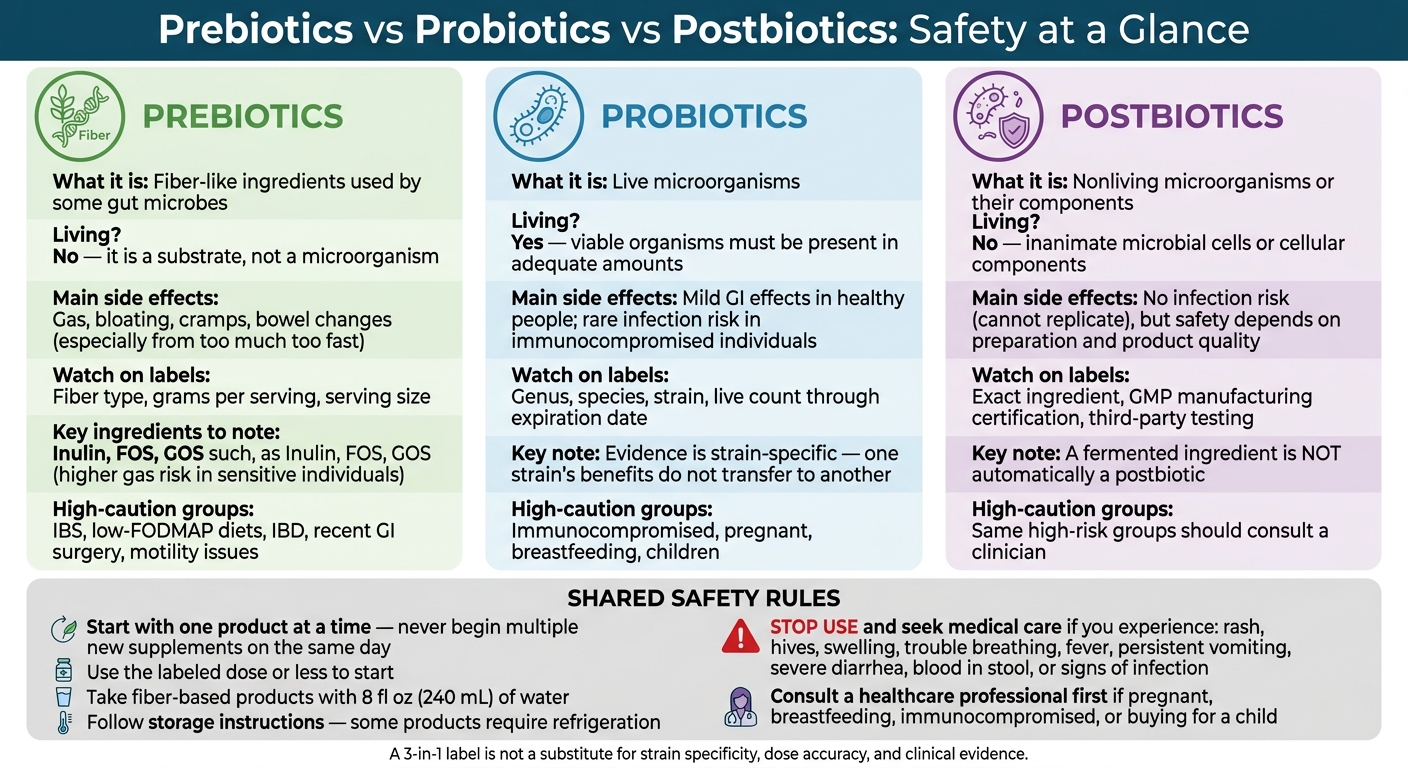
Prebiotics vs Probiotics vs Postbiotics: Safety Comparison Guide
Prebiotics, Probiotics, and Postbiotics Explained | Dr. Will Bulsiewicz
sbb-itb-1bbfe7f
Quick Comparison
| Type | What it is | Main thing I’d watch for | Best label check |
|---|---|---|---|
| Prebiotics | Fiber-like ingredients used by some gut microbes | Gas, bloating, cramps, bowel changes from too much too soon | Fiber type, grams per serving, serving size |
| Probiotics | Live microorganisms | Mild GI effects in many people; rare infection risk in high-risk groups | Genus, species, strain, live count through expiration |
| Postbiotics | Nonliving microorganisms or their parts | Safety depends on the exact preparation and product quality | Exact ingredient, manufacturing quality, third-party testing |
Bottom line: I’d treat these as three different tools, not one category. The safest move is simple: check the label, go slowly, and stop if symptoms are more than mild or do not settle down.
Prebiotics, Probiotics, and Postbiotics: What They Are and How They Differ
These three terms often get lumped together, but they don’t mean the same thing.
Prebiotics are ingredients that certain gut microbes can use to provide a health benefit.[5]
Probiotics are live microorganisms that, when administered in adequate amounts, confer a health benefit on the host.[7]
Postbiotics are preparations of inanimate microorganisms and/or their components that confer a health benefit on the host.[3]
Here’s the simple version: prebiotics feed microbes, probiotics add live microbes, and postbiotics provide nonliving microbial material or components.
The table below breaks down the differences that matter most when you’re trying to use these products safely and make sense of label claims.
| Feature | Prebiotics | Probiotics | Postbiotics |
|---|---|---|---|
| Living? | No - it is a substrate, not a microorganism | Yes - viable organisms must be present in adequate amounts | No - microorganisms or components are inanimate |
| Main safety consideration | Rapid increases may cause gas, bloating, cramps, or stool changes | Generally minor GI effects in healthy people; rare serious infections have been reported in severely ill or immunocompromised people[7] | Nonliving status may avoid infection risk associated with live microorganisms, but safety still depends on the specific preparation and population[2][4] |
| Why evidence must be specific | Effects depend on the substrate, selective utilization, dose, and individual tolerance | Benefits depend on strain, dose, viability, formulation, and health condition | Benefits depend on the exact microorganism or component, inactivation method, manufacturing process, and dose |
Why Definitions Matter for Safety
Fiber is not automatically a prebiotic. That’s a common mix-up. For something to count as a prebiotic, it must be selectively utilized by host microorganisms and linked to a demonstrated health benefit.[5] So if a label just says fiber, that alone doesn’t prove the ingredient has a clinically demonstrated microbiome effect.
Not all probiotics are interchangeable. This is where labels matter a lot. Evidence for one strain does not transfer to a different strain, even within the same species.[6] A product should list the microorganism at the genus, species, and strain level. The label should also show a viable count through expiration, not only at the time of manufacturing.
A fermented ingredient is not automatically a postbiotic. To fit the definition, the preparation must contain inanimate microbial cells or cellular components, not just a metabolite or fermentation byproduct.[3] That distinction may sound technical, but it helps you avoid giving a product credit for something it may not actually be.
These differences make label reading a lot less guesswork. In the next section, we’ll get into prebiotic side effects, daily use, and who should be more careful.
Prebiotic Safety: Common Side Effects and Daily Use Tips
Prebiotics are fermentable fibers, so it’s common to deal with gas, bloating, cramping, or changes in bowel movements at first. This tends to happen more when you add a concentrated supplement all at once or stack more than one fiber supplement at the same time.[8][11][14] In plain English, dose and timing are the big safety issues.
A simple way to ease into it:
- Start with the labeled serving or even less
- Add only one prebiotic at a time
- Increase slowly every few days
- Take each serving with 8 fl oz (240 mL) of water
- Keep up your fluid intake during the day[10][12]
It also helps to check the label closely. Look at the exact fiber type, the amount per serving, and the serving size. Inulin, FOS, and GOS are more likely to cause gas in people who are sensitive.[8][11]
A little gas or stomach rumbling during the first few days is often just part of the adjustment. If symptoms show up, they’ll often ease up if you lower the dose, slow down the increase, or stop the new product for now. But there’s a line where self-tinkering stops making sense. Stop use and contact a healthcare professional if symptoms are severe, stick around, get worse, or start getting in the way of daily life. That matters even more with ongoing diarrhea or constipation, major abdominal pain, repeated vomiting, visible abdominal swelling, blood or black stools, fever, dehydration, or an inability to pass stool or gas. Severe pain, fainting, confusion, signs of serious dehydration, or a rigid or sharply swollen abdomen call for prompt medical care instead of more trial and error.
Who Should Use Extra Caution With Prebiotics
Some people should be more careful with prebiotics from the start. That includes people with major or unexplained digestive symptoms, IBS, known sensitivity to fermentable carbohydrates, recent gastrointestinal flare-ups, inflammatory or obstructive bowel conditions, or a clinician-directed diet like a low-FODMAP or restricted-fiber plan. People recovering from gastrointestinal surgery, those with intestinal motility problems, and people taking medications that come with diet or fluid limits should check with a healthcare professional before using a concentrated fiber supplement.[8][9][13]
For IBS or low-FODMAP plans, the exact fiber and the dose matter more than the word “prebiotic.” Next, compare this fiber-based tolerance profile with prebiotics, probiotics, and postbiotics, which involve live microbes or nonliving preparations instead of fermentable fiber.
Probiotic and Postbiotic Safety: Live Microbes vs. Nonliving Preparations
Unlike fermentable prebiotics, probiotics and postbiotics bring up a different set of safety questions. The main reason is simple: probiotics contain live microbes, while postbiotics do not. Probiotics are live microorganisms. Postbiotics are nonliving preparations made from microorganisms or their components.
With probiotics, the specific strain matters a lot because both safety and effect depend on that strain. Some probiotic strains are used alongside antibiotics to help reduce antibiotic-associated diarrhea. That said, live microbes can carry a rare infection risk for people who are immunocompromised.
Postbiotics don't come with that same infection concern because they can't replicate. Still, that doesn't mean every product is automatically safe. Safety depends on the exact preparation, the ingredient list, the intended use, and how well the product is made. Look for GMP manufacturing and third-party testing. This difference matters most for people with higher medical risk.
| Safety Consideration | Probiotics (Live Microbes) | Postbiotics (Nonliving Preparations) |
|---|---|---|
| Composition | Live microorganisms | Nonliving preparations made from microorganisms or their components |
| Safety profile | Generally safe for healthy individuals; rare infection risk in immunocompromised people | Cannot replicate; no infection risk, but safety depends on the specific preparation and population |
| Quality controls | GMP certification and third-party testing for purity and potency | Same manufacturing standards apply |
When to Ask a Healthcare Professional First
Some groups should talk with a clinician before trying either product. That includes pregnant or breastfeeding people, immunocompromised people, and children.
It's also smart to ask first if you have:
- a weakened immune system
- a complex medical treatment plan
- a history of severe reactions
If symptoms start after you begin using either product, stop use right away.
When to Stop Use and Seek Medical Care
Stop use and get medical care if you develop rash, hives, swelling, trouble breathing, fever, persistent vomiting, severe diarrhea, blood in stool, or signs of infection.
How to Combine All Three in One Daily Routine
Once you’ve got the safety basics down, daily use comes down to dose, timing, and consistency.
Start with the labeled serving size. Don’t begin several new supplements at a full dose on the same day. If something feels off, you won’t know which one caused it. For the first few days, keep an eye on bloating, bowel changes, and any stomach discomfort so you can spot the source if symptoms show up.
Follow storage and prep directions exactly. Some products need refrigeration. Others don’t.
And here’s the big thing: a 3-in-1 label doesn’t automatically mean better results. What matters is the formula, the dose, the product quality, and whether there’s solid evidence behind it.
Each type works in its own way. Prebiotics feed gut microbes through fermentation, probiotics add live organisms, and postbiotics are nonliving preparations. Even so, the same day-to-day rules apply across all three: start low, check ingredients, and watch how your body responds.
A 3-in-1 Product Example: Rebirth RE-1
A combo product still plays by the same safety rules. Here’s one example of how a 3-in-1 routine can come packaged.
Rebirth RE-1 is a 3-in-1 sachet that combines prebiotics, probiotics, and postbiotics, provides 500 billion CFU per serving and 4.5 g of prebiotic fiber from GOS and inulin, and does not require refrigeration. [1] Starting with the 7-day supply is a practical way to check tolerance before moving into a longer routine. Review the full ingredient list for possible allergens, and talk with a healthcare professional before starting if you are pregnant, breastfeeding, or part of a higher-risk medical group.
Key Takeaways
- Know what you're taking and whether the evidence supports it: Prebiotics feed gut microbes, probiotics add live organisms, and postbiotics are nonliving preparations. Each has its own safety profile. A 3-in-1 label is not a substitute for probiotic strain specificity, dose accuracy, and clinical evidence.
- Higher-risk groups need professional guidance first: Pregnant or breastfeeding individuals and people with complex medical histories should consult a clinician before starting any biotic routine.
- Build slowly and follow the label: Introduce one product at a time, start at the labeled dose, and follow storage and preparation instructions exactly.
FAQs
How do I choose between a prebiotic, probiotic, and postbiotic?
Choose based on your goals and how your body reacts: prebiotics feed helpful bacteria, probiotics add live strains, and postbiotics give you useful microbial byproducts.
If you want a more all-in-one option, some people go with a 3-in-1 synbiotic like Rebiirth RE-1. If you're new to these supplements, or you're dealing with issues like SIBO, start with a low dose, build up slowly, and check with your healthcare provider.
How long should I try one before deciding it’s not a good fit?
Use a new supplement every day for at least 30 days. That gives your body time to adjust and gives the product a fair shot to work.
At first, you might notice mild bloating, gas, or changes in your stool. That can happen as your microbiome adjusts. If nothing improves after 30 days, it may be time to switch to a different product or strain.
If your symptoms stick around or get worse, talk to a healthcare professional.
Can I take these with antibiotics or other daily medications?
Always check with your healthcare provider before starting a new supplement if you take medications or have health conditions.
Probiotics may help lower the risk of antibiotic-related diarrhea, but timing matters. A doctor can help you choose the right strains and doses for your situation.