

Probiotics aren’t a proven insomnia treatment. My advice: match the exact strain and preparation to the research - not just the species name or CFU count. A 2026 review of 39 trials with 4,094 participants found a small improvement in sleep ratings, but confidence in the findings was very low.
I compare seven strains below. Some have direct sleep research; others were studied mainly for stress, mood, or infant colic. Feeling less stressed or tired doesn’t always mean sleeping better.
Quick Comparison
| Strain | Research focus | Main takeaway |
|---|---|---|
| B. longum 1714 | Adults with poor sleep | Better self-reported sleep; no change on actigraphy |
| L. gasseri CP2305 | Stress-related sleep trouble in students | Some sleep improvements with heat-inactivated cells |
| L. plantarum PS128 | Self-reported insomnia | Lower fatigue and depression scores; sleep findings mixed |
| L. brevis SBC8803 | Mild sleep disturbance | Some improvements in awakenings and morning restfulness with heat-killed cells |
| L. helveticus R0052 | Stress and mood, paired with R0175 | Direct sleep effects remain unproven |
| B. longum R0175 | Stress and mood, paired with R0052 | No established sleep effect on its own |
| L. reuteri DSM 17938 | Infant colic | One trial found 47 minutes less daily sleep; no proven adult sleep use |
Before trying a product, I’d check its strain code, preparation, studied dose, and trial length - and track one sleep complaint. <u>More CFUs don’t mean better sleep.</u> RE-1 is a separate formula, not a substitute for these strain-specific studies.
For persistent sleep trouble, I’d seek medical advice rather than keep testing supplements. Probiotics should not replace cognitive behavioral therapy for insomnia (CBT-I) or sleep apnea care. Infants and people with weakened immune systems need clinician guidance before use.
New Review Links Gut Microbes to Sleep Disorders Like Insomnia and Apnea
sbb-itb-1bbfe7f
What Studies Show About Probiotics and Sleep
Reviews found small average improvements in PSQI scores with probiotics and nonliving probiotic preparations: about 0.78 points from baseline and 0.59 points compared with controls on a 0–21 scale. Those changes don’t guarantee noticeably better sleep.[6][8] A 2023 meta-analysis of probiotic or prebiotic interventions found no statistically significant overall improvement in sleep quality (P = 0.31) or sleep duration (P = 0.43).[11][4] Differences in strains, doses, study groups, treatment length, and measurement methods help explain the mixed results.
How researchers measure sleep matters, too. PSQI measures self-reported sleep, actigraphy estimates sleep-wake patterns, and polysomnography measures brain, breathing, and movement signals. Feeling that you slept better doesn’t always match objective sleep data, which helps explain conflicting claims. In the 2020 review, probiotics and nonliving probiotic preparations showed no statistically significant pooled benefit on other sleep questionnaires or objective measures, including sleep efficiency and time to fall asleep.[6]
Results from stressed students with insomnia may not apply to someone with chronic insomnia. Studies have also measured outcomes over different periods, including 4–6 weeks and 8–16 weeks.[7][3][9] Stick to the studied strain, dose, and duration; results don’t carry over automatically to other products or study designs.
The sleep studies on CP2305 and SBC8803 used heat-inactivated preparations, not live strains.[7][12][13] These nonviable preparations may still contain biologically active cellular components, but their findings don’t automatically apply to live products. To track your response, consistently record time to fall asleep, awakenings, and daytime functioning for several weeks. A better sleep rating alone doesn’t prove that your sleep physiology has changed. Exact strain names matter more than species labels.
Why Exact Strain Names Matter
The strain name on the label must match the study exactly. Strains within the same species can differ in their genes, metabolites, and effects. So research on Bifidobacterium longum 1714 does not prove a sleep benefit for every B. longum strain.[14][21]
Older studies may use former Lactobacillus names. Those are name changes, not new strains.[19][20]
The same rule applies to Rosell strains: Rosell-52 = Lactobacillus helveticus R0052; Rosell-175 = Bifidobacterium longum R0175. Each name refers to one strain. If a study tested R0052 and R0175 together, its findings should not automatically be credited to either strain alone.[15][18]
If the strain code is missing, don’t match the product to sleep studies.[14][16][17]
These psychobiotic strains influence sleep through various biological pathways. The seven strain profiles below show which sleep-related issue each strain was studied for.
1. Bifidobacterium longum 1714
Exact Strain and Preparation
The 2024 trial tested Bifidobacterium longum 1714 (AH1714), taken as a daily capsule containing about 1 billion CFU.[22][26]
Sleep Measures and Study Population
The randomized, double-blind, placebo-controlled trial enrolled 89 healthy adults ages 18–45 with poor sleep quality (PSQI ≥5).[3][22]
Sleep quality and daytime sleepiness improved by week 4. Social functioning and energy/vitality improved by week 8, but actigraphy showed no change.[22][23] This makes the strain a better match for self-reported sleep complaints than for changes measured by sleep tracking.
Possible Complaint Match
The closest match is generally healthy adults with poor sleep, daytime sleepiness, low energy, and stress-related low well-being.[22][23][24][25] Matching these complaints to the tested strain matters more than choosing by species name alone.
Study Limits, Dose, and Duration
The studied dose was about 1 billion CFU daily for 8 weeks. Improvements were mainly self-reported, so these findings should not be extended to other doses or durations.[3][22][23]
2. Lactobacillus gasseri CP2305
Unlike the first strain, CP2305 was studied mainly in stressed students, using heat-inactivated cells.
Exact Strain and Preparation
The sleep studies used heat-inactivated Lactobacillus gasseri CP2305 - not live bacteria. In the 24-week trial, participants took 10 billion heat-inactivated cells daily.[28][30]
Sleep Measures and Study Population
In stressed medical students, CP2305 improved PSQI scores. One study also found that participants fell asleep faster and spent less time awake after falling asleep, based on sleep EEG measurements.[28][29]
A 2023 systematic review identified seven randomized trials and included six in its meta-analysis. PSQI scores improved by 0.77 points versus control (95% confidence interval for the difference: −1.37 to −0.16; P = 0.01).[27]
Possible Complaint Match
Best match: stress-related trouble falling asleep or staying asleep, especially during demanding periods at school or work. These findings do not establish CP2305 as a treatment for major insomnia disorder, obstructive sleep apnea, or restless legs syndrome.[27][29][31]
Study Limits, Dose, and Duration
The main trials lasted 5–24 weeks, so CP2305 is not established as an immediate sleep aid. The studies were small and mainly involved Japanese medical students, which limits how well the results apply to other groups.[28][29][30][31]
Check the label for CP2305 in its heat-inactivated format. Other L. gasseri strains are not equivalent.[28][29][30][31]
3. Lactiplantibacillus plantarum PS128
Exact Strain and Preparation
The study tested Lactiplantibacillus plantarum PS128 as two capsules taken daily after dinner for 30 days.[32]
Sleep Measures and Study Population
A randomized, double-blind, placebo-controlled pilot trial enrolled 40 adults ages 20–40 with self-reported insomnia. Participants taking PS128 had lower depressive-symptom and fatigue scores than those taking placebo. But feeling less tired or less depressed does not prove better sleep.[32]
Objective sleep findings were inconsistent, so PS128 should not be described as a reliable deep-sleep aid.[32][33]
Possible Complaint Match
Best fit: insomnia with stress, low mood, or fatigue. PS128 may be more relevant when these concerns accompany insomnia, but the evidence is preliminary - not proof that it treats insomnia. Track nighttime awakenings, morning fatigue, and mood separately to avoid mistaking feeling better for sleeping better.[32]
Study Limits, Dose, and Duration
The trial was small, lasted just 30 days, and relied on self-reported rather than clinically diagnosed insomnia.[32] When comparing products, check the label for PS128. The species name alone is not enough; match the strain code.
4. Levilactobacillus brevis SBC8803
Exact Strain and Preparation
Label details matter here. Researchers studied Levilactobacillus brevis SBC8803 in humans as a heat-killed preparation. In one study, participants took capsules providing 25 mg daily for 10 days. These findings should not be applied to live SBC8803.[35]
Sleep Measures and Study Population
Researchers assessed nighttime waking and how rested participants felt in the morning using self-reported sleep diaries and objective sleep monitoring.
A pilot study enrolled 17 men ages 41–69 with signs of an unbalanced gut microbiome, with 14 included in the analysis. Sleep diaries showed fewer nighttime awakenings (P = 0.047), but next-day sleepiness did not show a statistically clear improvement (P = 0.067). Athens Insomnia Scale scores and sleep EEG findings did not differ from placebo.[35]
A randomized trial included 220 healthy Japanese adults dissatisfied with their sleep quality (110 per group). After one tablet daily for 4 weeks, participants reported less morning sleepiness and feeling more rested. A sleep sensor mat also recorded better sleep efficiency and fewer awakenings (P < 0.05).[34]
Possible Complaint Match
The findings point to a narrow use: nighttime waking and feeling rested in the morning, rather than general insomnia relief.
Best fit: mild sleep disturbance with nighttime waking or mornings that don’t feel restful. Unlike PS128’s focus on mood and fatigue, SBC8803’s findings center on staying asleep and feeling rested upon waking. Neither study establishes SBC8803 as an insomnia treatment.[34][35]
Study Limits, Dose, and Duration
The pilot was short and non-randomized. The larger trial studied healthy adults, not people with diagnosed sleep disorders. It reported one tablet daily but did not give the tablet’s mass, so don’t assume it used the pilot’s 25 mg dose. Neither trial shows whether the effects last beyond the study period.[34][35]
Check the exact strain code and preparation. SBC8803’s results do not apply to other L. brevis products.
5. Lactobacillus helveticus R0052 (Rosell-52)
R0052’s link to sleep is indirect, mainly through its role in stress support.
Researchers most often study Lactobacillus helveticus R0052 (Rosell-52) alongside Bifidobacterium longum R0175 (Rosell-175). Most reported stress and mood benefits apply to the pair, not R0052 alone.[18][36][38] A 30-day trial involving 55 healthy adults tested the combination for stress and mood - not sleep. It therefore does not support a direct sleep claim.[18][38][39]
Sleep findings are limited and mixed. A four-week trial in 22 healthy adults ages 20–28 tested R0052 with R0175 and R1012 and found no statistically significant difference in sleep quality compared with placebo.[4] The only positive sleep finding here came from self-reports, not objective measurements. In an eight-week open-label pilot study, adults with depression reported better sleep by week 8. But without a placebo group, the study cannot show that the supplement caused the change.[40]
Possible Complaint Match
Closest research match: stress-induced insomnia or sleep difficulty linked to low mood. Research has not established relief for isolated insomnia or frequent awakenings.
Study Limits, Dose, and Duration
Studies commonly used about 3 billion CFU combined daily of R0052/R0175 for 30 days to 8 weeks. This is not an established sleep dose.[15][37][40] Check the label for both strain codes and the combined daily CFU dose; a higher CFU count does not guarantee the same outcomes.
6. Bifidobacterium longum R0175 (Rosell-175)
Exact Strain and Preparation
R0175 appears here because it’s part of the same stress-focused pair - not because it has strong sleep-specific evidence. Researchers usually study Bifidobacterium longum R0175 (Rosell-175, CNCM I-3470) with Lactobacillus helveticus R0052. A generic B. longum label doesn’t match the strains used in this research.[18][42]
Sleep Measures and Study Population
The original 30-day study included 55 generally healthy adults ages 30–60. It tracked stress and cortisol, not sleep, so it doesn’t prove a sleep benefit or tell us how people with insomnia would respond.[18][38][39][41]
Possible Complaint Match
Best research fit: sleep difficulty linked to stress, anxious feelings, low mood, or poor coping. This combination is not a proven insomnia treatment.[18][38]
Study Limits, Dose, and Duration
The paired-strain dose described above is a study protocol, not a standard sleep dose. It doesn’t establish a dose for R0175 alone or show a benefit for isolated insomnia.[18][41] Check both strain codes and the CFU count guaranteed through expiration.
The next strain shifts the focus to a different research context.
7. Limosilactobacillus reuteri DSM 17938
Exact Strain and Preparation
Limosilactobacillus reuteri DSM 17938 differs from the other strains in this list: research focuses mainly on infants with colic, not adult sleep trials. Trials used five oil-based drops once daily, providing about 100 million CFU/day.[43][45][47]
Sleep Measures and Study Population
Direct sleep results were unfavorable. In a randomized trial of infants with colic, DSM 17938 was linked to about 47 minutes less sleep per day than placebo after one month.[43] Less crying doesn't mean better sleep, and it doesn't support claims about adult insomnia.[46][48]
Possible Complaint Match
The closest research fit is infant rest disrupted by colic or gastrointestinal discomfort. A sleep benefit for adults remains unproven.[43][44][47]
Study Limits, Dose, and Duration
Infant-colic studies lasted 3–4 weeks. The regimen described above is not dosing guidance.[46][49][50] Consult a pediatric clinician before giving it to an infant.[45] DSM 17938 is a poor match for sleep-specific use within this list. For better results, consider how probiotics in food improve sleep quality through more established mechanisms.
Match the Research to Your Sleep Complaint
Different sleep complaints call for different measures. A strain may help with stress-linked sleep complaints without showing changes in objectively measured sleep.
Use this table to see which sleep complaint each strain was studied for - and what the findings don’t establish.
| Complaint or research question | What was studied | Main outcome | What remains unproven |
|---|---|---|---|
| Stress-linked poor sleep | B. longum 1714 in adults ages 18–45 with poor sleep quality | The PSQI sleep-quality component improved at four weeks.[22][3] | Reliable improvements in time to fall asleep, nighttime waking, total sleep time, or clinical insomnia |
| Stress-linked sleep disturbance | L. gasseri CP2305 in stressed students; some studies used heat-treated cells | Perceived sleep quality improved.[10][29] | Whether the results apply to other populations or live products |
| Psychological distress alongside sleep concerns | L. helveticus R0052 plus B. longum R0175, studied together | Psychological distress - not direct sleep improvement.[38][18] | Either strain’s effects on its own or direct sleep benefits |
| High-pressure work with sleep-disorder symptoms | L. plantarum PS128 in information-technology professionals | Self-reported sleep-disorder scores.[7] | Benefits for other populations or objectively measured sleep |
| Whether SBC8803 fits a particular sleep complaint | Heat-killed L. brevis SBC8803 in adults with mild sleep disturbance or sleep dissatisfaction | The evidence applies to the studied population and preparation; it does not support broad insomnia claims.[34][35] | Treatment of clinical insomnia |
| Digestive symptoms that disrupt sleep | Exact strains studied for the particular gastrointestinal symptom | Digestive symptoms that disrupt sleep | Whether digestive improvement also improves sleep |
Match the strain, formulation, population, and measured outcome. Check the study’s dose and duration, too. Lower stress scores don’t prove fewer awakenings, and sleep findings don’t prove relief from gastrointestinal (GI) symptoms. Without direct GI evidence for your symptom, the digestive match remains unproven.
Track what you want to change: minutes to fall asleep, nighttime awakenings, or perceived sleep quality.
Next, compare the seven strains by population, preparation, and outcome.
Compare the 7 Strains
Compare the exact strain, tested preparation, and sleep complaint before choosing a product. The table shows what each study found - and what it didn’t establish.
| Exact strain | Preparation | Study context | Sleep result | Best fit | Limitation |
|---|---|---|---|---|---|
| Bifidobacterium longum 1714 | Live, single strain | 8-week randomized trial in adults with poor sleep quality.[22][3] | Perceived sleep quality and daytime problems caused by sleepiness improved after four weeks. | Poor perceived sleep quality with daytime sleepiness | Overall sleep benefit was modest; effects on insomnia more broadly are not established. |
| Lactobacillus gasseri CP2305 | Heat-inactivated preparation | Short trial in students.[51] | Participants reported falling asleep sooner and sleeping longer overall. | Trouble falling asleep or short sleep during examination stress | Small, specialized population; results do not establish the same effects from live CP2305. |
| Lactiplantibacillus plantarum PS128 | Live, single strain | Placebo-controlled pilot in adults with self-reported insomnia.[8] | Sleep was measured, but benefit remains unproven. | Self-reported insomnia; a match to preliminary research | Small pilot; lasting benefits that matter clinically remain uncertain. |
| Levilactobacillus brevis SBC8803 | Heat-killed preparation | Trials in adults with mild sleep disturbance or sleep dissatisfaction.[34][35] | Some measures showed fewer awakenings and more restful mornings, but findings were mixed. | Mild nighttime waking or mornings without feeling rested | Findings do not establish treatment of clinical insomnia. |
| Lactobacillus helveticus R0052 (Rosell-52) | Studied only in combination with the paired strain | 21-day combination study in people with stress symptoms.[51] | The combination showed no statistically significant sleep benefit. | Stress symptoms alongside sleep concerns | Combination evidence does not establish R0052’s effect on its own. |
| Bifidobacterium longum R0175 (Rosell-175) | Studied only in combination with the paired strain | 21-day combination study in people with stress symptoms.[51] | The combination showed no statistically significant sleep benefit. | Stress symptoms alongside sleep concerns | Combination evidence does not establish R0175’s effect on its own. |
| Limosilactobacillus reuteri DSM 17938 | Live, single strain | Infant-colic research that also measured sleep.[43] | About 47 minutes less daily sleep than placebo after one month. | Infant colic; relevant only to GI-related sleep disruption | No demonstrated sleep benefit; infant findings do not establish effects on adult sleep. |
Count studies, not rows: R0052 and R0175 are separate strains, but their evidence here comes from one combination study. Also, “improved” may refer to just one questionnaire component - not the full sleep score. Higher CFU counts or extra strains don’t make a product equivalent to the tested formula.
Next, narrow the options by symptom, not by species name alone. Understanding how gut dysbiosis affects your health can help you identify which symptoms to prioritize when selecting a strain.
Choose a Formulation and Track Your Sleep
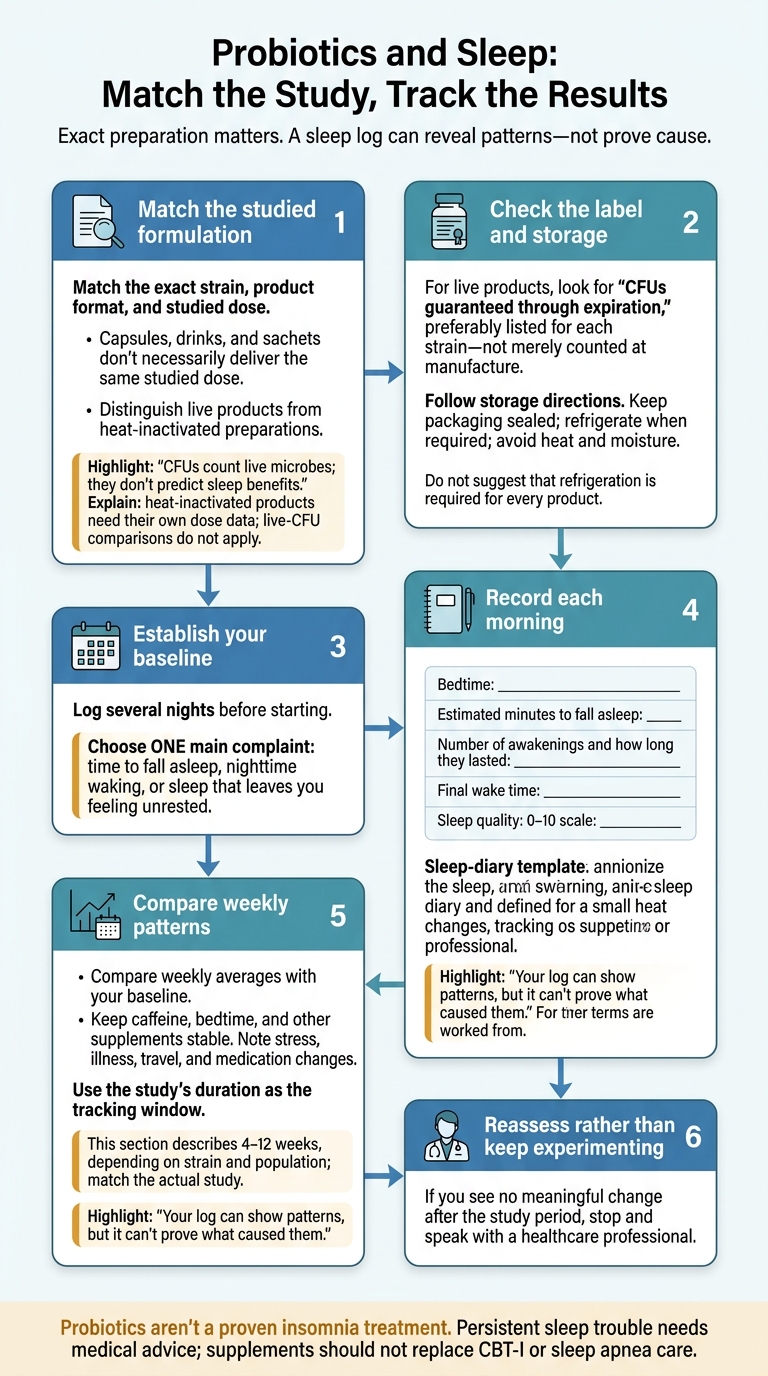
Probiotics and Sleep: Match the Study, Track the Results
Once you’ve matched the strain, match the formulation. Use the same product format and dose as the study - capsules, drinks, and sachets don’t necessarily deliver the same studied dose. CFUs count live microbes; they don’t predict sleep benefits. Heat-inactivated products need their own dose data, so live-CFU comparisons don’t apply.[56][53][54]
For live products, look for CFUs guaranteed through expiration, preferably listed for each strain - not just counted at manufacture. Follow the storage directions. Keep packaging sealed, refrigerate when required, and avoid heat and moisture, which can reduce the number of live microbes.[52][14]
Before starting, log several nights to establish a baseline. Choose one main complaint to track: time to fall asleep, nighttime waking, or sleep that leaves you feeling unrested. Each morning, record your bedtime, estimated minutes to fall asleep, awakenings and how long they lasted, final wake time, and sleep quality on a 0–10 scale.[55][57][58]
Keep tracking for the study’s duration: 4–12 weeks in these studies, depending on the strain and population. Compare weekly averages with your baseline, and keep caffeine, bedtime, and other supplements stable. Also note stress, illness, travel, or medication changes. Your log can show patterns, but it can’t prove what caused them.[1][4][57]
Use the study length as your trial window. If you see no meaningful change after that period, stop and speak with a healthcare professional.
Rebirth RE-1 and Microbiome Support
Rebirth RE-1 is a separate synbiotic product - not one of the seven strain-specific sleep studies above. According to the manufacturer, its sachets combine prebiotics, probiotics, and postbiotics, with 500 billion CFU and 4.5 grams of prebiotic fiber per serving. The HOSt™ label is branding, not proof of a sleep benefit or a match to the seven strains discussed in this article.[59]
The 7-day, 4-week, and 12-week protocols describe product formats. They don’t show that RE-1 improves sleep. A sleep claim needs support from sleep studies on the finished RE-1 formula.
For readers dealing with digestive symptoms and poor sleep, RE-1 offers a rationale for gut support - not proven sleep support. Digestive relief does not prove better sleep. Sleep benefits, digestive benefits, and tolerance are separate outcomes.
RE-1 contains added fiber and live microbes, so safety screening matters. Read the ingredient panel and package directions. Before using it, ask a healthcare professional if you’re sensitive to prebiotic fiber, pregnant, immunocompromised, seriously ill, taking prescription medication, or managing a diagnosed GI condition.
Safety and When to Get Medical Advice
If sleep problems continue, stop self-treating and see a clinician to check for a sleep disorder or another medical cause.
Chronic insomnia means trouble sleeping at least 3 nights a week for 3 months, along with problems functioning during the day. Seek help sooner if sleep loss interferes with daily life. The American Academy of Sleep Medicine recommends cognitive behavioral therapy for insomnia (CBT-I) as an initial treatment for chronic insomnia. Probiotics should not replace CBT-I or prescribed insomnia care.[66][67][68] Loud snoring or gasping may point to a problem beyond insomnia.
Habitual loud snoring, breathing pauses witnessed by someone else, or waking up gasping call for a sleep apnea evaluation, especially if you also have marked daytime sleepiness or hard-to-control blood pressure. A probiotic cannot treat airway obstruction. Don't delay sleep testing or stop prescribed CPAP to try one.[61]
Severe or worsening anxiety or depression needs prompt professional attention. If you have suicidal thoughts or trouble staying safe, call or text 988, the U.S. Suicide & Crisis Lifeline. Call 911 for immediate danger.
Talk with a clinician before starting probiotic supplements if you're pregnant, breastfeeding, immunocompromised, or have complex medical conditions. This includes cancer treatment, a central venous catheter, recent major surgery, or short-bowel syndrome. Rare serious infections have occurred, mainly in severely ill or immunocompromised people.[63][64][65] If side effects start after you begin a product, stop taking it and review the label with a clinician.
You can monitor brief, mild gas, but symptoms that persist or interfere with eating or sleep need reassessment.[14][52] Prebiotic fiber can cause gas, bloating, cramps, or diarrhea, especially at high doses or when started quickly.[60][62] Stop the product and seek medical advice for severe pain, fever, vomiting, dehydration, or blood in the stool. Bring the ingredient label and a 1–2-week sleep and symptom log to your appointment. Include the product's start date, dose, bowel changes, and other medications.
Conclusion: Choose by Strain-Specific Research
Across the seven strains, the takeaway is simple: match the exact strain to your specific sleep complaint. Sleep improvements are modest and inconsistent. Self-reported sleep improves more often than objective sleep measures.[3][6]
Benefits for stress or digestion don’t prove better sleep. Results from combination products apply only to the exact formula tested.[4][69]
Before buying, check the exact strain, preparation, dose, form, studied sleep outcome, and study duration.[5][1][22] A species name, CFU count, or marketing claim isn’t enough - the strain must match the sleep outcome studied.[4][3]
FAQs
Can I take probiotics alongside sleep medication?
If you take sleep medication or any other medications, talk with a healthcare provider before starting probiotics or synbiotics. They can check for possible interactions and help you decide whether these supplements are right for you [1].
Probiotics may support gut-brain health and sleep quality, but they don’t replace medical treatment or professional care. This is especially important if you have a severe sleep disorder or a major psychiatric condition, or if you take multiple medications [2].
Should I take probiotics at bedtime?
Some experts suggest taking probiotics at bedtime may give bacteria more time to settle as digestion slows. But consistency matters most for long-term benefits [1]. If you get gas or bloating after starting a new regimen, taking your dose in the morning may help keep those symptoms from disrupting your sleep [1].
For Rebiirth RE-1, the recommended use is one sachet with water each morning on an empty stomach to support the gut-brain axis [2].
Will sleep benefits last after I stop probiotics?
Some probiotic benefits may last after you stop taking them. In one trial, mood improvements after six weeks of supplementation held steady for three weeks without probiotics.
Probiotics help keep your gut microbiome balanced, but they’re part of a long-term approach to health, not a quick fix for sleep. Consistent sleep habits, stress management, and a nutrient-rich diet help maintain the benefits of the gut-brain axis and support sleep quality.